⏱ 9 min read
Enterprise Architecture has become a critical capability for organizations navigating digital transformation, cloud migration, regulatory compliance, and increasing IT complexity. Yet many enterprises still struggle with one key challenge: how do we create architecture models that actually support decision-making and transformation?

This is where ArchiMate plays a central role. As the leading open standard for enterprise architecture modeling, ArchiMate provides a structured language to describe and visualize the relationships between business strategy, applications, data, and technology infrastructure.
However, adopting ArchiMate successfully is not simply about drawing diagrams. Enterprises need a clear implementation roadmap that ensures modeling efforts deliver tangible value, support governance, and remain sustainable over time. ArchiMate tutorial for enterprise architects
This article provides a step-by-step roadmap for implementing ArchiMate in an enterprise environment, aligned with best practices from ArchiMate in TOGAF ADM and modern architecture governance approaches.
Why ArchiMate Matters for Enterprise Transformation
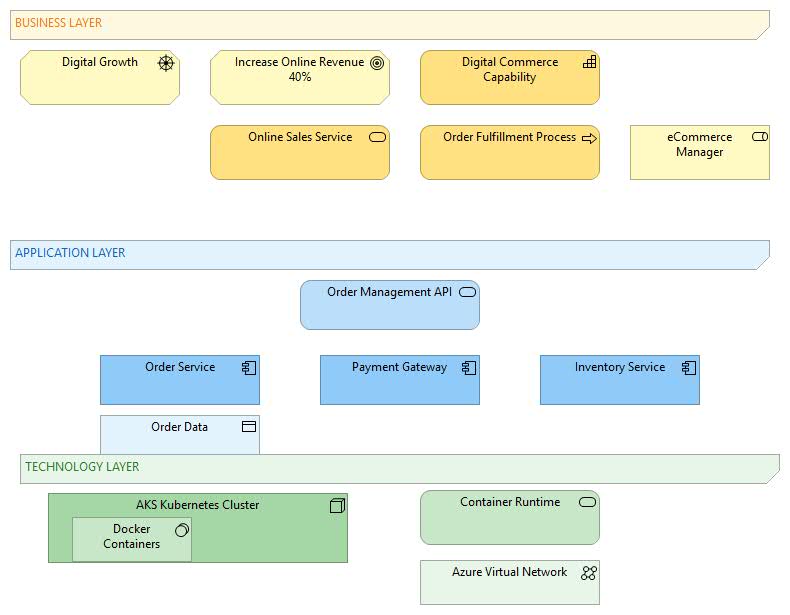
Most large organizations operate across multiple layers of complexity: business units with different strategies and priorities, hundreds of applications and integration points, hybrid infrastructure spanning cloud and on-premise environments, regulatory constraints requiring traceability and control, and continuous modernization through agile delivery.
In such environments, architecture often becomes fragmented. ArchiMate enables enterprises to establish a shared architecture language that supports business and IT alignment, capability-based planning, application portfolio management, technology modernization roadmaps, and enterprise-wide transformation governance. ArchiMate layers explained
Instead of isolated documentation, ArchiMate creates a connected architectural knowledge base that supports strategic planning and execution. ArchiMate relationship types
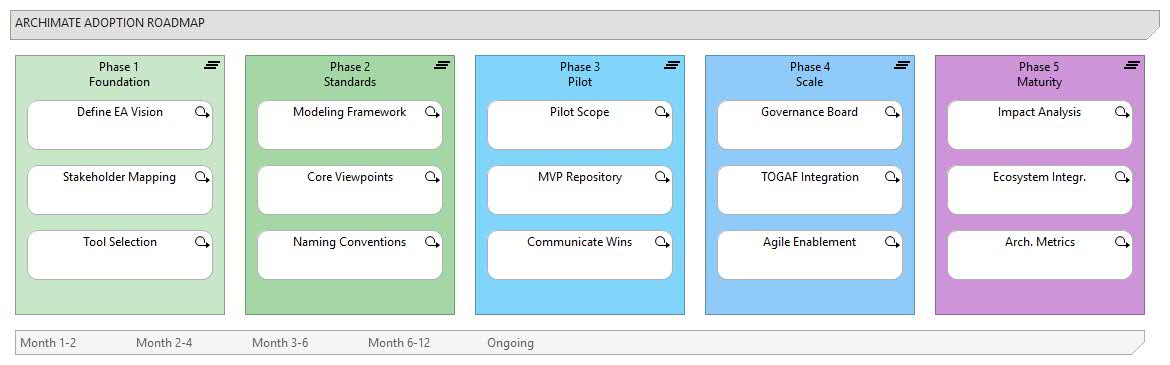
Phase 1: Establish the Foundation for ArchiMate Adoption
Successful ArchiMate implementation begins long before the first model is created. ArchiMate modeling best practices
Define the Enterprise Architecture Vision
Enterprises should start with clarity on why ArchiMate is being introduced. Common drivers include digital transformation initiatives, cloud migration programs, application rationalization efforts, regulatory architecture compliance, and strategic capability mapping. ArchiMate viewpoints
A strong architecture vision answers three questions: What decisions will architecture models support? Who are the stakeholders consuming the models? What transformation outcomes are expected?
Key Deliverable
A clear Enterprise Architecture Modeling Vision document linking ArchiMate adoption to business priorities.
Identify Stakeholders and Architecture Consumers
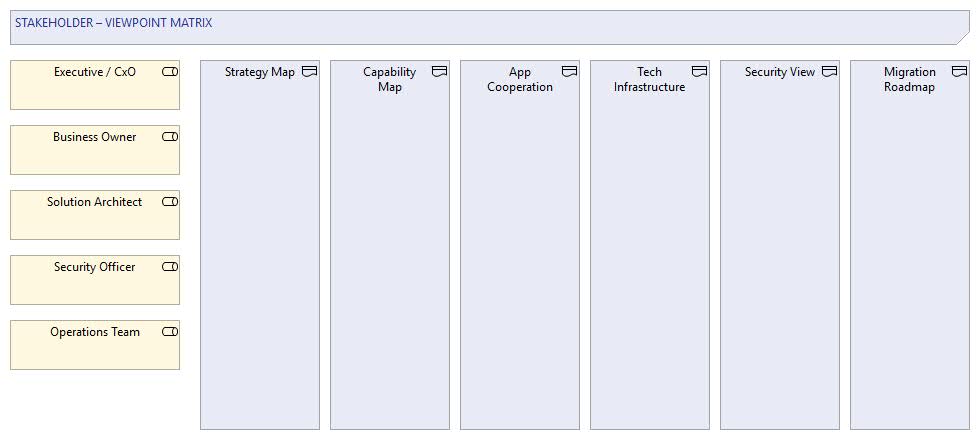
A common mistake is treating ArchiMate as an "architect-only" tool. In reality, architecture models must serve multiple audiences: executives and transformation leaders, business owners and product managers, solution architects and delivery teams, security and compliance officers, and infrastructure and operations teams.
Each group needs different levels of abstraction — this is why stakeholder mapping is essential before defining modeling standards.
Select the Right Tooling and Repository Approach
Enterprises typically adopt ArchiMate through professional modeling platforms. The leading options include:
- Sparx Enterprise Architect — full lifecycle modeling with deep UML/ArchiMate support and repository-based collaboration
- BiZZdesign Enterprise Studio — cloud-native platform with strong TOGAF integration
- MEGA HOPEX — governance-focused EA platform for large enterprises
- Archi — open-source ArchiMate tool, ideal for smaller teams or individual architects
Tool selection should consider repository scalability, governance and access control, integration with requirements and portfolio tools, support for TOGAF-based workflows, and collaboration across distributed teams. The goal is not diagram creation but building an enterprise architecture knowledge repository.
Phase 2: Define Enterprise Modeling Standards
Once the foundation is established, the next step is standardization.
Create an ArchiMate Modeling Framework
Without standards, enterprises quickly face inconsistent diagrams, unclear semantics, and loss of trust in the models. A modeling framework should define mandatory viewpoints, naming conventions, layer usage (Business, Application, Technology), relationship rules, and required metadata and attributes.
This ensures models remain consistent across teams and over time.
Start with Core Viewpoints That Deliver Immediate Value
Enterprises should not model everything at once. A successful ArchiMate roadmap starts with high-value viewpoints.
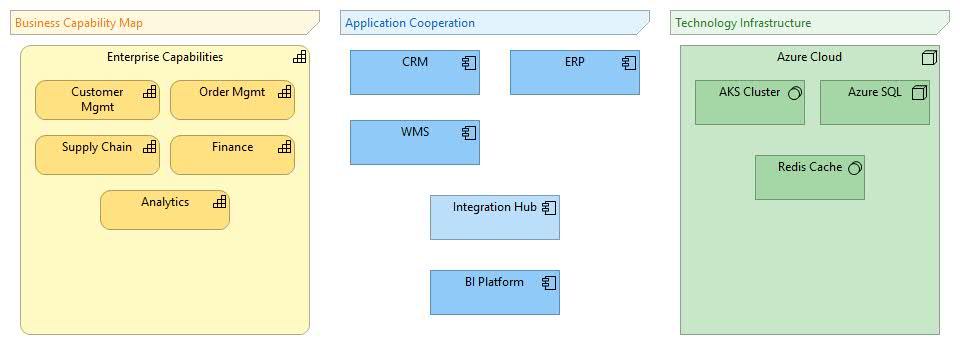
Business Capability Map
Capabilities provide a stable anchor for transformation planning. They help answer: What does the enterprise do? Where should investment focus? Which capabilities are weak or fragmented? Capability-based modeling is often the most effective entry point for ArchiMate adoption.
Application Cooperation View
This viewpoint supports application portfolio management by showing key applications, integration flows, redundancies and overlaps. It is especially useful in modernization and rationalization programs.
Technology Infrastructure View
For cloud migration or hybrid strategy, enterprises need visibility into deployment nodes, platforms and services, and technology dependencies. This viewpoint supports infrastructure transformation planning.
Phase 3: Pilot Implementation and Early Wins
Enterprises should treat ArchiMate adoption as a transformation initiative, not a documentation exercise.
Select a High-Impact Pilot Scope
A good pilot is strategically relevant, manageable in scope, visible to leadership, and connected to ongoing initiatives. Examples include modeling a cloud migration domain, mapping critical business capabilities, rationalizing a legacy application landscape, or supporting a regulatory compliance architecture.
The pilot should demonstrate measurable value quickly.
Build the Minimum Viable Architecture Repository
During the pilot phase, focus on creating a lean architecture baseline: core business capabilities, key applications and services, primary data objects, and major technology platforms. This repository becomes the foundation for scaling modeling across the enterprise.
Communicate Results to Stakeholders
ArchiMate models only succeed if they drive conversations and decisions. Early wins should be communicated through executive-level architecture dashboards, transformation roadmaps, capability heatmaps, and migration dependency views.
The emphasis should always be on decision support, not diagram quantity.
Phase 4: Scale ArchiMate Across the Enterprise
Once pilot success is proven, enterprises can scale adoption systematically.
Establish Architecture Governance
Governance ensures models remain consistent, trusted, and actively used. Key governance components include Architecture Review Boards, modeling standards enforcement, repository ownership and stewardship, version control and lifecycle management, and compliance checkpoints in delivery workflows.
Governance transforms ArchiMate from a tool into an enterprise discipline.
Integrate ArchiMate with TOGAF Architecture Development Method (ADM)
ArchiMate aligns naturally with TOGAF. A mature enterprise roadmap integrates modeling across ADM phases:
- Architecture Vision → High-level capability views
- Business Architecture → Value streams and processes
- Information Systems Architecture → Applications and data
- Technology Architecture → Platforms and infrastructure
- Migration Planning → Roadmaps and plateaus
This ensures ArchiMate is embedded into transformation governance rather than isolated. For more on this integration, see our article on implementing capability models with BPMN, ArchiMate and TOGAF.
Enable Collaboration Across Architecture and Delivery Teams
Modern enterprises operate through agile product teams. ArchiMate adoption must support agile delivery by enabling lightweight architecture views for squads, traceability from capabilities to epics, shared understanding of dependencies, and continuous architecture updates.
The architecture repository becomes a living transformation asset rather than static documentation.
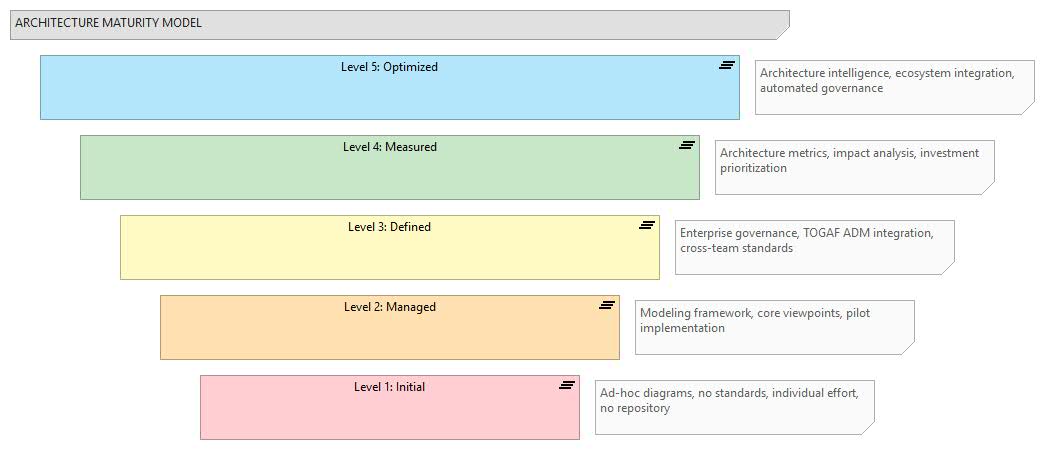
Phase 5: Achieve Architecture Maturity and Long-Term Sustainability
The final stage is maturity.
Move from Modeling to Architecture Intelligence
At high maturity levels, ArchiMate supports impact analysis, risk assessment, investment prioritization, transformation scenario planning, and regulatory traceability. Architecture becomes a strategic decision engine rather than a documentation exercise.
Automate and Integrate with Enterprise Ecosystems
Advanced enterprises integrate architecture repositories with CMDB systems, DevOps pipelines, cloud management platforms, requirements tools, and security governance frameworks. This creates an architecture ecosystem where models remain current and actionable. For practical automation approaches, see our guide on automating ArchiMate with Archi and jArchi.
Continuous Improvement Through Architecture Metrics
Long-term sustainability requires measurement. Useful metrics include repository coverage (percentage of critical applications modeled), model freshness and update frequency, stakeholder adoption and usage, transformation decisions supported, and reduction in redundant applications.
Enterprise Architecture becomes measurable, not theoretical.
Common Challenges in ArchiMate Implementation
Enterprises should anticipate common pitfalls:
- Over-modeling without business purpose — Every model element should trace to a decision or governance need
- Lack of governance and ownership — Without stewardship, repositories decay within months
- Diagrams too complex for stakeholders — Use audience-specific viewpoints to control complexity
- Treating ArchiMate as documentation — Models must drive decisions, not collect dust
- No integration with transformation programs — Architecture must connect to delivery pipelines
A roadmap-based approach prevents these issues by ensuring every phase delivers measurable outcomes before scaling further.
ArchiMate as a Strategic Enterprise Capability
Implementing ArchiMate is not about creating diagrams. It is about establishing a shared enterprise architecture language that enables business and IT alignment, transformation governance, capability-driven planning, application and technology modernization, and sustainable architectural decision-making.
With the right implementation roadmap, ArchiMate becomes one of the most powerful tools enterprises can adopt to manage complexity and execute transformation successfully.
Need Support Implementing ArchiMate?
Enterprises often benefit from expert guidance to accelerate adoption, establish modeling standards, and integrate ArchiMate into governance frameworks such as TOGAF. If your organization is planning an ArchiMate implementation or wants to mature its enterprise architecture practice, get in touch — we offer ArchiMate modelling coaching, enterprise architecture consulting, and enterprise architecture consulting to help you get there faster.
Frequently Asked Questions
How does ArchiMate support digital transformation planning?
ArchiMate supports transformation by modeling baseline architecture, target architecture, and transition plateaus. Implementation and Migration diagrams show work packages, migration events, and the sequencing of changes needed to move from current to future state.
What is a transition architecture in ArchiMate?
A transition architecture in ArchiMate represents an intermediate state between baseline and target. It describes the architecture at a specific milestone in the transformation journey, helping teams plan incremental delivery and manage dependencies across parallel workstreams.
How do you create an implementation roadmap in ArchiMate?
An implementation roadmap in ArchiMate is created using the Implementation and Migration layer, modeled with Work Packages (groups of work), Implementation Events (milestones or triggers), and Plateaus (stable architecture states). Gap Analysis diagrams show what must change between each plateau.