⏱ 23 min read
ArchiMate Viewpoints Explained for Architecture Stakeholders
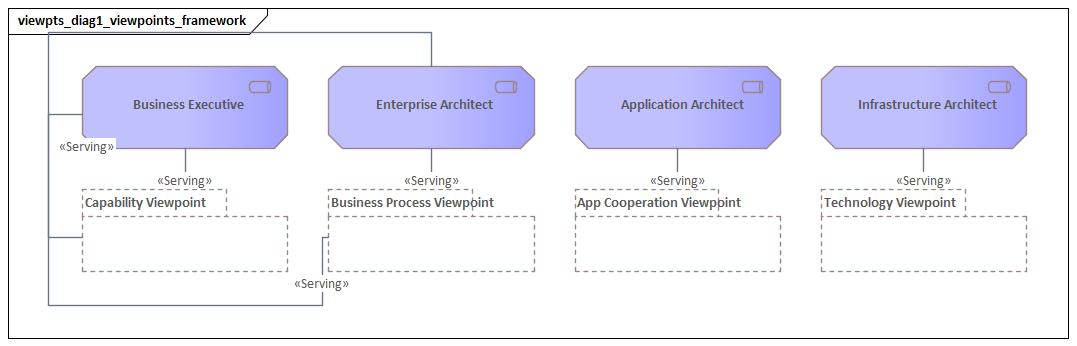
Learn how ArchiMate viewpoints help architecture stakeholders understand business, application, and technology concerns. Explore key viewpoint types, stakeholder mapping, and practical modeling guidance. ArchiMate tutorial for enterprise architects
ArchiMate viewpoints, ArchiMate stakeholders, enterprise architecture, architecture viewpoints, ArchiMate modeling, stakeholder concerns, business architecture, application architecture, technology architecture, ArchiMate framework, enterprise architect, architecture communication ArchiMate layers explained
Introduction
Enterprise architecture succeeds or fails on communication. Sound analysis has limited value if stakeholders cannot quickly see what a model means, why it matters, and what decision it is meant to inform. ArchiMate viewpoints address that problem by showing architecture from a specific perspective, shaped around a stakeholder concern, instead of forcing every audience to interpret one large, catch-all model. ArchiMate relationship types
That distinction matters because stakeholders do not approach architecture in the same way. Executives want to understand strategic impact, investment priorities, business outcomes, and risk. Business managers and product owners focus on capabilities, value streams, process performance, and delivery dependencies. Solution architects and engineers need visibility into applications, integrations, interfaces, and implementation constraints. Governance, security, and compliance teams look for accountability, control coverage, traceability, and operational exposure. A viewpoint lets each audience examine the same architecture in a form that supports the decision in front of them.
A viewpoint, then, is more than a diagram. It is a decision-support device. It helps architects show what is changing, what is affected, what remains stable, and where complexity or risk is concentrated. The same repository can support several different conversations: a capability view for senior leaders considering investment, an application cooperation view for delivery teams assessing integration effort, and a migration view for governance teams reviewing sequencing and control points. For instance, an architecture board may endorse a customer platform initiative based on a capability uplift view, then request a migration view before approving the rollout sequence across regions.
At the center of effective viewpoint use is a simple but often overlooked distinction: the model is the structured store of architectural facts; the viewpoint is the lens applied to those facts to answer a particular question. Keeping those separate allows architects to remain consistent without speaking to every stakeholder in the same way.
Viewpoints also impose discipline. When architects start with the stakeholder concern rather than the full contents of the repository, the result is usually a focused, usable view rather than a dense diagram that takes more effort to decode than it saves. In large enterprises, that kind of selective abstraction is not optional. Without it, architecture becomes too broad, too detailed, and too slow to support meaningful discussion.
The sections that follow examine why viewpoints matter, how ArchiMate defines them, which categories prove most useful in practice, how to choose the right one for different questions, and where teams commonly go wrong. The through-line is straightforward: viewpoints make architecture useful by turning a shared model into stakeholder-specific insight. ArchiMate modeling best practices
Why Viewpoints Matter in Enterprise Architecture
In enterprise architecture, the problem is rarely a shortage of information. More often, the challenge is exposing the right information at the right time, in the right form, for the right decision. That is where viewpoints earn their place. They turn architecture from a static collection of models into something people can use.
Their value begins with reduction of cognitive load. Rather than asking stakeholders to interpret a complex architecture model for themselves, the architect interprets it in relation to a defined concern. That shift is significant because enterprise architecture cuts across strategy, operating model, process, information, applications, technology, risk, and change. Put all of that into one picture and clarity disappears. A viewpoint narrows the field so the stakeholder can concentrate on what matters now.
The effect on decision quality is immediate. Leaders making investment choices need to see where architecture enables strategy and where it constrains it. Delivery teams need to understand dependencies that may affect implementation effort, release timing, or integration risk. Operations teams want to see resilience, support boundaries, and production impact. If those concerns are blended into one undifferentiated diagram, the result is usually confusion or delay. A well-chosen viewpoint creates focus, and focus improves both the speed and quality of decisions.
This becomes especially important in organizations where alignment is fragile. Large enterprises balance competing priorities across business units, platforms, programs, and governance forums. Architecture is often expected to provide a shared frame of reference in that environment. A viewpoint helps by showing how one issue cuts across organizational boundaries. In an application rationalization initiative, for example, a business-oriented view may reveal that three separate claims platforms support the same underwriting capability, while a technology view shows that two of those platforms still depend on an aging on-premise database cluster with no viable support contract. Seen together, those views support a more grounded decision than either one alone.
Viewpoints also strengthen governance. Governance tends to fail in one of two ways: reviews are either too abstract to expose delivery risk or too detailed to support strategic oversight. Viewpoints make it possible to work at several levels without losing coherence. An architecture board might use a capability or transformation view to test strategic fit, then ask for a lifecycle view showing that a proposed customer onboarding service still relies on an end-of-support API gateway. Domain architects, by contrast, may use application interaction or deployment views to assess feasibility, standards compliance, and operational readiness. Because the views come from the same underlying model, traceability is preserved from strategy through implementation.
There is a longer-term benefit as well. Architecture artifacts remain useful when they are organized around durable stakeholder concerns rather than around whatever was easiest to model. Cost, resilience, agility, customer impact, compliance, and execution risk do not disappear from one planning cycle to the next. When architects communicate through those concerns, the outputs stay relevant longer and the architecture practice gains credibility.
Ultimately, viewpoints matter because enterprise architecture creates value only when it helps people make better decisions together. Their purpose is not simplification for its own sake. It is to make complexity usable in planning, design, governance, and change.
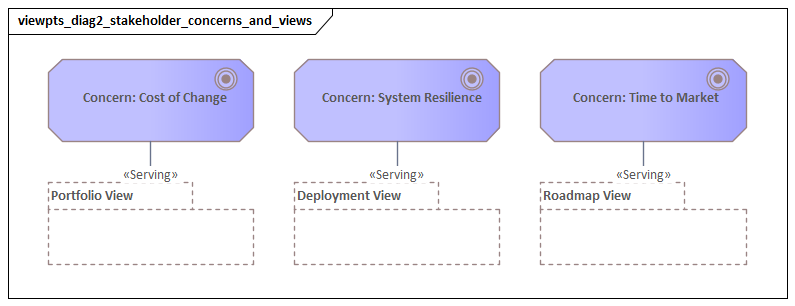
ArchiMate Viewpoints: Definition, Purpose, and Core Concepts
In ArchiMate, a viewpoint is not merely a diagram style or visual preference. It is a deliberate representation of an architecture model that selects specific elements, relationships, and levels of detail to address a defined stakeholder concern. Put differently, the model contains the facts; the viewpoint presents the subset of those facts that is relevant to a particular purpose.
A viewpoint answers three practical questions:
- Who is the audience?
- What concern needs to be addressed?
- Which part of the architecture is relevant to that concern?
That makes viewpointing an act of interpretation, not just visualization. Two views can be derived from the same model and look entirely different because they answer different questions. One may emphasize capability uplift and business outcomes; another may focus on system interactions, operational dependencies, or sequencing constraints. The usefulness lies not in the volume of content shown, but in what is selected and why.
This selectivity matters because ArchiMate spans multiple layers and levels of abstraction. Some viewpoints are conceptual and help frame conversations about direction, intent, or operating model implications. Others are more logical or implementation-oriented and support dependency analysis, traceability, or delivery planning. Mature architecture practices use viewpoints across these levels instead of relying on one representation to carry every discussion.
One principle deserves emphasis: viewpoints are concern-driven rather than layer-driven. ArchiMate is often introduced through business, application, and technology layers, but effective viewpoints frequently cut across those boundaries. An identity and access management modernization view, for example, may connect business roles, joiner-mover-leaver processes, authentication services, directory platforms, policy controls, and transition work packages in one coherent picture. That ability to move across layers is one of ArchiMate’s strengths in enterprise settings because it shows not only structure, but also the interaction between business intent, operational change, and technical delivery.
In practice, viewpoint design should begin with the stakeholder question, not with the repository. Is the goal to assess investment impact, evaluate integration complexity, clarify accountability, understand resilience exposure, or sequence a migration? Once the question is clear, the architect can decide what belongs in the view and what should be left out. Many weak views fail at this point. They include too much because they start with what is available rather than with the decision that needs support.
It is also worth noting that a viewpoint is not successful simply because it conforms to the standard. A view can be technically valid and still fail if it is overloaded, poorly scoped, or visually difficult to read. Strong viewpoints combine modeling discipline with editorial judgment. They use grouping, emphasis, layering, annotation, and narrative framing to guide interpretation without distorting the model.
That balance becomes even more important when architecture communication is organized around stakeholder needs rather than model completeness.
Stakeholder-Centric Communication with ArchiMate Viewpoints
The real strength of ArchiMate viewpoints becomes visible when communication is shaped around stakeholder intent rather than around the urge to display the full architecture. Stakeholders rarely ask for “the architecture.” They ask more pointed questions: What will this change improve? What is at risk? Which teams are affected? What dependencies could delay delivery? Which systems should be retired, modernized, or protected? A stakeholder-centric viewpoint is built to answer those questions directly.
This shifts the architect’s role. The architect is not just producing models; the architect is designing communication. The task is not merely to render the repository accurately. It is to select and frame part of that repository so a stakeholder can move toward a decision. That requires understanding not only the stakeholder’s formal role, but also the context in which they are operating. A CIO may care generally about platform simplification, but in one meeting the immediate concern may be investment timing, while in another it may be resilience, regulatory exposure, or vendor concentration. The same stakeholder may therefore need different viewpoints at different times.
A useful distinction is the one between stakeholder categories and stakeholder situations. Categories include executives, portfolio managers, business owners, solution architects, operations teams, security leaders, and program managers. Situations are the moments when they need architectural insight: funding approval, target-state alignment, design review, merger integration, control assessment, or migration planning. In practice, the most effective viewpoints are often designed for the situation first and the audience second. That approach reduces the risk of broad, generic diagrams that appear relevant to a stakeholder group in theory but are too vague to support action.
Language matters as much as structure. ArchiMate provides a formal vocabulary, but stakeholders do not always think in ArchiMate terms. Business leaders talk about journeys, products, outcomes, and operating friction. Risk teams focus on control ownership, auditability, and exposure. Delivery teams think in APIs, release trains, environments, and technical debt. A strong viewpoint keeps the modeling rigorous while using labels, annotations, and framing that match stakeholder language. A Kafka event architecture view, for example, will land better with engineering teams if it highlights producers, consumers, topics, schema ownership, and failure handling rather than relying only on formal application collaboration notation.
Visual hierarchy matters too. Not every element in a view should compete equally for attention. If the concern is impact, changed elements should stand out. If the concern is accountability, ownership boundaries should be unmistakable. If the concern is transition, plateaus, gaps, and dependencies should carry the narrative. In many cases, the quality of a viewpoint depends less on what is included than on what is emphasized.
In mature practices, viewpoints are often used as a set rather than in isolation. A transformation discussion might begin with a motivation or capability view for executive alignment, move to a cross-layer impact view for domain leads, and finish with an implementation and migration view for delivery governance. Each addresses a different concern, but together they create continuity from intent to execution. That is the practical expression of the model-versus-view distinction introduced earlier: one shared model, several targeted conversations.
The lesson is simple. Stakeholder-centric communication is not about showing everything that is true. It is about showing what a particular stakeholder needs in order to understand, decide, and act with confidence.
Overview of ArchiMate Viewpoint Categories and Their Use Cases
Once the principle of concern-driven communication is clear, the next step is to understand the main viewpoint categories and where they are most useful. The point is not to memorize a taxonomy. It is to recognize these categories as recurring patterns for answering different architectural questions.
1. Strategy and Motivation Viewpoints
These viewpoints are useful when the concern is direction, intent, value, or the case for change. They connect goals, drivers, outcomes, capabilities, and courses of action. Typical use cases include strategy execution planning, investment prioritization, portfolio alignment, and transformation sponsorship.
Their strength is that they answer why change is needed before moving into how it will be delivered. An executive steering group, for example, may need to see which capabilities support a growth objective and where capability gaps justify investment. In a retail bank, a strategy view might show that the goal of reducing mortgage approval time depends on strengthening digital onboarding, decision automation, and document management capabilities. That gives sponsors a clearer basis for funding than a list of proposed systems.
2. Business Viewpoints
Business viewpoints focus on how the enterprise operates in organizational and process terms. They typically show business actors, roles, collaborations, processes, services, products, and value delivery structures. These views are useful for operating model design, process improvement, customer journey analysis, and business service clarification.
They become especially valuable when technology conversations start running ahead of business design. By bringing attention back to business services, responsibilities, and value delivery, they keep technology choices grounded in enterprise purpose. In a healthcare provider, for instance, a business process view of outpatient referral handling may reveal that delays are caused less by application shortcomings than by unclear handoffs between triage, scheduling, and specialty review teams.
3. Application and Information Viewpoints
These viewpoints are used when stakeholders need to understand application behavior, service exposure, collaboration patterns, information flow, or system dependency. Common use cases include application rationalization, integration design, domain boundary analysis, and impact assessment for change initiatives.
This category often forms the bridge between enterprise architecture and solution architecture. It can show which applications support a capability, where redundant functionality exists, or how a proposed change affects upstream and downstream systems. In a Kafka-based event architecture, for example, an application cooperation view can show how order, payment, and fulfillment services exchange events asynchronously, where topic ownership sits, and which consumers are tightly coupled to event schemas. That kind of view is often the first place hidden delivery risk becomes visible.
4. Technology and Infrastructure Viewpoints
Technology viewpoints focus on nodes, devices, networks, system software, technology services, and deployment structures. They are most useful when the concern is resilience, environment design, hosting strategy, cloud transition, platform standardization, or infrastructure risk.
These views are not relevant only to infrastructure teams. Business and application changes often carry platform implications such as latency constraints, resilience limitations, or unsupported dependencies. A technology lifecycle governance view may show, for instance, that a customer-facing digital service still relies on a Windows Server build that reaches end of support within a year, with a legacy file transfer component that cannot yet run in the target cloud environment. That is not just an infrastructure issue; it directly affects transformation timing and risk.
5. Cross-Layer Viewpoints
Cross-layer viewpoints are often the most powerful in enterprise settings because they connect business, application, and technology concerns in a single representation. They are well suited to impact analysis, end-to-end traceability, and service-oriented discussions.
These views are especially useful when architecture must align business and IT stakeholders who otherwise work from separate mental models. A cross-layer view can show how a business service is realized by processes, applications, and infrastructure, or how a strategic initiative cascades through multiple layers of the enterprise. During a core insurance modernization, for example, a cross-layer view might trace the claims intake service from customer channels through workflow and policy systems down to imaging platforms and storage services, making it easier to see why a “simple front-end change” is not simple at all.
6. Implementation and Migration Viewpoints
These viewpoints are designed for change planning rather than static description. They show work packages, deliverables, plateaus, gaps, and transition states. Their strongest use cases include roadmap development, dependency sequencing, and governance oversight.
This is where architecture becomes directly actionable. These views help move from target-state ambition to execution logic by showing what changes first, what depends on what, and where transition risk must be managed. In an IAM modernization roadmap, for example, the first plateau may centralize authentication, the second may introduce privileged access controls, and the third may retire local credential stores and legacy directories. Without that staged view, stakeholders may support the target state while underestimating the operational disruption of getting there.
Taken together, these categories provide a practical framework for choosing the right communication instrument. The aim is not to use every category. It is to use the one that best fits the stakeholder concern and decision context.
Selecting the Right ArchiMate Viewpoint for Different Architecture Questions
Choosing the right viewpoint is less a matter of preference than of diagnosis. The starting point should always be the architecture question. Different questions imply different scopes, abstraction levels, time horizons, and evidence needs. If the question is vague, the resulting view will usually be either too broad to guide action or too narrow to reveal what matters.
One practical way to approach selection is to group architecture questions into a handful of decision types.
Direction-Setting Questions
These questions ask where the organization should invest, which capabilities need strengthening, or how strategy should be translated into change. Strategy or motivation viewpoints are usually the best fit, often combined with capability-oriented representations. The goal is to establish strategic relevance and a credible rationale for action.
Design and Dependency Questions
These ask how services collaborate, which applications are coupled, what data is exchanged, or where technical constraints exist. Application, information, or technology viewpoints are generally more appropriate here. A view that works for strategic sponsorship is often too abstract for this purpose. One of the most common communication failures in architecture is using a strategic view to answer an engineering question, or a highly detailed technical view to answer an executive one.
Impact and Risk Questions
These arise when stakeholders want to know what will be affected by a proposed change, how failure could propagate, or which controls and ownership boundaries are involved. Cross-layer viewpoints are often the strongest choice because they show the chain of consequences from business service through application and technology. In large enterprises, local changes frequently create wider effects that remain invisible in domain-specific views.
Transition and Roadmap Questions
These focus on sequencing rather than structure. They ask what must happen first, which dependencies may block delivery, and how the target state can be reached through intermediate stages. Implementation and migration viewpoints are the natural fit. A common mistake is to show the desired end state without showing the transformation logic needed to reach it. Stakeholders may agree with the destination while underestimating the cost, effort, and risk of the journey.
Beyond question type, architects also need to consider the decision horizon. Strategic questions call for simplification and aggregation. Tactical planning requires enough detail to compare options and identify constraints. Operational questions demand concrete visibility into interfaces, deployments, run-state dependencies, and support ownership. The viewpoint must match the level of commitment expected from the audience.
A useful test before modeling begins is to ask three questions:
- What decision will this view influence?
- What uncertainty must it reduce?
- What action should it enable next?
These questions impose discipline and make it easier to decide what to leave out. They also connect directly to the earlier principles: concern-driven design, stakeholder context, and the distinction between model and view.
In mature architecture practices, viewpoint selection is rarely a one-diagram exercise. A complex initiative may need a sequence of views: a capability-impact view for sponsorship, an application cooperation view for dependency analysis, and a migration roadmap for governance. A board may approve IAM modernization in principle, for example, then request a cross-layer dependency view before releasing funding for phased implementation across HR, ERP, and customer identity platforms. The strength lies in using each viewpoint for the question it is best suited to answer while keeping the broader architecture story consistent.
Common Pitfalls and Best Practices When Using ArchiMate Viewpoints
Using ArchiMate viewpoints well is less about notation than about practice. Most failures occur because the viewpoint is created without enough discipline around purpose, scope, and stakeholder usability. A view can be formally correct and still fail in the room.
Common Pitfalls
1. Viewpoint inflation
Architects often start with a valid concern, then keep adding elements in the name of completeness until the diagram becomes a compressed version of the repository. At that point, it serves no one particularly well. If everything appears equally important, the viewpoint has probably lost its center.
2. Mixing concerns without declaring one primary
A single view may attempt to show strategy, process impact, application dependency, ownership boundaries, and migration sequencing all at once. Those concerns are related, but forcing them into one diagram usually obscures the decision. If several concerns genuinely matter, the better answer is often a coordinated set of views.
3. Model-driven rather than question-driven creation
Teams sometimes produce views based on what is already modeled in detail rather than on what stakeholders actually need to decide. That creates the appearance of productivity, but it weakens architecture credibility. Well-documented areas become overrepresented, while strategically important but less-modeled concerns remain invisible.
4. Notation purity overriding comprehension
ArchiMate rigor matters, especially for consistency and traceability, but stakeholders gain nothing from a diagram they cannot read quickly. Too many fine-grained relationships, excessive line crossings, or unexplained notation can make a technically valid view unusable outside the architecture team.
5. Treating viewpoints as static documentation
In some organizations, diagrams are produced for approval gates and then archived. That misses much of their value. A viewpoint should be a working instrument, used to test assumptions, surface disagreement, and refine analysis as understanding develops.
6. Weak linkage to decisions
If a view does not clearly influence a funding choice, design direction, risk treatment, or delivery sequence, it may be polished but still weak in practice. An architect should be able to explain in one sentence what decision the viewpoint is meant to support.
Best Practices
Start with the decision, not the diagram.
Define the stakeholder concern and the decision to be supported before choosing concepts or notation.
Constrain scope aggressively.
Include only the elements needed to answer the question. Clarity often comes more from exclusion than inclusion.
Use visual hierarchy deliberately.
Highlight changed, critical, risky, or owned elements so the stakeholder sees the main point immediately.
Adapt language to the audience.
Keep the model sound, but use labels and framing that reflect stakeholder vocabulary.
Use coordinated views when needed.
If no single concern can dominate, create a short sequence of related viewpoints instead of one overloaded diagram.
Validate with real stakeholders early.
Do not rely only on architect-to-architect review. If the intended audience cannot quickly explain the takeaway, simplify the view.
The strongest viewpoints combine semantic accuracy with restraint. They do not try to prove that the architect knows everything. They help the organization see what matters most when a decision has to be made.
Conclusion
ArchiMate viewpoints are most valuable when they are treated as tools for enterprise decision-making rather than as diagramming conventions. Their contribution is not simply that they make architecture easier to look at. They make complexity manageable. By presenting the right slice of architecture to the right audience at the right time, viewpoints help organizations move from abstract understanding to coordinated action.
The central idea throughout this article has been consistent: a viewpoint is a selective lens applied to a shared architecture model to address a specific stakeholder concern. Once that principle is clear, the rest follows. Viewpoints matter because they improve decision quality. They work best when designed around stakeholder situations rather than generic audiences. Their categories are useful because they align with recurring types of architecture questions. And their effectiveness depends not only on formal correctness, but also on disciplined scope, clear emphasis, and direct relevance to a decision.
For practitioners, viewpoint discipline is often a sign of architectural maturity. Teams that frame views around stakeholder concerns tend to produce architecture that is trusted, reused, and connected to planning and delivery. Teams that rely on generic or overly technical views often struggle to demonstrate relevance beyond the architecture function. In that sense, viewpoint selection is not just a communication choice. It is evidence of whether architecture is operating as a business capability or merely as documentation.
The strongest practical approach is to treat viewpoints as part of an ongoing decision cycle. A view should be created with a clear meeting, review, or planning outcome in mind. It should help stakeholders compare options, expose dependencies, identify risk, or confirm alignment. After that, it should evolve in response to feedback and new information rather than remain frozen as a static artifact. That keeps the repository useful and ensures that views stay connected to real enterprise change.
Used well, ArchiMate viewpoints strengthen the link between strategy, design, and execution. They allow the same underlying architecture to support executive sponsorship, delivery coordination, governance oversight, and operational planning without losing coherence. That is the real advantage: not better diagrams for their own sake, but clearer conversations, stronger commitments, and more resilient transformation across the enterprise.
Frequently Asked Questions
What is enterprise architecture?
Enterprise architecture is a discipline that aligns an organisation's strategy, business operations, information systems, and technology infrastructure. It provides a structured framework for understanding how an enterprise works today, where it needs to go, and how to manage the transition.
How is ArchiMate used in enterprise architecture practice?
ArchiMate is used as the standard modeling language in enterprise architecture practice. It enables architects to create consistent, layered models covering business capabilities, application services, data flows, and technology infrastructure — all traceable from strategic goals to implementation.
What tools are used for enterprise architecture modeling?
Common enterprise architecture modeling tools include Sparx Enterprise Architect (Sparx EA), Archi, BiZZdesign Enterprise Studio, LeanIX, and Orbus iServer. Sparx EA is widely used for its ArchiMate, UML, BPMN and SysML support combined with powerful automation and scripting capabilities.
Viewpoints, once they leave the tool
A viewpoint is an editorial decision about what a given stakeholder should not have to read. That decision is wasted if the only way to see the result is to open the modelling tool.
Publishing the model with Architecture Publisher carries viewpoints through as perspectives — one extraction, several scoped views, each with its own landing artefact — so the scoping you did in the model is what the stakeholder actually experiences.