⏱ 19 min read
Most enterprise strategy decks are fiction.
Not malicious fiction. Just the polished, expensive kind. The kind with gradients, ambition words, and a roadmap that somehow skips the ugly middle where systems, teams, budgets, controls, and politics collide. Strategy says become digital. Execution says our IAM platform still takes six weeks to onboard an application and Kafka is running like a side project in three clouds with no ownership model.
That gap is where architecture is supposed to earn its keep.
And this is exactly why ArchiMate matters.
Not because it is elegant. Not because it is standardized. And definitely not because executives are begging to see more architecture notation. They are not. ArchiMate matters because, when used properly, it gives architects a disciplined way to connect strategic intent to operating change, and then all the way down to applications, integration patterns, infrastructure, and work packages. In plain English: it helps you show how “we want to grow digital revenue by 20%” turns into “we need event-driven customer onboarding, federated IAM, cloud landing zones, and a sequenced migration plan with clear dependencies.”
That is the useful part.
The less useful part is what a lot of architects do with it: they draw giant abstract diagrams no one can read, model every object in the enterprise, and then wonder why delivery teams ignore them. ArchiMate is not the point. Better decisions are the point. ArchiMate modeling guide
This article is about that practical middle ground: how to use ArchiMate to link strategy to execution in real enterprise architecture work, where priorities shift, funding is messy, and every “target state” is already compromised by inherited technology and organizational reality. ArchiMate tutorial
The simple version first: what ArchiMate actually does
If you strip away the notation anxiety, ArchiMate is just a modeling language for enterprise architecture. It gives you a way to describe:
- what the business wants to achieve
- what capabilities it needs
- what processes and value streams support those capabilities
- what applications and data are involved
- what technology and infrastructure underpin them
- what changes are planned and in what sequence
That’s the whole game.
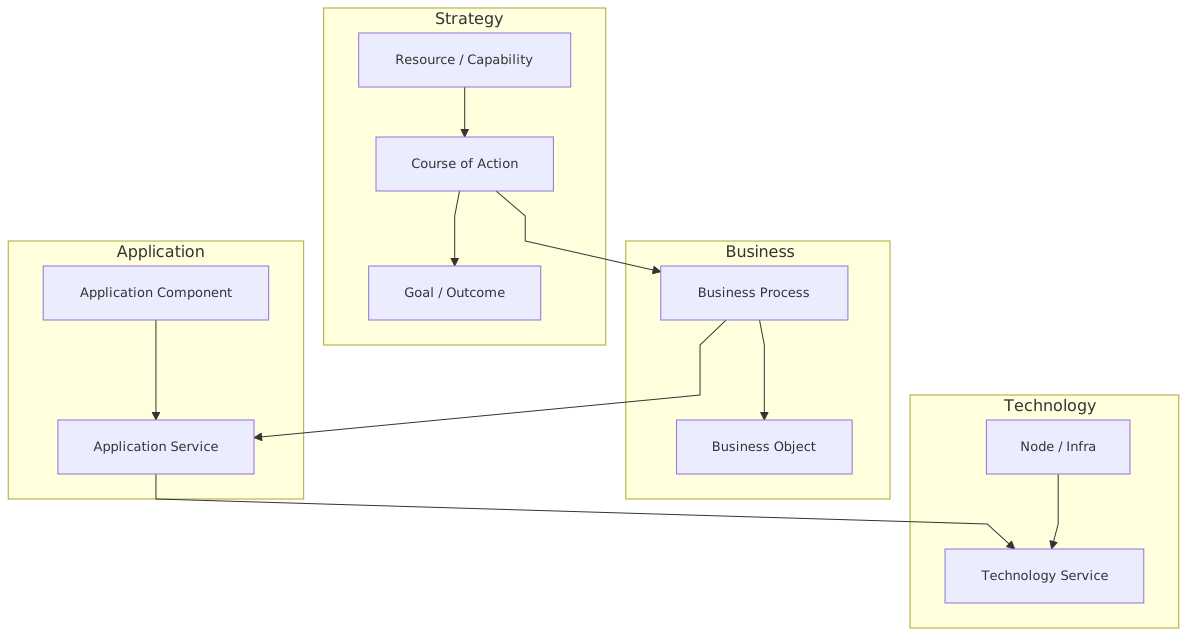
The reason architects use ArchiMate for strategy-to-execution is that it spans multiple layers:
- Strategy layer: goals, outcomes, capabilities, courses of action
- Business layer: products, services, processes, actors
- Application layer: applications, interfaces, data objects
- Technology layer: platforms, nodes, networks, cloud services
- Implementation and migration: work packages, plateaus, gaps, roadmaps
So instead of having a strategy document in one place, process models somewhere else, solution designs in PowerPoint, and migration plans in spreadsheets, you can create a coherent line of sight.
That line of sight is the value.
If your CIO says, “We need to reduce customer onboarding time from five days to ten minutes,” ArchiMate helps you trace from that objective to the necessary business capability uplift, process redesign, event architecture, IAM controls, application changes, and migration activities.
It does not execute anything for you. It does not remove politics. It does not make weak architects strong. But it does force clarity.
And clarity is rare.
The real problem: strategy and execution usually live in different worlds
In most enterprises, strategy and execution are separated by language.
Strategy talks in outcomes:
- grow market share
- improve customer trust
- reduce operational risk
- modernize the platform
- enable ecosystem partnerships
Execution talks in constraints:
- core banking release windows
- identity proofing vendor limitations
- Kafka topic sprawl
- cloud network segmentation
- audit findings
- budget allocations by quarter
- skills shortages in platform teams
Both are valid. But they usually don’t meet cleanly.
The strategy team often produces intent without architectural consequences. Delivery teams implement changes without strategic context. Enterprise architects sit in the middle and, frankly, often make this worse by adding conceptual overhead instead of reducing ambiguity.
This is where ArchiMate can be powerful, if you use it as a translation tool rather than a drawing exercise.
A good ArchiMate model answers questions like:
- Which strategic goals are we actually funding?
- Which capabilities are weak and blocking execution?
- Which applications are critical to the value stream we want to improve?
- Where are the dependencies between IAM, integration, and cloud platform work?
- What transformation work packages are foundational versus optional?
- What is the migration path, not just the target state?
That last question matters more than architects like to admit. A target state without a migration path is architecture cosplay. EA governance checklist
Strategy is not a diagram. But diagrams can expose weak strategy
Here’s a contrarian thought: ArchiMate does not just link strategy to execution. It also exposes when the strategy itself is lazy.
A lot of enterprise strategy is just aspirations stapled together:
- become customer-centric
- embrace cloud
- use data better
- simplify the estate
- improve resilience
Fine. But those are not strategies unless they imply choices.
Real strategy means trade-offs. It means saying:
- we will prioritize retail onboarding over branch modernization
- we will standardize IAM before launching external developer APIs
- we will consolidate event streaming on managed Kafka in two cloud regions and stop tolerating business-unit clusters
- we will retire custom authorization logic in favor of centralized policy enforcement even if some application teams resist
ArchiMate is useful because it pushes those choices into view. Once you map goals to capabilities, capabilities to services, services to applications, and applications to technology, the missing decisions become obvious. You can see whether the enterprise is trying to do ten transformations with funding for three.
That’s not a notation benefit. That’s a governance benefit.
How this works in real architecture work
Let’s make this practical.
In real architecture work, linking strategy to execution with ArchiMate usually happens through a sequence like this:
1. Start with a business outcome, not a platform agenda
This sounds obvious, but it is where many architecture efforts go wrong.
Bad starting point:
- implement enterprise Kafka
- modernize IAM
- move workloads to cloud
Those are not business outcomes. They are technology motions.
Better starting point:
- reduce time to open a new business account
- enable secure partner onboarding for embedded banking
- cut fraud losses without increasing customer friction
- improve resilience of payment processing
Now architecture has a reason to exist.
2. Identify the capabilities that matter
Once the outcome is clear, identify the business capabilities involved. For a bank improving digital onboarding, that might include:
- customer identity verification
- consent and preference management
- fraud detection
- product origination
- access management
- event processing
- case management
- compliance reporting
This is where many architects get too generic. “Customer management” is not enough. “Identity verification” and “access management” are distinct capabilities with different owners, maturity levels, controls, and technology implications.
3. Map the value stream or process pain
Capabilities are necessary, but not sufficient. You need to understand where the flow breaks.
For example, in a retail bank onboarding journey:
- customer starts application
- identity is verified
- risk checks run
- account is created
- credentials are issued
- welcome communications are triggered
- downstream systems are updated
If step 2 is manual for edge cases, step 4 depends on a nightly batch, and step 5 uses a separate IAM workflow with human approval, then your strategy problem is not “digital transformation.” It is a chain of specific execution failures.
ArchiMate lets you connect that flow to the underlying application and technology services.
4. Trace down to applications and platforms
This is where architecture becomes real.
For the onboarding example, you may find:
- the mobile onboarding app initiates the journey
- an identity proofing service validates documents
- Kafka distributes onboarding events to downstream consumers
- IAM provisions customer access and enforces authentication policy
- the core banking platform opens the account
- a CRM and communication service trigger notifications
- cloud-hosted APIs expose onboarding status
Now you can model dependencies and pain points:
- Kafka topics are inconsistent across domains
- IAM is centralized but not API-first
- core banking integration is synchronous and brittle
- cloud APIs lack standard observability
- fraud service has no event replay capability
This is architecture work. Not abstract boxes. Operationally meaningful relationships.
5. Define work packages and sequencing
Then, and only then, define change.
Not “future state by 2028.” Actual work packages:
- standardize onboarding event model
- deploy managed Kafka platform with governance controls
- implement IAM federation for customer channels
- externalize authorization policies
- build onboarding orchestration API layer
- decouple core banking account creation with asynchronous event handling
- introduce cloud landing zone controls for regulated workloads
You can then group these into plateaus:
- Plateau 1: stabilize current onboarding and reduce manual handoffs
- Plateau 2: enable event-driven onboarding and centralized IAM policy
- Plateau 3: support partner-led embedded onboarding via APIs
That progression matters. It turns architecture into a roadmap rather than a wish list. ArchiMate in TOGAF ADM
A real enterprise example: digital onboarding in a bank
Let’s use a realistic banking example.
A regional bank wants to grow small business accounts aggressively. Strategy says:
- increase digital acquisition
- reduce onboarding abandonment
- support partner distribution channels
- improve regulatory control
On paper, easy.
In reality, the current onboarding process is fragmented:
- customer data is captured in a web front end
- KYC checks are partly automated, partly manual
- account creation sits in a legacy core banking system
- IAM for business customers is separate from IAM for retail users
- event integration exists, but each domain publishes Kafka events differently
- cloud adoption is partial, with some APIs in cloud and core systems on-prem
- audit has raised concerns about entitlement review and access policy consistency
This is exactly the kind of transformation where ArchiMate is useful.
Strategic layer
The bank defines:
- Goal: grow SME digital account openings by 30%
- Goal: reduce onboarding cycle time to under 15 minutes
- Goal: improve compliance and access control consistency
- Outcome: higher conversion, lower operational cost, lower regulatory risk
- Course of action: redesign onboarding around event-driven processing and centralized identity services
Capability view
The architect identifies impacted capabilities:
- digital sales
- customer due diligence
- identity and access management
- account origination
- event management
- compliance monitoring
- partner integration
Then maturity is assessed. The weak points are obvious:
- IAM is fragmented
- event management exists technically but lacks governance
- partner integration is immature
- compliance monitoring is reactive
Business/application view
The onboarding value stream is linked to applications:
- onboarding portal
- KYC service
- fraud scoring engine
- IAM platform
- Kafka event platform
- core banking account service
- notification service
- compliance reporting platform
Now the architect can show something executives understand: the strategic outcome depends on specific changes in specific systems.
Technology view
Below that:
- Kafka clusters are deployed both on-prem and in cloud, with no common operating model
- IAM uses legacy LDAP patterns internally and modern identity federation externally
- the API layer runs in cloud, but private connectivity to core banking is a bottleneck
- audit logs are fragmented across tools
Implementation and migration
The roadmap becomes concrete:
- establish canonical onboarding events in Kafka
- introduce event governance and ownership by domain
- federate IAM for SME customers and unify policy enforcement
- expose account origination via resilient API and asynchronous processing
- centralize audit and access telemetry in cloud-native monitoring stack
- onboard partner channels after controls are proven internally
That is strategy linked to execution. Not because the notation is magical, but because the architecture model makes dependencies visible.
A useful mapping table
Here’s a practical way to think about strategy-to-execution traceability.
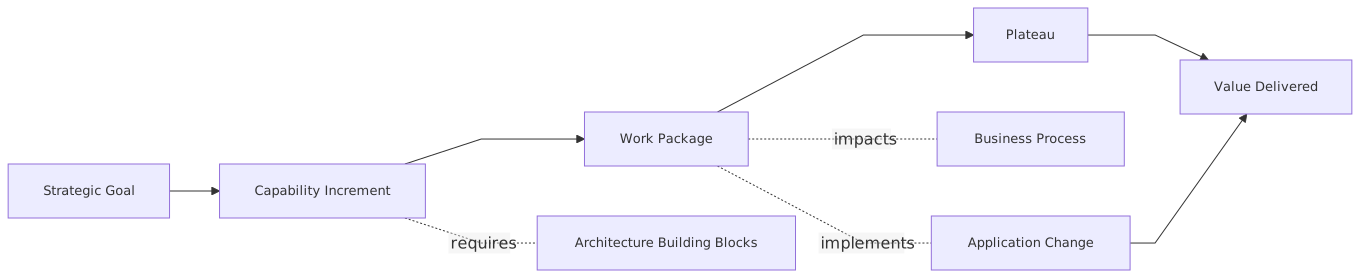
This table may look simple. Good. Simplicity is underrated in architecture. If your stakeholders cannot read your strategy-to-execution logic in five minutes, you have probably over-modeled it.
Where Kafka, IAM, and cloud really fit
Architects often treat Kafka, IAM, and cloud as separate initiatives. That is a mistake.
In practice, they are tightly connected in enterprise execution.
Kafka is not just integration plumbing
In banking, Kafka often becomes the backbone for event-driven processing:
- onboarding events
- payment events
- fraud alerts
- customer profile changes
- entitlement changes
- audit events
But many enterprises deploy Kafka without defining the business and governance model around it. They get technical success and organizational chaos.
Common symptoms:
- too many topics with weak ownership
- inconsistent event schemas
- no lifecycle management
- consumers tightly coupled to producer quirks
- no clear distinction between integration events and business events
In ArchiMate terms, Kafka should not just appear as a technology node. It should be connected to application services, business processes, and implementation work packages. Otherwise it remains “platform stuff” disconnected from strategic outcomes.
IAM is not a security side concern
IAM is usually dragged into transformation late, which is absurd because identity is foundational to digital business.
If your strategy includes:
- digital channels
- partner ecosystems
- workforce mobility
- zero trust
- regulatory control
then IAM is not a support function. It is a strategic capability.
In the bank onboarding example, IAM affects:
- customer authentication
- business user access
- delegated administration
- entitlement controls
- step-up authentication
- auditability
Architects who leave IAM out of early strategy mapping usually pay for it later through delays, exceptions, and ugly workarounds.
Cloud is not the strategy either
I’ll say it plainly: “move to cloud” is not a strategy. It is a delivery and operating model choice.
Sometimes the right answer is cloud-native modernization. Sometimes it is not. In regulated banking environments, hybrid reality is normal. Core systems may remain on-prem for years while customer channels, analytics, and API services move to cloud.
ArchiMate helps by making hybrid dependency visible:
- what business services depend on cloud-hosted applications
- what applications depend on on-prem systems
- where network, security, and latency constraints matter
- what work packages are required to make cloud adoption safe and repeatable
This is useful because cloud conversations are often ideological. Architecture should make them empirical.
Common mistakes architects make
Let’s be honest. The biggest problem with ArchiMate in enterprises is not the language. It is how architects misuse it.
1. Starting with the metamodel instead of the problem
Nobody cares that you can distinguish every element perfectly if the model does not answer a business question.
Start with the question:
- Why are onboarding times bad?
- What blocks partner enablement?
- What has to change to improve resiliency?
Then model only what helps answer it.
2. Modeling everything
This is the classic architecture failure mode. Huge repository, low usefulness.
You do not need to represent every application, process, actor, and node to link strategy to execution. You need enough model fidelity to support decisions.
Architecture is selective abstraction. If you cannot choose what to leave out, you are not abstracting.
3. Confusing capability maps with strategy
A capability map is helpful. It is not strategy.
Many architects produce a capability heatmap and act as if they have explained what the enterprise should do next. They have not. Strategy requires prioritization, sequencing, and trade-offs.
4. Drawing target states with no migration logic
This one is epidemic.
A glossy target architecture that ignores funding cycles, dependency chains, platform readiness, and organizational capacity is not architecture. It is decorative ambition.
Implementation and migration views are where credibility is earned.
5. Ignoring ownership and operating model
You can design the cleanest event-driven architecture in the world. If no one owns topic governance, schema lifecycle, IAM policy administration, or cloud platform controls, it will degrade fast.
Execution depends on operating model. ArchiMate can model roles, actors, and responsibilities. Use that. It matters.
6. Treating standards as architecture
Another contrarian point: standards alone are weak architecture.
“Use Kafka.” “Use OAuth.” “Use cloud-native services.” Fine. Those are choices, not architecture outcomes. The real question is where, why, under what constraints, and in what sequence.
What good ArchiMate usage looks like
In a healthy architecture practice, ArchiMate is used in layers of communication.
For executives
Show:
- strategic goals
- required capabilities
- key transformation dependencies
- phased outcomes
No notation purity contest. Keep it readable.
For portfolio and governance
Show:
- which work packages support which goals
- where dependencies create delivery risk
- what foundation work is non-negotiable
- what can be sequenced later
This is where architecture helps investment decisions.
For solution and platform teams
Show:
- the affected application services
- technology dependencies
- integration patterns
- ownership boundaries
- transition states
This is where architecture becomes executable.
A good enterprise architect can move between these levels without changing the core logic. That consistency is one of ArchiMate’s real strengths.
A practical way to build the model
If I were coaching an architecture team doing this for a bank, I would tell them to work in this order:
- Define 3–5 strategic outcomes
- measurable, not slogan-based
- Identify the business capabilities that are bottlenecks
- not the whole enterprise map, just the relevant slice
- Map one value stream or customer journey
- where does the outcome succeed or fail?
- Attach the critical applications and data flows
- only what materially affects the journey
- Map enabling technology dependencies
- Kafka, IAM, cloud connectivity, observability, resilience controls
- Identify gaps
- capability gaps, platform gaps, governance gaps, skill gaps
- Define work packages
- concrete changes with owners
- Sequence into plateaus
- what can be done now, next, later
- Use the model in governance
- not as a repository artifact, but as a decision tool
That last point is important. If the model is not used in steering, prioritization, or design review, it becomes shelfware.
Why architects should be a little more opinionated
Enterprise architecture has a bad habit of sounding neutral when neutrality is not helpful.
Sometimes the architect should say:
- No, we should not launch partner APIs before IAM federation is fixed.
- No, Kafka adoption is not mature enough to support another line of business without governance.
- No, moving this workload to cloud now creates more control risk than value.
- Yes, centralizing authorization policy is worth the short-term delivery pain.
- Yes, the strategy needs narrowing because the execution path is overloaded.
That is not arrogance. That is the job.
ArchiMate helps because it gives structure to those opinions. You can point to relationships, dependencies, and migration impacts rather than arguing from instinct alone.
Still, let’s not pretend the model decides. Architects do. The model just makes the reasoning testable.
Final thought
Linking strategy to execution is the core enterprise architecture problem. Everything else is secondary.
ArchiMate is useful because it can connect the lofty language of strategy to the stubborn reality of processes, applications, platforms, and transformation work. It gives architects a way to show not only what the enterprise wants, but what has to change, in what order, and why.
But it only works if used with discipline.
Use it to clarify, not impress.
Use it to expose trade-offs, not hide them.
Use it to build migration logic, not fantasy target states.
Use it to connect banking outcomes to Kafka design, IAM control, and cloud operating realities.
And maybe most importantly: use it to say something definite.
Because the enterprise does not need another architecture diagram.
It needs a credible path from ambition to delivery.
FAQ
1. Is ArchiMate too complicated for business stakeholders?
It can be, if architects make it so. Business stakeholders do not need full notation depth. They need clear views showing goals, capabilities, dependencies, and roadmap impacts. Use the language rigor underneath, but simplify what you present.
2. How is ArchiMate different from a capability map or a roadmap?
A capability map shows what the business needs to be good at. A roadmap shows timing. ArchiMate connects those things to business processes, applications, technology, and migration work. It provides traceability across layers, which standalone artifacts usually lack.
3. Can ArchiMate really help with cloud transformation?
Yes, if cloud is treated as part of execution rather than as the strategy itself. ArchiMate is useful for showing hybrid dependencies, platform constraints, security controls, migration sequencing, and which business outcomes actually benefit from cloud adoption.
4. Where do Kafka and event-driven architecture fit in an ArchiMate model?
Kafka can be modeled at the technology and application levels, but the important part is linking it to business services and transformation goals. If Kafka is only shown as infrastructure, you miss why it matters. In real architecture, it should be tied to event flows, application services, ownership, and migration work packages.
5. What is the biggest mistake when using ArchiMate for strategy execution?
Creating models that are complete but not useful. The biggest failure is over-modeling without decision support. If the model does not help prioritize investment, expose dependencies, or guide implementation sequencing, it is architecture theater.
Linking Strategy to Execution with ArchiMate
Frequently Asked Questions
What is enterprise architecture?
Enterprise architecture is a discipline that aligns an organisation's strategy, business processes, information systems, and technology. Using frameworks like TOGAF and modeling languages like ArchiMate, it provides a structured view of how the enterprise operates and how it needs to change.
How does ArchiMate support enterprise architecture practice?
ArchiMate provides a standard modeling language that connects strategy, business operations, applications, data, and technology in one coherent model. It enables traceability from strategic goals through business capabilities and application services to the technology platforms that support them.
What tools are used for enterprise architecture modeling?
The main tools are Sparx Enterprise Architect (ArchiMate, UML, BPMN, SysML), Archi (free, ArchiMate-only), and BiZZdesign Enterprise Studio. Sparx EA is the most feature-rich option, supporting concurrent repositories, automation, scripting, and integration with delivery tools like Jira and Azure DevOps.