⏱ 7 min read
Recommended Reading
Executive summary
CIO offices need architecture communication that is decision-oriented: where to invest, what risks threaten outcomes, and how platform initiatives enable business strategy. ArchiMate’s value here is its standardized, cross-layer language, enabling consistent capability-driven narratives and traceable dependencies across business and IT.
Capability map viewpoints support structured, executive-friendly overviews and can be used as heatmaps to identify investment areas, making them a natural “CIO dashboard primitive.”
When paired with decision records (ADR discipline) and governance processes (architecture boards and compliance review), ArchiMate views become governance artifacts rather than communication theatre. ArchiMate tutorial for enterprise architects
- Executive viewpoints: capabilities, outcomes, platforms
- Risk overlays and compliance narratives
- Roadmaps: plateaus and work packages

- ArchiMate 3.2 framing.
- Capability map viewpoint + heatmap use.
- ADR practice.
- TOGAF Architecture Board.
- TOGAF compliance review concept.
Five views every CIO office needs

Architecture models are useless if leadership cannot read them. The CIO office needs views that translate architecture complexity into decision-relevant information — without requiring ArchiMate literacy. ArchiMate layers explained
Strategic Dashboard: A single-page view showing the top 10 business capabilities, their current maturity (heatmap coloring), and their strategic importance. This answers: "Where should we invest in architecture improvement?"
Portfolio Health: A view showing all major Application Components, colored by lifecycle status (Active=green, Phase Out=amber, Retired=red, Planned=blue). This answers: "How healthy is our application portfolio?"
Risk and Compliance: A view showing compliance status per regulatory framework. Red items require immediate attention. This answers: "Are we compliant, and where are the gaps?"
Transformation Roadmap: A Migration view showing plateaus on a timeline. Each plateau shows which systems change and when. This answers: "What is our transformation plan, and are we on track?"
Investment Prioritization: A matrix view plotting capabilities by business value (y-axis) and technical fitness (x-axis). Capabilities in the high-value/low-fitness quadrant are top investment priorities. This answers: "Where should the next euro go?"
All five views are published via WebEA or exported as interactive PDFs. They refresh automatically as the underlying model is updated. The CIO office sees living architecture intelligence, not stale PowerPoint snapshots.
Stakeholder-specific view design
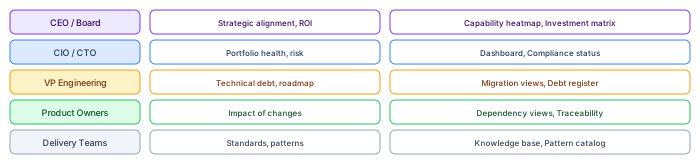
Different stakeholders need different views. The CIO office fails when it presents the same architecture content to everyone — executives do not care about technology components, and engineers do not need capability heatmaps. Design views for specific stakeholders with specific questions.
CEO and board: Care about strategic alignment and return on investment. Build a Capability Heatmap view showing top-15 capabilities colored by strategic fit and investment need. Build an Investment Prioritization matrix plotting capabilities by business value (y-axis) and technical fitness (x-axis). Limit to 15-20 elements. Use business language exclusively. Include a "so what" annotation: "Three red capabilities represent $4.2M annual risk exposure; remediation is budgeted in the Q3 capital plan."
CIO and CTO: Care about portfolio health, technology risk, and transformation progress. Build a Portfolio Health dashboard showing all major applications colored by lifecycle status. Build a Technology Radar view showing which technologies are adopting, holding, or phasing out. Build a Transformation Roadmap showing migration plateaus on a timeline. These views update monthly from the repository — the CIO sees living architecture intelligence, not quarterly PowerPoint snapshots.
VP Engineering: Cares about technical debt and delivery capacity. Build a Technical Debt Register view showing debt items prioritized by risk × impact. Build a Dependency Map showing which services block which teams. These views inform sprint planning and quarterly planning — they bridge the gap between architecture governance and delivery management.
Product owners: Care about how architecture decisions affect their product roadmap. Build Impact Analysis views that show, for a proposed change, which systems, services, and data flows are affected. This enables product owners to estimate the true cost of changes — not just development effort, but cross-team coordination and regression testing.
Delivery teams: Care about standards, patterns, and "how to build things here." Publish the Knowledge Base via WebEA: approved architecture patterns, technology standards, decision records, and onboarding guides. Teams should be able to find answers to common architecture questions without waiting for an architect — self-service architecture content scales better than individual consultations.
Keeping views current without manual effort
Architecture views that are stale are worse than no views — they create false confidence. The CIO office must ensure that views update automatically from the underlying model. In Sparx EA, views are live queries against the repository — when an element's tagged value changes (e.g., lifecycle status from "Active" to "Phase Out"), every view containing that element updates automatically. This is the fundamental advantage of model-based views over document-based reports: the model is maintained as part of the architecture workflow, and views are derived from the model, not maintained separately. Sparx EA best practices
Building the monthly CIO architecture briefing
Structure the monthly CIO briefing as a 15-minute presentation built entirely from live repository views. Slide 1: Portfolio Health dashboard (30 seconds — any new red items since last month?). Slide 2: Transformation Roadmap status (60 seconds — are we on track for the next plateau?). Slide 3: Risk and Compliance status (60 seconds — any compliance gaps opened or closed?). Slide 4: Top 3 architecture decisions requiring CIO awareness (variable — the substantive discussion). Slide 5: EA team metrics (30 seconds — reviews completed, value delivered). EA governance checklist
This structure works because it is consistent (the CIO knows what to expect), data-driven (every view comes from the repository), and action-oriented (each slide either confirms things are on track or surfaces something that needs attention). CIOs who receive this briefing consistently report that architecture transforms from an opaque overhead into a transparent, trusted governance function.
Anti-patterns in CIO communication
Three anti-patterns consistently undermine architecture communication to the CIO office. The model dump: presenting raw ArchiMate diagrams with full notation to executives who do not know ArchiMate. Fix: strip notation, use simple boxes and arrows with business language. The data overload: showing 100+ elements on a single view because "the CIO should see everything." Fix: aggregate into 15-20 elements maximum. The stale snapshot: presenting views from last quarter because updating them takes too long. Fix: use live repository views that update automatically when the model changes.
If you’d like hands-on training tailored to your team — Sparx Enterprise Architect, BPMN, SysML, Apache Kafka or the Archi tool — or modelling coaching in ArchiMate and TOGAF-aligned governance, you can reach us via our contact page.
Frequently Asked Questions
What is architecture governance in enterprise architecture?
Architecture governance is the set of practices, processes, and standards that ensure architecture decisions are consistent, traceable, and aligned to organisational strategy. It typically includes an Architecture Review Board (ARB), architecture principles, modeling standards, and compliance checking.
How does ArchiMate support architecture governance?
ArchiMate supports governance by providing a standard language that makes architecture proposals comparable and reviewable. Governance decisions, architecture principles, and compliance requirements can be modeled as Motivation layer elements and traced to the architectural elements they constrain.
What are architecture principles and how are they modeled?
Architecture principles are fundamental rules that guide architecture decisions. In ArchiMate, they are modeled in the Motivation layer as Principle elements, often linked to Goals and Drivers that justify them, and connected via Influence relationships to the constraints they impose on design decisions.