⏱ 22 min read
ArchiMate Capability Mapping for Strategic Planning: A Practical Guide
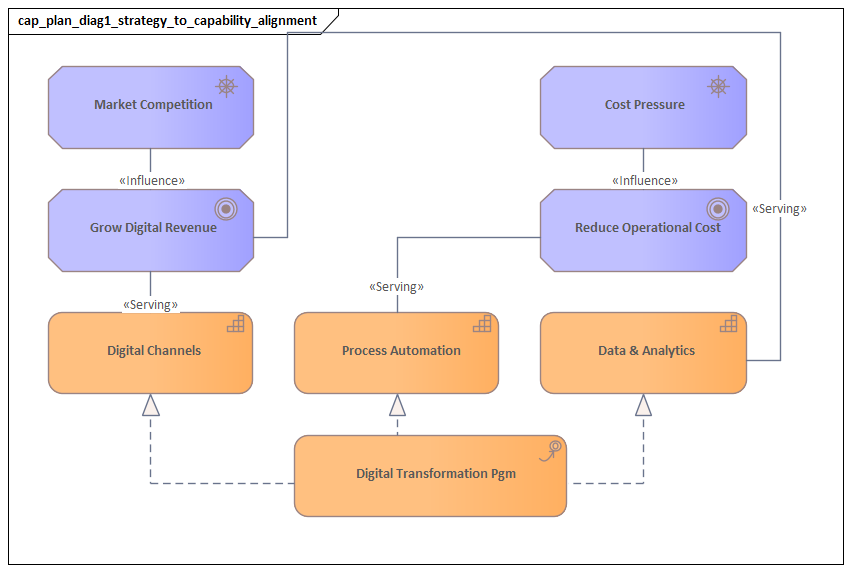
Learn how ArchiMate capability mapping supports strategic planning by aligning business capabilities, goals, and transformation initiatives for better enterprise architecture decisions. ArchiMate tutorial for enterprise architects
ArchiMate capability mapping, strategic planning, enterprise architecture, business capabilities, capability map, ArchiMate framework, strategy alignment, transformation planning, business architecture, capability-based planning ArchiMate layers explained
Introduction
Organizations rarely struggle to define ambition. They struggle to translate ambition into coordinated change. Strategic plans set goals for growth, resilience, customer intimacy, regulatory confidence, or cost efficiency, but those goals often remain detached from the enterprise abilities required to achieve them. Capability mapping closes that gap by describing what the enterprise must be able to do, independent of current departments, projects, products, or systems. In ArchiMate, that view is particularly useful because capabilities can be modeled in relation to goals, outcomes, value streams, resources, applications, and transformation initiatives within a single architectural language. ArchiMate relationship types
This capability-centered perspective improves planning because it shifts attention away from isolated solutions and toward enduring business ability. Instead of beginning with questions such as which platform to replace or which team owns a problem, leaders can ask which capabilities matter most, which are weak, and which require investment. That makes capabilities a more stable planning anchor than projects, products, or organizational structures, all of which tend to change more frequently.
In practice, ArchiMate capability mapping is not just a visualization technique. It supports judgment. It helps architects show where strategy is unsupported by current operating strength, where investment overlaps, and where dependencies may slow or derail transformation. A plan to expand digital channels, for example, may depend less on front-end redesign than on capabilities such as customer analytics, identity and access management, product configuration, and omnichannel service delivery. Modeling those relationships often reveals that the real constraint lies elsewhere: fragmented data, brittle integration, inconsistent process execution, or limited governance. ArchiMate modeling best practices
A retail bank provides a simple example. The board may sponsor a “digital onboarding” initiative, but the capability map shows that onboarding depends on identity verification, fraud decisioning, document management, and case handling. If identity proofing is outsourced, fraud rules are inconsistent across channels, and document capture still relies on branch scanning, the strategic issue is not the onboarding journey alone. It is the uneven strength of the capabilities behind it.
Capability mapping also gives business and technology stakeholders a common planning language. Executives can discuss priorities in business terms, while architects and delivery teams can trace those priorities into enabling services, systems, and work packages. That traceability is one of ArchiMate’s practical strengths. It keeps strategy connected to implementation without forcing planning into technical detail too early.
It also improves sequencing. Not every capability should be strengthened at once. Some are foundational and unlock others. Some are differentiating and justify targeted investment. Others are commodity capabilities, where standardization is more valuable than innovation. Making those distinctions explicit helps leadership decide where to invest, where to simplify, and where current-state limitations are acceptable for now.
Used well, ArchiMate capability mapping gives strategic planning a durable architectural backbone. It connects goals to enterprise ability, enterprise ability to operational and technology enablers, and change initiatives to measurable outcomes.
Why Capability Mapping Matters in Strategic Planning
The value of capability mapping begins with a distinction that many planning efforts blur: what the enterprise wants to achieve is not the same as what it must be able to do. Strategies often fail not because intent is weak, but because readiness is poorly understood.
A stable planning anchor under uncertainty
Markets shift. Regulations tighten. Competitors change the basis of competition. Technology options multiply faster than planning cycles can absorb them. Programs are launched and retired. Functions are reorganized. Yet core business abilities such as customer onboarding, product development, pricing, risk assessment, partner management, and service fulfillment usually remain relevant. Planning around capabilities therefore gives leaders a more durable frame than planning around temporary initiatives or current reporting lines.
This is especially useful in ArchiMate, where capabilities can remain stable even as the way they are realized changes. Teams may be restructured, applications replaced, and processes redesigned, but the capability model still provides continuity.
Better investment decisions
Strategic planning often produces too many initiatives, each with a plausible local business case. Without a capability view, those proposals can appear unrelated. Duplication is hard to see. Dependencies are easy to miss. Capability mapping sharpens the picture by showing:
- where multiple initiatives target the same business ability
- where a visible initiative depends on weak enabling capabilities
- where funding is flowing to low-relevance areas
- where foundational weaknesses are likely to limit business outcomes
The discussion shifts from project advocacy to enterprise effect. An architecture board, for instance, may decide to delay a new mobile feature because the underlying identity and access management capability is fragmented across several directories and creates unacceptable onboarding and fraud risk.
A bridge from strategy to change design
Capability maps become far more useful when they are linked to value streams, resources, applications, and work packages. That connection allows an architect to move from a board-level question such as “How do we improve retention?” to more practical questions:
- Which capabilities most influence retention?
- How strong are those capabilities today?
- What resources and systems realize them?
- Which gaps need to be addressed first?
At that point, capability mapping stops being a categorization exercise. It becomes a planning structure that supports transition architectures, roadmaps, and dependency-aware sequencing.
Visibility into uneven enterprise strength
Most organizations are not consistently strong across the board. They may be disciplined in execution but weak in innovation. They may have mature customer channels but poor data governance. They may automate well internally while struggling with partner integration. Strategic plans often assume a balanced operating model that does not exist. Capability mapping makes those asymmetries visible and helps leadership judge whether strategy is constrained by process discipline, information quality, platform scalability, skills, or governance.
A manufacturer expanding into direct-to-consumer sales illustrates the point. It may already excel at production planning and distributor fulfillment, yet remain weak in digital merchandising, order orchestration, returns handling, and customer support. Without a capability view, leadership may underestimate how much of the operating model must change to support the new channel.
A shared language for planning
Capability maps also improve communication. They give executives, business leaders, architects, and delivery teams a common structure for discussing priorities without forcing technical detail into the conversation too early. That shared structure becomes more powerful when capabilities are connected explicitly to ArchiMate concepts such as goals, outcomes, value streams, resources, and implementation elements.
In short, capability mapping matters because it gives strategy an architectural footing. It improves prioritization, clarifies readiness, and supports more realistic transformation decisions.
Core ArchiMate Concepts for Capability Modeling
Capabilities are useful planning anchors, but they become analytically valuable only when they are modeled in relation to the right ArchiMate concepts.
Capability
At the center is the Capability element itself. In ArchiMate, a capability represents an ability that an active structure element possesses. The important point is its abstraction level: a capability is not a department, process, or application. It describes what the enterprise can do, regardless of how that ability is currently organized or implemented.
That abstraction gives capability mapping its durability. If the model simply mirrors the current organization or system landscape, it loses strategic value as soon as those arrangements change.
Value Stream
Capabilities become more meaningful when they are related to Value Streams. A value stream describes how value is delivered to a stakeholder across stages; capabilities describe the abilities needed to perform those stages effectively.
A customer onboarding value stream, for example, may depend on capabilities such as identity verification, risk evaluation, offer configuration, and case management. Modeling value streams alongside capabilities helps determine whether friction in value delivery is caused by weak enabling abilities rather than by the visible customer journey itself.
Resource
Capabilities are realized through Resources such as people, data, technology platforms, facilities, and intellectual property. This relationship is essential for diagnosis. If a capability is weak, the architect can investigate whether the problem stems from limited skills, fragmented data, aging applications, insufficient governance, or a combination of factors.
Without that link, capability models often remain too conceptual to support real decisions.
Goals, Outcomes, and Courses of Action
Capabilities should also connect to the motivation and strategy elements of ArchiMate. They may support Goals, contribute to Outcomes, or be shaped by Courses of Action. This provides a formal answer to the question, “Why does this capability matter?”
Rather than labeling a capability as high priority based on intuition alone, the architect can show that it supports a strategic goal such as faster market entry, improved compliance, or higher customer retention.
Business, application, and technology layers
Capabilities should not sit apart from the rest of the architecture. They are realized across the core layers:
- In the business layer, through processes, roles, and business services
- In the application layer, through application services and components
- In the technology layer, through platforms, infrastructure, and integration mechanisms
This cross-layer linkage makes it possible to trace a capability gap into concrete operational or technical causes without redefining the capability itself. An IAM modernization effort, for example, may target the capability “Identity and Access Management,” while the underlying changes span onboarding processes, directory services, federation platforms, privileged access controls, and policy governance.
Implementation and migration elements
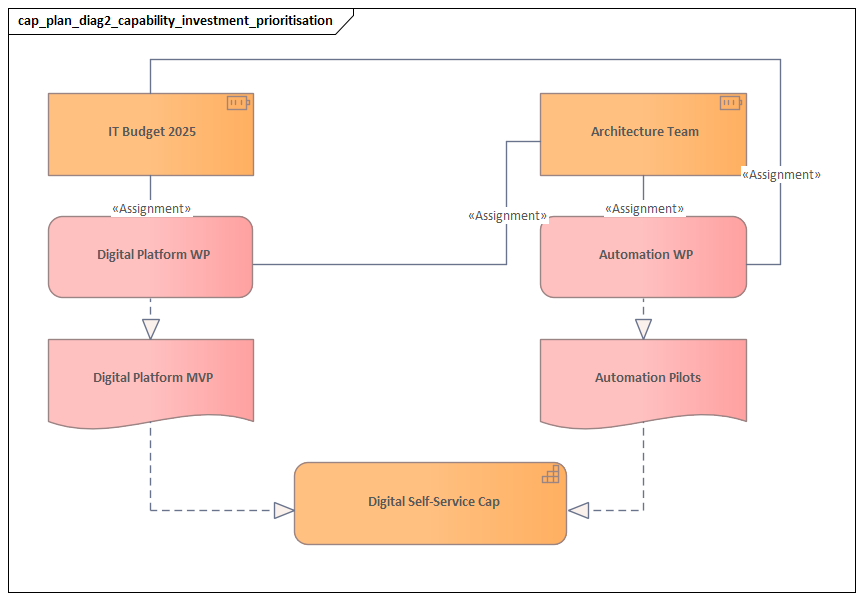
Capabilities become actionable when they are linked to work packages, plateaus, and gaps. Strategic planning requires movement from baseline to target, not just a description of current ability. By associating capabilities with implementation and migration elements, architects can show how specific initiatives are expected to improve enterprise ability over time.
Taken together, these concepts let a capability model do more than describe the enterprise. They allow it to support strategic interpretation, operating model analysis, and transformation planning in one coherent structure.
Designing a Capability Map with ArchiMate
With those concepts in place, architects can build capability maps that support planning decisions rather than simply documenting the landscape.
Start with the planning question
A capability map should be built for a purpose. A map created for merger integration will not look the same as one built for digital transformation, regulatory remediation, or geographic expansion. Before modeling begins, define:
- the planning question the map should answer
- the scope: enterprise-wide or domain-specific
- the audience: executives, architects, portfolio managers, or delivery teams
- the time horizon: annual planning, multi-year transformation, or target-state design
Without that framing, capability models tend to become encyclopedic and difficult to use.
Choose the right level of decomposition
Most effective maps use two or three levels of detail. The top level gives executives visibility into broad abilities such as Customer Management, Product Management, Risk Management, or Supply Chain Coordination. Lower levels break these down into more specific capabilities that can be assessed and linked to change initiatives.
Too little detail leaves the model vague. Too much detail turns it into process analysis under another name. A practical rule is that each capability should represent a distinct business ability that can be discussed in terms of strategic importance, current performance, and investment need.
ArchiMate supports this through capability composition, but decomposition should follow planning logic rather than organizational ownership.
Keep capabilities independent of the org chart
A capability is not a department. A map that mirrors the current org structure will quickly become obsolete when the organization changes. Capabilities should reflect stable business abilities, while ownership, realization, and accountability can be modeled through related actors, resources, and services.
That separation is one reason capability maps remain useful over time.
Classify capabilities for decision-making
Not all capabilities deserve the same treatment. A practical map usually distinguishes among:
- Foundational capabilities that enable broad operational stability
- Differentiating capabilities that support competitive advantage
- Commodity capabilities where efficiency and standardization matter more than uniqueness
ArchiMate does not prescribe these categories, but they can be represented through properties, assessments, or viewpoints. The distinction matters because it shapes architecture decisions. Differentiating capabilities may justify bespoke investment, while commodity capabilities may point toward standard platforms or managed services.
Create focused viewpoints, not overloaded diagrams
One of the most common mistakes is trying to show everything in one view. A better approach is to use the same underlying ArchiMate model to create multiple viewpoints, for example:
- capabilities and strategic goals
- capabilities and value streams
- capabilities and enabling applications
- capabilities and resources
- capability gaps and work packages
That keeps the model rich while making individual views readable.
Assess capabilities consistently
Assessment is what turns a capability map into a planning instrument. Capabilities should be evaluated against a small set of consistent criteria, such as:
- strategic criticality
- current maturity
- target maturity
- risk exposure
- dependency intensity
Heatmaps are useful only when the criteria behind them are clear. A red capability should indicate a specific condition, such as low maturity in a strategically important area, not a vague sense that “something is wrong.”
Model change over time
A static map has limited strategic value. Capability planning should distinguish baseline and target states, identify where uplift is needed, and connect those changes to work packages and transition architectures. This is where implementation and migration concepts become essential.
Consider a healthcare provider trying to improve referral coordination. In the baseline state, referrals are fax-based, specialist availability is tracked manually, and status updates are inconsistent. The target capability is not simply “digitize referrals.” It may require uplift in care coordination, provider directory management, interoperability, and patient communication. Modeling those changes over time prevents a narrow solution from being mistaken for a full capability improvement.
A well-designed capability map therefore does three things at once: it shows the enterprise’s stable business abilities, reveals which of those abilities matter most to strategy, and supports sequencing from current state to target state.
Linking Capabilities to Strategy, Value, and Outcomes
Capability maps become useful when they connect stable enterprise abilities to strategic intent and implementation. The critical middle step is linking capabilities to strategy, value, and outcomes.
Linking capabilities to strategy
Strategic themes such as growth, resilience, service excellence, or compliance confidence are too broad to guide investment on their own. Architects should break these themes down into goals and courses of action, then identify which capabilities are needed to support them.
A strategy to reduce customer churn, for example, does not require equal investment across every customer-facing area. It may depend disproportionately on capabilities such as customer insight, issue resolution, personalized offer management, and retention decisioning. Modeling those dependencies helps leadership focus on the capabilities that materially influence strategic success.
Linking capabilities to value
Not every important capability creates value in the same way. Some contribute directly to stakeholder value, while others enable or protect value indirectly. Relating capabilities to value streams makes that distinction easier to see.
For example:
- A pricing capability may directly influence revenue and competitiveness.
- A customer support capability may directly influence trust and retention.
- A data governance capability may not create visible value directly, but it may protect compliance, accuracy, and decision quality across many value streams.
This distinction improves prioritization because it shows not only that a capability matters, but how it matters.
Linking capabilities to outcomes
Capability discussions often stay abstract unless they are tied to observable business effects. Architects should therefore define intended outcomes in terms business leaders can test, such as:
- reduced onboarding time
- improved straight-through processing
- fewer compliance breaches
- higher cross-sell conversion
- lower service cost
- improved recovery time
In ArchiMate, associating capabilities with outcomes creates a more accountable model. Capability uplift is no longer assumed to be beneficial; it is justified by a defined enterprise result.
Not every capability needs a direct metric
Some capabilities are platform-like and support many outcomes indirectly. Identity management, integration enablement, and data governance often work this way. Others sit closer to value realization and can be tied to more direct business results.
Recognizing that difference prevents oversimplification. Strategic models should preserve the distinction between capabilities that deliver value directly and those that enable or safeguard value across the architecture.
Using these links in governance and funding
These relationships become especially useful in portfolio governance. When initiatives compete for funding, capability-to-goal and capability-to-outcome traceability allows decision-makers to compare proposals on a common basis:
- Which strategically important capability is being strengthened?
- Is there a meaningful capability gap today?
- What outcome is expected if the gap is closed?
- Is the initiative improving a direct value capability or an enabling one?
- Are there prerequisite capabilities that must be strengthened first?
A logistics company, for example, may propose same-day delivery in selected cities. The visible proposition sits in the customer value stream, but the capability model may show prerequisite dependence on dynamic routing, inventory visibility, partner dispatch integration, and exception management. That changes the funding conversation. The question is no longer whether same-day delivery is attractive; it is whether the enabling capabilities can support it at scale.
Using Capability Maps to Drive Portfolio and Transformation Decisions
Once capabilities are linked to goals, value, and outcomes, they become a practical instrument for portfolio management and transformation planning.
Shift from project narratives to enterprise effect
Programs often enter the portfolio with strong local sponsorship and persuasive business cases. Viewed one by one, many seem worthwhile. Mapped to capabilities, however, they can be evaluated more rigorously:
- Which strategic capability do they strengthen?
- Is that capability currently weak or already well supported?
- Do multiple initiatives target the same area?
- Does the initiative depend on unresolved weaknesses elsewhere?
- Is the expected outcome proportionate to the investment?
That changes the conversation from project rhetoric to enterprise contribution.
Identify concentration and fragmentation
Capability mapping also reveals portfolio imbalance.
- Concentration occurs when too much change is aimed at a small set of capabilities, creating bottlenecks, dependency risk, or stakeholder fatigue.
- Fragmentation occurs when many small initiatives are spread thinly across the map without materially improving any capability.
Both conditions are common. A capability view helps architects judge whether the enterprise is overloading a critical area, underinvesting in foundational abilities, or spreading resources too broadly to create meaningful change.
Improve dependency-aware sequencing
Many visible business improvements depend on less visible enabling work. Ambitions in personalization, automation, or ecosystem integration often rely first on capabilities such as data management, interoperability, identity, decision management, and governance.
Capability maps help make those prerequisite relationships explicit. That allows portfolio decisions to reflect architectural readiness rather than stakeholder urgency alone. Sequencing becomes more realistic because initiatives can be ordered according to enabling dependency, not just executive preference.
A common example is event-driven architecture. A business may want real-time customer notifications, but the actual prerequisite is a stronger integration and event management capability, perhaps implemented through Kafka before downstream products can consume events reliably. Without that sequencing, the enterprise funds visible features before establishing the capability needed to operate them safely.
Distinguish investment types
A useful portfolio discussion often separates three categories of investment:
- Capability uplift: strengthening known weaknesses in important business abilities
- Technical sustainment: preserving the health of resources that realize capabilities
- Strategic experimentation: testing emerging capabilities before broader commitment
When these categories are mapped against capability importance and current performance, leaders gain a clearer view of whether the portfolio is too maintenance-heavy, too innovation-heavy, or neglecting critical operational strengths.
Support governance after funding decisions
Capability maps remain useful after initiatives are approved. They provide a reference model for assessing whether delivery is actually improving the intended enterprise ability. A program may be on time and on budget yet still fail to strengthen the capability it was meant to improve.
For that reason, capability-based governance should track more than milestones and scope. It should ask whether the target capability uplift is happening and whether the expected outcomes remain credible.
Make trade-offs explicit
Perhaps the most important contribution of capability mapping is that it makes trade-offs visible. Not every weak capability should be improved immediately. Not every strategic aspiration can be pursued at once. Some weaknesses are tolerable. Others constrain multiple value streams or expose the enterprise to disproportionate operational, regulatory, or competitive risk.
Capability maps do not replace executive judgment. They strengthen it by giving leaders a more structured way to decide where to differentiate, where to standardize, where to delay, and where to invest first.
Governance, Stakeholder Alignment, and Common Pitfalls
For capability mapping to influence decisions over time, the model has to be governed as a living planning instrument rather than treated as a one-time strategy artifact.
Treat the map as an operating asset
Many organizations create a strong capability map during a strategy exercise and then let it drift out of date. To avoid that, the model needs an operating model of its own. That includes deciding:
- how capability definitions are maintained
- when assessments are refreshed
- how changes in strategy or organization trigger updates
- how capability implications are reflected in planning forums
Governance does not need to be bureaucratic, but it does need to be explicit.
Establish shared accountability
Capability maps usually require several stewardship roles:
- enterprise architects maintain modeling consistency
- business leaders validate strategic relevance
- portfolio or transformation offices connect capability assessments to investment decisions
This shared accountability reflects the nature of capabilities themselves: they cross business and technology boundaries and should not be reduced to single-function artifacts.
Build stakeholder alignment around meaning
Different stakeholders interpret capabilities differently. Executives may see investment categories, business managers may see operating responsibilities, architects may see abstractions for traceability, and delivery teams may see requirement sources. Misalignment begins when those interpretations remain implicit.
A practical response is to define early:
- what counts as a capability
- what does not
- how decomposition works
- how capability health is assessed
- how capability maps relate to processes, applications, and organization structures
That common vocabulary is often more important than the diagram itself.
Embed capability thinking into decision processes
A capability map has limited value if it sits outside budgeting, portfolio review, risk governance, and architecture review. The strongest practice is to embed capabilities into recurring decisions. For example:
- investment proposals should state which capabilities they affect
- architecture reviews should test whether solutions strengthen or complicate those capabilities
- transformation governance should monitor expected capability uplift
- strategy refreshes should revisit capability importance and target state
That is how capability mapping becomes part of enterprise management rather than architecture documentation. In practice, an architecture board might approve a standard Kafka platform as a shared enabler, reject a fourth point-to-point integration pattern, or require IAM consolidation before approving a new partner portal.
Common pitfalls
Several pitfalls repeatedly weaken capability mapping efforts.
1. False precision
Teams often assign maturity scores or heatmap colors with more confidence than the evidence supports. A simpler, more transparent assessment model is usually better than a complex scoring scheme no one trusts.
2. Confusing capabilities with processes, products, applications, or departments
This collapses the abstraction level and turns the map into a relabeled current-state model. Capabilities should remain stable business abilities even when realization changes.
3. Overloading a single view
Trying to show strategy, risk, compliance, application support, ownership, technical debt, and funding status in one diagram makes the model unreadable. It is better to maintain a rich underlying model and present separate viewpoints for specific decisions.
4. Disconnect from evidence
Capability discussions based only on workshops and opinion quickly lose credibility. Assessments should be informed, where possible, by operating metrics, customer data, risk indicators, platform health, and delivery performance.
5. Weak lifecycle governance
Organizations often invest in new platforms without deciding when legacy technologies will be contained or retired. Capability maps become more useful when linked to technology lifecycle governance, for example by showing that a capability still depends on an end-of-life database or unsupported middleware that now creates delivery and resilience risk.
When governance is disciplined, stakeholder meaning is aligned, and the model is tied to real decisions, capability mapping becomes a durable planning practice rather than a one-time artifact.
Conclusion
ArchiMate capability mapping is most valuable when it is used as a strategic decision tool rather than a classification exercise. Its purpose is to help the enterprise make better choices under constraint: where to differentiate, where to standardize, where to defer investment, and where hidden dependencies make ambition unrealistic.
A strong capability practice also changes the role of enterprise architecture. Instead of reacting to projects one at a time, architects can shape planning earlier by showing which enterprise abilities are strategically important, how those abilities are realized, where they are weak, and what sequence of change is required to strengthen them. That creates a more useful conversation with leadership because the focus shifts from solution preference to enterprise advantage.
The strength of capability mapping lies in the combination of ideas behind it. Capabilities provide a stable planning anchor. ArchiMate supplies the concepts needed to connect those capabilities to value streams, resources, goals, outcomes, and implementation elements. Those links make it possible to diagnose weakness, prioritize investment, design transition paths, and govern change against intended enterprise effect.
The result is a planning approach that keeps strategy, operating model, and execution in the same frame without collapsing them into one another. That is what makes ArchiMate capability mapping effective for strategic planning: it gives leaders a durable basis for prioritization, gives architects formal traceability across business and technology, and gives transformation teams a clearer view of what meaningful enterprise change actually requires.
Frequently Asked Questions
What is a capability map in enterprise architecture?
A capability map is a structured view of what a business must be able to do — independent of how it is currently organised or which applications support it. Capabilities are grouped by domain and linked to strategic goals, helping architects prioritise investment and identify gaps.
How do capabilities relate to applications in ArchiMate?
In ArchiMate, Application Components realise Business Capabilities through Realisation relationships. This traceability shows which systems support which capabilities, enabling portfolio analysis, rationalisation decisions, and investment planning linked directly to business outcomes.
What is capability-based planning?
Capability-based planning is a strategic approach where investment decisions are driven by the capabilities the organisation needs to develop or improve, rather than by project requests. It aligns IT investment to business strategy by making the capability gap explicit and measurable.