⏱ 27 min read
Modeling Integration Architecture with ArchiMate: A Practical Enterprise Guide
Learn how to model integration architecture with ArchiMate using clear viewpoints, application interfaces, services, and data flows. A practical guide for enterprise architects. ArchiMate tutorial for enterprise architects
Modeling Integration Architecture with ArchiMate, ArchiMate integration architecture, ArchiMate application cooperation, enterprise architecture modeling, integration architecture design, ArchiMate viewpoints, application interfaces, application services, data flow modeling, enterprise integration patterns, ArchiMate tutorial, system integration architecture ArchiMate layers explained
Introduction
Integration architecture sits near the center of enterprise change. Very little business value comes from a single application operating in isolation. Customer onboarding, order fulfillment, claims handling, and financial close all rely on coordinated interactions among channels, core systems, data platforms, external partners, and shared technology services. As organizations expand and modernize, those interactions multiply. APIs, event streams, batch exchanges, file transfers, SaaS connectors, and legacy interfaces often coexist in the same landscape. Without a clear model, that environment becomes difficult to understand, govern, or change safely.
ArchiMate is particularly effective here because it treats integration as part of the enterprise architecture, not as a set of technical links. Rather than showing only that systems connect, it allows architects to represent the applications involved, the services they expose or consume, the interfaces through which they interact, the data they exchange, and the technology services that support those exchanges. Those elements can also be tied back to business capabilities and processes, so the model shows not only how systems interact, but why the interaction matters. ArchiMate relationship types
That broader perspective is important because integration is not merely technical plumbing. It shapes agility, resilience, data quality, and operating model choices. A synchronous API call creates one kind of dependency; an event stream creates another. A batch file exchange has different business consequences from an orchestrated workflow. A centralized mediation layer implies different ownership and governance choices from a domain-owned API landscape. When those distinctions are modeled clearly, enterprise architects, solution architects, integration specialists, and platform teams can work from a shared language rather than from disconnected technical views.
ArchiMate also improves governance by making dependencies visible. Architects can trace which business processes rely on which application services, identify overlapping or redundant interfaces, and expose hidden risks—for example, critical processes that depend on fragile batch jobs or undocumented middleware logic. In hybrid environments, where cloud services, on-premises platforms, and external partners introduce operational and trust boundaries, that visibility becomes even more valuable. It gives governance forums something concrete to assess. An architecture board, for instance, may see that three teams are exposing different customer APIs and decide to standardize on a single enterprise customer profile service rather than allow duplication to spread. ArchiMate modeling best practices
A disciplined ArchiMate model should remain abstract enough to support decisions without turning into a mirror of implementation detail from gateways, brokers, or integration platforms. Its purpose is to clarify responsibility, service boundaries, interaction patterns, and business impact. Used well, it becomes a practical bridge between enterprise architecture and delivery-oriented integration design.
This article explains how to model integration architecture with ArchiMate in a way that supports analysis, communication, governance, and roadmap planning. It begins with why integration matters, then introduces the ArchiMate concepts most relevant to integration, shows how to model common interaction patterns, connects them to business architecture, and closes with guidance on governance and change planning.
1. Why Integration Architecture Matters
Integration architecture matters because enterprise capabilities are rarely delivered by one system alone. What the business experiences as a single capability usually depends on a chain of interactions. A customer request might move through digital channels, identity services, CRM, ERP, workflow engines, payment platforms, and notification services before the outcome is complete. If those interactions are fragile or poorly governed, the business feels the result as delay, inconsistency, and risk.
From an enterprise architecture standpoint, integration is not a secondary technical concern. It is the mechanism through which capabilities are combined, shared, and scaled. It determines how information moves across organizational and application boundaries, how quickly new solutions can be introduced, and how safely existing platforms can be changed. In many transformation programs, the real constraint is not the absence of new technology. It is the difficulty of connecting what already exists.
Integration architecture also has a direct effect on agility. Most organizations modernize incrementally rather than replacing core systems in one step. Legacy platforms, packaged applications, cloud services, and custom solutions often coexist for years. Integration is what allows them to work together in a controlled way. When the architecture is coherent, teams can add channels, automate processes, expose reusable services, and retire obsolete components without destabilizing the wider environment. When it is not, even small changes can have unintended consequences elsewhere.
A simple retail example makes the point. An e-commerce team may launch a new “click and collect” feature in a matter of weeks, yet the feature only works if the web storefront, inventory service, order management system, store fulfillment application, and customer notification platform remain aligned. If stock updates still move overnight in batch while the storefront promises real-time pickup, the integration architecture—not the front-end design—becomes the business problem.
Integration architecture also reflects the enterprise operating model. Decisions about centralized integration platforms, domain-owned APIs, shared event backbones, or partner gateways are also decisions about ownership, autonomy, and governance. A centralized model may improve consistency and control. A domain-oriented model may better support product-based delivery. Neither is inherently right. The architecture needs to reflect where standardization is essential and where local autonomy creates value.
Data sharpens the issue further. Many problems that appear to be process or reporting issues are actually integration problems involving timing, semantics, and authority. Duplicate customer records, inconsistent inventory positions, delayed reporting, and fragmented dashboards often stem from weak integration design rather than flaws in individual applications. Integration architecture provides the structure for deciding which system is authoritative, how information is propagated, where transformation belongs, and what degree of consistency is acceptable.
Consider a bank replacing a legacy directory with a cloud identity platform. On paper, that may look like a security upgrade. In practice, it is an integration redesign that affects HR, customer portals, MFA services, service desks, and access provisioning flows. If HR remains the source of worker identity, the cloud platform becomes the control point for authentication, and downstream SaaS applications still depend on old LDAP extracts, the architecture must make those dependencies explicit before migration starts.
There is also a clear risk dimension. Integrations frequently cross trust boundaries, contractual boundaries, and technology boundaries. They connect internal systems to external partners, regulated data to shared services, and business-critical workflows to third-party platforms. As a result, resilience, security, monitoring, replay, and service-level expectations all need to be treated as architectural concerns. Many serious incidents are caused not by the failure of one application, but by failures in the interaction between applications.
For all of these reasons, integration should be modeled as a first-class part of the enterprise landscape. It deserves the same architectural attention as business capabilities, application portfolios, and technology standards. Once modeled explicitly, it becomes much easier to govern. Architects can identify strategic interfaces, expose hidden dependencies, evaluate coupling, and support roadmap decisions with greater confidence.
The next section introduces the ArchiMate concepts that make this possible.
2. ArchiMate Fundamentals for Integration Modeling
To model integration well, it helps to begin with one of ArchiMate’s core strengths: it separates structure, behavior, and relationships while still allowing them to connect across layers. That matters because integrations are too often reduced to lines between systems. In reality, an integration usually involves a component performing behavior, exposing or consuming a service, exchanging information through an interface, and relying on underlying technology.
At the application layer, four elements matter most:
- Application Component: the logical application or deployable unit involved in the interaction
- Application Service: the functionality made available to others
- Application Interface: the access point through which that service is exposed
- Data Object: the information exchanged
This distinction is fundamental. When one application calls another, the real architectural questions are not simply which systems are connected. They are: which component provides the behavior, what service is being consumed, through which interface, and what information is exchanged? That yields a far more useful model than a simple arrow between two boxes.
Behavior elements add another level of precision. Application Function, Application Process, and Application Interaction can show how integration logic is carried out. This becomes important when the integration itself performs meaningful work, such as routing, transformation, validation, orchestration, or event enrichment. Instead of hiding all of that behind a generic middleware symbol, ArchiMate allows it to be modeled explicitly.
Relationships matter just as much:
- Serving shows which element provides value or support to another
- Access shows how behavior reads or writes data
- Flow shows transfer of information or value
- Triggering shows sequence or causality between behaviors
These relationships become especially important when distinguishing patterns such as synchronous service calls, asynchronous event propagation, and orchestrated workflows. Used consistently, they give the model analytical value. Connectivity becomes dependency, and dependency becomes something the enterprise can reason about.
Another strength of ArchiMate is cross-layer traceability. An application service may support a business process, while a technology service may support the application component that delivers that service. This is what allows integration architecture to connect business design, application interaction, data semantics, and technology enablement. Section 5 builds directly on that idea when linking integrations to capabilities and processes.
In practice, abstraction level matters. At enterprise level, it may be sufficient to show that a customer management application exposes a customer profile service through an API interface and that a sales platform consumes it. At solution level, more detail can be added, such as mediation, event publication, or transformation behavior. The goal is not to maximize detail. It is to make responsibility, dependency, and business significance clear.
A healthcare example illustrates the point. At portfolio level, it may be enough to show that the patient administration system exposes a patient demographics service consumed by the scheduling platform and billing system. At a solution level, however, architects may need to show that an integration component validates identifiers, maps local codes to enterprise codes, and publishes admission events for downstream care coordination. Both views are valid; they simply answer different questions.
These concepts provide the modeling vocabulary for the rest of the article. The next section organizes them into four integration concerns that should remain distinct, but connected: applications, services, data, and technology.
3. The Four Core Concerns: Applications, Services, Data, and Technology
A clear integration model is easier to read when four concerns are separated and then deliberately linked: the applications involved, the services they provide or consume, the data exchanged, and the technology that enables the interaction. The previous section introduced these through ArchiMate elements. Here, they become the main analytical frame.
3.1 Applications as Integration Participants
The first concern is the application landscape itself. In ArchiMate, applications should be modeled as logical participants in enterprise behavior, not simply as product names or runtime hosts. An Application Component might represent a packaged platform, a domain service, a custom solution, or an integration product when it is architecturally significant.
The key question is not just which systems are connected, but what role each one plays. One application may be the system of record, another may aggregate information, another may orchestrate workflow, and another may provide the digital channel. Modeling those roles supports ownership discussions and change analysis. It also avoids the common mistake of treating every connected system as architecturally equivalent.
For example, in an insurance claims landscape, the claims platform may remain the system of record, a fraud service may provide risk scoring, a document management platform may hold evidentiary material, and a workflow service may coordinate adjuster tasks. All four participate in the same business outcome, but they play different architectural roles and should not be modeled as interchangeable boxes.
3.2 Services as Stable Capability Boundaries
The second concern is service exposure and consumption. In integration architecture, services are the stable units of capability that other applications depend on. Applications may change internally, but the enterprise depends on continuity at the service boundary.
In ArchiMate, an Application Service can represent capabilities such as customer lookup, order creation, payment authorization, shipment tracking, or invoice retrieval. Modeling services explicitly helps architects move away from application-centric thinking and toward contract-centric thinking. That shift has practical governance value. Teams can manage integrations around clear services and service ownership rather than around informal knowledge of application internals.
This service perspective also makes reuse easier to see. If multiple consumers depend on the same business capability, the model should make that visible. That becomes important later when identifying strategic services and reducing duplication.
3.3 Data as Meaning, Not Just Payload
The third concern is informational meaning. Integration failures are often caused less by connectivity issues than by ambiguity about what the data actually means. Two systems may exchange a “customer” object while holding different assumptions about identity, lifecycle state, or data authority.
That is why the Data Object matters. It should not be treated as a simple payload label. It anchors discussion about semantics, ownership, transformation, and quality. In practice, architects should model the business information that is most important to the interaction: customer profile, order, invoice, shipment event, claim decision, and so on. Doing so helps expose hidden mappings, duplicate mastering, and inconsistent assumptions across domains.
A familiar example appears in telecoms. A CRM platform may define a “customer” as a billing party, while the network provisioning platform treats the same concept as a service subscriber. If the integration model labels both simply as Customer, the ambiguity stays hidden until downstream failures appear in billing, support, or regulatory reporting.
3.4 Technology as Enabler and Constraint
The fourth concern is the technology foundation. Enterprise models should avoid unnecessary implementation detail, but technology still matters because it influences reliability, scalability, trust boundaries, and operational constraints. Message brokers, API gateways, event streaming platforms, managed integration services, file transfer services, and network zones may all be relevant when they materially affect architectural decisions.
ArchiMate allows these to be represented through technology layer elements such as Technology Service and related structural elements. The aim is not to document every runtime configuration. It is to show which enabling capabilities support the application interactions described earlier. This becomes especially relevant in hybrid environments, where hosting location, platform ownership, and latency can materially shape the design. A Kafka platform, for example, may be modeled not as a generic box, but as the event streaming service that supports order, inventory, and shipment events across domains.
3.5 Why the Separation Matters
The value of this four-part view is that it discourages common shortcuts. It prevents architects from equating APIs with applications, payloads with business meaning, or middleware products with architecture. More importantly, it creates a clear structure for the rest of the model:
- applications participate in interactions
- services define what is offered or consumed
- data defines what is exchanged and what it means
- technology defines how interaction is enabled and constrained
The next section uses this structure to model recurring integration patterns. Those patterns become much clearer once these four concerns are distinct.
4. Modeling Integration Patterns and Interaction Flows
Once applications, services, data, and technology have been separated conceptually, the next step is to model recurring integration patterns rather than isolated links. This is where ArchiMate becomes especially useful. It allows the architect to show the nature of an interaction, not just the fact that it exists.
4.1 Request-Response Integration
A common pattern is request-response integration, usually implemented through APIs or direct service calls. Using the concepts introduced earlier, this can be modeled by showing:
- an Application Component providing an Application Service
- that service exposed through an Application Interface
- another component using the service
- relevant Data Objects flowing between them
The architectural significance lies in the dependency created. A synchronous interaction introduces temporal coupling: the consumer depends on the provider being available at the moment of use. If the interaction is business-critical, that dependency should be visible in the model. Behavior elements and flow relationships can make this explicit, especially when the service call supports a wider application or business process.
This pattern is often the right choice when an immediate response is required. A payment authorization service is a straightforward example. A checkout process cannot usually proceed without a timely response from the payment provider. In an ArchiMate view, the commerce platform consumes a payment authorization service exposed through an API interface, while the payment gateway component serves that capability. The model can then make the operational dependency visible to both business and technology stakeholders.
4.2 Event-Driven Integration
A different pattern is event-driven integration, in which one application publishes a business event and other applications respond independently. This should not be modeled as a disguised API call. The producer performs behavior that creates a Data Object representing a meaningful event, and an intermediary application or technology service may distribute it to multiple consumers.
This pattern reduces direct dependency between producer and consumer, but it introduces different architectural questions. Who owns the event definition? What delivery guarantees are needed? How is replay handled? Does the event represent a true business fact or just a technical notification? Those questions connect directly back to the earlier distinction between data semantics and technology enablement.
A good ArchiMate model should therefore show more than the fact that an event is published. It should also show whether the event is strategically important and which consumers depend on it. That helps prevent uncontrolled event proliferation and semantic drift. A realistic example is an order platform publishing OrderPlaced and OrderCancelled events to Kafka, with downstream consumers in fulfillment, billing, and customer notification. In the model, Kafka is not the business service itself; it is the technology service enabling distribution of those events.
4.3 Orchestration and Mediation
In some architectures, the integration layer performs significant behavior of its own: routing, transformation, enrichment, protocol conversion, validation, or coordination across multiple downstream services. In those cases, the integration capability should be modeled as an active participant rather than as a passive box.
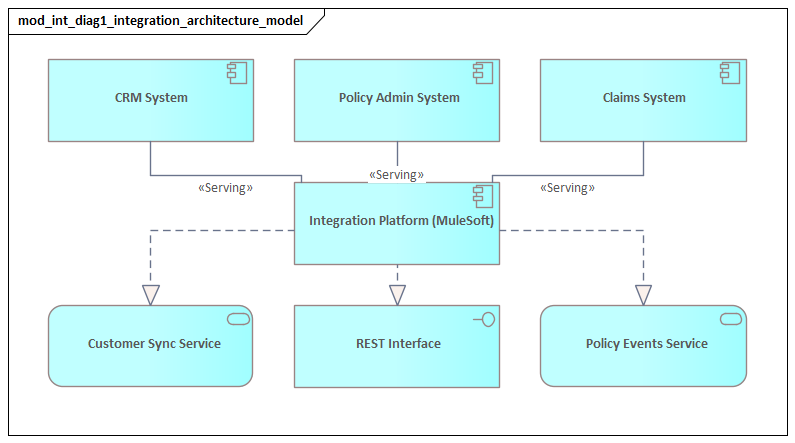
ArchiMate supports this by representing the integration platform or orchestration service as an Application Component, with relevant Application Functions or Application Processes to show its behavior. This is especially important when the mediator sits on the critical path of business execution. If hidden orchestration logic coordinates order processing, onboarding, or claims handling, the architecture should make that dependency explicit.
This also improves governance. It becomes possible to distinguish reusable integration capability from ad hoc middleware logic and to assess whether too much business coordination has been centralized into the integration layer.
A realistic public-sector example is benefits processing. A citizen portal may submit an application that passes through an orchestration layer responsible for identity validation, eligibility checks, document verification, and handoff to a case management platform. If that orchestration layer contains most of the business sequencing logic, the architecture should say so clearly. Otherwise, the organization may believe the case system owns the process when, in practice, the integration layer does.
4.4 Batch and File-Based Exchange
Batch and file-based integration remains common, especially in finance, supply chain, and legacy modernization. It may be less fashionable than APIs or events, but it often carries critical business loads. In ArchiMate, batch exchange can still be modeled through interfaces, flows, and data objects, but its operational character should be visible: scheduled transfer, delayed consistency, and dependency on handoff windows.
That matters because business stakeholders may assume near-real-time behavior where none exists. A model that shows only “integration” without indicating timing can create false expectations. By using the concepts established earlier, the architect can represent both the interaction and its business implications without dropping into low-level job design.
Financial close provides a common example. A general ledger platform may receive end-of-day journal files from multiple operational systems through secure file transfer. The integration is business-critical, yet it does not behave like an API or event stream. If the file arrives late or fails validation, the consequence may be a delayed close, not an immediate transaction failure. The model should make that timing dependency visible.
4.5 Flows and Triggering
A common modeling mistake is to use the same line for every kind of interaction. ArchiMate becomes much more useful when these distinctions are applied consistently:
- use Flow when something meaningful is transferred, such as a request, event, document, or status update
- use Triggering when one behavior initiates or causes another
- use Serving when one element provides capability to another
This distinction matters most when comparing patterns. A synchronous service call, an event publication, and an orchestrated process may connect the same applications, but they create very different architectural dependencies.
4.6 Why Pattern-Based Modeling Matters
Pattern-based modeling supports better decisions than interface inventories alone. It helps architects identify where synchronous coupling threatens resilience, where event-driven design makes sense, where mediation introduces hidden centralization, and where batch dependencies limit business responsiveness. It also supports standardization. Enterprises can define preferred patterns and assess whether actual solutions align with them.
The next section builds on this by connecting these patterns to business capabilities and processes. That connection is what turns an integration model from a technical map into an enterprise decision tool.
5. Connecting Integration to Business Capabilities and Processes
The concepts and patterns described so far become much more useful when they are tied directly to business architecture. Without that link, integration models remain technical descriptions of interaction. With it, they show which enterprise outcomes depend on which services, data exchanges, and interaction patterns.
5.1 Capabilities as the Business Context for Integration
A useful starting point is the business capability. Capabilities such as customer onboarding, claims management, product fulfillment, or financial close describe what the enterprise must be able to do. They are more stable than individual processes or systems, which makes them a strong anchor for integration analysis.
When a capability depends on several applications owned by different teams or domains, integration is often what makes that capability operational. Modeling this relationship helps separate local technical connections from strategic enterprise dependencies. Not every interface matters equally. Some support peripheral automation; others are critical to core business execution.
5.2 Processes as the Operational Realization
Business processes add a more operational perspective. A capability may be stable, but the process that realizes it contains specific interaction points: data capture, validation, approval, fulfillment, notification, reconciliation, and reporting. In ArchiMate, a Business Process can be linked to the Application Services that support these steps.
This is where the patterns from the previous section become especially useful. Some process steps require an immediate response and are therefore good candidates for request-response interaction. Others can tolerate delayed completion and may be better supported by events or batch exchange. By linking process steps to application services and integration behavior, architects can make timing, dependency, and criticality visible.
5.3 Cross-Layer Traceability
One of ArchiMate’s greatest strengths is the ability to trace across layers:
- a Business Capability is realized through one or more Business Processes
- those processes are supported by Application Services
- those services are exposed through Application Interfaces
- they may depend on mediation components or technology services
- they exchange Data Objects whose semantics matter to the business outcome
This layered structure supports practical analysis. Architects can ask: Which business capabilities depend on a legacy batch integration? Which customer-facing process relies on a central orchestration engine? Which strategic capability is exposed if a partner gateway fails? These are investment and governance questions, not just modeling questions.
5.4 Operating Model Implications
Linking business architecture to integration architecture also reveals operating model issues. A capability that appears domain-aligned may, in practice, depend on hidden mediation owned by a central platform team. Conversely, a fragmented set of local integrations may show that a shared enterprise process lacks sufficient standardization.
That matters because integration architecture often reflects organizational design as much as technical design. By making those dependencies visible, the model supports more grounded conversations about ownership, accountability, and whether the target operating model is actually being achieved.
5.5 Using Business-Driven Views
In practice, the most useful models often begin with a business problem or transformation objective rather than with the middleware landscape. If the enterprise wants to reduce onboarding time, improve order visibility, or eliminate reconciliation effort, the architect can model:
- the relevant business capability
- the supporting business process
- the application services involved
- the integration patterns and dependencies between them
- the data and technology constraints that affect the outcome
This creates a focused viewpoint that stakeholders can understand and use. It also gives the enterprise a practical basis for prioritization. Instead of trying to improve every integration at once, it can focus on the ones with the greatest business impact.
A good example is IAM modernization. An architect may start from the onboarding capability, then trace how an HR event triggers identity creation, approval workflows, directory updates, MFA enrollment, and SaaS provisioning across multiple platforms. In that view, the integration model becomes a map of business execution risk and modernization opportunity, not just a diagram of connectors.
The final section builds on this by showing how such models support governance, roadmapping, and architectural decision-making over time.
6. Governance, Roadmapping, and Modeling Best Practices
An integration model is useful only if it supports decisions over time. For that reason, governance and roadmapping should be treated as primary purposes of integration architecture, not as activities that happen after diagrams are drawn.
6.1 Governance Through Consistent Modeling
A basic governance requirement is consistency of meaning. Different teams often model integrations in different ways: one treats APIs as interfaces, another as services, and another uses only arrows between systems. The result is not just inconsistent notation, but inconsistent analysis.
A practical governance approach should therefore define a small set of conventions based on the concepts established earlier in this article:
- represent applications as Application Components
- represent exposed capabilities as Application Services
- represent access points as Application Interfaces
- represent important exchanged information as Data Objects
- represent significant mediation or orchestration as explicit behavior or components
- include technology services only when they materially affect the architecture
This is not about methodological purity. It is about making models comparable across portfolios and programs.
6.2 Ownership and Accountability
Integration models often expose a gap between connectivity and accountability. An interface may exist, but ownership of its contract, lifecycle, resilience, or data quality may be unclear. By modeling services, interfaces, and intermediary components explicitly, ArchiMate gives governance forums a concrete basis for asking the right questions:
- Who owns this service?
- Who approves changes to its contract?
- Who is responsible for monitoring and incident response?
- Which dependencies are external or third-party controlled?
- Which data definitions are authoritative?
These ownership questions matter because integration architecture expresses operating model choices as much as it expresses technical design.
6.3 Roadmapping Integration Change
Integration landscapes evolve continuously. Batch exchanges are replaced with APIs, point-to-point links move behind gateways, synchronous dependencies are reduced through events, and legacy hubs are decomposed into more domain-aligned patterns. ArchiMate supports this especially well when architects distinguish baseline, transition, and target states.
Rather than producing one overloaded diagram, it is usually better to show how a critical interaction changes over time. An order management capability, for example, might move from direct ERP calls, to mediation through an integration platform, and then to a more event-driven domain model. This makes architectural intent visible and helps stakeholders understand modernization as a sequence of dependency changes rather than as a single replacement event.
6.4 Capability-Based Roadmaps
A particularly useful technique is to roadmap integration capability uplift rather than redesigning interfaces one by one. The roadmap may aim to introduce:
- reusable API management
- event publication standards
- centralized monitoring and observability
- partner integration controls
- canonical identity or master data services
These can be modeled as enabling application or technology services that support multiple future interactions. That shifts the discussion from isolated project delivery to enterprise capability building, which is often a stronger basis for investment decisions.
6.5 Modeling Best Practices
Several practices improve long-term usefulness:
- Model at the level of decision relevance. Include enough detail to assess dependency, criticality, and impact, but not so much that the model turns into a technical inventory.
- Keep logical and physical concerns distinct. Only introduce product-specific detail when the product choice is architecturally significant.
- Highlight strategic integrations. Not every interface deserves the same attention; emphasize those tied to critical capabilities, regulatory exposure, external ecosystems, or major technical debt.
- Use audience-specific viewpoints. Enterprise governance, solution design, platform planning, and risk review often need different views of the same underlying model.
- Reference business context. As shown in the previous section, integration models are most useful when linked to capabilities and processes rather than maintained as isolated technical artifacts.
- Make patterns explicit. Distinguish request-response, events, orchestration, and batch interactions rather than collapsing them into generic connectivity.
6.6 Making the Model Operational
The strongest integration models are embedded in governance routines. They are used in architecture review boards, modernization planning, platform strategy discussions, and impact analysis. Maintained in that way, they stop being static documentation and become working instruments for enterprise change.
A board might use the model to approve Kafka as the strategic event backbone, require IAM integrations to move from direct LDAP dependencies to standards-based identity services, or classify an aging ESB as “tolerate until 2027, retire by 2029” under technology lifecycle governance. Those are not diagramming decisions. They are enterprise decisions made possible by clear architecture views.
Conclusion
Modeling integration architecture with ArchiMate is ultimately about improving enterprise decision-making. By separating applications, services, data, and technology, architects can represent integration with much more precision than informal system diagrams allow. By modeling patterns such as request-response, event-driven interaction, orchestration, and batch exchange, they can expose the real dependencies and trade-offs in the landscape. By connecting those models to business capabilities and processes, they can show why those dependencies matter.
This article has followed that progression deliberately. It began by establishing integration as a first-class architectural concern, then introduced the ArchiMate concepts needed to model it, organized those concepts into four core concerns, used them to describe recurring interaction patterns, and finally connected those patterns to business architecture, governance, and roadmapping. That sequence reflects a practical modeling discipline: start with purpose, define the vocabulary, represent the essential concerns, and then use the model to support business and architectural decisions.
The most effective integration models are selective and decision-oriented. They focus on the interactions that matter most: those tied to critical capabilities, major transformations, cross-boundary data exchange, external ecosystems, or significant operational risk. A model that makes those dependencies explicit is far more valuable than one that attempts to catalog every interface in the enterprise.
As enterprises continue moving toward hybrid platforms, composable services, and event-driven operating models, the need for clear integration architecture will only increase. ArchiMate provides a practical way to keep that architecture understandable across business, application, data, and technology concerns. Used well, it shifts the conversation from “what connects to what” to “what interaction design best enables enterprise change.”
Frequently Asked Questions
How is integration architecture modeled in ArchiMate?
Integration architecture in ArchiMate is modeled using Application Components (the systems being integrated), Application Services (the capabilities exposed), Application Interfaces (the integration endpoints), and Serving relationships showing data flows. Technology interfaces model the underlying protocols and middleware.
What is the difference between API integration and event-driven integration?
API integration uses synchronous request-response patterns where a consumer calls a provider and waits for a response. Event-driven integration uses asynchronous message publishing where producers emit events that consumers subscribe to — decoupling systems and improving resilience.
How does ArchiMate model middleware and ESB?
Middleware and ESB platforms appear in ArchiMate as Application Components in the Application layer that expose Integration Services. They aggregate connections from multiple source and target systems, shown through Serving and Association relationships to all connected applications.