⏱ 19 min read
Most enterprise strategy decks are theater.
That sounds harsh, but if you’ve been around architecture long enough, you’ve seen it: glossy slides about “customer centricity,” “digital transformation,” “platform operating model,” and “data-driven growth,” none of which survives first contact with delivery reality. The business says one thing, portfolios fund another, and technology teams build whatever they can get approved before the quarter closes.
This is exactly where ArchiMate 3.x should help. Not as a documentation exercise. Not as a repository graveyard. And definitely not as another way to draw boxes nobody reads. Its real value is in making strategy concrete enough to govern decisions. And the best entry point for that, in practice, is capability-based modeling.
Here’s the simple version up front: capability-based modeling in ArchiMate means describing what the enterprise must be able to do, independent of org charts, projects, and specific systems, then connecting those capabilities to strategy, value streams, processes, applications, and technology. That’s it. That’s the point. It creates a bridge from ambition to execution.
If you do it well, capability maps become one of the few architecture artifacts that business leaders, portfolio managers, security teams, and engineers can all use without pretending they mean the same thing by “transformation.”
If you do it badly, you get a color-coded wallpaper of vague nouns like “Innovation Management” and “Operational Excellence,” with no decision power at all.
Let’s talk about the difference.
Why capability-based modeling matters more than most strategy models
A lot of strategy modeling fails because it starts too high and stays too abstract. We model goals, outcomes, principles, maybe a few value streams, and then we stop right before the uncomfortable part: which parts of the enterprise need to change, in what order, with what dependencies, and why.
Capabilities solve that because they sit in the useful middle.
A capability is not a team.
It is not a process.
It is not an application.
It is not a project.
It is an ability the enterprise has or needs.
“Customer Identity and Access Management” is a capability.
“Real-Time Event Distribution” is a capability.
“Credit Risk Assessment” is a capability.
“Cloud Landing Zone Management” is a capability.
Those are useful because they are stable enough to support strategic planning, but concrete enough to tie to actual execution.
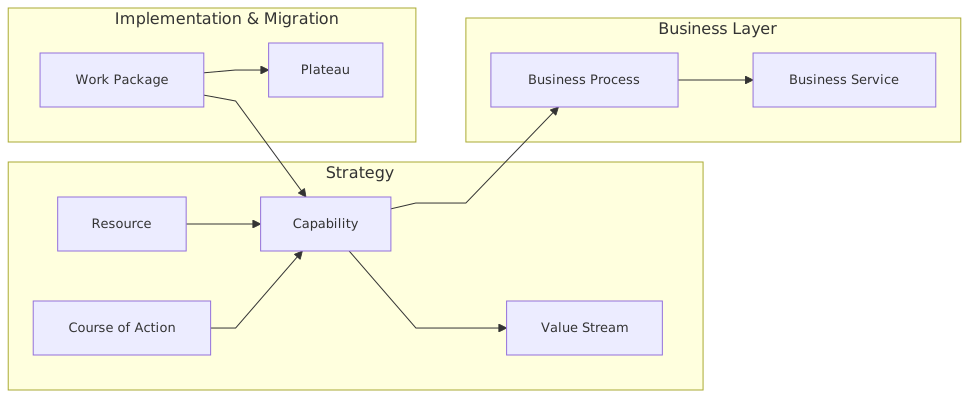
This is one of the strongest aspects of ArchiMate 3.x strategy modeling. The strategy layer gives us concepts like Capability, Resource, and Course of Action, and lets us link them to goals, value streams, business behavior, and implementation work. In theory, that’s straightforward. In real architecture work, it becomes the difference between saying “we need to be more digital” and saying:
- we need stronger Digital Onboarding
- which depends on Identity Verification
- and Consent Management
- and Fraud Detection
- and Event-Driven Customer Notification
- and these are weak today because IAM is fragmented, Kafka governance is immature, and cloud tenancy patterns are inconsistent
Now we’re talking like architects, not motivational speakers.
What “reifying strategy” actually means
“Reifying strategy” sounds academic, but the idea is practical: turn strategy into something real enough to model, assess, prioritize, and govern.
Strategy is usually expressed in slippery language:
- become a digital bank
- improve customer trust
- reduce cost-to-serve
- scale securely in the cloud
- leverage data as a product
None of that is wrong. It’s just incomplete. Strategy becomes operationally meaningful only when it is expressed as changes to enterprise capabilities.
So instead of stopping at “improve customer trust,” we ask:
What capabilities make that possible?
Maybe:
- Customer Identity Management
- Authentication and Authorization
- Consent and Preference Management
- Fraud Monitoring
- Customer Communication Orchestration
- Data Retention and Privacy Compliance
Then we ask harder questions:
- Which of these are differentiating versus commodity?
- Which are underperforming?
- Which are duplicated across business units?
- Which are fragile because they depend on legacy platforms?
- Which should be platform capabilities versus domain-owned capabilities?
- Which should be improved first to unlock value streams?
This is where ArchiMate stops being a notation and becomes a reasoning tool.
A practical ArchiMate 3.x view of capability-based modeling
Let’s make it plain.
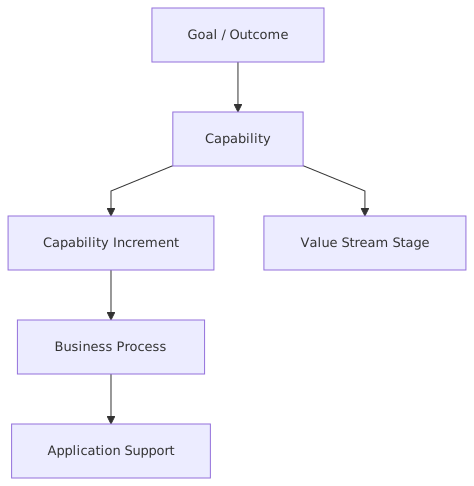
In ArchiMate 3.x, a solid strategy-to-execution chain often looks something like this:
This layering matters because too many architects jump directly from strategy to applications. That’s usually a mistake.
When someone says, “Our strategy is to improve customer onboarding,” and the architecture response is “Let’s implement a new IAM platform,” the team has already skipped several critical steps. Maybe IAM is part of the answer. Maybe Kafka-based eventing is more urgent because onboarding stalls due to asynchronous fraud checks. Maybe the real bottleneck is fragmented process ownership. Maybe cloud isn’t the problem at all, despite everyone wanting it to be.
Capabilities slow down that premature solutioning. In a good way.
The core discipline: model abilities, not assets
This is the first common mistake architects make: they model the inventory they have, not the abilities the enterprise needs.
They create “capabilities” like:
- Salesforce
- IAM Platform
- Data Lake
- Kafka Cluster
- AWS
- Core Banking System
Those are not capabilities. Those are technologies, platforms, or products.
A capability is what those things may help enable.
For example:
This may seem pedantic, but it’s not. If you confuse assets with capabilities, your strategy model becomes biased toward current vendors and current org structures. Then your supposedly strategic model just mirrors the implementation landscape. Which is exactly what strategy modeling is supposed to rise above.
A capability model should survive a platform migration.
It should survive a reorg.
It should survive product replacement.
If it can’t, it’s not a capability model. It’s a disguised system catalog.
Capabilities are not all equal, and pretending otherwise wastes money
Another thing architects often avoid saying out loud: not every capability deserves equal investment.
Some capabilities are differentiating. Some are mission-critical but commodity. Some are just table stakes. And some are frankly overbuilt because an executive once got excited about them.
This is where capability-based planning becomes useful for portfolio decisions. You can assess each capability across dimensions such as:
- strategic importance
- current maturity
- risk exposure
- regulatory sensitivity
- cost efficiency
- degree of duplication
- dependency criticality
You do not need a giant maturity framework to start. In fact, giant maturity frameworks often become a bureaucratic substitute for judgment.
A simple heatmap with honest discussion is usually better than a 60-question scoring model nobody trusts.
For example, in a bank, Identity and Access Management is often not differentiating in a market sense, but it is deeply strategic because it underpins security, regulatory compliance, digital onboarding, workforce productivity, and third-party integration. It is a foundational capability. If it’s weak, everything slows down.
Likewise, Real-Time Event Distribution via Kafka may not appear in the board strategy deck, but if the operating model depends on event-driven coordination across channels, fraud systems, payments, and customer notifications, then that capability becomes a major strategic enabler.
Architecture has to say this clearly. Sometimes the capabilities that matter most are not the ones with the best branding.
A real enterprise example: retail banking modernization
Let’s ground this in a realistic case.
Imagine a mid-sized retail bank operating across three countries. It has:
- legacy core banking in two regions
- separate digital channels per market
- multiple IAM stacks from acquisitions
- Kafka used inconsistently by different teams
- a cloud-first policy that is mostly PowerPoint
- rising fraud pressure
- regulatory pressure around consent, privacy, and resilience
The executive strategy says:
- improve digital customer acquisition
- reduce onboarding abandonment
- strengthen trust and security
- increase speed of product launch
- lower integration cost across markets
This is where many architecture teams go wrong. They jump into target-state diagrams full of cloud services, API gateways, CI/CD pipelines, and identity products. Useful, yes. But too early.
A better approach is to model the strategy through capabilities first.
Step 1: identify the relevant capabilities
At a minimum, the strategy might map to capabilities like:
- Customer Onboarding
- Identity Verification
- Identity and Access Management
- Consent Management
- Fraud Detection and Response
- Real-Time Event Distribution
- Product Configuration
- Customer Communication Management
- API Exposure and Partner Integration
- Cloud Platform Governance
- Data Sharing and Analytics
Notice what this does. It reveals that “digital acquisition” is not one thing. It’s a bundle of abilities, some customer-facing, some operational, some technical, some foundational.
Step 2: assess each capability
Now you assess current state.
Maybe the bank finds:
- Customer Onboarding: fragmented by market, highly manual exception handling
- Identity Verification: outsourced in one market, absent in another
- IAM: duplicated platforms, inconsistent MFA, weak lifecycle integration
- Consent Management: captured in channels but not centrally governed
- Fraud Detection: batch-heavy, limited real-time signals
- Real-Time Event Distribution: Kafka exists, but no enterprise event model or ownership
- Product Configuration: deeply tied to legacy core systems
- Cloud Platform Governance: multiple landing zones, inconsistent controls
That assessment is more valuable than 100 pages of target architecture fluff, because now the bank can reason about where to invest.
Step 3: connect capability gaps to value streams
This is where ArchiMate gets especially useful. Capabilities should not float in isolation. They should support value streams.
For the value stream Acquire Customer, the enabling capabilities may include:
- Customer Onboarding
- Identity Verification
- IAM
- Consent Management
- Fraud Detection
- Customer Communication Management
For Service Customer Digitally:
- IAM
- Customer Communication Management
- Real-Time Event Distribution
- API Exposure
- Data Sharing and Analytics
For Launch New Product:
- Product Configuration
- API Exposure
- Cloud Platform Governance
- Data Sharing and Analytics
Now your strategy has shape. You can see where a capability weakness blocks multiple value streams. That’s where the investment case gets stronger.
Step 4: map to actual architecture
Only now do we get to systems and technology.
For example:
- IAM capability is realized by a mix of workforce IAM, customer CIAM, directory services, policy enforcement, and lifecycle integration
- Real-Time Event Distribution is realized by Kafka clusters, schema governance, event cataloging, producer standards, consumer reliability patterns, and operational support
- Cloud Platform Governance is realized by landing zones, policy-as-code, identity federation, logging, secrets management, and network patterns
And because this is ArchiMate, you can actually model those realization and serving relationships, rather than hand-waving them.
Step 5: drive implementation sequencing
This is the part executives care about, whether they say so or not.
The bank may conclude:
- Phase 1: stabilize IAM and consent foundations, establish Kafka governance, define onboarding target process
- Phase 2: unify digital onboarding journeys and fraud event integration
- Phase 3: decouple product launch from legacy constraints through API and event patterns
- Phase 4: rationalize regional duplication
That sequencing is much more credible than “move onboarding to cloud and modernize security.”
Where Kafka fits, and where architects exaggerate it
Let me be slightly contrarian here: Kafka is often over-marketed inside architecture conversations.
Not because it isn’t useful. It is. In many enterprises it’s a critical part of the integration backbone. But architects sometimes treat Kafka as if installing it automatically creates event-driven capability. It doesn’t.
Kafka is not the capability.
Kafka is not even the operating model.
Kafka is just part of the realization.
The capability is something like:
- Real-Time Event Distribution
- Event-Driven Process Coordination
- Operational Data Streaming
Those capabilities require more than a cluster. They require:
- event ownership
- schema discipline
- topic lifecycle governance
- reliability patterns
- security integration
- observability
- replay and retention policies
- data classification
- consumer accountability
In banking, this matters because event-driven patterns often cross sensitive boundaries: customer profile changes, authentication events, fraud alerts, payment lifecycle events, consent updates. If IAM is weak and data governance is weak, Kafka can become a very efficient way to spread risk quickly. ArchiMate for governance
So in ArchiMate terms, don’t draw Kafka in a technology view and pretend the strategy has been addressed. Model the capability, model the business and application services it supports, and show how the technology actually realizes it. That’s a grown-up architecture move.
IAM is the classic example of a hidden strategic capability
IAM is one of those areas that suffers from being both essential and boring to non-specialists. Which means it gets underfunded until it becomes a crisis.
In capability terms, Identity and Access Management is rarely just one capability. In practice it often breaks down into sub-capabilities such as:
- Identity Lifecycle Management
- Authentication
- Authorization and Policy Decisioning
- Privileged Access Management
- Federation and SSO
- Consent and Delegation
- Access Governance
- Customer Identity Management
In retail banking, weak IAM affects nearly everything:
- onboarding drop-off due to clumsy identity proofing
- customer friction from fragmented login experiences
- operational risk from poor joiner/mover/leaver controls
- audit findings from weak access certification
- cloud security issues due to inconsistent role design
- API and partner integration delays due to federation complexity
Yet many architecture teams still model IAM as a single platform box and call it done.
That misses the point. The strategic question is not “what IAM tool do we have?” It is “what identity-related capabilities do we need, how mature are they, and where do they constrain value delivery?”
This is the kind of question capability modeling handles very well.
Cloud examples: stop calling cloud a strategy
Another opinion, and I’ll stand by it: cloud is not a strategy. It is at best a means, and often just a procurement and operating model shift.
When enterprises say “our strategy is cloud-first,” architecture should politely translate that into capability language. Usually what they mean is some combination of:
- Elastic Workload Hosting
- Environment Provisioning Automation
- Platform Security Governance
- Resilience Engineering
- Data Platform Scalability
- API and Integration Agility
That translation matters because cloud migration without capability clarity becomes a very expensive relocation exercise.
In ArchiMate, cloud should show up as part of the technology and implementation architecture that realizes required capabilities. If your strategy view is full of AWS accounts, Kubernetes clusters, or landing zones, you’ve probably dropped too quickly into solution space.
A better pattern is:
- Goal: reduce time-to-market
- Capability: Environment Provisioning Automation
- Capability: Application Deployment Management
- Capability: Platform Security Governance
- Course of Action: establish standardized cloud platform product
- Application/Technology realization: CI/CD tooling, policy-as-code, cloud landing zones, identity federation, observability stack
That chain is actually useful. It lets you ask whether cloud investments are solving strategic capability gaps or just creating new architecture debt with better marketing.
Common mistakes architects make in capability-based modeling
Let’s be blunt. Most failed capability models fail for predictable reasons.
1. They use vague names
Capabilities like “Digital,” “Innovation,” or “Transformation” are nearly worthless. If you can’t imagine how to assess or realize it, it’s too vague.
2. They confuse hierarchy with truth
A giant decomposition tree is not inherently insightful. Some teams spend weeks debating whether “Authentication” sits under IAM or Security Operations or Customer Management. That can matter, but not as much as people think. Don’t confuse taxonomy neatness with strategic value.
3. They never connect capabilities to value streams
A standalone capability map is only half useful. The real power comes from showing which capabilities enable which outcomes and value stages.
4. They model current ownership instead of enterprise need
If every capability mirrors the current org chart, your model is already compromised.
5. They skip assessment
Capabilities without heat, maturity, cost, risk, or strategic importance are just labels.
6. They jump too fast to products
“Capability gap” does not automatically mean “buy a platform.”
7. They try to boil the ocean
You do not need a perfect enterprise-wide capability model before making decisions. Start with a strategic problem area.
8. They avoid politics
Capability rationalization often exposes duplication, weak ownership, and platform empire-building. If your model never creates discomfort, it may not be telling the truth.
How this applies in real architecture work
This is the practical part. Because if capability-based modeling stays inside architecture tooling, it’s dead.
Here’s where it genuinely helps in day-to-day enterprise architecture.
Portfolio prioritization
When funding requests come in, capabilities provide a common evaluation lens. Instead of comparing unrelated projects by who shouts loudest, you ask: which strategic capabilities are improved, by how much, with what dependencies?
Roadmap sequencing
Capabilities reveal prerequisites. For example, if a bank wants real-time customer servicing but IAM federation is fragmented and Kafka governance is immature, then “build new omnichannel experience” probably should not be phase one.
Rationalization
Capabilities expose duplication across regions, business units, or acquired entities. Three onboarding platforms might be acceptable if they support different regulatory contexts. Or they may represent waste. Capability analysis helps decide.
Risk conversations
Security and resilience become easier to discuss when tied to capabilities rather than isolated controls. “Weak IAM” lands differently than “we need to improve role engineering.”
Target operating model design
Capabilities help define what should be centralized, federated, or domain-owned. For example, in a platform model, Kafka infrastructure might be centrally enabled while event ownership remains domain-specific.
Architecture review
During solution review, architects can ask whether a design strengthens a target capability, duplicates an existing one, or bypasses enterprise standards in ways that increase future fragmentation.
That’s real architecture work. Not just diagrams for the repository.
A pragmatic modeling approach in ArchiMate 3.x
If I were setting this up for a real enterprise team, I would keep it practical.
Start with a strategic slice
Pick one business concern: onboarding, fraud reduction, cloud control, partner integration, product launch speed. Don’t start with the entire enterprise.
Identify goals and drivers
Model the drivers, goals, and assessments. Keep them few and meaningful.
Define 8–15 relevant capabilities
That’s usually enough for a strategic slice. Name them clearly. Test whether they are stable and technology-agnostic.
Add value streams
Show where those capabilities contribute to value creation. This is what makes the model intelligible to business stakeholders.
Assess current state
Use simple ratings: strategic importance, maturity, pain, risk, duplication.
Connect to business and application elements
Map the major processes, services, applications, and technology realizations. Not every detail. Just enough to support decisions.
Model gaps and work packages
Use implementation elements to show transition states and roadmap intent. ArchiMate in TOGAF ADM
This produces architecture that can actually be used in steering forums, not just architecture forums.
The uncomfortable truth: capability models are only useful if they lead to decisions
This is probably the strongest opinion in the article, and maybe the most important.
A capability model that does not influence investment, standards, sequencing, or accountability is just enterprise art.
Pretty, expensive, and politically safe.
The whole point of reifying strategy in ArchiMate is to make trade-offs visible. If your model doesn’t help answer questions like these, it’s not done yet: ArchiMate modeling guide
- Which capabilities deserve investment now?
- Which are foundational versus differentiating?
- Which are duplicated and should be consolidated?
- Which strategic goals are blocked by weak capabilities?
- Which technology initiatives are enablers versus distractions?
- Where do we need platform standardization, and where do we need domain autonomy?
If those questions are not being answered, then the issue is not the notation. It’s the courage to use it properly.
And yes, that’s often the real problem.
Final thought
Capability-based modeling in ArchiMate 3.x is one of the few architecture practices that can genuinely connect boardroom language to engineering reality. But only if we resist the usual traps: vague labels, tool-driven modeling, premature solutioning, and the fantasy that strategy can stay abstract forever. ArchiMate tutorial
In banking, in IAM transformation, in Kafka-enabled event architectures, in cloud operating model work, the same lesson keeps showing up: strategy becomes real when you can describe the enterprise abilities you need, assess how good they are today, and trace what must change to improve them.
That’s what reification means here. Not theory. Not notation purity. Just making strategy concrete enough that people have to make choices.
And architecture, at its best, is exactly that: making choices visible before the organization makes them badly.
FAQ
1. What is a capability in ArchiMate 3.x, in simple terms?
A capability is an ability the enterprise possesses or needs. It is not a team, process, or system. Think “Identity and Access Management” or “Real-Time Event Distribution,” not “Okta” or “Kafka cluster.”
2. How is capability-based modeling different from process modeling?
Process modeling shows how work is performed. Capability modeling shows what the enterprise must be able to do. Capabilities are more stable and better suited for strategic planning, especially across org changes and platform changes.
3. Should capabilities be mapped directly to applications?
Eventually yes, but not immediately. First connect capabilities to goals and value streams. Then map them to business processes, services, applications, and technology. If you jump straight to applications, you usually bias the strategy toward current systems.
4. How detailed should a capability model be?
Less detailed than most architects initially want. For a strategic domain, 8–15 well-defined capabilities is often enough to start. Add decomposition only when it improves decision-making.
5. Where do Kafka, IAM, and cloud fit in a capability model?
Usually as realizations or enablers of capabilities, not as capabilities themselves. Kafka may realize Real-Time Event Distribution. IAM tools may realize Identity and Access Management. Cloud platforms may realize Elastic Hosting or Platform Governance capabilities. The capability comes first; the product choice comes later.
Capability-Based Modeling in ArchiMate 3.x
Frequently Asked Questions
What is enterprise architecture?
Enterprise architecture is a discipline that aligns an organisation's strategy, business processes, information systems, and technology. Using frameworks like TOGAF and modeling languages like ArchiMate, it provides a structured view of how the enterprise operates and how it needs to change.
How does ArchiMate support enterprise architecture practice?
ArchiMate provides a standard modeling language that connects strategy, business operations, applications, data, and technology in one coherent model. It enables traceability from strategic goals through business capabilities and application services to the technology platforms that support them.
What tools are used for enterprise architecture modeling?
The main tools are Sparx Enterprise Architect (ArchiMate, UML, BPMN, SysML), Archi (free, ArchiMate-only), and BiZZdesign Enterprise Studio. Sparx EA is the most feature-rich option, supporting concurrent repositories, automation, scripting, and integration with delivery tools like Jira and Azure DevOps.