⏱ 25 min read
ArchiMate for Architecture Governance: Models, Views, and Best Practices
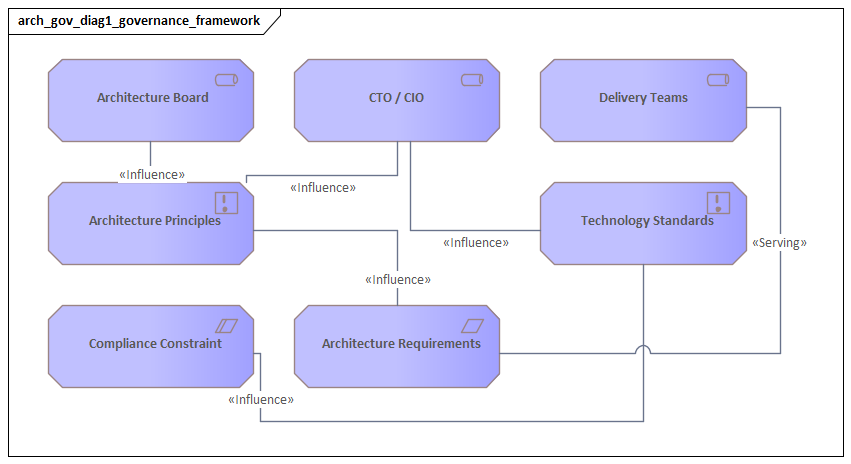
Learn how ArchiMate supports architecture governance with clear models, stakeholder views, and traceability across strategy, business, application, and technology layers. ArchiMate tutorial for enterprise architects
ArchiMate, architecture governance, enterprise architecture, ArchiMate governance, architecture modeling, stakeholder views, traceability, enterprise architecture framework, business architecture, application architecture, technology architecture, governance best practices ArchiMate layers explained
Introduction
Architecture governance is what turns architectural intent into consistent enterprise outcomes. Most organizations already have strategies, principles, standards, target states, and solution designs. The harder part is not defining those artifacts. It is ensuring they influence real decisions about investment, delivery, risk, and operations across a distributed enterprise. Without an effective governance approach, architecture remains descriptive rather than directive, and local choices gradually introduce duplication, inconsistency, and unnecessary complexity.
ArchiMate is useful here because it provides a shared modeling language that connects concerns governance often handles separately. Strategic drivers, goals, principles, requirements, capabilities, processes, applications, technologies, risks, and transition plans can all be represented within a single structure. That matters when governance bodies need to determine whether an initiative aligns with the target architecture, whether an exception is justified, or whether a technology choice will create downstream cost or risk. Rather than relying only on narrative documents and disconnected diagrams, architects can use ArchiMate to expose dependencies, trace decisions back to intent, and show the likely effects of change. ArchiMate relationship types
Governance, of course, does not happen through models alone. In practice, it operates through review boards, design authorities, standards catalogs, investment checkpoints, exception processes, and compliance assessments. ArchiMate strengthens those mechanisms by giving them a common analytical backbone. A governance review can use a focused ArchiMate view to show how a project contributes to capability uplift, which application services it reuses, where it depends on non-standard technology, and what transition steps are needed to reach the target state. For example, an architecture board deciding whether to approve a new customer onboarding solution might use one view to confirm reuse of the enterprise identity service and another to show that introducing a second workflow engine would duplicate an existing platform capability. The discussion shifts from interpretation to evidence. ArchiMate modeling best practices
ArchiMate is especially valuable because governance has to span both strategy and delivery. Enterprises rarely move straight from the current state to the target state. They move through interim architectures, phased migrations, work packages, and temporary compromises. Governance often weakens when it concentrates only on the destination and ignores the realism of the path. ArchiMate helps close that gap by linking motivation, design, and implementation in the same model, so governance can assess not just whether the destination is attractive, but whether the route is workable.
The language also supports a more proportionate style of governance. Different stakeholders need different levels of detail. Executives want to see strategic contribution. Architecture boards care about design coherence. Security and risk teams focus on controls. Delivery teams need clarity on implementation constraints. ArchiMate allows those views to come from the same underlying model. Used well, it makes governance more transparent, traceable, and adaptable without making it heavier.
This article looks at how ArchiMate can be used as an active instrument of architecture governance: to clarify accountability, improve traceability, support transformation decisions, strengthen compliance and risk oversight, and connect architecture more effectively to enterprise governance practices.
1. Architecture Governance in the Enterprise Context
Architecture governance is the system of decision rights, controls, and feedback mechanisms that steers change toward desired business and technology outcomes. It is broader than a design review board and far more practical than a set of architectural principles sitting on paper. Governance is the operating model through which architecture influences investment choices, solution design, technology adoption, delivery behavior, and lifecycle management across the enterprise.
Enterprises need governance because change is distributed. Business units pursue local goals. Product teams optimize for speed. Platform teams focus on stability and reuse. Risk functions emphasize control. Each of those perspectives is legitimate. Without a governance structure, however, the combined effect is often fragmentation: duplicated capabilities, inconsistent data handling, incompatible platforms, and short-term decisions that cut across enterprise strategy. Governance exists to balance local autonomy with enterprise coherence.
A useful way to frame architecture governance is through three complementary concerns:
- Direction: defining what the enterprise is aiming for through principles, target states, roadmaps, and standards.
- Conformance: assessing whether initiatives and designs align with those expectations.
- Adaptation: adjusting governance when priorities shift, delivery realities change, or new technologies open better options.
These concerns run through the rest of this article. ArchiMate is particularly effective because it can represent all three in one connected model: the intent behind change, the structures affected by change, and the implementation path through which change actually happens.
Governance matters only when it is embedded in the investment and delivery lifecycle. Early in that lifecycle, governance needs evidence about business value, strategic fit, and capability impact. Later, it needs deeper visibility into integration choices, data movement, security controls, platform dependencies, and transition risk. A common failure is to use the same artifacts, at the same level of detail, at every checkpoint. Effective governance does the opposite. It asks for different evidence at different stages while preserving traceability back to the original intent.
Governance also works across several scopes. At the enterprise level, the focus is broad coherence: capability maps, shared platforms, data domains, and cross-functional standards. At the domain or portfolio level, the emphasis shifts toward consistency within a business area, including reuse opportunities and shared services. At the solution level, attention turns to design quality, implementation risk, and adherence to approved patterns. A mature governance approach links these levels so local decisions remain traceable to enterprise priorities.
Accountability is another essential element. In governance, the real problem is rarely a lack of policies or standards. More often, it is unclear ownership. Someone must own technology standards, data policies, domain architectures, exception decisions, and remediation actions. Enterprise architects, domain architects, product owners, platform leads, security specialists, and engineering managers all have distinct roles to play. Governance works only when those roles and decision rights are explicit.
In the end, governance should be judged by outcomes, not ceremony. More reviews, more documents, and more committees do not automatically lead to better architecture. Good governance reduces avoidable complexity, improves reuse, makes decisions easier to understand, and helps the enterprise change with less risk. The rest of this article takes that outcome-oriented view and shows how ArchiMate can make governance more practical and more effective.
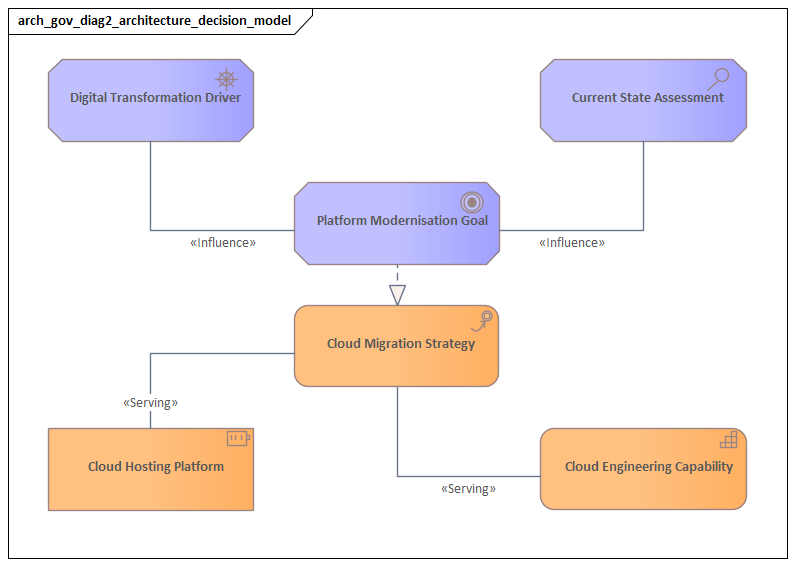
2. ArchiMate as a Governance and Decision-Support Language
Governance depends on direction, conformance, and adaptation. ArchiMate is valuable because it does more than describe architectural structure. It makes decision context visible across all three concerns. Governance decisions are rarely about a single application or platform in isolation. They usually involve trade-offs between strategic intent, delivery feasibility, operational constraints, standards compliance, and risk exposure. ArchiMate provides a way to model those trade-offs in a connected form.
One of the language’s main strengths is its ability to relate motivation, design, and implementation without splitting them into disconnected artifacts. Drivers, goals, outcomes, principles, requirements, and constraints can be linked to capabilities, value streams, business processes, application services, data objects, technology services, and migration elements. That traceability is the foundation of model-based governance. It allows stakeholders to ask:
- Does this initiative support an approved business objective?
- Which capabilities does it enhance or duplicate?
- Which standards and principles apply?
- What risks or constraints influence the design?
- What downstream dependencies are created by the proposed change?
In many organizations, governance reviews rely on slide decks that summarize conclusions without showing the relationships underneath them. ArchiMate improves the quality of evidence by making those relationships explicit. The same underlying model can support different governance questions through different views:
- A portfolio committee may need a strategy-to-capability view to assess investment alignment.
- A design authority may need an application cooperation or technology usage view to assess reuse and standards compliance.
- A risk or security forum may need a cross-layer view showing data flows, control points, and infrastructure dependencies.
- A transformation board may need a roadmap view showing work packages, plateaus, and transition dependencies.
This ability to derive multiple decision views from one model is one of ArchiMate’s strongest governance advantages. It reduces the need for each stakeholder group to work from a separate architectural narrative.
Another benefit is control over abstraction. Governance often becomes ineffective when architects either present too much technical detail too early or too little detail when implementation risk is already material. ArchiMate supports staged elaboration. Early governance can focus on strategic intent, capabilities, business services, and major constraints. As a proposal matures, the model can be expanded to show interfaces, data relationships, deployment choices, control implementation, and migration sequencing. An IAM modernization initiative, for example, may begin with a capability view centered on identity lifecycle management and access governance, then later add application services for SSO and MFA, directory dependencies, and the transition from legacy LDAP-based authentication to a cloud identity platform. Governance becomes more proportionate, and unnecessary documentation falls away.
ArchiMate also helps surface decision points that might otherwise remain hidden. A model can reveal that several applications provide similar services, that a business process depends on a non-standard platform, or that a transition state introduces temporary complexity with no agreed end date. Those are exactly the issues governance needs to identify early.
Consider a retail example. A merchandising team proposes a new pricing engine to support dynamic promotions. On its own, the proposal appears reasonable. A cross-layer ArchiMate view may show, however, that the same enterprise pricing capability is already provided through a shared commerce platform, that the new engine would require separate product master synchronization, and that it would introduce a second rules repository subject to audit controls. The governance question is no longer whether the local feature is useful, but whether the enterprise should accept the duplication and control overhead.
As later sections will show, the value of ArchiMate is not completeness for its own sake. Its governance value comes from focused, connected views that help stakeholders judge alignment, impact, accountability, risk, and change paths with greater confidence.
3. Mapping Governance Structures, Roles, and Accountability
If governance depends on clear decision rights, then the governance system itself should be modeled. In many enterprises, governance is described only through policies, RACI matrices, organization charts, and review procedures. Those are useful, but they are often disconnected from the architecture they are meant to govern. ArchiMate allows governance to be represented as part of the enterprise operating model.
A practical place to start is the business layer. Governance bodies such as architecture boards, design authorities, portfolio committees, domain councils, and security forums can be modeled as business actors, roles, or collaborations. Their activities can then be linked to governance processes such as:
- investment review
- solution assessment
- standards approval
- exception management
- compliance review
- post-implementation evaluation
This gives a clearer picture than an org chart alone because it shows how governance is carried out, not just who exists.
The motivation layer adds another level of precision. Governance roles should not be modeled as abstract administrative entities. They should be linked to the principles, requirements, constraints, and outcomes they are responsible for upholding. For example:
- an enterprise architect may be accountable for platform coherence and target-state integrity
- a security architect may be accountable for control requirements tied to regulatory drivers
- a product owner may be accountable for a business outcome but constrained by enterprise integration standards
- a platform owner may be responsible for shared services that other teams must consume
By connecting roles to governing intent, ArchiMate makes accountability traceable instead of leaving it implied.
This is especially useful in federated enterprises, where decision rights are spread across central and domain teams. Governance often becomes ineffective not because authority is missing, but because authority, responsibility, and execution are blurred together. A design authority may approve a pattern, a domain architect may assess conformance, and an engineering team may implement the design. If those distinctions are not visible, governance can become either too centralized or too weak to enforce. ArchiMate relationships can clarify:
- who owns a standard
- who assesses compliance
- who approves exceptions
- which architectural elements are in scope
- who must remediate non-conformance
The same modeling discipline can expose the governance value chain. Architects can show where decisions originate, where they are validated, where exceptions are granted, and where operational feedback should trigger policy updates. This is particularly helpful when governance itself is being redesigned. Many organizations try to speed delivery by removing review steps, but often do so without understanding which control points are essential and which are redundant. A model-based view helps streamline governance without stripping away necessary oversight.
Another practical use is mapping accountability to architectural assets. Technology standards can be linked to owners, data objects to stewards, application services to service or product owners, and migration deliverables to accountable sponsors. This becomes especially powerful when a project requests a deviation. Governance can identify not just the affected standard, but also the accountable owner, the impacted capabilities, and the downstream dependencies. If a team proposes a point-to-point integration instead of the approved Kafka-based event backbone, the model can show the standard owner, the consuming domains affected, and the remediation work package needed to move to the enterprise pattern later.
A healthcare example illustrates the point. Suppose a clinical scheduling product wants to store patient reminder preferences in its own database rather than in the master patient communication service. On the surface, this looks like a small local design choice. Once modeled, the decision touches data stewardship, consent management, audit obligations, and downstream notification services used by other care pathways. The governance discussion changes immediately because ownership and impact are no longer abstract.
Modeling governance structures in ArchiMate therefore does more than improve documentation. It turns accountability into an architectural concern that can be analyzed, communicated, and improved. That sets up the next section, where the same traceability is applied to strategy and transformation.
4. Governing Strategy, Change, and Transformation
The earlier sections established two core ideas: governance must connect direction, conformance, and adaptation, and ArchiMate provides the traceability to make that possible. Those strengths become most valuable during transformation, when strategic ambition has to be translated into governed change.
Architecture governance becomes most visible when the enterprise is in motion: launching transformation programs, redesigning operating models, modernizing data, consolidating platforms, or moving to the cloud. In these situations, strategic objectives are often expressed in broad terms such as improving customer experience, reducing cost-to-serve, increasing resilience, or accelerating product delivery. Those ambitions matter, but governance cannot act on them until they are translated into assessable architectural consequences.
ArchiMate supports that translation by linking drivers, goals, outcomes, and courses of action to the capabilities, services, processes, applications, and technologies needed to realize them. This allows governance bodies to test whether an initiative genuinely advances strategy or simply claims strategic value. A program can be assessed not just by its business case, but by its contribution to target capabilities, its use of shared services, and its consistency with platform strategy.
This becomes especially important in large portfolios. Several initiatives may claim to support the same objective, yet one may strengthen reusable enterprise capabilities while another adds further fragmentation. With ArchiMate, architects can model those relationships explicitly and identify overlap, duplication, and sequencing conflicts across the portfolio. Governance can then move beyond project-by-project review and toward portfolio-level orchestration.
Transformation also has to be governed across time. Enterprises rarely move directly from baseline to target state. They pass through interim architectures, coexistence arrangements, temporary integrations, phased retirements, and migration dependencies. These transition states are often where governance is weakest, because they are treated as delivery detail rather than architectural risk.
ArchiMate addresses this through implementation and migration concepts such as work packages, deliverables, plateaus, and gaps. These elements allow architects to model not only the desired future state, but also the route used to reach it. Governance can then ask more rigorous questions:
- Which capabilities are uplifted in each phase?
- Which legacy systems remain in use, and for how long?
- What dependencies must be resolved before later phases can begin?
- Which temporary solutions risk becoming permanent?
- Where do transition states create control, cost, or complexity risk?
This makes roadmap governance more credible. Many programs are approved on the strength of an end-state vision, only to struggle later because the migration path was never specified in enough detail. A well-structured ArchiMate roadmap view makes it easier to see whether the proposed sequence is realistic. In an IAM modernization program, for example, governance may approve a phased path in which workforce SSO moves first, privileged access management follows, and customer identity remains temporarily on the legacy stack until application dependencies are removed. The model makes the coexistence period explicit rather than accidental.
A second example comes from core banking modernization. A bank may set a strategic goal to reduce product time-to-market by introducing domain-aligned services. If the roadmap shows that customer onboarding, KYC checks, and account origination will remain tied to a mainframe workflow for another two years, governance can see that the strategic outcome depends on an interim integration layer and duplicate customer status logic. That is not a reason to reject the program, but it is a reason to govern the transition tightly.
ArchiMate also supports governance under uncertainty. Enterprises often need to commit to a direction before every design detail is known. In those cases, governance should define what must be fixed and what can remain flexible. For example, governance may approve a target platform direction, a domain boundary, and a set of integration principles while leaving service decomposition or deployment timing to delivery teams. Modeling those decision boundaries helps avoid two common failures: over-prescriptive governance that slows delivery, and under-specified governance that allows drift.
Cross-layer visibility is another major benefit. A transformation decision that looks attractive from a delivery perspective may create operational burdens, data risks, or process disruption elsewhere. Because ArchiMate connects business, application, and technology concerns, it allows governance to evaluate change systemically rather than locally. That is particularly useful in event-driven transformation: a Kafka adoption decision may look like a simple integration choice, but the model can reveal its implications for domain ownership, event schemas, consumer onboarding, observability, and legacy batch interfaces.
In short, ArchiMate helps governance move from static target-state control to active transformation steering. That becomes even more important when the governance question is not only strategic alignment, but also compliance, risk, and control.
5. Enabling Compliance, Risk Management, and Control Traceability
The governance patterns discussed so far—traceability, accountability, and transition visibility—apply directly to compliance and risk as well. In many enterprises, these concerns are managed outside the architectural model in separate policy repositories, risk registers, audit workflows, or GRC tools. The result is fragmented governance: architecture reviews assess design, while control functions assess compliance using different artifacts and different levels of abstraction.
ArchiMate helps close that gap by connecting obligations, risks, controls, and architectural elements in one traceable structure.
That matters because compliance is rarely just a technology issue. A regulatory or internal control requirement may affect business processes, decision points, data handling, application behavior, integration patterns, hosting choices, and operational procedures at the same time. Using motivation concepts, requirements and constraints can be linked to the architectural elements that must satisfy them. This gives governance a stronger basis for testing whether a control is merely stated or actually realized.
Risk management also becomes more precise when the model shows where exposure sits structurally. Instead of attaching a generic risk label to a project, architects can model the conditions that create risk, such as:
- concentration on a single platform
- unsupported legacy dependencies
- non-standard data movement across domains
- manual controls embedded in critical processes
- temporary transition components with unclear ownership
The advantage is that governance can see not just the presence of risk, but its architectural cause and likely impact path.
Control traceability is one of the most practical uses of ArchiMate. Consider a data retention rule. Policy may state the requirement clearly, but governance still needs to know:
- which data objects are subject to the rule
- which business processes create or update those records
- which applications store or replicate them
- which integrations distribute them
- which technology components host them
- which roles are accountable for enforcement
A well-structured ArchiMate view can trace that chain from requirement to implementation. This strengthens design review, simplifies audit preparation, and makes remediation more targeted when gaps are found.
This approach is especially valuable in high-control environments such as financial services, healthcare, government, and critical infrastructure. It is equally relevant in modern cloud-first organizations. Delivery teams may move quickly and assemble services from multiple platforms. In that setting, governance cannot rely on broad policy statements alone. Architects need lightweight but credible ways to show which controls are inherited from shared platforms, which must be implemented by product teams, and where residual risk remains.
A realistic cloud example makes this concrete. A product team deploys a new document-processing service on Kubernetes and stores uploaded files in object storage. The enterprise policy requires encryption at rest, malware scanning, retention tagging, and restricted cross-border data transfer. In an ArchiMate model, those obligations can be linked to the document object, the upload API, the scanning service, the storage service, the hosting cluster, and the accountable operational role. If malware scanning is inherited from a shared platform service but retention tagging must be implemented by the product team, governance can see the split clearly.
Exception management is another area where model-based governance helps. Not every deviation from a standard is a failure; some are justified by timing, legacy constraints, or business urgency. The real governance question is whether the impact of that deviation is understood. By modeling the relationship between a non-standard element, the requirement it does not meet, the associated risk, and any compensating control or remediation work package, ArchiMate gives exception decisions a much stronger basis. A useful example is technology lifecycle governance: if a product team requests continued use of an end-of-support database for 12 months, the model can link that exception to the affected applications, resilience and security risks, compensating controls, and the funded retirement work package.
Over time, this also improves organizational learning. Audit findings, incidents, and recurring control weaknesses can be mapped back into the architecture model, revealing structural patterns that isolated reports often miss. If multiple issues cluster around a particular integration style, platform, or process handoff, governance can respond structurally rather than case by case.
The next challenge is practical. Even if ArchiMate can support governance in principle, how does it become part of day-to-day governance rather than a parallel modeling exercise?
6. Integrating ArchiMate into Governance Practices and Toolchains
For ArchiMate to strengthen governance, it has to be embedded in the way governance is actually performed. The language can support strategic alignment, accountability, transformation control, and compliance traceability. Those benefits appear only when models are tied to governance moments, operational data, and decision workflows.
A common failure pattern is to adopt ArchiMate as a notation but not as a governance capability. The organization produces consistent diagrams, yet those diagrams remain disconnected from investment decisions, delivery workflows, and control processes. The goal should be different. ArchiMate should become part of the governance operating system.
A practical starting point is to align model views with governance checkpoints rather than with documentation templates. Each governance moment should have a small set of expected views that answer specific questions. For example:
- Portfolio review: strategy-to-capability mapping, high-level impact, major dependencies
- Solution approval: service usage, application cooperation, standards alignment, key data flows
- Exception review: deviation impact, affected standards, associated risks, compensating controls, remediation plan
- Transformation review: roadmap, plateaus, work packages, dependency sequencing
- Compliance review: control traceability, accountable roles, affected data and technology elements
This keeps modeling focused on decisions rather than repository completeness.
Toolchain integration is just as important. Governance evidence often sits across portfolio systems, CMDBs, agile planning tools, service catalogs, standards registers, GRC platforms, and collaboration environments. ArchiMate works best as a federating layer across these sources, not as a replacement for them. An architecture repository can link model elements to authoritative records elsewhere:
- applications to a service catalog
- technologies to standards registers
- controls to GRC systems
- initiatives to portfolio tools
- work items to agile platforms
That preserves a practical balance. The model provides structure and traceability, while operational systems remain the source of detailed execution data.
Governance loses confidence in models when architects have to recreate operational information by hand. Disciplined integration—through synchronization where possible and reference linking where necessary—helps keep ArchiMate views current enough to support decisions without demanding unrealistic automation.
Another important practice is to treat governance views as managed products. A diagram prepared for an investment board or design authority should have clear ownership, refresh expectations, and minimum quality criteria. Otherwise, views get created for a single meeting and then abandoned. Over time, organizations should build a library of reusable governance viewpoints: standardized enough to support comparison across initiatives, but flexible enough to allow domain-specific detail.
Role design matters as well. Architects should not be the only people who can interpret model-based governance artifacts. Product managers, platform owners, security specialists, and delivery leads need enough familiarity to use the views in real decisions. That does not require enterprise-wide mastery of notation. It requires pragmatic viewpoints, clear legends, disciplined modeling conventions, and facilitation that emphasizes interpretation over notation purity.
A telecom example shows why this matters. If a network platform team proposes introducing a separate API gateway for 5G partner services, the architecture board, security lead, and operations manager should all be able to read the same governance view and see different implications: policy enforcement duplication, certificate lifecycle overhead, latency impact, and support model changes. If only architects can decipher the model, it will never become part of the real decision process.
Finally, ArchiMate should feed governance feedback loops, not just approval gates. Post-implementation reviews, incidents, technical debt assessments, platform rationalization efforts, and audit findings should update the model when they reveal meaningful architectural change or governance lessons. That turns the repository into a living governance asset. In practice, that might mean updating the technology lifecycle view when a board decides to move Kafka client libraries to “tolerate” status, or recording that an IAM exception remains open until legacy applications support modern federation protocols.
When integrated in this way, ArchiMate supports continuous governance rather than episodic review. It helps the enterprise maintain traceability from strategy to execution, from control requirement to implementation, and from operational feedback back into architectural direction.
Conclusion
ArchiMate is most powerful in architecture governance when it is treated as a decision instrument rather than a documentation notation. Its value lies in making relationships explicit: between strategy and design, accountability and control, target state and migration path, obligation and implementation. Those are the relationships governance needs if it is to be credible, timely, and evidence-based.
Across this article, one theme has remained consistent. Effective governance requires clear direction, visible conformance, and the ability to adapt as reality changes. ArchiMate supports all three because it connects motivation, structure, behavior, and implementation in a single model. That makes it possible to govern not only what the enterprise wants to become, but also how it is changing, who is accountable, where risk sits, and what consequences follow from architectural decisions.
The practical lesson is straightforward. Success does not come from modeling everything. It comes from modeling the relationships that matter most to governance: strategic intent, capability impact, standards alignment, decision ownership, transition dependencies, control realization, and exception consequences. Focused views tied to real governance checkpoints, and linked to operational toolchains, are far more valuable than large repositories that no one uses.
Used with that discipline, ArchiMate helps architecture governance become more transparent without becoming bureaucratic, more structured without becoming rigid, and more connected to delivery without losing enterprise perspective. For organizations that need to govern change at speed while preserving coherence, it provides a practical foundation for making architecture traceable, governable, and continuously relevant.
Frequently Asked Questions
What is architecture governance in enterprise architecture?
Architecture governance is the set of practices, processes, and standards that ensure architecture decisions are consistent, traceable, and aligned to organisational strategy. It typically includes an Architecture Review Board (ARB), architecture principles, modeling standards, and compliance checking.
How does ArchiMate support architecture governance?
ArchiMate supports governance by providing a standard language that makes architecture proposals comparable and reviewable. Governance decisions, architecture principles, and compliance requirements can be modeled as Motivation layer elements and traced to the architectural elements they constrain.
What are architecture principles and how are they modeled?
Architecture principles are fundamental rules that guide architecture decisions. In ArchiMate, they are modeled in the Motivation layer as Principle elements, often linked to Goals and Drivers that justify them, and connected via Influence relationships to the constraints they impose on design decisions.