⏱ 26 min read
ArchiMate Layers Explained: Enterprise Architecture Examples Across Business, Application, and Technology
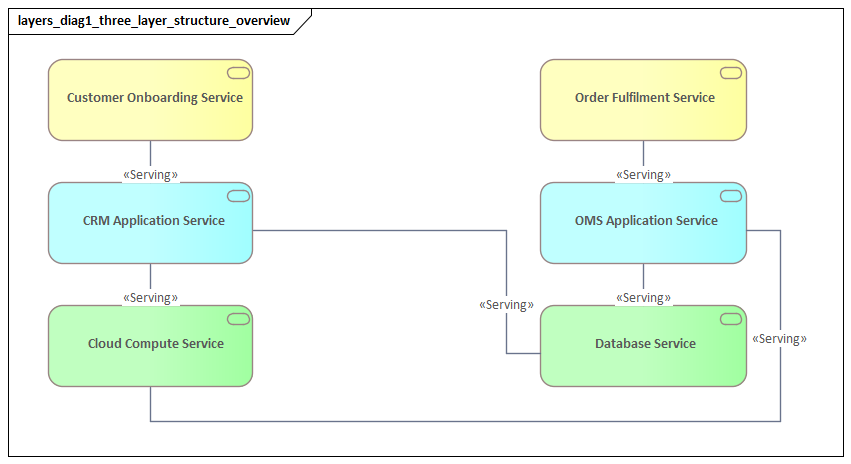
Learn how ArchiMate layers work with clear enterprise architecture examples. Explore business, application, and technology layers, their relationships, and how to model them effectively. ArchiMate tutorial for enterprise architects
ArchiMate layers, ArchiMate explained, enterprise architecture examples, ArchiMate business layer, ArchiMate application layer, ArchiMate technology layer, enterprise architecture modeling, ArchiMate framework, ArchiMate relationships, TOGAF ArchiMate, business application technology layers, ArchiMate tutorial ArchiMate relationship types
Introduction
ArchiMate gives enterprise architects a common language for describing how an organization operates, changes, and delivers value. Its advantage is not just consistent notation. It is the ability to connect business intent, applications, and technology in one model. In large enterprises, that matters because each stakeholder group sees a different part of the landscape. Business leaders focus on capabilities, services, and outcomes. Application teams care about systems, integrations, and data flows. Infrastructure and platform teams look at hosting, networks, resilience, and operational control. ArchiMate helps them work from the same architectural picture without forcing everyone into the same level of detail. ArchiMate modeling best practices
The idea of layers sits at the center of that value. ArchiMate separates concerns without breaking the links between them. An architect can show how a business service is supported by application services, and how those services depend on specific platforms, environments, and infrastructure components. That structure is useful because enterprise architecture problems rarely come from one weak system in isolation. More often, they come from unclear dependencies between business priorities and technical implementation. Layering makes those dependencies visible. ArchiMate viewpoints
That visibility is practical, not theoretical. During transformation planning, architects can trace which business processes and capabilities will be affected by a system replacement. During operating model redesign, they can see where several business services rely on the same application or platform. In governance and risk reviews, they can assess whether critical services depend on aging technology, brittle integrations, or shared points of failure. In roadmap planning, they can distinguish what must change together from what can change independently. If an architecture board is reviewing a regional SaaS proposal, for example, a layered model can show not only the business benefit but also the IAM, integration, support, and data residency implications.
Layers also help control complexity. Most enterprises are dealing with legacy estates, cloud adoption, mergers, regulatory pressure, and new digital products at the same time. Without a layered structure, architecture diagrams tend to drift to one of two extremes: too technical for business stakeholders or too abstract for delivery teams. ArchiMate provides a workable middle ground. It is structured enough for analysis and clear enough for communication.
There is an accountability benefit as well. Layered models make ownership easier to see. They show which teams provide enabling services to others and how change in one domain ripples across the enterprise. A decision to modernize an integration platform, for instance, is not just a technology matter. It can affect application interactions, business process performance, support models, and customer service levels. With layered traceability, those effects are easier to understand and govern.
This article explains the ArchiMate layers through enterprise architecture examples. It begins with the purpose of layered architecture, then looks at the business, application, and technology layers in turn. It then examines the relationships across layers and closes with practical transformation scenarios where layered modeling supports impact assessment, transition planning, and governance.
Understanding ArchiMate and the Purpose of Layered Enterprise Architecture
ArchiMate is an enterprise architecture modeling standard used to represent structure, behavior, and relationships across an organization in a consistent way. Its real value lies in giving architects a common grammar for showing how strategy becomes operational execution and technical enablement. Instead of relying on separate diagrams for business processes, applications, and infrastructure, ArchiMate allows those views to be connected in one model.
A useful way to think about ArchiMate is as a language for dependencies. Enterprises do not operate as separate stacks of business, software, and infrastructure. They operate as connected networks of services, roles, information, applications, and platforms. ArchiMate allows architects to model what supports what, what realizes what, and what is affected when change occurs. That makes it particularly useful in transformation programs, where the hard part is often understanding the consequences of change rather than describing the target state.
Layering exists to organize that dependency mapping into coherent viewpoints. It separates concerns so each domain can be examined at the right level of abstraction while preserving traceability to the others. A business leader may ask which capabilities support a new market offering. An application architect may want to know which systems exchange customer data. A platform architect may ask which environments host integration workloads. Layering makes it possible to answer each question clearly without losing the broader enterprise picture.
This is less about rigid boundaries than controlled abstraction. Architects need to decide what to show, what to leave out, and how to connect viewpoints so stakeholders can act on the model. In a banking modernization, for example, the business layer may highlight account servicing and customer onboarding. The application layer may identify workflow, customer master, fraud screening, and transaction systems. The technology layer may reveal dependencies on mainframe hosting, middleware, cloud platforms, and identity services. Each layer contributes different evidence to the same decision.
Layering also strengthens governance. Many architecture problems arise when local design decisions are made without understanding enterprise-wide effects. A SaaS purchase may solve an immediate business problem while creating downstream impacts on identity, data integration, compliance, support, and vendor management. Because ArchiMate links layers through explicit relationships, governance can move beyond opinion and focus on traceable consequences. That is often what allows an architecture board to approve a solution with conditions, such as mandatory SSO integration, API reuse, or a time-bound exception to platform standards.
It is equally valuable when change unfolds over time. Enterprise architecture is rarely just about describing the current state. More often, it is about transition: from legacy to cloud, from siloed applications to shared platforms, or from fragmented processes to product-centric operating models. Layered models help architects show what changes in each domain, what remains stable, and which dependencies must be managed in sequence. That is why ArchiMate is more than a documentation standard. It is a practical framework for analysis, planning, and decision-making in complex change environments.
The Business Layer: Modeling Capabilities, Processes, Roles, and Services
The business layer is where enterprise architecture becomes directly meaningful to business stakeholders. It represents how the organization creates value through capabilities, roles, processes, products, and business services. While the later layers explain digital and technical enablement, this layer defines what the enterprise does, for whom, and through which organizational arrangements.
A good way to view the business layer is as the enterprise in motion. It does not simply show organizational charts or process maps. It shows how business behavior is organized to deliver outcomes. In ArchiMate, this often includes business actors, business roles, business processes, business functions, business services, and business objects. Together, these elements help answer questions such as:
- Which role owns customer onboarding?
- Which business services support claims handling?
- Which processes must change to support a new product model?
- Which capabilities are strategically important?
Capabilities are often the most useful element in this layer because they connect strategy to execution without being tied too closely to the current organization chart. A capability such as customer identity management, order fulfillment, or regulatory reporting can remain stable even when teams, processes, or applications change. For that reason, capability modeling is often one of the best ways to frame investment decisions. Leaders usually invest to improve a business capability, remove an operational constraint, or strengthen service performance, not simply to buy a new system.
Processes add precision. If capabilities describe what the business must be able to do, processes describe how work gets done. That distinction matters in transformation planning. An organization may have a strong customer support capability in principle while the underlying processes remain manual, fragmented, or inconsistent across regions. By modeling processes in relation to roles and services, architects can identify bottlenecks, control points, and redesign opportunities.
Business services matter just as much because they shift the discussion toward outcomes delivered to internal or external consumers. A retail bank may define business services such as account opening, loan servicing, and dispute resolution. A healthcare provider may model appointment scheduling, referral management, and discharge coordination. These services are useful because they align with customer journeys, service ownership, and performance expectations. They also provide a stable anchor for tracing dependencies downward into the application and technology layers.
A small example makes this concrete. In an insurer, the business service First Notice of Loss may be delivered by the claims operations team, supported by the claims intake process, and owned by a claims service manager. That service sounds straightforward until the model shows its dependencies: call center handling, digital intake, document capture, fraud triage, and regulatory logging. What looked like a single service is actually a coordinated set of business behaviors.
From a practical architecture perspective, the business layer is where scope is clarified before solution design begins. If an initiative claims to modernize customer operations, the business layer helps test what that actually means. Does it affect onboarding only, or also identity verification, case management, complaints handling, and branch support? Which roles are involved? Which capabilities are expected to improve? How will success be measured? In IAM modernization, the business question is not only authentication technology. It is also which services require stronger identity proofing, delegated access, or step-up authentication. Without this step, architecture quickly becomes technology-led rather than outcome-led.
The business layer also strengthens governance by making ownership visible. When capabilities, processes, and services are modeled clearly, architects can identify where accountability is fragmented, where similar services are duplicated across business units, and where standardization may be possible. That supports better portfolio decisions and clearer ownership of change.
In short, the business layer establishes the terms the rest of the architecture must support. The application and technology layers should not be treated as separate technical landscapes. Their purpose is to enable the business services, capabilities, and processes defined here.
The Application Layer: Representing Applications, Services, Interfaces, and Data Flows
If the business layer defines what the organization must deliver, the application layer shows which software components support that delivery and how they work together. In ArchiMate, this layer typically includes application components, application functions, application services, interfaces, and data objects. It forms the bridge between business demand and technical execution.
One common architecture mistake is to treat applications as isolated products. In practice, enterprise value is usually delivered through chains of interacting applications. A customer onboarding journey might involve CRM, identity verification, workflow, document management, sanctions screening, and core transaction systems. Modeling these as connected components exposes where orchestration happens, where dependencies are brittle, and where multiple systems perform overlapping roles. That is why the application layer matters so much in transformation planning: it reveals the operational consequences of system change.
Application functions provide a more precise view than system names alone. A single platform can support many functions, and those functions matter differently to different stakeholders. An ERP platform may provide billing, procurement, inventory, and finance capabilities. In a modernization effort, architects need to know not only that the ERP exists, but which functions are used by which business services defined in the business layer. That level of detail is essential when decomposing monoliths, consolidating platforms, or replacing only part of a legacy estate.
Application services represent the behavior applications make available to consumers. Those consumers may be business processes, users, or other applications. This service-oriented view helps separate internal implementation from externally consumed capability. A customer master system, for example, may expose services for profile retrieval, identity update, and consent verification. In an IAM modernization, application services might include authentication, token validation, role provisioning, and access certification, consumed by HR, customer portals, and internal business applications. Modeling these as services helps architects assess reuse, define clearer boundaries, and identify duplicate service provision across platforms.
A realistic micro-example is a retailer introducing click-and-collect. The customer sees one business service, but the application layer often tells a different story. The web storefront captures the order, the order management platform reserves stock, the POS system confirms store availability, and the notification service sends pickup messages. If architects model only the storefront, they miss the fact that the customer promise depends on near-real-time inventory synchronization between applications that were never designed to work together at that speed.
Interfaces and data flows bring the layer into practical focus. Many enterprise risks come less from individual applications than from the way they exchange information. Point-to-point integrations, undocumented file transfers, duplicated master data, and inconsistent event handling are common sources of fragility. ArchiMate allows these interactions to be modeled explicitly, making hidden coupling easier to spot. In rationalization programs, this often explains why retiring an apparently redundant application is more complicated than expected: it may still feed reporting, compliance, or operational processes through poorly understood integrations.
Another small example: a finance team may believe a legacy reporting application is no longer needed because a modern analytics platform exists. The application model shows otherwise. Each night, the old system still receives a flat-file extract from the policy platform, enriches it with reference data, and sends reconciled output to regulatory reporting. The “redundant” system is actually performing a business-critical transformation that nobody had documented properly.
As with the business layer, application analysis should stay anchored in business value. Useful questions include:
- Which applications support each business service?
- Which systems are systems of record, and which are only consumers?
- Where do multiple applications provide the same function for different business units?
- Which business-critical services depend on unsupported software?
- Where should APIs be standardized or integration patterns modernized?
These are not abstract modeling concerns. They directly affect cost, resilience, delivery speed, and governance. A common example is event architecture. An enterprise may introduce Kafka as a shared event backbone, but the application model still needs to show which domains publish events, which consumers depend on them, and where synchronous APIs remain necessary for operational reasons.
The application layer is also central to target-state design. When organizations want to simplify, improve agility, or reduce risk, architects often need to decide whether to consolidate platforms, modularize services, or clarify system boundaries. A strong application model supports those decisions by showing not just what systems exist, but how responsibilities, interfaces, and data dependencies are distributed across the enterprise.
In that sense, the application layer is where software architecture becomes enterprise architecture. It is not only about designing individual systems well. It is about shaping the application landscape so it can support business change coherently.
The Technology Layer: Mapping Infrastructure, Platforms, Networks, and Deployment
The technology layer represents the digital foundation on which applications run and through which technical services are delivered. In ArchiMate, this includes nodes, devices, system software, technology services, communication networks, and artifacts. If the application layer explains how software components collaborate, the technology layer shows where those components are deployed, what runtime environments support them, and which underlying services make them secure, reliable, and scalable.
This layer matters because many enterprise constraints are not visible at the application level alone. Two applications may appear independent in a portfolio view, yet depend on the same database cluster, identity platform, integration runtime, or network segment. A cloud migration may look straightforward as an application move, but the technology layer may reveal dependencies on legacy middleware, unsupported operating systems, storage constraints, batch windows, or regional hosting requirements.
A useful way to understand this layer is as the operational context for the application landscape described earlier. Nodes may represent physical servers, virtual machines, containers, or cloud compute services. System software may include operating systems, database platforms, Kubernetes environments, API gateways, or message brokers. Communication paths represent how environments connect. Technology services describe what the environment provides to consumers, such as hosting, storage, backup, monitoring, authentication, or network connectivity.
In practice, the technology layer becomes critical when assessing resilience, standardization, and operational risk. An application may appear modern because it exposes APIs and supports digital workflows, but the technology model may show that it runs in a single data center, depends on manual failover, or shares infrastructure with unrelated workloads. That changes the architectural assessment significantly. The question is no longer only application fitness, but recovery capability, dependency concentration, and platform sustainability.
Consider a realistic example from healthcare. A patient appointment platform may have been front-ended with a modern web application and mobile API. On paper, it looks cloud-ready. The technology model shows that the scheduling engine still depends on an on-premises Oracle cluster in one hospital data center, with nightly backup but no tested cross-site failover. The business service appears digital; the runtime foundation is still fragile. Without the technology layer, that risk remains hidden.
This layer is also where platform strategy becomes visible. Many enterprises aim to reduce complexity by moving toward standardized technology services such as cloud landing zones, managed databases, container platforms, observability stacks, centralized identity, and event streaming platforms. ArchiMate allows architects to model these shared services and show which applications consume them. That creates a traceable view of alignment and exception. Architects can see where teams are adopting enterprise standards, where local deviations are increasing, and where technical debt is being preserved behind modern interfaces.
Deployment relationships add particular practical value. It is one thing to know an application exists; it is another to know that its front-end service runs in one region, its database in another, and its analytics workload on a separate platform. These deployment patterns affect latency, data residency, support ownership, and incident response. In regulated environments, they also affect control and auditability.
The earlier layers remain essential here. A technology platform matters architecturally because of the business services and application services it supports. Useful questions therefore include:
- Which business-critical applications depend on end-of-life hosting?
- Which shared platforms are single points of failure?
- Which workloads are suitable for rehosting, replatforming, or retirement?
- Where do network constraints affect application integration?
- Which environments need stronger observability or security controls before change can proceed?
A strong technology-layer model does more than document servers and networks. It connects runtime reality to the application and business dependencies established earlier, allowing architects to judge whether the infrastructure estate can support the services the enterprise relies on. It also supports lifecycle governance by showing where business-critical services still depend on platforms approaching end of support, making upgrade and retirement decisions easier to prioritize.
Relationships Across Layers: Connecting Business, Application, and Technology Views
The real strength of ArchiMate lies not in the layers taken separately, but in the relationships between them. The business, application, and technology layers each provide a useful viewpoint, but enterprise architecture becomes actionable only when those viewpoints are linked. Cross-layer relationships show how business intent is supported by software behavior and how software, in turn, depends on technical infrastructure.
The business layer defines services, capabilities, and processes. The application layer shows the digital components that support them. The technology layer provides the runtime environment. Cross-layer modeling connects these into a traceable chain of support and realization. A business service such as order fulfillment may be realized by several application services, which are then hosted on shared technology platforms. This structure allows architects to analyze impact in both directions: from business change downward and from technical change upward.
That is where ArchiMate becomes especially valuable for stakeholder questions. If a business service is underperforming, which applications support it? If an application is being replaced, which business roles, processes, and services are affected? If a data center is being exited or a cloud platform introduced, which business operations are exposed to risk? Cross-layer relationships provide a structured way to answer those questions without relying on separate diagrams and manual interpretation.
One simple way to think about this is as a dependency chain:
- Business services and processes express what the organization delivers.
- Application services and components realize and automate that delivery.
- Technology services and nodes host and enable the applications.
In practice, this chain is rarely one-to-one. A single business service may depend on multiple applications, and a single application may consume several shared platforms. The value of ArchiMate is that it can represent this many-to-many reality clearly enough to support analysis.
A practical micro-example from logistics illustrates the point. A parcel tracking business service may depend on a shipment management application, an event ingestion service, a customer notification platform, and a mobile API. Those in turn may rely on a cloud event broker, a managed database, and a regional API gateway. If the event broker has a resilience issue, the business impact is not just “integration degraded.” Customers stop receiving tracking updates, the call center receives more contacts, and service-level commitments may be breached. Cross-layer traceability makes that chain visible.
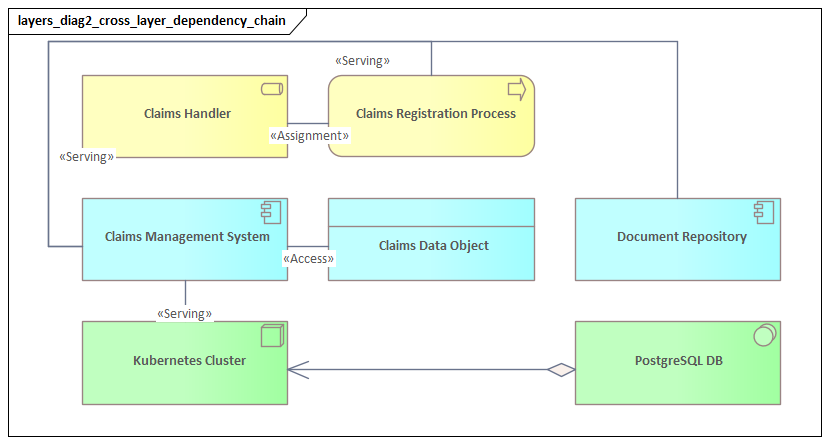
These relationships become particularly important in change impact assessment. Consider an insurer modernizing its claims platform. At the business layer, affected elements may include claims registration, assessment, settlement, and fraud review. At the application layer, the change may involve claims management, document repository, workflow, and integration services. At the technology layer, it may depend on a cloud platform, managed database, identity federation, and secure partner connectivity. Modeling the relationships across these layers helps architects identify not just what is changing, but what must remain stable, what must move together, and where transition risks sit.
Cross-layer analysis also reveals hidden concentration risk. A business capability may appear resilient because several teams and processes contribute to it, yet all may rely on a single identity service, Kafka cluster, or integration platform. On the other hand, what looks like redundant software may support genuinely different business services with distinct regulatory or regional requirements. Without traceability across layers, architects can easily oversimplify or preserve unnecessary complexity.
From a governance perspective, these relationships are what make architectural review evidence-based. A cross-layer model can reveal a business-critical process with no resilient hosting pattern, an application service with no clear business owner, or a technology platform supporting workloads that have never been formally tied to business value. Those are the kinds of findings that improve investment decisions, roadmap sequencing, and design assurance.
In short, relationships across layers are not an optional refinement. They are the mechanism that turns separate viewpoints into enterprise analysis.
Enterprise Architecture Examples: Using ArchiMate Layers in Transformation Scenarios
The value of ArchiMate layers becomes clearest when they are used to support real change decisions rather than static documentation. In practice, architects are asked to clarify scope, expose dependencies, reduce delivery risk, and support governance. The earlier sections described the purpose of each layer and the importance of cross-layer traceability. The following scenarios show how those ideas work in real transformation settings.
1. Cloud Migration of a Legacy Customer Service Platform
A cloud migration may initially look like a technology initiative. In reality, the complexity often sits in cross-layer dependencies.
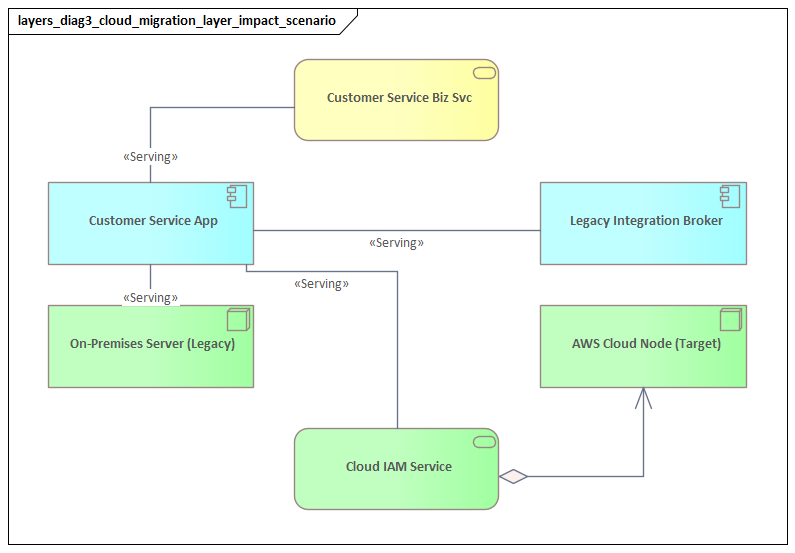
At the business layer, the platform may support complaint handling, service request resolution, and customer communications. At the application layer, it may depend on CRM functions, workflow orchestration, document storage, and outbound messaging. At the technology layer, it may rely on a legacy integration broker, tightly coupled databases, and on-premises identity controls.
A layered ArchiMate model helps architects challenge the assumption that the migration is only about moving workloads. It may show that business service continuity depends on application refactoring, that integration patterns must change before hosting can change safely, that identity and access controls need redesign, and that some components can be rehosted while others require replacement. The result is a more realistic migration roadmap and less risk of treating a business-critical transformation as a simple infrastructure exercise.
2. Post-Merger Application Rationalization
After a merger, leadership often expects rapid simplification through system consolidation. A portfolio spreadsheet may suggest obvious duplication, but the business and cross-layer views usually tell a different story.
Suppose two policy administration platforms appear redundant. The business layer may show that one supports standard retail products while the other supports region-specific compliance services and broker processes. The application layer may reveal differences in workflow, product rules, and reporting. The technology layer may show that one platform is costly and aging, but still supports critical local integrations not yet available elsewhere.
By modeling these dependencies, architects can evaluate options more credibly: immediate retirement, phased convergence, temporary coexistence, or capability-by-capability replacement. Without layered analysis, rationalization efforts either move too aggressively and disrupt service or move too slowly and preserve unnecessary complexity.
3. Launch of a New Digital Self-Service Channel
A digital channel initiative often begins with customer experience goals, but success depends on whether the supporting business and application services can actually operate at digital scale.
At the business layer, architects can identify which customer services are being extended into self-service and which support roles remain involved behind the scenes. At the application layer, they can distinguish reusable capabilities such as identity, notification, and case management from gaps that require new APIs or channel-specific services. At the technology layer, they can test whether the existing platform estate can support the required resilience, scalability, and security.
This layered approach helps avoid a common failure pattern: delivering a polished front end while leaving critical back-office processes manual or dependent on fragile integrations. It also supports better sequencing by showing which foundational services must improve before the channel can scale.
4. Core Platform Modernization in a Regulated Environment
A regulated enterprise, such as a bank or insurer, may need to modernize a core platform while preserving compliance and operational control.
The business layer identifies which regulated services, controls, and reporting obligations depend on the platform. The application layer shows the systems of record, integrations, and downstream consumers. The technology layer exposes hosting regions, resilience patterns, access controls, and data residency constraints.
A cross-layer ArchiMate model can reveal that the hardest part of modernization is not the application replacement itself, but preserving regulatory traceability and operational control through the transition. That often leads to a phased target state in which some services are modernized first while high-risk dependencies are stabilized before migration.
5. Shared Platform Strategy and Exception Management
Many enterprises pursue standard platforms for integration, identity, observability, and hosting. The challenge is not defining the standards, but understanding where the organization follows them and where exceptions are accumulating.
Here, the technology layer models shared services such as cloud landing zones, identity platforms, Kafka event streaming, and container runtimes. The application layer shows which systems consume them and which still use local alternatives. The business layer helps prioritize remediation by showing which business services are exposed to unsupported or non-standard patterns.
This matters because not every exception carries the same weight. A local deviation supporting a low-risk internal process may be tolerable; the same deviation supporting a critical customer-facing service may not be. The layered model helps governance focus on business-relevant remediation rather than technical purity alone.
6. Technology Lifecycle Governance and Architecture Board Review
Technology lifecycle governance is often treated as a separate operational discipline, but it becomes far more effective when modeled across layers.
An architecture board reviewing an end-of-life database platform, for example, can use the business layer to identify affected services such as payments or claims processing, the application layer to identify dependent systems, and the technology layer to assess upgrade, migration, or retirement options. The board may approve a temporary exception for one application, require remediation for another, and prioritize funding where customer-facing services are exposed.
This is a good example of how layered ArchiMate models support practical governance: not just documenting technical debt, but linking it to business impact and decision-making.
What These Scenarios Show
Across these examples, the same pattern appears:
- The business layer clarifies value, scope, ownership, and outcome.
- The application layer identifies software dependencies, interfaces, and systems of record.
- The technology layer exposes runtime constraints, resilience issues, and platform dependencies.
- The relationships across layers make change impact, sequencing, and risk visible.
That is why ArchiMate is most useful when applied to decisions. It helps architects move the discussion away from isolated solution choices and toward enterprise consequences.
Conclusion
ArchiMate layers are most valuable when they help architects turn complexity into decisions. Their purpose is not to force the enterprise into a rigid stack, but to provide a disciplined way to examine how business value, digital enablement, and operational foundations interact.
Each layer serves a distinct role. The business layer defines capabilities, processes, services, and ownership. The application layer shows how software supports and automates those business needs. The technology layer reveals the runtime platforms and infrastructure that make the application landscape possible. The real analytical value appears when these layers are connected through explicit relationships, allowing dependency and impact to be traced across the enterprise.
This layered structure improves architectural work in several ways. It supports clearer scoping at the start of initiatives, stronger impact assessment during change, better governance of local design decisions, and more realistic transition roadmaps. It also improves communication across stakeholder groups by giving business leaders, architects, delivery teams, and operations teams a shared model with different but connected viewpoints.
The practical test of an ArchiMate model is whether it supports action. Can it show which business services are exposed by a platform decision? Can it reveal where application duplication is real and where it reflects legitimate business variation? Can it identify transition risks caused by hidden infrastructure dependencies? Can it help sequence change so business continuity, technical feasibility, and strategic intent stay aligned? If it can, the model is doing real enterprise architecture work.
For architects, the key is to use layers selectively and intentionally. Not every initiative needs a full enterprise model, but every significant change benefits from clear traceability across business, application, and technology concerns. Used with that discipline, ArchiMate becomes more than a notation standard. It becomes a practical decision-support tool for transformation, governance, and target-state design.
Frequently Asked Questions
What are the three core ArchiMate layers?
The three core ArchiMate layers are the Business layer (processes, roles, services), the Application layer (software components and data), and the Technology layer (infrastructure, platforms, networks). Together they provide a complete cross-domain view of the enterprise.
How do ArchiMate layers connect to each other?
ArchiMate layers connect through Serving and Realisation relationships. The Application layer serves the Business layer by providing application services that support business processes. The Technology layer serves the Application layer by providing hosting, networking and runtime infrastructure.
Why are layers important in enterprise architecture modeling?
Layers separate concerns so each audience sees the right level of detail. Business stakeholders focus on the Business layer, solution architects work with the Application layer, and infrastructure teams use the Technology layer. All three layers remain traceable in one coherent model.
Layers you can query
Layered examples like the ones above are most useful when a reader can follow a thread through them — this business process, that application service, the technology underneath — and see where the chain breaks.
That is considerably easier when the layers are one model rather than a stack of drawings. Mooodels supports the ArchiMate layers as a profile and lets you traverse the relationships between them, which is what turns "which capabilities have no technology support" from an eyeballing exercise into a query.