⏱ 24 min read
Modeling Digital Transformation Architecture with ArchiMate: A Practical Enterprise Guide Sparx EA guide
Learn how to model digital transformation architecture with ArchiMate to align business, application, and technology layers, improve traceability, and support enterprise transformation planning. how architecture review boards use Sparx EA
Modeling Digital Transformation Architecture with ArchiMate, ArchiMate digital transformation, enterprise architecture modeling, ArchiMate framework, digital transformation architecture, business application technology alignment, enterprise transformation planning, architecture traceability, ArchiMate business layer, ArchiMate application layer, ArchiMate technology layer, enterprise architecture best practices Sparx EA best practices
Introduction
Digital transformation is not simply a technology refresh. It is a coordinated redesign of how an enterprise creates value: the capabilities it needs, the processes it runs, the information it depends on, and the platforms that support execution. Most organizations do not fail for lack of ideas. They struggle because change fragments across business units, programs, vendors, and planning cycles. Strategy is set in one forum, process redesign happens elsewhere, application decisions are made locally, and infrastructure evolves on a separate timetable. The result is familiar: duplication, hidden dependencies, and roadmaps that appear coherent until delivery begins.
ArchiMate is useful precisely because it addresses that fragmentation. It provides a common modeling language that links strategy, operations, applications, information, and technology in a single architectural structure. Instead of maintaining separate artifacts for strategy maps, process flows, application landscapes, data models, and infrastructure views, architects can show how these elements relate. A business goal can be tied to a capability, that capability to business services and processes, those services to supporting applications, the applications to the data they use, and the whole chain to the underlying technology platforms. That end-to-end traceability turns architecture into a decision tool rather than a documentation exercise.
The value is clearest in transformation programs, where the challenge is not only to define a target state but to manage change over time. Enterprises cannot replace legacy systems overnight. Regulatory obligations, budget constraints, technical debt, contract commitments, and organizational readiness all shape the path forward. ArchiMate helps architects represent those realities directly through concepts such as plateaus, gaps, work packages, and migration relationships. Instead of describing only an ideal future, architects can show how current and future states coexist and how the enterprise moves between them.
Digital change also cuts across architecture domains. A customer self-service initiative may affect onboarding processes, customer master data, security controls, integration patterns, support operations, and cloud platform design at the same time. Modeling those relationships in one language helps teams see where a local change actually requires enterprise coordination and where reusable building blocks can reduce repeated effort. In a retail bank, for example, launching a mobile account-opening journey might seem like a channel project, but the architecture quickly reveals dependencies on KYC services, consent management, fraud controls, CRM integration, and identity federation. Sparx EA training
For that reason, ArchiMate delivers the most value when models are tied to decisions. Good transformation models should help answer practical questions. Which capabilities need investment first? Which systems constrain strategic goals? Where are the highest-risk dependencies? Which platform changes are foundational even if they are not customer-visible? An architecture board might approve a customer portal only on the condition that IAM modernization and API governance are funded first. The rest of this article shows how to use ArchiMate in that way: first to define intent, then to connect business, application, data, and technology change, and finally to govern the transition from current state to target state.
Why ArchiMate Matters for Digital Transformation Architecture
Digital transformation is difficult because enterprises must coordinate several kinds of change at once. Strategic priorities shift faster than operating models. Customer expectations move faster than core systems. Data improvement programs, cloud migrations, compliance obligations, and product innovation often run on different timelines and under different ownership. Without a shared architectural language, these efforts are documented in disconnected ways and governed through separate decision processes. That is why organizations so often end up with duplicated initiatives, conflicting assumptions, and roadmap dependencies discovered too late.
ArchiMate matters because it frames transformation as a connected system rather than a collection of projects. Its strongest contribution is not merely that it can describe architecture components, but that it makes relationships visible. In transformation work, the greatest risks usually sit in those relationships: a process redesign that depends on data improvements not yet funded, a cloud migration that breaks legacy control mechanisms, or a customer initiative that assumes shared services another program is already changing. ArchiMate makes those dependencies explicit across business, application, data, and technology layers.
It also supports traceability from strategic intent to implementation. Enterprises often define themes such as customer centricity, resilience, or data-driven decision-making, but those themes are too abstract to guide investment unless they are tied to concrete architectural change. ArchiMate allows architects to connect goals, capabilities, value streams, business services, applications, data objects, and technology services. That linkage helps portfolio and governance bodies distinguish work that directly enables transformation from work that is only locally attractive.
Just as important, ArchiMate helps expose the difference between visible change and enabling change. A new digital channel may attract executive attention; a shared identity platform, API management capability, or observability stack may not. Yet the latter often determines whether the former can scale safely. In one insurer, a digital claims portal was delayed not because the front end was unfinished, but because policy data was spread across three administration systems and access controls differed by region. Modeling the relationships made the real bottleneck visible and shifted investment toward data and identity foundations.
Traceability, however, only matters if it begins with a clear expression of intent. Before architects model processes or systems, they need a disciplined way to define goals, capabilities, and stakeholder concerns. That is where transformation architecture begins.
Defining Digital Transformation Goals, Capabilities, and Stakeholders
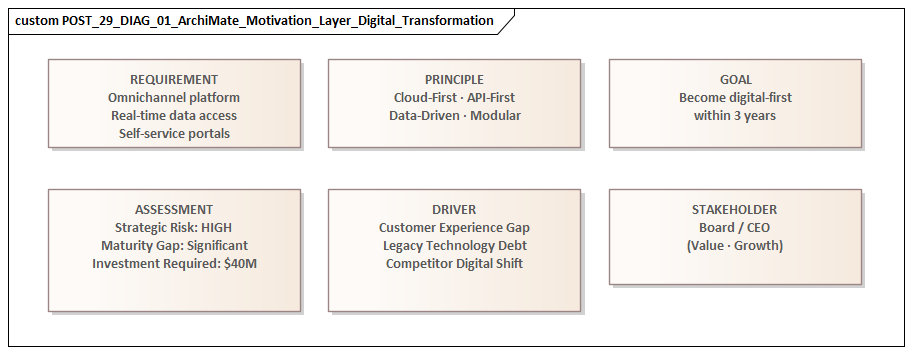
A transformation model is only useful when it starts with clear intent. In ArchiMate, that intent should be expressed through motivation and strategy concepts that explain why change is happening, who cares about it, and what the enterprise is trying to achieve. If that foundation is weak, later models may become technically detailed yet strategically vague.
The motivation layer is the right place to start. Here, architects can represent stakeholders, drivers, assessments, goals, outcomes, principles, and requirements. That matters because transformation is never driven by a single concern. Executive leadership may focus on growth, margin, and speed to market. Regulators may emphasize transparency and control. Customers want convenience and responsiveness. Operations teams care about stability, recoverability, and support burden. Modeling these concerns together exposes both alignment and tension. A faster onboarding experience may support growth while increasing compliance risk if identity controls are weakened. Capturing both in the same model creates a basis for explicit trade-off analysis.
Goals should then be translated into capabilities, because capabilities are a more stable planning anchor than projects, products, or organizational structures. Product names change, teams are reorganized, and initiatives are rebranded, but the enterprise still needs capabilities such as customer onboarding, order fulfillment, case management, analytics, partner integration, or identity and access management. In ArchiMate, capabilities can be linked upward to goals and downward to the processes, services, applications, and technologies that realize them. That gives architects a clear path from strategic ambition to operating and technical design.
A useful discipline is to distinguish differentiating capabilities from foundational ones. Differentiating capabilities shape customer value or competitive advantage, such as personalized engagement, rapid product configuration, or dynamic pricing. Foundational capabilities make transformation scalable and governable, such as integration, master data management, cybersecurity, observability, and platform engineering. IAM modernization is a common example: it may not be customer-visible on its own, but without centralized identity, MFA, role governance, and federation, self-service channels usually remain brittle or noncompliant.
Stakeholder modeling should also extend beyond executives. Product owners, risk teams, data stewards, service operations, external partners, and implementation vendors all influence architecture decisions. Each group evaluates architecture through a different lens. Product teams prioritize speed. Security teams control risk. Operations teams focus on recoverability and maintainability. Linking stakeholders to goals, principles, and requirements helps explain why constraints exist and prevents governance from appearing arbitrary.
This is often where transformation scope is either clarified or lost. If goals are too broad, every initiative can claim alignment. If capabilities are too generic, prioritization becomes difficult. Effective architects therefore define goals in measurable terms and assess capability maturity explicitly. “Improve customer experience” is too vague to guide investment. “Reduce onboarding completion time by 60 percent while preserving compliance checks” is far more useful. Likewise, saying a capability “needs improvement” is less helpful than identifying whether the problem lies in process fragmentation, data inconsistency, application limitations, control gaps, or an operating model weakness.
A realistic example helps. In a healthcare provider, the stated goal might be to “improve digital patient access.” On its own, that is broad enough to justify almost any initiative. Once translated into capabilities, the architecture becomes sharper: appointment scheduling, patient identity management, referral intake, and clinical document exchange. Stakeholder concerns then clarify constraints. Clinicians may want fewer manual handoffs, patients want faster booking, and compliance teams require stronger consent controls. The resulting model supports better choices than a generic digital-access theme.
Once goals, capabilities, and stakeholders are defined, the next step is to show how they are realized across the core architecture layers: business, application, data, and technology.
Modeling Business, Application, Data, and Technology Layers with ArchiMate
After intent is defined, architects need to model how transformation is realized across the core architecture layers. This is where ArchiMate becomes effective as a cross-domain design language. Instead of documenting business processes, systems, data, and infrastructure separately, it allows architects to show how each layer supports or constrains the others. In digital transformation, that coherence is essential because many initiatives fail not at the strategy level, but where business change meets application behavior, information quality, and platform reliability.
At the business layer, the focus is on the structures that deliver value: actors, roles, processes, functions, interactions, and business services. In transformation work, it is often more useful to begin with business services than with internal processes. Services such as digital onboarding, self-service support, claims handling, or partner collaboration express what the enterprise must reliably provide to customers, employees, or partners. Processes and roles can then be modeled as the mechanisms that realize those services. This keeps the architecture anchored in value delivery rather than organizational charts.
The application layer shows how software enables that business behavior. Here, architects model application components, application services, application functions, and cooperation between systems. The key question is not simply which applications exist, but how responsibilities are distributed across them. Legacy environments often contain overlapping functions, duplicated business rules, and tightly coupled integrations that make change expensive. By linking application services to business services, architects can identify where capabilities depend on fragile system landscapes and where modernization should establish clearer service boundaries.
This is also the layer where integration patterns become visible. APIs, event streams, orchestration services, workflow platforms, and shared domain services should be modeled as architectural mechanisms rather than left implicit. For example, an event-driven architecture using Kafka might publish CustomerCreated and OrderSubmitted events so onboarding, billing, and analytics services can react independently instead of relying on brittle point-to-point integration. In a logistics company, that same pattern might support parcel status updates, warehouse allocation, and customer notifications without requiring every downstream system to call the transport management platform directly.
Data deserves explicit treatment, even though ArchiMate distributes information concepts across layers. Architects should model business objects, data objects, and the applications and processes that create, use, or govern them. This becomes critical when transformation depends on consistent customer, product, case, or transaction data across channels. A common failure pattern is to redesign the user experience while leaving data ownership unresolved. ArchiMate helps expose whether a key object such as Customer Profile is mastered centrally, replicated inconsistently, or enriched through multiple processes without clear stewardship.
At the technology layer, architects model the infrastructure and platform services that sustain the application landscape: nodes, networks, system software, cloud platforms, identity services, observability tooling, encryption mechanisms, and high-availability services. In transformation architecture, this should not be treated as a generic hosting diagram. The technology layer should show which platform capabilities matter architecturally and why. A customer-facing service with strict availability targets may depend on resilient deployment architecture. A data-intensive capability may depend on scalable storage and processing services. A regulated workflow may depend on encryption, auditability, and access-control services.
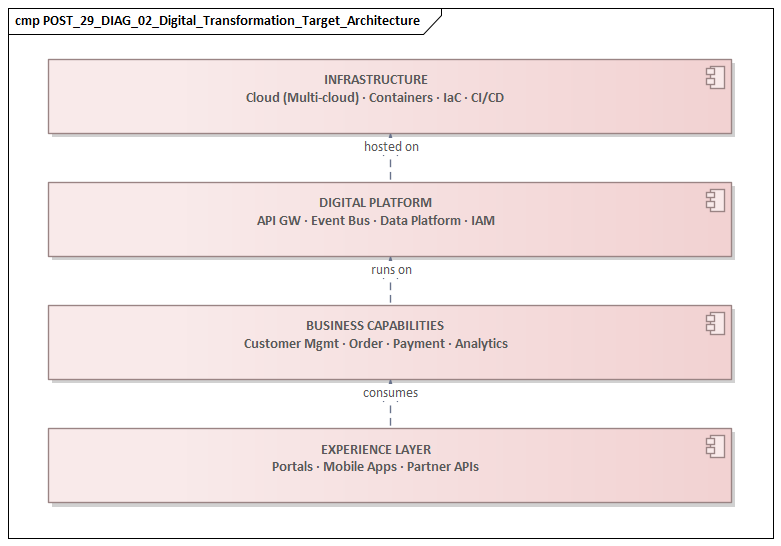
The real value comes from the relationships across layers rather than from separate inventories. A business service is realized by processes and roles, supported by application services, dependent on data objects, and hosted on technology services. Once those links are explicit, architects can perform meaningful impact analysis. They can see which business outcomes are constrained by a legacy database, which process improvements require integration refactoring, or which cloud migration decisions affect control obligations. That layered traceability also supports communication at different levels: executives can discuss service and capability impact, while delivery teams can drill into the applications and platforms involved.
A simple micro-example illustrates the point. Suppose a manufacturer wants to offer dealer self-service for warranty claims. The business layer includes the warranty submission and adjudication services. The application layer reveals dependence on a dealer portal, a claims engine, and an ERP module. The data view shows that product serial numbers are mastered in one system while warranty entitlements sit in another. The technology view exposes that the claims engine still runs on an unsupported platform. The issue is no longer “build a portal”; it is a coordinated change involving data alignment, application modernization, and platform risk reduction.
But layered traceability is only part of the picture. Transformation also requires alignment across competing initiatives. That is where motivation, strategy, and value stream views become especially useful.
Using Motivation, Strategy, and Value Stream Views to Align Change Initiatives
Transformation programs often fail because initiatives are approved as though they were independent, even when they compete for the same capabilities, data, platforms, and change capacity. ArchiMate helps address this through a combination of motivation, strategy, and value stream views. Taken together, these views show why change is needed, how the enterprise intends to respond, and where specific initiatives improve or disrupt the flow of value.
A motivation view frames the logic behind investment decisions. As discussed earlier, it connects drivers, assessments, goals, outcomes, principles, and requirements. This is more useful than a simple list of strategic themes because it reveals why certain initiatives deserve priority. For example, rising customer churn may lead to an assessment that onboarding is too slow and fragmented, which in turn supports goals for faster activation and improved retention. Those goals can then be linked to principles such as API-first integration, data ownership clarity, or security by design. Proposals can be tested against these structures instead of relying on generic claims of strategic relevance.
A strategy view adds discipline by focusing on capabilities, resources, and courses of action. This is particularly helpful when multiple programs claim to support the same objective in different ways. One initiative may propose a new customer platform, another process automation, and a third analytics-driven personalization. A strategy view allows architects to see whether these efforts reinforce one another, depend on shared enabling capabilities, or duplicate investment. It also separates strategic intent from implementation preference. “Improve digital channel responsiveness” is a strategic objective. “Replace the CRM immediately” is only one possible response.
The value stream view makes this alignment operational. Value streams describe how value is created through stages such as discover, onboard, fulfill, support, and renew. This perspective matters because enterprises are usually organized by functions, while customers and partners experience outcomes end to end. By mapping capabilities and services to value stream stages, architects can identify where friction accumulates and where improvement will have the greatest effect. A fragmented onboarding journey may span marketing, sales, identity verification, contract management, provisioning, and support. Modeling it as a value stream reveals handoff failures and highlights which initiatives improve the whole flow rather than one department’s activity.
A practical way to use these views together is during portfolio planning. Start with motivation to clarify the enterprise problem and decision criteria. Use strategy to identify the capabilities and courses of action required. Then use value streams to test whether proposed initiatives improve end-to-end value delivery or merely create local optimization. This sequence helps architects challenge initiatives that are technically attractive but only loosely connected to enterprise outcomes.
These views are particularly effective in investment boards and transformation steering forums because they create a common basis for comparison. Initiatives can be assessed in terms of the goals they support, the capabilities they strengthen, the value stream stages they improve, and the principles or constraints they must respect. An architecture board might reject a second workflow tool, approve Kafka as the enterprise event backbone, and defer portal expansion until identity federation is in place. A proposal that looks beneficial in isolation may duplicate an existing capability, conflict with a broader platform strategy, or shift complexity elsewhere in the value stream.
Consider a telecom example. A sales team proposes a new partner portal to speed reseller onboarding. A separate operations program is already redesigning order orchestration, while the security team is introducing external identity federation. In isolation, each initiative appears justified. In a combined motivation, strategy, and value stream view, the dependencies become obvious: the portal cannot scale without the identity capability, and both efforts rely on the same order status APIs. That insight changes sequencing and avoids duplicate integration work.
Still, alignment is not enough. Even when the right initiatives are selected, the enterprise must move through intermediate states. That is where transition architectures and governance become essential.
Designing Transition Architectures, Roadmaps, and Implementation Governance
A target architecture is necessary, but in transformation programs it is never sufficient. Enterprises do not move from current state to target state in a single step. They move through constrained, temporary, and often imperfect intermediate states. ArchiMate is especially useful here because it allows those transition states to be modeled explicitly rather than left as informal delivery assumptions.
A practical starting point is to define a small number of plateaus that represent meaningful architectural states over time. These should not be arbitrary calendar snapshots. Each plateau should describe a decision-relevant condition of the enterprise, such as “digital onboarding introduced for one market,” “customer data mastered centrally,” or “legacy integration hub retired from priority channels.” That distinction matters because project completion does not necessarily equal enterprise transition. A project may be delivered while the organization still depends on duplicate data stores, manual workarounds, or legacy interfaces. Plateaus make progress measurable in architectural terms.
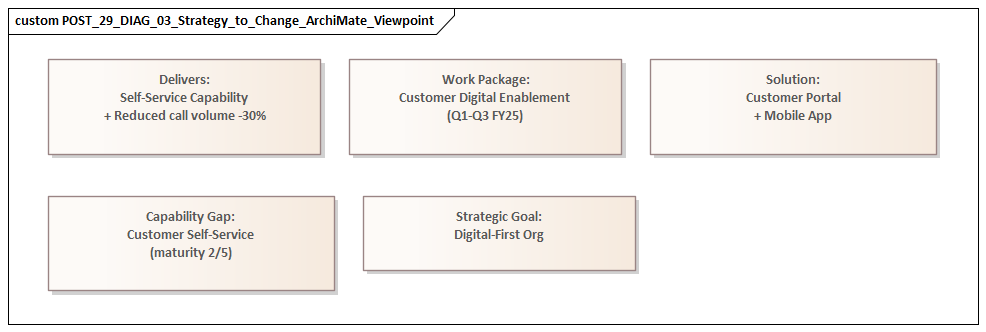
Between plateaus, architects can model gaps, work packages, and deliverables to show what must change and how that change will be governed. This creates a more disciplined roadmap than a simple sequence of projects. A customer self-service program, for example, may require identity federation, API enablement, consent management, process redesign, support model updates, and data stewardship before it can scale safely. If those dependencies are not modeled, the roadmap may prioritize visible front-end delivery while deferring enabling work that is essential for resilience and compliance.
Transition architectures should also be designed for risk containment, not just forward progress. Intermediate states often introduce temporary complexity: dual-running systems, replicated data, bridging interfaces, and hybrid operating procedures. These can be more fragile than either the current or target state. Architects should therefore make temporary structures explicit, including where controls, ownership, and service responsibilities change during migration. This is especially important in regulated environments, where a transition state may unintentionally weaken auditability, segregation of duties, or operational resilience if governance focuses only on the target design.
Roadmapping improves when implementation sequencing is tied to capability readiness rather than technology deployment alone. A platform may be installed, but if support teams are not ready, data stewardship is undefined, or business processes still assume old behaviors, the enterprise has not really transitioned. Architects should ask not only whether a component has been implemented, but whether the related capability can now be performed reliably at scale. This reinforces the earlier point that capabilities are a better anchor than projects or organizational units.
Implementation governance is where architecture either gains authority or loses relevance. ArchiMate supports governance by linking approved goals, principles, target states, and plateaus to specific work packages and solution decisions. Review bodies can then assess whether implementation choices advance the intended transition state, create unmanaged divergence, or introduce local optimizations that compromise the roadmap. Governance should focus on controlled evolution, not rigid conformance. Some deviation is inevitable, but it should be visible, justified, and assessed for downstream impact.
Technology lifecycle governance also belongs here. A board may allow a legacy ESB for 12 months as a transition dependency while setting a formal retirement date and blocking new integrations on it. Similarly, a cloud migration may permit temporary batch replication from a mainframe while requiring all new services to consume canonical APIs. Those are architecture decisions, not merely delivery details, and ArchiMate gives them a place in the transition model.
The most effective architecture teams use transition models as live governance instruments. They update plateaus as delivery realities change, revise dependencies when programs slip or expand, and use roadmap views to explain consequences clearly to both executives and delivery teams. In that form, architecture stops being a static picture of the future and becomes a way to guide the enterprise through change.
Common Challenges, Best Practices, and Patterns for Enterprise Adoption
Adopting ArchiMate at enterprise scale is rarely difficult because of the notation itself. The harder challenge is turning modeling into a credible management practice rather than an isolated architecture activity. Many organizations produce a few polished diagrams and then fail to sustain usage because the models are not embedded in portfolio planning, solution delivery, or governance routines. Enterprise adoption works when ArchiMate becomes part of the architecture operating model.
A common challenge is overmodeling. Architecture teams sometimes respond to complexity by producing highly detailed models that are technically correct but difficult for stakeholders to use. In practice, adoption improves when models are created for decisions, not for completeness. A portfolio board may need capability impact and dependency views. A platform team may need application cooperation and technology usage views. A risk function may need transition-state control views. The metamodel can be standardized centrally, but viewpoints should be tailored to stakeholder questions.
Another frequent issue is inconsistent abstraction. Teams often mix strategic concepts, solution details, and implementation tasks in the same diagram, which makes models hard to interpret and govern. Good enterprise practice is to define conventions for what belongs in each view, what level of granularity is acceptable, and how elements are named. Capabilities should remain stable and business-oriented. Application components should reflect governable system units. Work packages should describe bounded change. Without those conventions, the repository becomes difficult to trust.
Repository fragmentation is a third problem. Different domains or programs may maintain their own models with little integration, undermining the cross-domain traceability that ArchiMate is meant to provide. A practical response is a federated modeling approach. Core enterprise concepts such as capabilities, business services, major applications, key data objects, technology platforms, and reusable building blocks should be governed centrally, while domain teams extend them locally within agreed boundaries. This balances consistency with delivery autonomy.
Several practices consistently improve adoption. First, start with a small set of high-value viewpoints rather than trying to model everything at once. Momentum grows when stakeholders see that models answer real questions such as investment overlap, application rationalization, platform dependency risk, or transformation sequencing. Second, connect ArchiMate to existing governance artifacts. If investment proposals, architecture reviews, and roadmap checkpoints refer to approved models, usage becomes institutional rather than optional. Third, maintain links between ArchiMate models and complementary evidence such as capability assessments, process metrics, application inventories, control libraries, and risk registers. The model becomes more valuable when it is connected to facts, not just structure. free Sparx EA maturity assessment
There are also several repeatable patterns that work well in digital transformation. The capability-to-platform pattern maps strategic capabilities to enabling application and platform services, revealing shared investment needs across business units. The journey-to-integration pattern links value stream stages to processes, applications, and integrations, making handoff and orchestration problems easier to diagnose. The legacy containment pattern models legacy systems not simply as technical debt, but as bounded dependencies with explicit retirement conditions, temporary interfaces, and named risk ownership.
Another useful pattern is domain-based reuse. In a large enterprise, teams often build similar functions repeatedly because they cannot see where reusable services already exist. A shared notification service, consent service, or document-generation platform may support multiple journeys if it is modeled clearly and governed as a reusable building block. In one public-sector organization, three programs planned separate messaging capabilities for citizens, case workers, and providers. A federated ArchiMate repository showed that a common notification platform could serve all three with different templates and channel rules.
Ultimately, adoption depends less on diagram quality than on governance behavior. If architects use ArchiMate to clarify decisions, expose duplication, and explain trade-offs in language stakeholders understand, the practice gains credibility. If models are maintained only for compliance or documentation, they quickly go stale.
Conclusion
Modeling digital transformation architecture with ArchiMate is most valuable when it helps the enterprise manage change as a system of interdependent decisions rather than as a pipeline of disconnected projects. Its real strength is not simply that it provides a standardized notation, but that it connects strategic intent, capability planning, value delivery, application change, information dependencies, and platform evolution in a form that can be governed over time.
As this article has shown, the discipline starts with clear goals, capabilities, and stakeholder concerns. It then connects those concepts across business, application, data, and technology layers, aligns initiatives through motivation, strategy, and value stream views, and finally governs movement through explicit transition architectures and roadmaps. That progression matters because digital transformation succeeds only when intent, design, and implementation remain connected.
The practical test of any transformation model is whether it remains useful under delivery pressure. Priorities change, budgets tighten, and implementation realities expose new constraints. Architecture must therefore be stable enough to preserve enterprise coherence while flexible enough to absorb learning from programs already in flight. ArchiMate supports that balance by allowing architects to update relationships, impacts, and transition states without losing the larger logic of the transformation.
In the end, digital transformation becomes more manageable when the enterprise can see what must change together, what can change independently, and what trade-offs are involved. Used well, ArchiMate gives architecture teams that visibility and helps turn complexity into coordinated action.
Frequently Asked Questions
What is enterprise architecture?
Enterprise architecture is a discipline that aligns an organisation's strategy, business processes, information systems, and technology. It provides a structured approach to understanding the current state, defining the target state, and managing the transition — using frameworks like TOGAF and modeling languages like ArchiMate.
How does ArchiMate support enterprise transformation?
ArchiMate supports transformation by modeling baseline and target architectures across business, application, and technology layers. The Implementation and Migration layer enables architects to define transition plateaus, work packages, and migration events — creating a traceable roadmap from strategy through to implementation.
What tools are used for enterprise architecture modeling?
The most widely used tools are Sparx Enterprise Architect (ArchiMate, UML, BPMN, SysML), Archi (ArchiMate-only, free), and BiZZdesign Enterprise Studio. Sparx EA is the most feature-rich — supporting concurrent repositories, automated reporting, scripting, and integration with delivery tools like Jira and Azure DevOps.