⏱ 25 min read
Using ArchiMate in Enterprise Architecture Transformation | Best Practices
Learn how ArchiMate supports enterprise architecture transformation by improving modeling, stakeholder communication, impact analysis, and strategic alignment across business, application, and technology layers. ArchiMate tutorial for enterprise architects
ArchiMate, enterprise architecture transformation, ArchiMate framework, enterprise architecture modeling, business architecture, application architecture, technology architecture, architecture transformation, stakeholder communication, impact analysis, strategic alignment ArchiMate layers explained
Introduction
Enterprise architecture transformation is no longer an occasional redesign exercise carried out at a distance from delivery. In most organizations, it has become a continuous discipline shaped by cloud adoption, platform modernization, regulatory demands, data growth, and pressure to respond faster to market change. In that environment, architecture teams need more than static diagrams or scattered documentation. They need a modeling approach that connects strategy, operations, technology, and implementation in a form that supports real decisions. That is where ArchiMate earns its place. ArchiMate relationship types
At its core, ArchiMate is a modeling language for describing how an enterprise works and how it changes. Its practical value lies not simply in representing business, application, and technology domains, but in showing how those domains interact. That matters in transformation because replacing a core platform, redesigning a customer journey, or consolidating data services rarely affects a single area in isolation. A change that begins in one domain usually ripples across processes, applications, integrations, infrastructure, ownership, and delivery sequencing. ArchiMate makes those dependencies visible. ArchiMate modeling best practices
This becomes especially important when architects have to turn strategic intent into executable design. Leaders may define goals such as improving customer experience, reducing operating cost, or increasing resilience. Those ambitions then have to be translated into changes to capabilities, processes, services, applications, data, and platforms. ArchiMate supports that translation by allowing architects to model motivation, baseline architecture, target architecture, and transition states within one coherent framework. Instead of treating strategy, design, and implementation as separate conversations, it preserves traceability between them.
It also improves communication across stakeholder groups. Executives need clarity on outcomes and trade-offs. Portfolio managers need to understand priorities and dependencies. Solution architects need design boundaries. Operations teams need to see runtime and support implications. A model-based approach gives each audience a different view into the same architecture rather than leaving them to work from disconnected documents and competing assumptions.
Governance is another area where ArchiMate proves useful. Transformation programs often struggle not because the target state is unclear, but because dependencies, sequencing, and ownership are poorly understood. By modeling services, capabilities, work packages, plateaus, and gaps, architects can make roadmaps more concrete and easier to govern. Consider a phased identity and access management modernization: once the model shows that identity services underpin customer onboarding, workforce access, and cloud platform controls, the board can evaluate sequencing and risk with far more confidence.
Used well, ArchiMate is more than a notation standard. It becomes a practical means of aligning intent, design, and execution across the transformation lifecycle.
Why ArchiMate Matters in Transformation
ArchiMate matters because it gives architects a disciplined way to make change visible, comparable, and actionable. Transformation programs usually involve several efforts at once: capability uplift, process redesign, application replacement, data consolidation, platform migration, and operating model change. Each may appear justified on its own. The harder task is understanding how they reinforce one another, compete for the same dependencies, or introduce new risks. ArchiMate helps reveal that wider picture by representing transformation as an interconnected set of structural and behavioral changes rather than a collection of separate projects.
One of its strongest advantages is traceability. In transformation work, strategic intent often gets diluted as planning moves from executive objectives into programs, backlogs, and technical tasks. ArchiMate helps preserve the line of reasoning. It allows architects to show how an objective such as faster onboarding or lower operational risk is supported by particular capabilities, business services, application services, technology services, and implementation initiatives. That traceability improves design quality, but it also strengthens governance, funding discussions, and benefit tracking.
It becomes even more useful when organizations move away from project-centric planning toward capability- or product-centric models. In many enterprises, value depends less on individual programs than on improvements to shared platforms, common services, and reusable data assets. ArchiMate supports that shift by linking strategic drivers and business capabilities to enabling applications, platforms, and work packages. This gives architects a stronger basis for deciding where to invest first and for identifying whether a business problem stems from process fragmentation, poor integration, duplicated systems, or infrastructure constraints.
Transformation also rarely starts from a blank slate. Most organizations have to modernize while keeping critical legacy estates running. That means architects need to model coexistence: old and new applications operating in parallel, staged data migration, temporary controls, and transitional integrations. ArchiMate is particularly effective here because its implementation and migration concepts allow transition architectures to be represented in a structured way. Architects can show which components are strategic, which are being contained, and which are nearing retirement.
A further advantage is decision support. Architecture teams are regularly asked whether to consolidate platforms, where to standardize services, how to reduce duplication, or which dependencies could delay a milestone. ArchiMate provides a firmer basis for those discussions than narrative documents alone because the relationships are explicit. If an architecture board is reviewing an event-driven integration proposal, for example, the model can show whether Kafka is being introduced as a governed enterprise backbone with clear topic ownership or simply as another point-to-point mechanism under a new label. That distinction has direct implications for risk, operating model, and long-term value.
In the end, ArchiMate matters because it makes enterprise architecture more operational. It helps architects move beyond abstract target-state descriptions and engage directly with sequencing, trade-offs, and implementation constraints. In transformation work, that is the difference between architecture that describes change and architecture that helps direct it.
Core Concepts and Layered Modeling Foundations
To use ArchiMate effectively in transformation, it helps to understand the small set of concepts that recur throughout the language. That consistency is one of its strengths. Rather than applying one modeling logic to business, another to applications, and another again to technology and change, ArchiMate uses the same structural thinking across layers. That is what makes cross-domain traceability possible.
At a practical level, ArchiMate distinguishes between three questions:
- What performs?
- What happens?
- What is used or produced?
These correspond broadly to active structure, behavior, and passive structure. Active structure elements are the entities that perform behavior, such as business actors, application components, or technology nodes. Behavior elements represent processes, functions, interactions, and services. Passive structure elements represent what behavior acts on, such as business objects, data objects, or artifacts.
This distinction is useful because it avoids a common architecture problem: mixing organizational ownership, process flow, application functionality, and data into one blurred picture. When those concerns are separated, analysis becomes clearer. If a process changes, architects can more easily see which actors perform it, which services expose it, which applications support it, and which data it relies on.
ArchiMate organizes these concepts across layers:
- Business layer: actors, roles, processes, functions, products, and business services
- Application layer: application components, interfaces, data objects, and application services
- Technology layer: nodes, devices, system software, networks, and technology services
These layers are not intended to become silos. The value lies in connecting them. A business capability improvement may require process redesign in the business layer, service decomposition in the application layer, and platform changes in the technology layer. Layering provides structure; relationships create integration.
Another important distinction is between internal behavior and externally visible services. An organization or system may carry out many internal activities, but consumers interact through services. Modeling services explicitly helps define stable interaction points while allowing internal implementation to evolve. This matters in transformations involving APIs, shared services, platform operating models, or business service standardization. In an IAM modernization effort, for instance, authentication and authorization are best modeled as enterprise services consumed by channels, workforce tools, and cloud platforms rather than as scattered application-specific functions.
Relationships matter as much as the elements themselves. Structural relationships such as composition, aggregation, assignment, and realization show how elements are built and connected. Dependency-oriented relationships such as serving, access, and flow show how value, information, or support moves through the architecture. These are what turn diagrams into analytical models. If several business services depend on one application component, and that component depends on a fragile technology node, the model quickly reveals concentration risk.
ArchiMate also extends beyond structural architecture into motivation and implementation. Drivers, goals, outcomes, principles, constraints, work packages, plateaus, and gaps allow architects to connect architecture to planning and execution. That is what makes the language useful in transformation: it can express why change is needed, what must change, and how it will be delivered.
A simple example illustrates the point. A bank may set a goal to reduce mortgage approval time from five days to one. In ArchiMate, that goal can be linked to a lending capability, to a business process for credit assessment, to application services for document validation and decisioning, and further down to cloud-hosted analytics services and implementation work packages. The value is not the diagram itself; it is the ability to follow the chain from business outcome to enabling change.
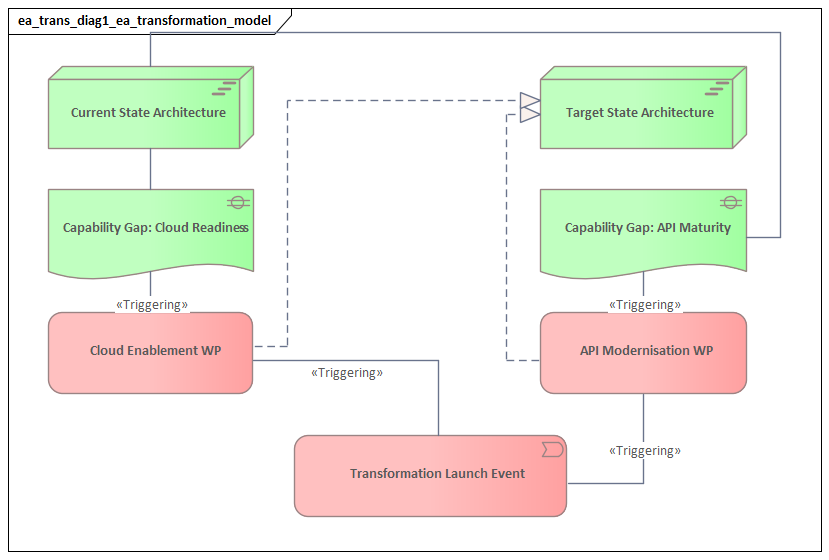
Mapping Current-State and Target-State Architectures
One of the most practical uses of ArchiMate is modeling both the current architecture and the intended future architecture in a way that makes their differences explicit. Current-state and target-state modeling sit at the center of its value as a decision support tool.
A useful starting principle is to model the current state as a decision-oriented baseline, not as an exhaustive inventory. The goal is not to document everything in the enterprise. It is to capture the elements and relationships that materially affect the transformation in scope. If the objective is to modernize customer onboarding, the baseline should show the relevant business processes, roles, supporting applications, integrations, key data objects, and infrastructure dependencies that shape onboarding performance, cost, and risk.
That selective approach keeps models usable. It also prevents ArchiMate from turning into a broad documentation exercise detached from decisions.
Current-state modeling is especially effective at exposing hidden complexity. Legacy environments often seem manageable when reduced to application lists or process narratives, but the real constraints usually sit in the interdependencies. A process may rely on manual workarounds because application services are inconsistent. Several systems may depend on the same data store, creating migration risk. A platform assumed to be isolated may in fact support multiple critical services through undocumented interfaces. By modeling those relationships directly, architects can see where the current architecture is tightly coupled, operationally fragile, or misaligned with strategic priorities.
Target-state modeling requires a different discipline. The aim is not to draw a cleaner version of today’s environment, but to define an architecture intentionally shaped around future operating needs. That means using layers and services to establish clearer boundaries. A strong target-state model should show what will be standardized, what will be consolidated, what will become a shared service, and what will be retired or contained. In a target state built around event streaming, for example, event producers, consumers, topic ownership, and integration boundaries should be clearer than in the baseline, where dependencies may be buried in batch jobs and point-to-point interfaces.
For comparison to be meaningful, current-state and target-state views need to be modeled at comparable levels of abstraction. If the baseline is highly detailed but the target remains vague, the path between them will be difficult to assess. If the target is more detailed than the baseline, the effort needed to move from one to the other may be underestimated. Architects should therefore keep scope and abstraction level consistent across both views, often centered on affected capabilities, value streams, application services, data domains, and enabling platforms.
ArchiMate also helps distinguish between differences that matter and those that do not. Some changes are local optimizations. Others alter service boundaries, ownership, dependencies, or control points and therefore carry broader transformation significance. Replacing a user interface may have limited architectural impact; introducing a new shared integration service may reshape multiple domains. Because ArchiMate models relationships explicitly, it helps architects focus attention on the changes with the greatest strategic value or delivery risk.
A realistic example comes from retail. A current-state model may show online returns handled by one application, store returns by another, and refund approvals routed through email and spreadsheets. The target state might consolidate returns into a shared business service supported by a single application service and a common inventory data object. The architectural difference is not just application consolidation; it is a change in process ownership, service boundary, and data control.
Used in this way, state mapping becomes more than documentation. It becomes a structured comparison exercise that shows what must change, what can remain stable, and where transition architectures will be needed.
Connecting Strategy, Business, Application, and Technology Domains
A major challenge in transformation is that strategic intent is often too broad to guide design directly. Goals such as growth, resilience, customer intimacy, or efficiency are valid, but they do not by themselves indicate which capabilities must change, which systems need modernization, or which technology constraints must be removed. ArchiMate is valuable because it connects these concerns through a common modeling structure.
Its practical strength lies in building traceable chains across domains. A strategic driver can be linked to goals, outcomes, capabilities, value streams, business processes, application services, and technology services. This is more than a documentation convenience. It changes the quality of architectural decision-making. When leaders ask why a platform investment is necessary, architects can show which capabilities it enables and which outcomes it supports. When a business team proposes a new capability, architects can assess whether the application and technology landscape can realistically support it.
Capabilities are particularly useful as a bridge between strategy and execution. They provide a relatively stable anchor because they describe what the enterprise must be able to do regardless of how teams or systems are arranged at a given moment. In ArchiMate, capabilities can be connected to business behavior, supporting applications, and enabling infrastructure. This makes it easier to see whether a capability is weak because strategy is unclear or because the supporting architecture is fragmented. A capability such as real-time customer decisioning, for example, may depend on process redesign, shared data services, event-driven integration, and scalable cloud platforms. Modeling those dependencies together makes it clear that capability uplift is rarely confined to a single domain.
Cross-domain modeling also helps clarify operating model implications. Strategy often falters when it is translated into system change without enough attention to ownership, interaction patterns, and service boundaries. By connecting business actors, roles, and services to application interfaces and platform services, architects can show how responsibility is distributed across the enterprise. This is especially important in federated organizations, product-centric models, or platform businesses where local autonomy must coexist with enterprise standards.
The objective is not to capture every possible relationship. The focus should remain on the relationships that affect investment, sequencing, standardization, and control. If several business capabilities depend on the same integration platform, that concentration should be visible. If a technology choice creates lock-in that affects future business options, that should appear as an architectural concern. If a strategic priority depends on a small number of critical applications, those dependencies should be explicit.
Cross-domain modeling also improves trade-off discussions. Standardizing a platform may reduce cost while limiting local flexibility. Accelerating cloud migration may improve scalability while introducing compliance and skills challenges. Consolidating applications may simplify support while increasing short-term migration risk. A common example is IAM modernization: centralizing identity services may improve security, auditability, and user experience, but it also creates migration dependencies across HR, customer channels, and legacy applications. Because ArchiMate ties these choices back to capabilities, services, and dependencies, it helps stakeholders discuss trade-offs in enterprise terms rather than from isolated domain perspectives.
Another micro-example is common in healthcare. A strategy to expand digital patient access may look like a channel initiative, but the architecture model may reveal dependencies on appointment scheduling, consent management, identity verification, API security, and hosting resilience. Without that cross-domain view, the organization may fund the portal and underestimate the enabling work.
In this way, ArchiMate makes strategy structurally meaningful, grounds business change in technical reality, and connects technology decisions visibly to enterprise outcomes.
Transformation Planning, Roadmapping, and Gap Analysis
Once the current and target states are understood, the next challenge is defining a transformation path that is realistic, sequenced, and governable. This is where ArchiMate’s implementation and migration concepts become especially useful. The language is most effective when it links architecture to execution rather than stopping at a target-state description.
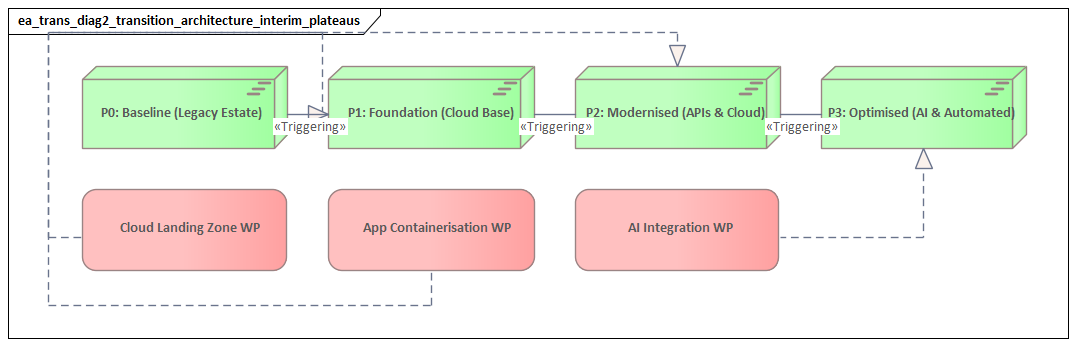
A practical way to think about transformation is in terms of transition architectures, not a single leap from baseline to target. Most enterprises cannot move directly to the desired future state because technical debt, contracts, regulatory controls, budget cycles, and operational dependencies all constrain the pace of change. ArchiMate addresses this with concepts such as plateaus, gaps, and work packages.
- Plateaus represent meaningful states of architectural maturity.
- Gaps represent what is missing or misaligned between states.
- Work packages represent the change initiatives needed to move between them.
This allows architects to model transformation as a progression through controlled states. One plateau might represent API enablement of legacy systems, another a partial channel migration, and a later plateau full platform consolidation. In a technology lifecycle governance example, an intermediate plateau may show an operating state where unsupported middleware is isolated behind standard services before final retirement. This is more useful than a simple timeline because each state can be understood in terms of architectural capability, value delivered, and risk exposure.
Gap analysis also becomes stronger when it is modeled structurally rather than described only in prose. The most important gaps are often not missing systems, but missing capabilities, weak service boundaries, duplicated data ownership, insufficient resilience, or unclear accountability. ArchiMate allows those gaps to be located in relation to specific architecture elements and relationships. A gap affecting a core business service has a very different significance from one affecting a peripheral reporting process. Structural gap analysis helps architects distinguish between strategically blocking issues, operational risks, and lower-priority improvements.
Roadmapping benefits in the same way from explicit dependency modeling. Many transformation plans fail because initiatives are sequenced according to budgets or organizational boundaries rather than architectural prerequisites. A customer-facing capability may be scheduled before the underlying data service is standardized. An application retirement may be announced before dependent interfaces are migrated. A cloud move may begin before identity, networking, or observability foundations are in place. By linking work packages to the elements they implement, modify, or retire, ArchiMate helps expose these sequencing problems early.
Another valuable use is identifying shared enablers across multiple initiatives. In large portfolios, different programs often propose similar foundational work under different labels: API mediation, workflow orchestration, security uplift, master data improvement, platform automation. When these are modeled within one architecture, they become visible as reusable building blocks rather than duplicated project activities. That supports better portfolio rationalization and helps justify investment in enterprise capabilities that unlock several initiatives at once. A Kafka platform, for example, may emerge not as an isolated integration project but as a shared enabler for customer notifications, operational telemetry, and real-time data propagation.
ArchiMate also improves governance during execution. A roadmap is not just a schedule; it is a hypothesis about how change will deliver value at an acceptable level of risk. As programs move forward, architects can use the model to test whether planned plateaus still make sense, whether dependencies have shifted, and whether new constraints require resequencing. Because the same model links outcomes, architecture changes, and implementation work, it is easier to adapt than a static roadmap maintained separately from the architecture.
A realistic example can be seen in ERP modernization. The target may be a single cloud ERP, but the first plateau may focus only on finance and procurement, while manufacturing remains on the legacy platform behind standardized integration services. The gap is not merely technical; it includes data ownership, control changes, and support model adjustments. Modeling that explicitly helps avoid the false impression that the first release completes the transformation.
Used this way, ArchiMate brings discipline to transformation planning. It connects architectural change, delivery sequencing, and portfolio decision-making so that roadmaps are both strategically meaningful and operationally credible.
Governance, Stakeholder Communication, and Adoption Practices
ArchiMate delivers the most value when it is embedded in governance rather than used only as a documentation technique. Its strength lies in making relationships, dependencies, and transition logic visible. Governance is where that visibility becomes useful. In transformation programs, governance is not simply about checking compliance with standards; it is about ensuring decisions remain aligned with enterprise intent as local optimizations and delivery pressures begin to reshape the plan.
In practice, ArchiMate should be treated as a decision-support mechanism. Governance forums should not ask only whether a team has produced a model. They should ask whether the model makes key concerns visible: which capability is affected, which services are impacted, what dependencies are introduced, what legacy elements remain, and what roadmap commitments change as a result. This shifts architecture governance away from artifact inspection and toward evidence-based review. An architecture board may, for example, approve use of a strategic cloud service but reject an exception to technology standards because the model shows it would extend the life of a product already in retirement.
Stakeholder communication is just as important. Different stakeholders need different views of the same architecture:
- Executives need concise views tied to outcomes, cost, and risk.
- Portfolio leaders need visibility into dependencies and sequencing.
- Domain and solution architects need structural precision.
- Operations teams need runtime implications, ownership boundaries, and transition impacts.
ArchiMate supports this through viewpoints, but using them well requires discipline. Views should be tailored to audience and purpose while remaining traceable to a coherent underlying model. That is what turns ArchiMate from a specialist notation into a practical communication tool.
A common adoption mistake is trying to model too much, too early. Enterprise-wide ArchiMate initiatives often stall because teams attempt to capture the whole organization in high detail before proving immediate value. A better approach is incremental adoption tied to transformation priorities. Start with a bounded use case such as application rationalization, platform modernization, regulatory traceability, or capability uplift in a critical value stream. Build only the depth needed to support decisions in that area. Once stakeholders see clearer roadmaps or better impact analysis, broader adoption becomes much easier to justify.
Lightweight modeling standards are also essential. Without them, repositories quickly become inconsistent: the same concept is modeled in several ways, relationships are used ambiguously, and cross-team analysis becomes unreliable. Standards do not need to be heavy, but they should define naming conventions, abstraction levels, required viewpoints, and the representation of key elements such as capabilities, services, applications, and work packages. Ownership matters as well. If no one is accountable for model quality and coherence, the repository will degrade quickly.
Tooling and operating model choices should reinforce integration with normal architecture and portfolio practices. If ArchiMate models are disconnected from roadmaps, standards, solution reviews, or investment governance, they become shelfware. If they are built into those processes, they become part of how the enterprise reasons about change. In many organizations, this works best through a federated model: central architecture teams maintain metamodel discipline and enterprise views, while domain teams maintain local detail within agreed guardrails.
Successful adoption is therefore less about notation training than about institutionalizing a model-based way of working. The goal is not more diagrams. It is a shared architectural language that improves governance, sharpens communication, and keeps transformation decisions coherent over time.
Common Challenges, Limitations, and Success Factors
Despite its strengths, ArchiMate is not a guaranteed answer to transformation complexity. Many organizations adopt it expecting the notation itself to create clarity, only to discover that poor modeling discipline, weak governance integration, or unrealistic scope limits its value. The language becomes useful only when it is tied to real decision processes.
One common challenge is abstraction mismatch. Transformation conversations move across very different levels, from strategic themes to platform dependencies. If models mix those levels inconsistently, they become difficult to interpret. A view that places high-level business outcomes alongside low-level infrastructure components without an intermediate structure may look comprehensive, but it usually obscures more than it clarifies. Architects need to decide explicitly what level of abstraction a given model is meant to support and avoid forcing every view to serve every audience.
A second limitation is the false sense of completeness that a polished model can create. Because ArchiMate is expressive and visually structured, stakeholders may assume a well-formed model reflects the full reality of the enterprise. In practice, many critical transformation factors sit partly outside formal architecture: political resistance, funding uncertainty, vendor constraints, skills shortages, data quality issues, and informal operational workarounds. ArchiMate can represent some constraints, but it cannot replace architectural judgment about organizational readiness and delivery feasibility.
Another challenge is repository decay. Transformation programs move quickly, and architecture models lose credibility when they are not updated as decisions change. An outdated repository is often worse than no model at all because teams continue to rely on obsolete dependencies and target-state assumptions. This is not just a tooling issue; it is an operating model issue. Organizations need clear ownership for which teams maintain which parts of the model, when updates are required, and how changes are validated.
There is also the risk of over-modeling. Architects sometimes respond to complexity by adding more and more detail, assuming richer representation will produce better insight. Often the opposite happens. Excessive detail makes transformation models harder to navigate and less useful in decision-making. The most effective use of ArchiMate is selective, focused on the elements that influence investment choices, dependency risk, sequencing, standardization, and accountability. If a relationship does not affect a decision, it may not need to be modeled at that stage.
These challenges point to a set of practical success factors:
- Tie ArchiMate to clear transformation use cases such as portfolio rationalization, dependency analysis, regulatory traceability, or target operating model design.
- Maintain stable modeling conventions so views can be compared across teams and over time.
- Embed models in governance and delivery rhythms so they are reviewed, challenged, and updated as part of normal work.
- Apply judgment alongside formal modeling to account for organizational behavior, commercial realities, and delivery capacity.
- Model selectively so the architecture remains decision-oriented rather than encyclopedic.
The broader lesson is straightforward. ArchiMate works best as an architectural thinking framework, not merely a diagramming technique. Its value comes from helping teams sharpen choices, expose hidden dependencies, and maintain coherence across long-running transformation efforts. Where that discipline exists, ArchiMate becomes a practical enabler of enterprise change. Where it does not, it risks becoming just another well-structured but lightly used documentation layer.
Conclusion
ArchiMate is most valuable in transformation when it makes architecture operational. Its contribution is not cleaner diagrams, but a consistent way to reason about change across strategy, structure, delivery, and governance. In complex transformation environments, that consistency matters because decisions are rarely isolated. A platform choice affects service boundaries, integration patterns, ownership, risk, investment timing, and ultimately business outcomes.
A clear theme runs through the discussion above: ArchiMate is strongest when it preserves traceability. It connects strategic intent to capabilities, capabilities to services and systems, and those systems to implementation work and transition states. That traceability reduces ambiguity, improves planning, and strengthens governance.
It also supports continuity. Enterprises do not transform through a single decisive redesign; they evolve through repeated decisions made under pressure and constraint. A well-governed ArchiMate model provides a stabilizing reference point that helps preserve intent as scope changes, budgets shift, and implementation realities emerge.
Using ArchiMate well therefore requires discipline, selectivity, and sound architectural judgment. It works best when focused on decisions that matter, maintained as part of active governance, and connected directly to portfolio and delivery practices. Applied in that way, ArchiMate strengthens enterprise architecture from advisory documentation into a practical instrument for steering transformation with clarity, traceability, and control.
Frequently Asked Questions
How does ArchiMate support digital transformation planning?
ArchiMate supports transformation by modeling baseline architecture, target architecture, and transition plateaus. Implementation and Migration diagrams show work packages, migration events, and the sequencing of changes needed to move from current to future state.
What is a transition architecture in ArchiMate?
A transition architecture in ArchiMate represents an intermediate state between baseline and target. It describes the architecture at a specific milestone in the transformation journey, helping teams plan incremental delivery and manage dependencies across parallel workstreams.
How do you create an implementation roadmap in ArchiMate?
An implementation roadmap in ArchiMate is created using the Implementation and Migration layer, modeled with Work Packages (groups of work), Implementation Events (milestones or triggers), and Plateaus (stable architecture states). Gap Analysis diagrams show what must change between each plateau.