⏱ 7 min read
When people search for "ArchiMate vs TOGAF difference," they are usually not looking for textbook definitions. They are asking practical questions: Which one should we implement first? Do we really need both? Why does our architecture feel disconnected from strategy? Why do we have models that nobody actually uses? ArchiMate tutorial for enterprise architects

This guide goes beyond certification-level comparisons. It explains how ArchiMate in TOGAF ADM and ArchiMate modeling guide work together in real enterprise environments — cloud migrations, banking transformations, digital government programs, and large-scale modernization initiatives.
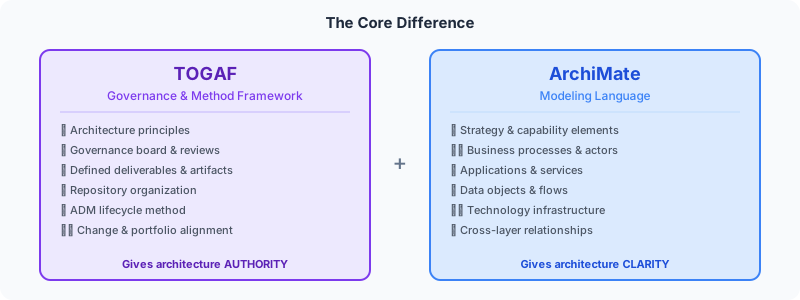
The Core Difference: Governance vs Language
TOGAF is a governance and method framework. It defines how an Enterprise Architecture function operates: who approves decisions, how changes are managed, which artifacts are produced, and how architecture aligns with portfolio and project governance.
ArchiMate is a modeling language. It defines a standardized way to describe strategy and capabilities, business processes and actors, applications and services, data objects, technology infrastructure, and migration planning — with formal relationships connecting everything across layers.
They are complementary, not competing. If TOGAF is the operating model of your EA function, ArchiMate is the structured language it uses to describe reality. ArchiMate layers explained
What TOGAF Actually Does in an Organization
Most architects know TOGAF because of the ADM (Architecture Development Method). But in practice, TOGAF is much more than a lifecycle diagram. It provides architecture principles, governance structures with Architecture Boards and review checkpoints, defined deliverables and artifacts, repository organization, change management alignment, and integration with portfolio and project governance.
In real enterprises, TOGAF helps answer critical questions: Who approves architectural decisions? How are deviations managed? How do we align projects with strategy? How do we ensure compliance and traceability?
Without this structure, architecture becomes reactive and fragmented. However — and this is critical — TOGAF does not define a standardized visual modeling language. That is where ArchiMate becomes essential.
What ArchiMate Solves
ArchiMate provides semantic structure. Instead of creating random Visio diagrams, PowerPoint-based "architectures," isolated BPMN models, or disconnected infrastructure drawings, ArchiMate allows you to create traceable, layered models.
It defines not only elements but also relationships between them. This enables something extremely powerful: impact analysis and cross-layer traceability. When a business capability changes, you can trace the impact through processes, applications, data, and infrastructure — automatically if your models are maintained in a repository tool like Sparx Enterprise Architect.
Why Many Enterprise Architecture Initiatives Fail
Organizations typically fall into one of two traps.
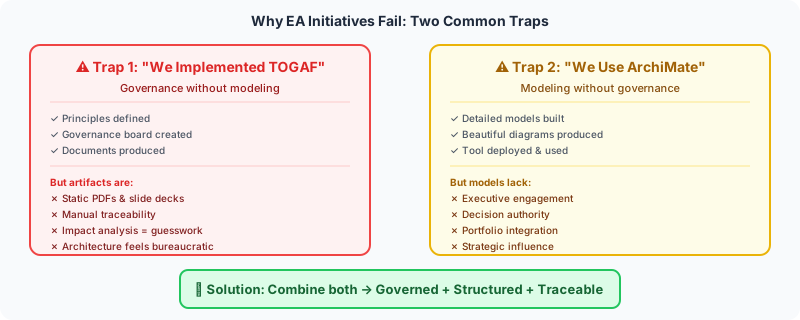
Trap 1: "We Implemented TOGAF"
The organization defines governance, creates principles, and produces documents. But architecture artifacts remain static PDFs, Word documents, and slide decks. There is no structured modeling backbone. Traceability becomes manual, impact analysis becomes guesswork, and architecture becomes bureaucratic — a compliance exercise rather than a transformation enabler.
Trap 2: "We Use ArchiMate"
Teams build detailed models in tools and produce beautiful diagrams. But there is no governance ensuring executive engagement, lifecycle discipline, decision authority, or integration with portfolio management. The models exist, but they do not influence strategy. Architecture becomes an academic exercise disconnected from organizational decision-making.
The Real Answer: You Need Both
TOGAF gives architecture authority. ArchiMate gives architecture clarity. Together, they create enterprise-grade architecture capability where models are not just documentation but active decision-support instruments governed by a mature EA function.
A Practical Implementation Roadmap
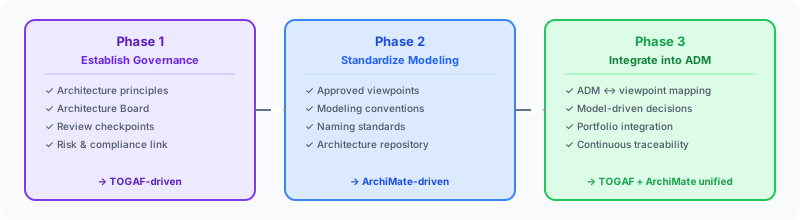
Phase 1: Establish Governance First
Before any modeling begins, the organizational foundation must be in place. Define architecture principles that reflect business priorities. Establish an Architecture Board with clear authority and stakeholder representation. Integrate architecture reviews into the project lifecycle so that no significant initiative bypasses architectural oversight. Align architecture governance with risk, compliance, and security functions.
Architecture must become part of decision-making, not an afterthought. This is where TOGAF guide provides the foundation for architects and governance stakeholders.
Phase 2: Standardize Modeling with ArchiMate
With governance in place, introduce ArchiMate as the common modeling language. Define approved viewpoints that serve specific stakeholder needs. Establish modeling conventions so that diagrams are consistent across teams. Enforce naming and relationship standards that prevent semantic drift. Organize a structured architecture repository that becomes the single source of truth.
ArchiMate becomes the common language across business, application, and technology domains — understood by architects, developers, business analysts, and management alike. ArchiMate relationship types
Phase 3: Integrate ArchiMate into the ADM Cycle
The most powerful step is mapping ADM phases directly to ArchiMate viewpoints, making architecture model-driven rather than document-driven. ArchiMate modeling best practices
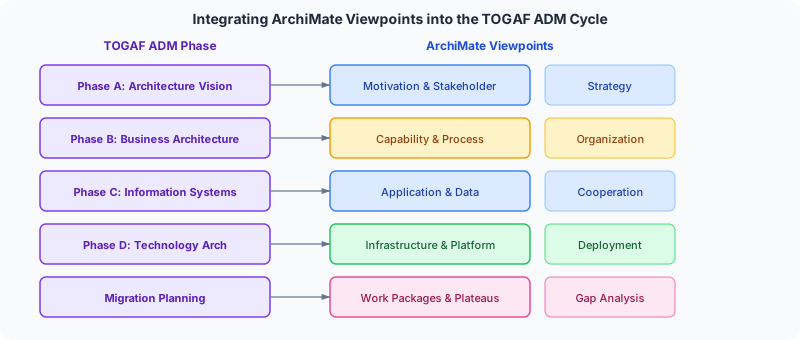
This integration means that every ADM deliverable is backed by a formal model, every architecture decision is traceable through the model repository, and every migration plan uses ArchiMate plateaus and gap analysis rather than static roadmap slides. For a deeper dive into this integration approach, see our ArchiMate implementation roadmap.
Real-World Application: Where This Matters Most
Cloud Migration Programs
When migrating to cloud, TOGAF governance ensures that migration decisions align with business strategy and that security, compliance, and cost constraints are addressed systematically. ArchiMate models provide the application-to-infrastructure mapping that makes migration dependency analysis possible — which applications depend on which infrastructure, what is the migration sequence, and what are the risks at each plateau.
Banking and Financial Services Transformation
In regulated financial environments, TOGAF governance structures integrate with regulatory compliance frameworks. ArchiMate models provide the traceability that regulators demand: from business capabilities through applications to data stores, showing exactly where customer data resides and how it flows through the system landscape. ArchiMate viewpoints
Digital Government Programs
Government modernization programs span multiple agencies, each with their own technology landscape. TOGAF provides the cross-agency governance model. ArchiMate provides the shared modeling language that allows different agencies to describe their architectures consistently, identify shared services, and plan federated integration.
Choosing the Right Tooling
The TOGAF+ArchiMate combination works best when supported by a proper modeling repository. Sparx Enterprise Architect provides full ArchiMate support with repository-based collaboration, traceability matrices, and document generation that produces TOGAF-compliant deliverables directly from the model. This eliminates the gap between modeling and governance artifacts.
Conclusion
The question is not "ArchiMate vs TOGAF." The real question is: how mature do we want our Enterprise Architecture capability to be?
If you only implement TOGAF, you get governance without modeling precision. If you only implement ArchiMate, you get modeling precision without authority. If you combine them thoughtfully, you get architecture that is governed, structured, traceable, strategically aligned, and operationally influential.
That is the difference between architecture as documentation and architecture as a transformation driver.
We can help with enterprise architecture consulting and ArchiMate modelling coaching, as well as enterprise architecture consulting to help organizations build this combined capability from the ground up. Get in touch to discuss your architecture maturity goals.
Frequently Asked Questions
What is TOGAF used for?
TOGAF (The Open Group Architecture Framework) is used to structure and manage enterprise architecture programmes. It provides the Architecture Development Method (ADM) for creating architecture, a content framework for deliverables, and an enterprise continuum for reuse.
How does ArchiMate relate to TOGAF?
ArchiMate and TOGAF are complementary. TOGAF provides the process framework (ADM phases, governance, deliverables) while ArchiMate provides the notation for creating the architecture content. Many organisations use TOGAF as their EA method and ArchiMate as the modeling language within each ADM phase.
What is the TOGAF Architecture Development Method (ADM)?
The ADM is a step-by-step process for developing enterprise architecture. It consists of a Preliminary phase and phases A through H: Architecture Vision, Business Architecture, Information Systems Architecture, Technology Architecture, Opportunities and Solutions, Migration Planning, Implementation Governance, and Architecture Change Management.