⏱ 20 min read
Most ArchiMate models do not fail because the notation is weak. They fail because architects draw whatever is convenient in the moment, call it a “view,” and then wonder why nobody trusts the repository six months later.
That is the uncomfortable truth.
If your ArchiMate views feel inconsistent, confusing, or oddly political, the problem is usually not the tool and not the framework. It is that the architecture team never agreed what a view is for, what belongs in it, and what level of truth it is supposed to represent.
And yes, I mean truth. Not decoration. Not “stakeholder-friendly picture.” Not a diagram that helps someone survive a steering committee. A view should say something precise about the enterprise. If two architects produce two views of the same thing and both are “technically valid,” but they tell different stories, then your architecture practice is already leaking credibility.
So let’s make this practical.
The simple explanation first: what is a consistent ArchiMate view?
A consistent ArchiMate view is a diagram that:
- uses ArchiMate concepts in a predictable way
- keeps one clear purpose per view
- stays at one intentional level of abstraction
- shows relationships that mean the same thing across the repository
- can be understood in relation to other views without contradiction
That’s the simple version.
In real architecture work, consistency means this: when someone sees Application Service, Business Process, Technology Service, Data Object, or Flow, they should not have to guess what your team meant this time. The semantics should be stable.
If your “integration view” sometimes shows deployed infrastructure, sometimes business capabilities, and sometimes a wishlist for next year’s migration, that is not architecture. That is diagram-shaped anxiety.
Why this matters more than architects like to admit
A lot of architects secretly believe views are mainly communication tools. That’s true, but only half true.
Views are not just for communication. They are also control mechanisms.
A consistent set of views lets you:
- compare one domain with another
- identify duplication
- trace impact of change
- challenge solution designs
- expose policy violations
- support governance without endless meetings
Without consistency, you cannot do any of that at scale. You are left with handcrafted PowerPoint architecture. Pretty maybe. Reusable no.
I’ll go further: if your ArchiMate repository does not produce consistent views, your enterprise architecture function is probably operating as a presentation service, not as a discipline.
That sounds harsh. It is also mostly accurate.
The first mistake: starting with notation instead of intent
This is the classic architect move.
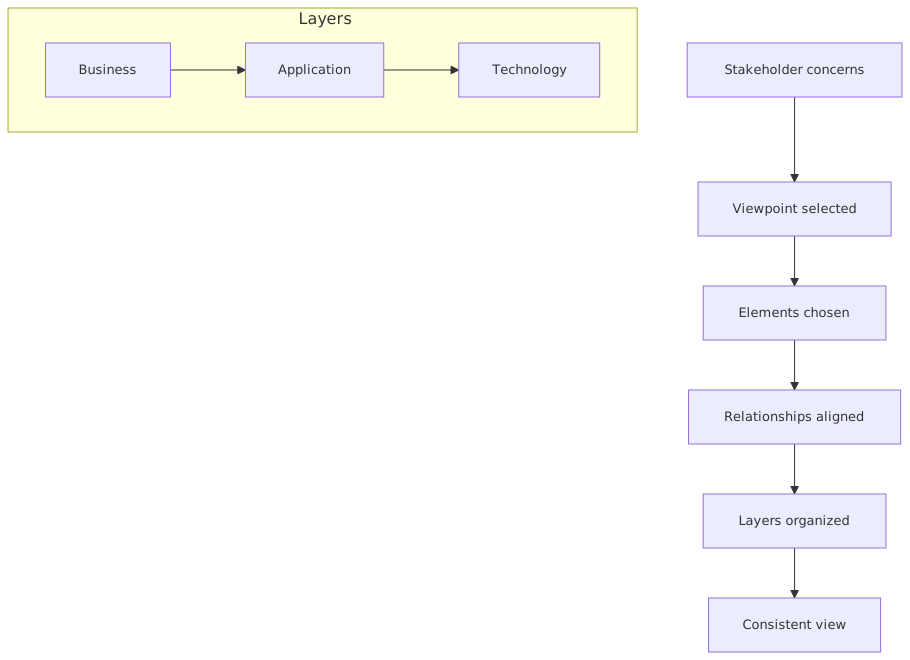
A team says, “We need ArchiMate standards.” Then they produce a modeling convention document full of element definitions, naming rules, line styles, color codes, and maybe a stern paragraph about when to use aggregation versus composition. ArchiMate modeling guide
Fine. Useful even.
But they skipped the first question: what decisions are these views supposed to support?
Until you answer that, consistency is impossible.
Because a view is not consistent just because the notation is legal. A view is consistent when it is fit for decision-making in a repeatable way.
For example:
- A CIO investment view needs to compare capability uplift, cost concentration, and strategic dependency.
- A platform engineering view needs to show runtime dependencies, deployment boundaries, resilience risks, and ownership.
- A security architecture view needs identity flows, trust boundaries, privileged access paths, and control enforcement points.
Those are not the same view. They should not be forced into one mega-diagram. Yet many teams do exactly that, then complain ArchiMate is “too complex.” ArchiMate tutorial
No. The model is not too complex. Your view design is undisciplined.
The real rule: one view, one question
This is the most useful principle I know for building consistent ArchiMate views:
Every view should answer one primary question.
Not three. Not seven. One.
Examples:
- Which business processes consume the IAM platform?
- How does Kafka support event distribution across banking domains?
- What application services depend on cloud-managed platform services?
- Which capabilities are affected by core banking modernization?
- Where are customer identity controls enforced across channels?
If a view cannot be named as a question, it usually becomes a dumping ground.
This sounds obvious, but architects are bad at it. We like completeness. We like showing we understand the whole landscape. We like adding “just enough context.” Then the context takes over and the actual point disappears.
A consistent repository is built from focused views, not heroic diagrams.
What consistency actually means in ArchiMate
Let’s get a bit deeper.
Consistency has at least five dimensions.
1. Semantic consistency
An element type means the same thing everywhere.
If Application Component means a deployable or logically bounded software unit in one domain, it should not mean “vendor product” in another and “team-owned platform” in a third.
If Business Service means externally visible business behavior in one place, do not use it elsewhere to mean “internal operational function.”
This is where many repositories rot. The symbols look consistent, but the semantics drift.
2. Abstraction consistency
A view should not mix strategic intent, logical architecture, and implementation detail unless there is a deliberate reason.
One of my least favorite diagram habits is this:
- top row: strategic capabilities
- middle row: business processes
- lower row: applications
- side note: Kafka topics
- another side note: AWS account structure
- bottom corner: target migration phases
That is not layered architecture. That is a collision.
A good ArchiMate view can span layers, yes. But it should do so with a controlled purpose. If you are showing traceability from business capability to application service to technology service, fine. If you are casually mixing roadmap, runtime, and governance in one place, no. TOGAF roadmap template
3. Relationship consistency
Relationships need stable meaning too.
This is a massive source of mess.
Many architects overuse Serving, underuse Access, misuse Flow, and treat Association as a get-out-of-jail-free card. If everything is associated with everything, you have built an ontology of shrugging.
Strong opinion: if your repository has a high volume of generic associations, your architecture team either lacks modeling discipline or is avoiding hard decisions.
Usually both.
4. Viewpoint consistency
Even if you do not rigidly apply ArchiMate’s formal viewpoints, your organization should define a small set of standard view types.
For example:
- capability-to-application mapping view
- business process support view
- integration context view
- deployment and hosting view
- identity and access control view
- transition architecture view
These become repeatable products. Same purpose, same element set, same level of abstraction. That is what gives executives, engineers, and risk teams confidence.
5. Narrative consistency
This one is less discussed, but it matters.
A view should tell the same story as neighboring views. Not identical, but aligned.
If one diagram says IAM is a shared enterprise platform and another presents it as a channel-specific component, stakeholders will notice. Maybe not immediately, but eventually. Then the repository starts feeling unreliable.
Architecture trust is slow to build and fast to lose.
A practical method for building consistent views
Here’s the method I’ve seen work in actual enterprise teams.

Step 1: Define your core modeling vocabulary
Before you create view standards, define the small set of concepts your team will use repeatedly and what they mean in your enterprise.
Not generic textbook definitions. Enterprise-specific ones.
For example:
- Business Capability: what the bank must be able to do, independent of org chart and process design
- Business Process: ordered behavior performed to realize business outcomes
- Application Component: logically bounded software system or platform component with clear ownership
- Application Service: externally consumable behavior exposed by an application component
- Data Object: information structure relevant to architecture-level analysis
- Technology Service: platform or infrastructure behavior consumed by applications
- Node: execution environment or deployable infrastructure boundary
This sounds boring. It is also foundational. Without this, every view becomes a local dialect.
Step 2: Define standard view contracts
I call them view contracts because “template” is too weak.
A view contract should specify:
- purpose
- audience
- question answered
- allowed element types
- allowed relationship types
- required level of abstraction
- naming convention
- what is explicitly excluded
That last one matters a lot. Exclusion is what protects consistency.
Here is a practical example.
This table alone can rescue a lot of struggling repositories.
Step 3: Set abstraction rules brutally early
Architects hate losing expressive freedom. Too bad. Repositories need discipline more than artistry.
Set rules like:
- capability views do not show Kafka topics
- integration views do not show strategic goals unless directly relevant
- deployment views do not show business processes
- IAM views do not model every LDAP group and policy object
- roadmap views only include elements that change across states
These are not arbitrary restrictions. They stop views from turning into multi-purpose junk drawers.
Step 4: Standardize relationship usage
You do not need all relationship types in daily practice. Most enterprises should narrow usage to a practical subset and define them clearly.
For example:
- Serving: provider-consumer relationship of behavior or service
- Access: read/write/use relationship to data
- Flow: transfer of information or value between behaviors or active structures
- Realization: implementation of a logical/abstract element by a more concrete one
- Assignment: responsibility or allocation of behavior to active structure
- Composition/Aggregation: structural decomposition only when meaningful
- Association: rare, temporary, justified
Contrarian thought: many teams should ban Association from standard views unless the architect can explain why no stronger semantic relationship applies. It is too often used as modeling duct tape.
Step 5: Review views as products, not diagrams
A consistent view is not “done” because it looks nice.
Review it against the contract:
- Does it answer the intended question?
- Is the abstraction level coherent?
- Are all element types used according to vocabulary?
- Are the relationships semantically precise?
- Does it contradict any adjacent view?
- Can another architect update it without reinventing the notation?
That last test is a killer. If only the original author can interpret the diagram, it is not enterprise architecture. It is personal expression.
Real architecture work: how this plays out
Let’s get out of theory.
In real enterprises, views are built under pressure:
- transformation deadlines
- merger integration
- cloud migration
- audit findings
- security incidents
- platform modernization
- executive confusion
You rarely get a clean slate. You inherit messy models, strong personalities, tool constraints, and half-documented decisions.
That is exactly why consistency matters.
When architecture is under stress, inconsistency multiplies quickly. A project architect creates a local view for a delivery board. Another team copies it. A security architect adds controls in a different style. Someone exports to PowerPoint and removes half the legend. Six months later, there are three “source of truth” diagrams and none agree.
A consistent ArchiMate practice creates friction in the right places. It forces people to model deliberately.
And yes, that sometimes annoys project teams. Good. Governance should be slightly annoying. If it is painless, it is probably superficial. ArchiMate for governance
A real enterprise example: retail bank, Kafka, IAM, and cloud
Let’s use a realistic banking case.
A retail bank is modernizing customer onboarding and digital servicing. It has:
- a legacy core banking platform
- a digital channel stack for mobile and web
- an enterprise IAM platform
- Kafka as the event backbone
- cloud-hosted customer engagement services
- on-prem and cloud coexistence
The bank’s architecture team wants to model this in ArchiMate.
What usually goes wrong
The first attempt often produces one giant diagram showing:
- customer onboarding business process
- mobile app and web portal
- IAM login and MFA
- Kafka event streams
- KYC services
- customer profile database
- cloud landing zone
- target-state arrows
- maybe even cost tags and risk notes
Everyone says, “Looks comprehensive.”
It is not comprehensive. It is unreadable. Worse, it is semantically unstable. Different stakeholders interpret different parts at different levels.
A better approach: split into consistent views
1. Business support view
Question: Which applications support customer onboarding and account opening?
Show:
- Business Process: Customer Onboarding
- Business Process: KYC Verification
- Business Service: Account Opening
- Application Component: Digital Banking Portal
- Application Component: Onboarding Service
- Application Component: Core Banking Platform
- Application Component: IAM Platform
- Application Services exposed by these components
- Serving relationships
Do not show:
- Kafka topics
- cloud nodes
- detailed IAM policies
- migration phases
This view helps business and domain stakeholders understand support mapping.
2. IAM control view
Question: Where are identity, authentication, and authorization controls enforced in onboarding?
Show:
- Business Actor: Customer
- Business Role: Operations Analyst
- Application Component: IAM Platform
- Application Service: Authentication Service
- Application Service: Authorization Service
- Application Component: Digital Banking Portal
- Application Component: Onboarding Service
- Technology Service: MFA Service, Secrets Management, Token Validation
- Flows for token/assertion propagation
- Serving and Flow relationships
Do not show:
- broad capability maps
- deployment clusters
- all user lifecycle workflows unless relevant
This view supports security review and audit.
3. Integration context view
Question: How does onboarding exchange data and events?
Show:
- Application Components: Onboarding Service, Core Banking Platform, Customer Profile Service, Notification Service, Fraud Engine
- Application Interface or Application Service where relevant
- Data Objects: Customer Profile, Onboarding Event, KYC Result
- Kafka represented as Application Component or Technology Service depending your modeling policy
- Flow relationships between producers and consumers
Now here is where teams need to be careful. Kafka is often modeled inconsistently.
Sometimes architects model Kafka as infrastructure. Sometimes as middleware application platform. Sometimes as a set of topics. Sometimes as “integration.” None are inherently wrong; the inconsistency is the problem.
Pick a policy. In many enterprises, a practical choice is:
- model the Kafka platform as a Technology Service or Application Component depending how your repository treats middleware platforms
- model topics only in lower-level solution views, not enterprise domain views
- model producer/consumer relationships via Flow and service exposure where useful
That keeps the repository manageable.
4. Deployment view
Question: Where do onboarding and IAM components run?
Show:
- Application Components
- Node: Cloud Kubernetes Cluster
- Node: On-Prem VM Cluster
- System Software: Kafka Broker Runtime, API Gateway Runtime
- Technology Services: Managed Database, Load Balancing, Identity Federation
- Artifacts if needed for deployment detail
Do not show:
- business process decomposition
- capability heatmaps
- strategic objectives
This supports platform engineering and resilience analysis.
What consistency gives the bank
With these views aligned, the architecture team can answer real questions fast:
- If IAM changes token format, which services are impacted?
- If Kafka is unavailable, which onboarding steps degrade?
- Which business services depend on cloud-only platform services?
- Where are customer identity controls enforced versus merely consumed?
- What remains tied to legacy core banking?
That is architecture value. Not the diagram itself. The decision support it enables.
Common mistakes architects make with ArchiMate views
Let’s be candid. These happen everywhere.
Mistake 1: modeling everything at once
This comes from fear of omission. Architects worry that if they leave something out, the view will be criticized as incomplete.
But omission is part of good architecture. A view is selective by design.
If you cannot explain why something is included, remove it.
Mistake 2: confusing repository model with presentation layer
Some teams build one detailed canonical model and then expect every stakeholder to consume direct exports from it.
That rarely works.
You need a disciplined underlying model, yes. But views are curated expressions of that model. They are not just random windows into a giant object graph.
Mistake 3: using ArchiMate types as loose labels
This is very common in capability mapping and platform architecture.
For instance:
- using Application Service to mean “product feature”
- using Business Function when they really mean “team”
- using Node to mean “cloud account”
- using Technology Service to mean “vendor SKU”
These shortcuts feel harmless. They are not. They erode trust and make cross-domain analysis unreliable.
Mistake 4: overusing color and underusing semantics
A lot of architecture teams compensate for weak modeling with visual tricks.
Red for target state. Blue for SaaS. Green for strategic. Dashed boxes for domains. Little cloud icons. Tiny padlocks. It starts to look informative. But often the semantics are in the decoration, not the model.
That is dangerous. Colors do not survive exports, accessibility requirements, printing, or interpretation. The model should carry the meaning first.
Mistake 5: no ownership for view quality
If every architect can create any kind of view in any style, consistency will collapse.
You need domain ownership, review standards, and a small architecture authority for modeling practices. Not to police creativity for its own sake, but to preserve repository coherence.
Mistake 6: treating ArchiMate as a compliance burden
This one is subtle.
If architects think ArchiMate is just something they must do for the EA team, they will produce minimal, lifeless diagrams. The notation becomes ritual.
The way out is simple: make views solve real delivery problems. If a good integration context view helps engineers understand Kafka event dependencies, they will engage. If an IAM control view helps audit close findings faster, people care.
Usefulness creates discipline better than mandates.
Some contrarian thoughts architects need to hear
A few opinions that may annoy purists.
Not every relationship needs to be modeled
Consistency does not mean maximum detail. A sparse, purposeful view is often more consistent than a complete one full of questionable semantics.
Formal viewpoints are useful, but not sacred
ArchiMate’s viewpoint guidance helps, but enterprises should adapt it. If your architecture practice needs a standard “cloud platform dependency view” or “IAM trust boundary view,” define it. Do not wait for textbook permission.
Sometimes less ArchiMate is more ArchiMate
If a stakeholder needs a simple architecture story, forcing every possible layer and relationship into the diagram can reduce clarity. Better to use fewer element types correctly than many loosely.
Tool-generated views are usually mediocre
Auto-layout and auto-generated relationship maps can be fine for analysis, but they are rarely good architecture communication. A real architect should shape the view intentionally.
Consistency is more important than purity
If your enterprise decides to represent Kafka as an application platform component across all integration views, I can live with that even if another school of thought would model it lower in the stack. Stable convention beats endless semantic debate.
A practical checklist for architects
Before publishing an ArchiMate view, ask:
- What exact question does this answer?
- Who is the audience?
- Is the abstraction level stable throughout?
- Are all element types used according to enterprise vocabulary?
- Are the relationships specific and justified?
- What did I intentionally leave out?
- Does this align with adjacent views in the repository?
- Could another architect maintain it next quarter without calling me?
If you cannot answer these cleanly, the view is not ready.
How to introduce consistency in an existing messy repository
Most teams are not starting fresh. They are walking into a modeling landfill.
Here’s the realistic sequence.
First, stop the bleeding
Do not try to fix the entire repository at once.
Pick 3–5 standard view types that matter most, such as:
- application support view
- integration context view
- deployment view
- IAM control view
- transition roadmap view
Define contracts for those and require all new work to follow them.
Second, normalize vocabulary
Create a short modeling handbook. Short means short. Ten pages beats seventy.
Include:
- element definitions
- relationship guidance
- naming examples
- do/don’t patterns
- one good example of each standard view
Third, refactor only high-value areas
Focus on architecture domains under active change:
- customer identity
- event-driven integration
- cloud landing zone and shared services
- core banking modernization
Do not waste months cleaning diagrams for dead systems nobody cares about.
Fourth, add review into delivery rhythm
Model review should happen where architecture decisions happen:
- solution review board
- domain architecture forum
- security architecture review
- platform design authority
If consistency sits outside delivery, it will always lose.
Final thought
Consistent views in ArchiMate are not about making diagrams pretty or academically correct. They are about making architecture dependable.
That is the word I care about most: dependable.
When executives ask what is impacted by a banking product change, when engineers ask how Kafka dependencies really work, when auditors ask where IAM controls are enforced, when platform teams ask what still depends on legacy hosting — your views should answer without embarrassment.
If they cannot, the issue is not that ArchiMate is too abstract. The issue is that the architecture practice has not been disciplined enough about truth, purpose, and abstraction.
And honestly, that is fixable.
It takes fewer view types, stronger semantics, more ruthless exclusion, and less architect ego on the page.
A good ArchiMate repository should feel like a coherent body of thought, not a gallery of individual styles.
That is how you build consistent views.
FAQ
1. How many standard ArchiMate view types should an enterprise define?
Usually 5 to 10 is enough. More than that and teams forget them. Fewer than that and people start inventing ad hoc views for common needs.
2. Should Kafka be modeled as an application component or technology service in ArchiMate?
Either can work, depending on your enterprise convention. The important thing is consistency. Pick one approach for your repository and document when lower-level topic detail is allowed.
3. What is the biggest mistake in ArchiMate view design?
Trying to answer multiple questions in one diagram. That is the fastest path to clutter, mixed abstraction, and stakeholder confusion.
4. How do ArchiMate views help in real architecture governance?
They let teams assess impact, dependency, control coverage, and platform fit in a repeatable way. That makes architecture review faster and less subjective.
5. How detailed should an IAM view be in ArchiMate?
Detailed enough to show trust boundaries, control points, service dependencies, and identity flows. Not so detailed that it becomes a dump of directory groups, policy syntax, or implementation minutiae.
Frequently Asked Questions
What is enterprise architecture?
Enterprise architecture is a discipline that aligns an organisation's strategy, business processes, information systems, and technology. Using frameworks like TOGAF and modeling languages like ArchiMate, it provides a structured view of how the enterprise operates and how it needs to change.
How does ArchiMate support enterprise architecture practice?
ArchiMate provides a standard modeling language that connects strategy, business operations, applications, data, and technology in one coherent model. It enables traceability from strategic goals through business capabilities and application services to the technology platforms that support them.
What tools are used for enterprise architecture modeling?
The main tools are Sparx Enterprise Architect (ArchiMate, UML, BPMN, SysML), Archi (free, ArchiMate-only), and BiZZdesign Enterprise Studio. Sparx EA is the most feature-rich option, supporting concurrent repositories, automation, scripting, and integration with delivery tools like Jira and Azure DevOps.