⏱ 19 min read
Most enterprise IAM architecture is still presented like a tidy little castle: users on the left, apps on the right, a directory in the middle, maybe an SSO box, maybe MFA, maybe some cloud icons for modernity. It looks clean. It is also usually misleading.
The uncomfortable truth is this: identity and access management is not a technology stack problem first. It is a trust, control, and operating model problem. And if you use ArchiMate like a diagramming stencil instead of an architecture language, you will absolutely miss the point.
I’ve seen this over and over. Architects produce “IAM target architecture” decks full of logos and arrows, but when you ask basic questions — who is authoritative for workforce identity, where entitlement decisions are made, how Kafka service identities are managed, what happens when HR is wrong, how cloud roles are governed, who owns break-glass access — the room gets quiet very quickly.
That is exactly where ArchiMate can help. Not because it makes diagrams prettier. Frankly, prettier diagrams are often the problem. ArchiMate helps when it forces you to model structure, behavior, responsibility, dependency, and motivation together. IAM needs that discipline more than most domains.
The simple explanation first
If you want the SEO-friendly version early: ArchiMate is useful for IAM because it lets you model identities, roles, access services, applications, processes, data, infrastructure, and governance in one coherent view.
That matters because IAM is never just one thing. It spans:
- business policy
- operating processes
- application integration
- data ownership
- infrastructure control planes
- security services
- compliance obligations
In plain English: IAM is where HR, security, cloud, application teams, and auditors all crash into each other.
ArchiMate gives you a way to show:
- who requests access
- who approves it
- what system grants it
- which policy controls it
- what data is used
- what technology enforces it
- what risk or compliance outcome it supports
That is the real value. Not “we have an IAM platform.” Plenty of companies have expensive IAM tools and still have terrible identity architecture.
Why IAM is unusually hard to model
IAM looks simple from a distance because the vocabulary sounds familiar: users, groups, roles, policies, access. But at enterprise scale, those words mean different things to different teams.
A banker says “role” and means job function.
An application owner says “role” and means app-specific entitlements.
A cloud engineer says “role” and means an assumable runtime identity.
A Kafka admin says “principal” and means a service or user identity used for authentication and authorization.
An auditor says “role” and means evidence that access is appropriate and reviewable.
All of them are right. And all of them are talking past each other half the time.
This is where ArchiMate is underrated. It can separate concerns without pretending they are disconnected. You can model:
- Business roles as business-layer concepts
- Application roles or access profiles as application-layer concepts
- Technology identities and runtime permissions as technology-layer concepts
- Policies, requirements, and controls in the motivation layer
- Operational workflows for joiner/mover/leaver, access request, certification, and incident response in the business layer
If you don’t make those distinctions, IAM diagrams become hand-wavy fiction.
My strong opinion: most IAM diagrams are too vendor-shaped
Let me be blunt. A lot of so-called IAM architecture is just a procurement diagram wearing an architecture badge.
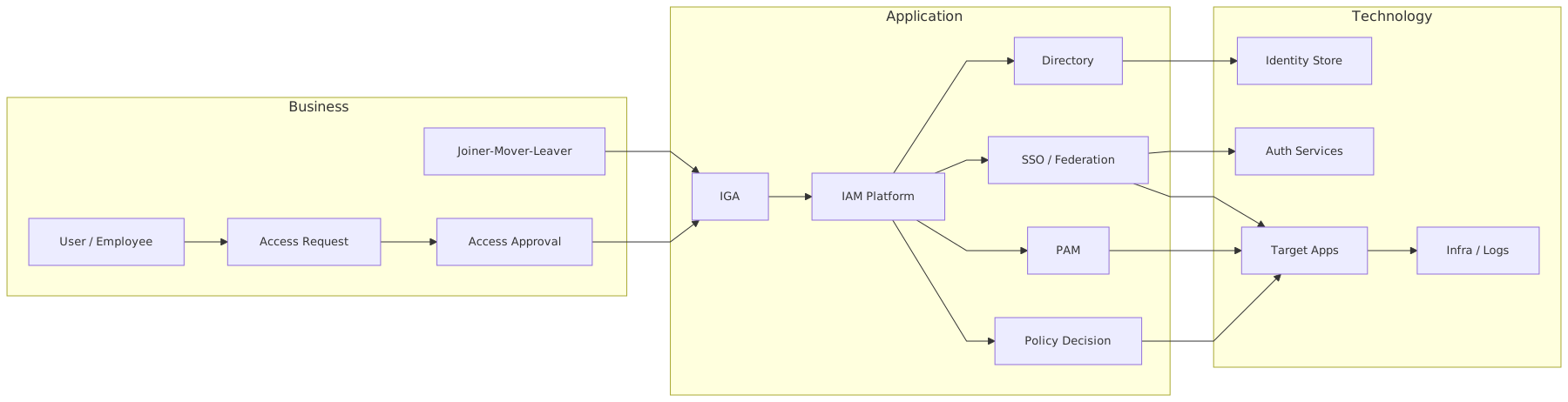
You know the type:
- Entra ID here
- Okta there
- CyberArk somewhere
- SailPoint in the middle
- AWS and Azure around the edge
- arrows everywhere
- no actual explanation of control ownership
That is not architecture. That is a shopping receipt.
Real IAM architecture has to answer harder questions:
- What is the system of record for identity attributes?
- What is the source of truth for access policy?
- Where are authentication decisions made?
- Where are authorization decisions made?
- Which entitlements are birthright, which are requestable, which are privileged?
- How do service identities differ from human identities?
- What is the design for machine-to-machine trust, especially across Kafka, APIs, and cloud workloads?
- How are temporary elevated privileges controlled?
- What is the revocation path and how fast does it work?
- Which controls are preventive, which are detective, and which are just governance theater?
ArchiMate is powerful here because it can force a model that starts with enterprise meaning, not product placement.
What ArchiMate should represent in IAM
For IAM, I usually think in six dimensions. You do not need all of them in every view, but if your architecture ignores one or two, you will create blind spots.
1. Identity sources and authority
Who is authoritative for what?
- HR for workforce identity basics
- contractor system for non-employees
- customer master or CRM for external identities
- PKI or workload platform for service identities
- cloud control plane for runtime role assumptions
This is not a technical footnote. This is foundational architecture.
2. Access lifecycle processes
How access is requested, approved, granted, changed, reviewed, and removed.
This includes:
- joiner / mover / leaver
- access request
- privileged access elevation
- periodic certification
- emergency access
- incident-driven revocation
3. Authentication services
SSO, federation, MFA, adaptive authentication, certificate-based auth, workload auth.
4. Authorization model
RBAC, ABAC, policy-based access, entitlement catalogs, application-specific authorizations, Kafka ACLs, cloud IAM policies, secrets-based trust if you are still unlucky enough to have that.
5. Enforcement points
Where access is actually enforced:
- application gateways
- SaaS platforms
- Kafka brokers
- database engines
- cloud IAM policy engines
- Kubernetes admission or service mesh layers
- PAM vaults and session brokers
6. Governance and assurance
Policies, segregation of duties, attestation, logging, audit evidence, risk controls, exception handling.
If you model only the identity provider and forget the enforcement points, you are not doing IAM architecture. You are drawing front door security and ignoring the rest of the building.
How to use ArchiMate layers properly for IAM
A lot of architects either go too abstract or too technical. The trick is to use ArchiMate layers to connect the story.
Here is a practical way to think about it.
That table looks simple, but this is where many IAM efforts either become useful or collapse into slideware.
Business layer: where many architects underinvest
Architects who come from infrastructure or security engineering often rush past the business layer because it feels soft. Big mistake.
In IAM, the business layer is where you model things like:
- employee onboarding
- access approval
- role ownership
- control ownership
- access review
- SoD exception handling
- privileged access approval
- offboarding
If you skip this, your target architecture will assume the organization behaves rationally and consistently. It does not.
For example, “Application Owner approves access” sounds fine until you discover:
- the owner is a shared mailbox
- the owner changed six months ago
- no one knows what the entitlement actually does
- approval is delegated informally
- access review is a checkbox exercise
ArchiMate can expose that mess instead of hiding it.
Application layer: where IAM tools belong, but not alone
This is where your identity provider, IGA platform, access gateway, PAM solution, policy engine, directory, secrets manager, and API security tools usually sit.
But don’t just model the products. Model the services they provide:
- authentication service
- federation service
- identity lifecycle management service
- access certification service
- privileged session management service
- policy decision service
- secrets issuance service
That shift matters. Products change. Services are what the enterprise actually depends on.
Technology layer: the place where cloud and Kafka reality shows up
Here is another contrarian view: many IAM architecture diagrams stop at the application layer because that is where the corporate IAM products live. That is a bad habit from the old world.
In cloud-native and event-driven environments, some of the most important access control happens in the technology layer.
Think about:
- AWS IAM roles assumed by workloads
- Azure managed identities
- Kubernetes service accounts
- Kafka broker authentication using mTLS or SASL/OAUTHBEARER
- Kafka ACLs or RBAC in Confluent environments
- database engine roles
- vault-issued short-lived credentials
These are not implementation details to hand-wave away. These are core parts of enterprise trust architecture.
A real enterprise example: bank modernizing IAM across cloud and Kafka
Let’s make this concrete.
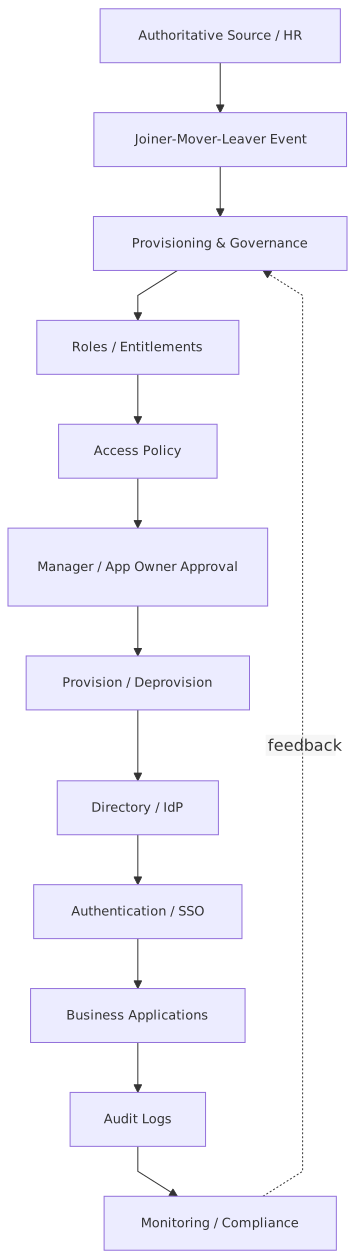
Imagine a large retail bank. Not a fictional startup bank. A real, messy incumbent bank with:
- 40,000 employees
- 12,000 contractors
- legacy AD forests
- a modern cloud program in AWS and Azure
- Kafka as the event backbone for payments, fraud, customer notifications, and operational telemetry
- hundreds of internal applications
- strict regulatory obligations
- recurring audit findings around privileged access and leaver controls
The bank says it wants a “modern IAM architecture.” That phrase is dangerous because everyone hears what they want.
Security wants stronger MFA and PAM.
Cloud wants federated role-based access.
Application teams want less friction.
Audit wants certifiable controls.
Data teams want secure Kafka access.
Operations want less manual provisioning.
Executives want fewer incidents and lower cost.
A proper ArchiMate model helps align this.
What the baseline usually looks like
The current state often has these characteristics:
- HR feeds AD, but not reliably for contractors
- many applications still use local accounts
- cloud access is partly federated, partly direct IAM users, partly shared admin accounts if things are really bad
- Kafka uses a mix of service accounts, certificates, and loosely governed ACLs
- privileged access is split across server admin tools, database tools, and ad hoc secrets sharing
- access reviews are spreadsheet-driven
- offboarding revokes central accounts, but application entitlements linger
- there is no coherent ownership model for entitlements
Now, if you only draw the target as “HR -> IGA -> IdP -> apps/cloud,” you will miss the actual bank problem.
What the ArchiMate target should show
At the motivation layer, model:
- regulatory requirements for strong customer and workforce access controls
- principles such as “all identities are attributable,” “privileged access is time-bound,” “human and machine identities are governed differently,” “authoritative sources are explicit”
- constraints like legacy applications that cannot consume modern federation directly
At the business layer, model:
- business actors: Employee, Contractor, Application Owner, Access Approver, Security Operations, IAM Operations, Platform Team
- business processes: Joiner/Mover/Leaver, Access Request, Privileged Access Elevation, Access Certification, Incident Revocation
- business services: Workforce Identity Governance, Privileged Access Governance, Service Identity Governance
At the application layer, model:
- HR platform as source of workforce identity data
- contractor management platform
- IGA platform for lifecycle and certifications
- IdP for authentication and federation
- PAM platform for elevated access
- policy administration and decision components where relevant
- entitlement catalog repository
- Kafka platform management tooling if it carries application-layer governance logic
At the technology layer, model:
- Active Directory and cloud directories
- AWS IAM roles and Azure managed identities
- Kafka brokers and authorization mechanisms
- certificate authority or workload identity issuer
- bastion/session broker components
- secrets vault
- logging and SIEM integration as technology services supporting assurance
And then — this is the part people skip — connect them with the right relationships to show:
- HR data triggers identity lifecycle events
- IGA provisions app entitlements and cloud group assignments
- IdP provides authentication services to SaaS and internal apps
- PAM mediates privileged sessions to infrastructure
- workload identity service issues credentials to Kafka producers and consumers
- Kafka brokers enforce ACLs or RBAC against authenticated principals
- certification process consumes entitlement data from IGA and app sources
- incident response invokes emergency revocation across IdP, PAM, cloud roles, and Kafka service credentials
That is architecture. It shows how the enterprise actually controls trust.
Kafka is where weak IAM architecture gets exposed
Kafka is worth calling out because it reveals whether architects understand machine identity or not.
A lot of enterprise IAM thinking is still heavily workforce-centric. SSO, MFA, employee lifecycle, access reviews. All important. But modern enterprises run on non-human identities: services, jobs, containers, connectors, event processors, CI/CD agents.
In a bank using Kafka, those machine identities are everywhere:
- payment service publishes transaction events
- fraud engine consumes and enriches them
- notification service reads customer events
- data platform replicates streams
- connectors move data in and out of core systems
Each of those interactions needs trust.
Common anti-patterns include:
- shared Kafka service accounts across multiple applications
- long-lived credentials embedded in config files
- ACLs granted broadly because no one understands topic-level ownership
- no lifecycle process for service identities
- no mapping between business application ownership and Kafka principal ownership
- no distinction between platform admin rights and producer/consumer rights
This is where ArchiMate can be surprisingly useful. You can model:
- the Application Component that produces or consumes events
- the Technology Service provided by Kafka
- the Technology Interface or access path if needed
- the Artifact or credential material
- the Business Role responsible for approving service access
- the Requirement for non-repudiation and least privilege
The key is not to overmodel every topic. Don’t be ridiculous. But do model the control pattern clearly enough that ownership and enforcement are visible.
My advice: create a reusable ArchiMate pattern for machine identity governance. Most enterprises need it now, and many still pretend IAM is mostly about humans logging into portals.
Common mistakes architects make with ArchiMate in IAM
Let’s be honest. The notation is not the problem. The thinking is.
1. Confusing identity with account
An identity is not the same as an account. One person can have multiple accounts. One workload can have multiple credentials. One business identity can map to many technical principals.
If your model collapses identity and account into one thing, lifecycle and traceability will become messy fast.
2. Treating roles as universal
There is no single “role” concept that works cleanly across HR, business access, applications, cloud, and Kafka. Model the distinctions. Otherwise your role model becomes a political compromise and a technical disaster.
3. Drawing authentication and ignoring authorization
A polished SSO architecture means very little if application entitlements, cloud permissions, and Kafka ACLs are unmanaged. Authentication gets attention because users feel it. Authorization causes the bigger audit findings.
4. Ignoring machine identities
Still one of the most common failures. Service accounts, workload identities, API clients, certificates, tokens, and automation principals need architecture, not ad hoc handling.
5. No authoritative source mapping
If you cannot state which system is authoritative for identity attributes, role assignments, entitlement metadata, and approval ownership, your provisioning design is built on sand.
6. Modeling tools, not services
Vendor logos are not architecture elements. The enterprise depends on authentication service, provisioning service, privileged access service, policy decision service, credential issuance service. Model those.
7. No transition architecture
IAM is never transformed in one move. Legacy LDAP, old apps, cloud-native patterns, PAM rollout, Kafka modernization — these coexist for years. If you present only a pristine target state, you are doing aspiration management, not architecture.
8. Forgetting operating model and ownership
Who owns the role catalog? Who approves service identities? Who manages cloud break-glass? Who certifies Kafka producer access for regulated data streams? If your ArchiMate model does not make ownership visible, delivery teams will invent it later, badly. ArchiMate modeling guide
How this applies in real architecture work
This is the part that matters more than notation purity.
In real enterprise architecture work, ArchiMate for IAM is useful in four practical situations. ArchiMate tutorial
1. Defining target state and principles
When an organization says “we need modern IAM,” the first job is to stop vague ambition and create a target operating model.
Use ArchiMate to show:
- identity domains: workforce, external, privileged, machine
- authoritative sources
- central vs federated control points
- lifecycle services
- policy and enforcement boundaries
- ownership and governance
This helps turn a security slogan into an architecture position.
2. Resolving disagreements between teams
IAM is cross-functional by nature. HR, security, cloud engineering, app teams, platform teams, and audit all have partial truths and conflicting incentives.
ArchiMate is useful because it creates a shared language to answer questions like:
- should cloud access be directly managed in AWS accounts or brokered through enterprise groups?
- where should Kafka service identities be issued and governed?
- does PAM cover Kubernetes admin and cloud control plane access, or only servers?
- which app entitlements belong in IGA and which stay local?
A good model surfaces trade-offs. It does not pretend there is one perfect pattern for everything.
3. Designing transition architectures
This is where enterprise architecture earns its keep.
You may need a sequence like:
- phase 1: centralize workforce authentication and MFA
- phase 2: establish authoritative joiner/mover/leaver feeds
- phase 3: onboard high-risk apps to IGA and certification
- phase 4: modernize privileged access
- phase 5: implement workload identity standards for cloud and Kafka
- phase 6: retire legacy local accounts and shared admin patterns
ArchiMate plateaus and gaps are useful here. Very useful, actually. IAM transformation is full of dependencies and awkward coexistence periods. Show them.
4. Supporting risk and audit conversations
Auditors often ask in control language. Engineers answer in implementation language. Executives want business risk language. Architects need to translate among all three.
ArchiMate lets you connect:
- requirement: privileged access must be attributable and time-bound
- business process: privileged access request and approval
- application service: PAM elevation workflow
- technology service: session brokering and credential vaulting
- assessment: current state lacks cloud admin session recording
That traceability is gold when used well.
A few contrarian thoughts architects should hear
Not every entitlement belongs in centralized IGA. Some app-specific permissions are too dynamic, too contextual, or too operationally coupled. Forcing all of them into one central model can create brittle governance theater. ArchiMate for governance
Not every access decision should be abstracted into enterprise policy engines. Sometimes local enforcement is the right answer, especially in high-throughput platforms like Kafka or tightly integrated cloud services.
Not every role model should be simplified. Architects love simplification. Auditors love simplification. Operations often suffers from simplification. Some complexity is real and should be represented, not flattened.
And one more: zero trust slogans do not remove the need for explicit IAM architecture. In many organizations, “zero trust” became a branding layer over the same old weak identity foundations.
What a good IAM ArchiMate deliverable actually looks like
Not one giant poster. Please stop making giant posters.
A useful IAM architecture pack usually includes:
- a motivation view with principles, requirements, and constraints
- a business process/ownership view
- an application cooperation view for IAM services and integrations
- a technology view for enforcement points and runtime identity patterns
- a transition roadmap view
- a small set of reusable patterns:
- workforce SSO pattern
- privileged access pattern
- machine identity pattern for cloud workloads
- Kafka producer/consumer access pattern
That is enough to guide delivery without drowning everyone in notation.
Final thought
ArchiMate will not fix bad IAM strategy. It will not fix weak governance. It will not make application owners care about entitlement quality. It will not magically unify cloud and legacy access models. EA governance checklist
But it will expose where your IAM architecture is incoherent. And that is valuable.
Used properly, ArchiMate helps you show that IAM is not one product, not one team, and definitely not just login. It is a layered enterprise control system for trust.
If that sounds a bit severe, good. It should. In banking, especially, poor IAM architecture is not just untidy. It becomes fraud exposure, operational fragility, audit pain, and expensive remediation.
So yes, use ArchiMate for IAM. But use it like an architect. Not like a stencil operator.
FAQ
1. Is ArchiMate really worth using for IAM, or is it too abstract?
It is worth it if you use it to connect business process, control intent, application services, and technical enforcement. If you use it only to draw boxes around IAM tools, then no, it adds little.
2. How detailed should an ArchiMate model get for IAM?
Detailed enough to show ownership, lifecycle, decision points, and enforcement boundaries. Not so detailed that you model every group, topic, or policy statement. Focus on patterns and control structure.
3. How do you model Kafka access in ArchiMate without overcomplicating it?
Model the producer/consumer applications, the Kafka technology service, the authentication/authorization mechanism, the service identity pattern, and the approval/ownership process. Do not model every topic ACL unless that is the specific problem being addressed.
4. What is the biggest IAM modeling mistake in cloud environments?
Treating cloud IAM as an implementation detail. Cloud roles, managed identities, and policy enforcement are core architecture elements. If they are absent from the model, the architecture is incomplete.
5. Should IAM architecture separate human and machine identities?
Yes. Strongly yes. They intersect, but they are governed differently, lifecycle differently, and fail differently. If your model treats them the same, you will create security and operational problems.
Frequently Asked Questions
How is Identity and Access Management modeled in ArchiMate?
IAM is modeled in ArchiMate with the IAM platform as an Application Component providing authentication and authorization services. Business Roles consume these services through Business Processes. Technology Nodes (identity provider, policy decision point, LDAP/AD) are modeled in the Technology layer, assigned to the Application Components they support.
What ArchiMate elements are used for IAM architecture?
Key elements: Application Component (IAM platform, IdP, PAM), Application Service (authentication, authorisation, SSO, MFA), Application Interface (SAML, OAuth2, OIDC endpoints), Business Role (user types, service accounts), Data Object (identity claim, access token, policy), Technology Node (LDAP, Active Directory, HSM).
Why is IAM architecture important in enterprise EA?
IAM is the security boundary for every enterprise system. Modeling it in ArchiMate makes authentication and authorisation dependencies visible — critical for security governance, regulatory compliance (GDPR, ISO 27001, SOX), zero-trust architecture design, and impact analysis when identity systems change or are consolidated.