⏱ 20 min read
Most enterprise architecture work fails in exactly the same boring way: people draw beautiful diagrams that nobody uses to make decisions.
That’s the uncomfortable truth.
A lot of teams say they are “doing architecture,” but what they really mean is they are producing slides, capability maps, and application inventories that sit in a repository until the next audit. Then someone adds color coding, exports a PDF, and calls it strategic alignment. It looks serious. It isn’t.
If you want ArchiMate to matter, it has to do one thing very well: connect business intent to technology reality in a way that helps people decide what to fund, what to stop, what to standardize, and what risk they are actually carrying. Not theoretically. In the real enterprise. With politics, legacy systems, cloud migrations, IAM messes, Kafka clusters nobody fully owns, and delivery teams that are already behind.
That’s where ArchiMate is useful. And also where it gets abused.
What ArchiMate is, in simple terms
Let’s make this plain early.
ArchiMate is a modeling language for enterprise architecture. It helps you describe how business processes, capabilities, applications, data, and technology infrastructure relate to each other.
That’s the simple SEO-friendly version. It’s true, but it’s not enough.
A better version is this: ArchiMate is a way to trace business change down into systems and platforms without losing the logic in the middle.
That middle matters. A lot.
Because strategy is usually vague. Technology is usually concrete. And most organizations are weak in the translation layer between the two. Business says “improve customer onboarding.” Technology hears “buy another workflow tool.” Security says “add stronger identity controls.” Operations says “please don’t break production.” Everyone is technically talking about the same thing, but they are not describing the same problem.
ArchiMate gives you a grammar for that translation.
It lets you model:
- Business layer: capabilities, value streams, actors, processes, products, services
- Application layer: application components, services, data objects, interfaces
- Technology layer: infrastructure, nodes, devices, system software, networks
- plus motivation, strategy, implementation, and physical aspects if you want to use them
That sounds structured because it is. But the value is not the structure by itself. The value is that you can answer practical questions like:
- Which business capabilities depend on this IAM platform?
- What customer journeys will break if we retire this core banking integration?
- Where is Kafka a strategic platform, and where is it just accidental middleware?
- Which cloud services support regulated workloads, and which ones should never have been used in the first place?
- What business outcomes are blocked by a technology bottleneck?
That is what “from business to technology” actually means.
The biggest misconception: ArchiMate is not the goal
Here’s the contrarian view: ArchiMate itself is not important.
I know, slightly provocative. But it needs saying.
The notation is not the product. The product is better decision-making.
Too many architects become amateur language lawyers. They spend energy debating whether something is a business service or an application service, whether a capability should realize an outcome or influence it, whether a data object is better modeled here or there. Meanwhile, the CIO is trying to decide whether to modernize IAM now or next year because three cloud programs depend on it.
If your model cannot help with that decision, it does not matter how correct it is.
Good architecture work uses ArchiMate as a shared decision model, not as a purity exercise.
That means a few things:
- Model only what you need to decide
- Favor traceability over completeness
- Use viewpoints for audiences, not one giant master diagram
- Accept some messiness if it reflects enterprise reality
- Keep the semantics good enough, not academically perfect
That last point annoys some people. Fine. Real organizations are messy. If your model cannot survive contact with reality, your model is the problem.
Why ArchiMate works when PowerPoint doesn’t
PowerPoint is great for storytelling. It is terrible for maintaining architectural truth over time.

A slide can show a target state. It cannot easily preserve the relationships that make the target state meaningful. ArchiMate can.
That matters because enterprise architecture is not just about “what we want.” It is about dependency logic.
For example, if a bank wants to launch near-real-time fraud decisioning, that sounds like a business initiative. But the architecture path often runs through:
- customer event capture
- integration patterns
- Kafka topics and governance
- IAM token propagation between services
- data residency controls in cloud environments
- API security
- observability
- legacy core banking constraints
Without a connected model, every team sees only its own local problem. The fraud team sees analytics. The integration team sees messaging. Security sees access control. Cloud sees landing zones. Nobody sees the whole decision chain.
ArchiMate can connect the chain.
Not magically. But clearly.
How this applies in real architecture work
Let’s get practical, because this is where many articles drift into theory and stay there.
In real architecture work, ArchiMate is useful in five recurring situations. ArchiMate modeling guide
1. Investment planning
You are asked, usually at short notice, “Why are we funding this platform?” or “What depends on this thing?”
If you have a decent ArchiMate model, you can show: ArchiMate tutorial
- the business capabilities enabled
- the applications consuming the platform
- the technology services underpinning it
- the risks if it fails
- the transformation initiatives relying on it
This is much stronger than saying “it’s strategically important.”
2. Rationalization
Every enterprise says it wants fewer systems. Very few know how to get there.
Application rationalization fails when teams inventory software without understanding business usage and technical dependency. ArchiMate helps identify:
- duplicate application services
- overlapping business support
- integration chokepoints
- hidden dependencies on shared identity, messaging, or data platforms
This is especially useful in post-merger environments, where “we have two of everything” is not a joke but an operating condition.
3. Transformation design
Cloud migration, core modernization, event-driven architecture, zero trust, digital onboarding — these are not technology projects alone. They are cross-layer changes.
ArchiMate helps define the transition from current to target by showing:
- what business process changes are intended
- what application services need to appear or disappear
- what technology shifts are required
- what work packages and plateaus structure the journey
That gives the transformation some backbone.
4. Risk and control mapping
Security and operational resilience are often modeled separately from architecture. That is a mistake.
If IAM is weak, that is not just a security issue. It is a business continuity issue, a compliance issue, and in many industries a revenue issue.
Using ArchiMate, you can connect:
- business services
- application services
- identity providers and access mechanisms
- cloud control points
- technology nodes and dependencies
Then risk conversations become specific instead of generic.
5. Governance without bureaucracy
Good governance is not more review boards. It is faster decisions with clearer standards.
ArchiMate can support governance by making standards visible in context. For example: ArchiMate for governance
- where Kafka is the approved event backbone
- where synchronous APIs are acceptable
- where IAM federation is mandatory
- which cloud patterns are approved for regulated workloads
That is much better than a PDF standards catalog nobody reads.
A real enterprise example: retail banking onboarding modernization
Let’s use a realistic banking scenario.
A retail bank wants to reduce customer onboarding time from five days to under one hour for standard products. That sounds like a business objective. It is. But the architecture implications run deep.
Current state looks something like this:
- onboarding is fragmented across web, branch, and call center channels
- customer identity proofing is partly manual
- multiple product systems each maintain their own customer records
- IAM is split between workforce identity, customer identity, and legacy directory services
- integration relies on a mix of batch jobs, point-to-point APIs, and an aging ESB
- fraud and compliance checks are not event-driven, so they create delays
- some new digital services are in cloud, but core customer and account platforms remain on-prem
This is where many architects make the first mistake: they jump straight to solution design. “We need a new onboarding platform.” Maybe. Maybe not.
A better approach is to model the situation across layers.
Business layer
You start with the business outcome: faster, compliant onboarding.
Then identify the relevant capabilities:
- Customer Onboarding
- Identity Verification
- Product Origination
- Fraud Assessment
- Consent Management
- Customer Communication
Then the business processes:
- Capture Application
- Verify Identity
- Screen for AML/KYC
- Assess Fraud Risk
- Create Customer Record
- Open Product Account
- Notify Customer
Already this helps. Why? Because it tells you onboarding is not one thing. It is a chain of capabilities and processes. If one capability is weak, the whole business promise fails.
Application layer
Now map the applications and services supporting that process:
- Digital Onboarding Portal
- Customer Identity Service
- Fraud Decision Engine
- Compliance Screening Service
- Customer Master Data Service
- Product Origination System
- Notification Service
- API Gateway
- Event Streaming Platform
This is where Kafka often enters. Not because “event-driven” is fashionable, but because the bank needs decoupled, near-real-time propagation of onboarding events:
- application-submitted
- identity-verified
- screening-completed
- fraud-score-issued
- customer-created
- account-opened
Kafka becomes an application/platform enabler, not the center of the universe. That distinction matters. In weak architecture teams, the platform itself becomes the story. In good teams, the platform serves the business change.
Technology layer
Then model the technology:
- cloud-managed Kubernetes or container platform for digital services
- Kafka cluster, possibly managed or self-hosted depending constraints
- IAM components: customer identity provider, workforce IdP, token service, directory integration
- API gateway and service mesh
- cloud landing zone controls
- on-prem core banking nodes
- network connectivity and private integration links
Now the dependency picture becomes visible.
For example:
- The business process Verify Identity depends on the Customer Identity Service
- That service depends on the Customer IAM platform
- Product Origination depends on both Customer Master Data and Compliance Screening
- Event propagation for onboarding status depends on Kafka
- Cloud-native onboarding services depend on secure connectivity to on-prem core systems
This is architecture that can be used.
Why this matters in decision-making
Suppose leadership asks: “Why can’t we just buy a SaaS onboarding solution?”
Your model can show the answer.
Because the problem is not just UI workflow. It is:
- fragmented identity assurance
- inconsistent customer master creation
- delayed compliance integration
- missing event backbone
- dependency on legacy product origination
- inconsistent authorization across cloud and on-prem systems
A SaaS tool might improve one slice. It won’t fix the operating model unless it integrates into the capability chain.
That is the practical power of ArchiMate. It stops shallow solutioning.
A useful mapping table
Here’s a simple example of how architects can structure traceability from business to technology.
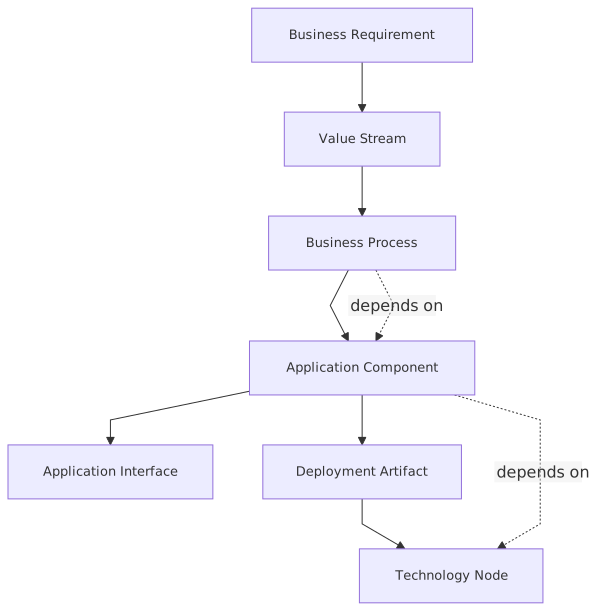
This table may look simple. Good. It should. The point is to give stakeholders a quick line of sight from business need to implementation dependency.
The IAM problem architects underestimate
Let’s talk about IAM, because almost every enterprise underestimates it.
Architects often model identity as a box on a diagram labeled “IAM” and move on. That is lazy architecture.
In practice, IAM is one of the most important cross-cutting capabilities in any transformation, especially in banking, healthcare, government, and any cloud-heavy enterprise.
Why? Because IAM affects:
- customer experience
- security posture
- compliance
- API design
- service-to-service trust
- operational resilience
- auditability
In the banking onboarding example, IAM is not just login. It includes:
- customer identity lifecycle
- identity proofing integration
- authentication methods
- authorization policies
- delegated access
- consent linkage
- workforce access to exceptions handling
- machine identities between services
- token exchange across channels and services
A common mistake is separating “business architecture for onboarding” from “security architecture for IAM.” That split is artificial. Identity is part of the business flow.
If a customer cannot be trusted, cannot be matched, or cannot consent safely, the business process is broken.
ArchiMate helps here because you can show IAM as supporting application services and business processes, not as some detached infrastructure concern.
Kafka: useful, overhyped, still necessary
Another strong opinion: Kafka is not a strategy.
I’ve seen organizations behave as if deploying Kafka means they now have an event-driven enterprise. They don’t. They have a distributed queueing and streaming platform that may or may not be governed properly.
Kafka is valuable when it supports real business decoupling and timely event propagation. It is not valuable when used as a fashionable replacement for thinking.
In ArchiMate terms, Kafka usually belongs as a platform element supporting application services and interactions. The key is not to model “Kafka” everywhere. The key is to model:
- which application components publish events
- which consume them
- what business events those represent
- who owns the topics
- what service contracts or event schemas exist
- where resilience and replay matter
- what compliance boundaries apply
In banking, for example, customer and transaction events are not just technical artifacts. They may be regulated data flows.
Common mistake: teams model Kafka as a central hub and stop there.
Better approach: show the business events that matter and the service dependencies they enable. Then Kafka has a reason to exist in the model.
Cloud architecture: where ArchiMate can save you from hand-waving
Cloud transformations are full of vague promises.
Agility. Scalability. Innovation. Faster time to market. Fine. Maybe.
But cloud architecture gets real very quickly when someone asks:
- Which workloads can move?
- What data is regulated?
- What must stay close to core systems?
- Where does IAM federation break?
- Which integration patterns are acceptable?
- What resiliency requirements apply?
ArchiMate is especially helpful here because cloud migration is not just a technology relocation. It is often a redesign of application services and operating responsibilities.
For example, in our bank:
- Digital onboarding services move to cloud-native deployment
- Kafka may run as managed service or in a controlled self-managed pattern
- IAM may require hybrid identity with on-prem directories and cloud-native policy enforcement
- Core banking remains on-prem for now
- Sensitive customer data may require regional controls and encryption boundaries
- API gateway and service controls need consistent policy across environments
A cloud target-state slide can show this in one picture. An ArchiMate model can show what depends on what, and therefore what sequencing is realistic.
That sequencing is the difference between architecture and wishful thinking.
Common mistakes architects make with ArchiMate
Let’s be blunt. Most ArchiMate problems are not language problems. They are architect problems.
1. Modeling everything
This is the classic failure mode.
The architect discovers a repository tool, imports half the CMDB, models 900 applications, 300 business processes, and enough interfaces to make everyone give up. The result is technically impressive and practically useless.
Model for decisions, not for archaeology.
2. Staying too abstract
The opposite problem also happens.
Everything is modeled as capabilities and principles, with no application or platform depth. It sounds strategic but cannot support funding, design, or risk decisions.
If your business capability map never connects to actual systems, it’s decoration.
3. Starting from technology instead of business change
This is very common in platform-heavy teams.
They start with “we need Kafka,” “we need zero trust,” “we need API management,” “we need cloud-native IAM.” Maybe true. But what business problem are these enabling, and what process or product change do they support?
Technology-first architecture often produces platform sprawl with weak adoption.
4. Ignoring ownership
One of the most important things in real architecture is ownership. Who owns the business capability? Who owns the application service? Who owns the Kafka topic? Who owns the IAM policy model?
If your ArchiMate model is all structure and no accountability, it won’t survive implementation.
5. Mixing target state fantasy with current state reality
Architects love target state. Delivery teams live in current state.
A model that confuses the two creates false confidence. You need clear plateaus, transition states, and work packages. Especially in large transformation programs.
6. No viewpoints for different stakeholders
Executives do not need your full cross-layer model. Engineers do not need your strategic principles slide. Risk teams need control traceability. Product teams need service and dependency views.
One model, multiple viewpoints. This is where ArchiMate is genuinely strong, and many teams barely use it.
7. Treating the repository as the outcome
The repository is not the outcome. The changed decision is the outcome.
This sounds obvious. It is not how many EA teams behave.
What good ArchiMate practice looks like
In a healthy architecture function, ArchiMate is used in a disciplined but pragmatic way.
A few patterns work well.
Use a small set of core questions
Before modeling, ask:
- What decision is this model meant to support?
- Which stakeholders need to understand it?
- What level of detail is enough?
- What relationships must be traceable?
- What will be maintained after the workshop ends?
That last one is underrated. If nobody will maintain the model, be careful how much you create.
Build from capability to service to platform
A strong practical pattern is:
- identify the business capability or value stream
- identify the business process or service change needed
- identify supporting application services and components
- identify data, integration, IAM, and platform dependencies
- identify implementation work packages and transition states
This keeps the model grounded.
Make cross-cutting platforms visible
Some platforms matter across many initiatives:
- IAM
- API management
- event streaming / Kafka
- observability
- master data
- cloud landing zones
- secrets and key management
These should not be hidden inside random solution diagrams. They should be visible as enterprise enablers with explicit dependencies.
Keep naming sane
Half of architecture confusion is naming confusion.
If one team calls something “Customer Profile Service,” another calls it “Party Service,” and a third calls it “Client Master API,” your model will turn into politics.
Naming is architecture. Not glamorous, but true.
The uncomfortable reality: architecture is social before it is formal
Here’s another contrarian thought.
The hardest part of using ArchiMate is not learning the notation. It is getting agreement on what the enterprise actually is.
That means negotiating language, ownership, boundaries, and priorities across business and technology teams. The notation helps, but it does not solve organizational dysfunction.
If your bank has three competing customer masters, two IAM roadmaps, and six definitions of “real-time,” ArchiMate won’t magically fix that. But it will expose it. And sometimes that exposure is exactly why people resist architecture modeling in the first place. ArchiMate in TOGAF ADM
Good architects know this. They use the model as a conversation tool, not just a documentation device.
That often means being slightly informal in workshops. Less “let us now instantiate a layered metamodel.” More “show me where this process actually breaks and who owns the fix.”
Honestly, that tone gets better results.
How to introduce ArchiMate without making everyone hate it
A practical point to end the main discussion.
If your organization is not mature in model-based architecture, do not launch with a giant enterprise repository initiative. That is how you create resistance.
Start with one meaningful business problem. For example:
- retail onboarding modernization
- IAM consolidation for cloud adoption
- Kafka governance for enterprise eventing
- application rationalization after merger
- resilience mapping for critical banking services
Then produce a few useful viewpoints:
- executive dependency view
- business-to-application traceability view
- platform dependency view
- transition roadmap view
Show how those views improve a real decision. Once people see the value, the method earns trust.
Not before.
Final thought
ArchiMate is at its best when it helps architects do what the role is supposed to do: connect intent, design, and operational reality.
Not with generic boxes. Not with framework theater. With traceable decisions.
Used well, it helps you show that a business goal like faster customer onboarding is inseparable from IAM maturity, event architecture, integration design, cloud constraints, and legacy core dependencies. Used badly, it becomes another notation layer sitting on top of enterprise confusion.
So yes, learn the language. But more importantly, learn when to stop modeling and start deciding.
That’s architecture.
FAQ
1. Is ArchiMate only useful for large enterprises?
No. It is more visible in large enterprises because complexity is higher, but the value is not size alone. Any organization with multiple business processes, applications, and platform dependencies can benefit. That said, small organizations should use it lightly. If you only have a handful of systems, don’t build a cathedral.
2. How is ArchiMate different from UML or BPMN?
UML is mainly for software/system design. BPMN is mainly for process modeling. ArchiMate is broader: it connects business, application, and technology layers in one language. It is better for enterprise-level traceability. It is worse if your goal is very detailed workflow or code-level design.
3. Should Kafka be modeled as a core enterprise capability?
Usually no. Kafka is a technology or platform enabler, not a business capability. The business capability might be real-time decisioning, event-driven integration, or operational visibility. Kafka supports those. Making the platform the capability is a category error, and it happens more often than it should.
4. What is the most common ArchiMate mistake in cloud programs?
Treating cloud as the target state by itself. “Move to cloud” is not a business architecture. The real questions are what services change, what operating model changes, what IAM and control patterns are needed, and what dependencies remain on legacy platforms. If the model doesn’t show that, it’s just migration marketing.
5. How much detail should an ArchiMate model include?
Only enough to support the decision at hand and survive maintenance. That usually means clear capability-to-service-to-platform traceability, but not every interface, class, or server detail. A model that is slightly incomplete and actively used is better than a perfect model that nobody trusts or updates.
Frequently Asked Questions
What is enterprise architecture?
Enterprise architecture is a discipline that aligns an organisation's strategy, business processes, information systems, and technology. Using frameworks like TOGAF and modeling languages like ArchiMate, it provides a structured view of how the enterprise operates and how it needs to change.
How does ArchiMate support enterprise architecture practice?
ArchiMate provides a standard modeling language that connects strategy, business operations, applications, data, and technology in one coherent model. It enables traceability from strategic goals through business capabilities and application services to the technology platforms that support them.
What tools are used for enterprise architecture modeling?
The main tools are Sparx Enterprise Architect (ArchiMate, UML, BPMN, SysML), Archi (free, ArchiMate-only), and BiZZdesign Enterprise Studio. Sparx EA is the most feature-rich option, supporting concurrent repositories, automation, scripting, and integration with delivery tools like Jira and Azure DevOps.