⏱ 10 min read
Introduction: method vs language — complementary, not competing
TOGAF and ArchiMate are frequently mentioned together but commonly misunderstood. TOGAF is a method — it defines how to do enterprise architecture (the ADM process, governance framework, architecture repository concept, stakeholder management). ArchiMate is a language — it defines how to represent architecture (element vocabulary, relationship rules, viewpoint definitions, layer structure). They are complementary, not competing: TOGAF tells you what to do at each phase; ArchiMate gives you the notation to produce the deliverables each phase requires.
Recommended Reading
This article explains how to use them together practically: mapping ADM phases to ArchiMate deliverables, integrating ArchiMate models into TOGAF governance, handling the areas where the combination has gaps, and making architecture review boards model-literate.
TOGAF as method, ArchiMate as language
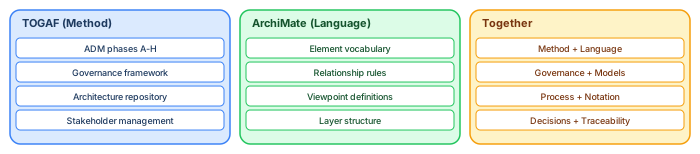
The practical value of combining TOGAF and ArchiMate is that every ADM phase produces specific, model-based deliverables instead of Word documents. When ArchiMate models replace documents, the architecture becomes queryable, traceable, and maintainable. ArchiMate tutorial for enterprise architects
TOGAF provides: The Architecture Development Method (ADM) — an iterative cycle of phases from Architecture Vision through Business, Information Systems, and Technology Architecture to Migration Planning. A governance framework for managing architecture compliance, dispensations, and change requests. An architecture repository concept for storing and managing architecture artifacts. Stakeholder management techniques for identifying concerns and communicating architecture content.
ArchiMate provides: A formal element vocabulary covering strategy, motivation, business, application, technology, and implementation/migration concepts. Relationship rules that constrain how elements can be connected (the metamodel). Viewpoint definitions that map stakeholder concerns to specific element and relationship combinations. Layer structure that organizes architecture from business intent through application support to technology infrastructure.
Mapping TOGAF ADM phases to ArchiMate deliverables
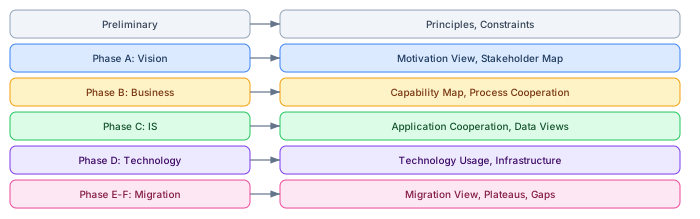
Preliminary Phase: Define Principles and Constraints as ArchiMate Motivation elements. Model the enterprise architecture capability itself — who does architecture, what tools they use, what governance applies. This becomes the foundation that subsequent phases build on.
Phase A — Architecture Vision: Build a Motivation View showing Stakeholders and their Concerns, Drivers (regulatory pressure, competitive threat, technology obsolescence), Goals (cost reduction, faster time-to-market, improved compliance), and the Requirements that flow from them. This view is the justification for everything that follows — if a Goal is not modeled, the architecture work that supports it has no traceable rationale.
Phase B — Business Architecture: Build Capability Map views and Business Process Cooperation views. Tag capabilities with maturity assessments. Model value streams showing how the organization creates and delivers value. Link Business Services to the Goals they support — this creates traceability from business motivation to business operations.
Phase C — Information Systems Architecture: Build Application Cooperation views showing how applications interact. Build Information Structure views showing data objects and their relationships. Show which Application Services serve which Business Processes — this is the critical cross-layer traceability that enables impact analysis.
Phase D — Technology Architecture: Build Technology Usage views showing infrastructure nodes, platform services, and deployment patterns. Link Technology Services to the Application Components they support. Model the physical deployment: which applications run on which nodes, in which data centers, in which cloud regions.
Phase E–F — Opportunities, Solutions, Migration Planning: Build Migration views with Plateaus, Gaps, and Work Packages. Each Plateau is a stable architectural state that the organization transitions through. Each Gap represents a difference between adjacent plateaus. Each Work Package is a project or initiative that closes a specific gap. This is where ArchiMate's Implementation & Migration extension directly supports TOGAF's transition architecture deliverables.
TOGAF ADM workflow with ArchiMate model-based evidence

In practice, the workflow integrates TOGAF process steps with ArchiMate modeling activities. Each ADM iteration produces updated ArchiMate views that serve as both working artifacts (used by the architecture team during analysis) and governance artifacts (presented to the architecture review board for decisions). ArchiMate layers explained
The critical discipline is that ArchiMate views are not created at the end of a phase as "documentation" — they are created during the phase as analytical tools. When you build the Application Cooperation view in Phase C, you are not documenting what you already know; you are discovering integration dependencies, identifying redundancies, and analyzing impact. The model is the analysis tool, not the documentation output. ArchiMate relationship types
Governance integration: using models in architecture review boards

The ultimate test of the TOGAF + ArchiMate combination is whether it improves governance decisions. Architecture review boards should use ArchiMate views as primary evidence: ArchiMate modeling best practices
Change requests: When a project proposes an architecture change, the review board examines the relevant ArchiMate views to understand impact. Which capabilities are affected? Which applications change? Which technology services need updating? Which other projects are impacted? The model provides the impact analysis; the review board provides the judgment.
Compliance reviews: When checking that a solution complies with architecture principles, trace from the Principle (Motivation element) through the Requirement to the implementing Application Component. If the traceability chain is broken, the solution has a compliance gap that must be addressed or formally dispensed.
Roadmap governance: Migration views with Plateaus and Work Packages give the review board a visual roadmap they can govern. Is each plateau a viable operational state? Does each gap have an assigned work package with timeline and resources? Are there dependency conflicts between work packages? The model makes these questions answerable.
Where the combination has gaps — and how to handle them
The TOGAF + ArchiMate combination is powerful but not complete. Three areas require pragmatic handling:
Detailed process design. ArchiMate's Business Process element is abstract — it does not model swimlanes, gateways, or message flows. When Phase B requires operational process detail, use BPMN for the detail and link BPMN processes to ArchiMate Business Process elements via Realization relationships. ArchiMate provides enterprise context; BPMN provides operational detail. In Sparx EA, both notations coexist in the same repository with cross-notation traceability.
Solution architecture design. ArchiMate models at the enterprise level — it does not specify API contracts, database schemas, or deployment manifests. When Phase G (Implementation Governance) requires solution-level detail, use UML for class diagrams, sequence diagrams, and component specifications. Link UML components to ArchiMate Application Components to maintain traceability from solution design to enterprise architecture.
Portfolio management data. TOGAF's architecture repository concept includes financial and risk data (application costs, risk scores, ROI projections). ArchiMate can carry some of this as tagged values, but it is not a portfolio management tool. Use dedicated portfolio tools (LeanIX, ServiceNow CMDB) for financial data, and integrate with the ArchiMate model via tagged values or automated data feeds — the ArchiMate model provides the structural relationships, the portfolio tool provides the financial metrics.
Making it work in practice: lessons from enterprise deployments
Start with Phase A. The Motivation View is the easiest to build and the most immediately useful — it connects business drivers to architecture goals. Build this first, present it to the architecture sponsor, and use the positive reaction to justify continued investment.
Do not try to model all ADM phases simultaneously. Pick two phases that your organization is currently executing (typically B and C) and build ArchiMate deliverables for those phases. Expand to other phases as competence grows.
Train the review board. Architecture review board members do not need to model, but they need to read ArchiMate views. A 2-hour "ArchiMate for Reviewers" session teaches them to read the core viewpoints. Without this investment, the board reverts to PowerPoint presentations because they cannot interpret the models.
Measure governance improvement. Track: time to complete architecture reviews (should decrease), quality of impact analysis (should increase), and percentage of decisions that reference model-based evidence (should increase). These metrics justify the combined TOGAF + ArchiMate investment to leadership.
Full traceability chain: from driver to technology

The ultimate deliverable of the TOGAF + ArchiMate combination is a full traceability chain that connects business motivation to technology implementation. This chain has five links:
Link 1: Driver → Goal. A business driver (regulatory pressure, competitive threat, customer demand) motivates one or more goals (reduce onboarding time, improve compliance, lower cost). This is established in Phase A.
Link 2: Goal → Requirement. Each goal generates specific requirements that the architecture must satisfy (KYC verification must complete in under 60 seconds, all PII must be encrypted at rest). This bridges motivation to specification.
Link 3: Requirement → Application Component. Each requirement is realized by one or more application components (the KYC Engine realizes the verification speed requirement). This connects specification to implementation.
Link 4: Application Component → Technology Service. Each application component depends on technology services for execution (the KYC Engine runs on a Kubernetes cluster served by an AWS managed database). This connects implementation to infrastructure.
Link 5: Work Package → Gap → Plateau. Migration planning connects the chain to delivery: work packages close gaps between plateaus, moving the architecture from baseline to target state. This connects architecture to project governance.
When a regulator changes a KYC rule, you traverse the chain: which requirements are affected? Which application components must change? Which technology services are impacted? Which work packages need updating? This traversal takes minutes with a model — it takes weeks without one.
If you’d like hands-on training tailored to your team — Sparx Enterprise Architect, BPMN, SysML, Apache Kafka or the Archi tool — or modelling coaching in ArchiMate and TOGAF-aligned governance, you can reach us via our contact page.
Frequently Asked Questions
What is TOGAF used for?
TOGAF (The Open Group Architecture Framework) is used to structure and manage enterprise architecture programmes. It provides the Architecture Development Method (ADM) for creating architecture, a content framework for deliverables, and an enterprise continuum for reuse.
How does ArchiMate relate to TOGAF?
ArchiMate and TOGAF are complementary. TOGAF provides the process framework (ADM phases, governance, deliverables) while ArchiMate provides the notation for creating the architecture content. Many organisations use TOGAF as their EA method and ArchiMate as the modeling language within each ADM phase.
What is the TOGAF Architecture Development Method (ADM)?
The ADM is a step-by-step process for developing enterprise architecture. It consists of a Preliminary phase and phases A through H: Architecture Vision, Business Architecture, Information Systems Architecture, Technology Architecture, Opportunities and Solutions, Migration Planning, Implementation Governance, and Architecture Change Management.