⏱ 19 min read
Most enterprise architecture teams do not fail with ArchiMate because the language is weak. They fail because they turn it into bureaucracy inside a modeling tool and then wonder why nobody reads the diagrams.
That is the uncomfortable truth.
ArchiMate in Sparx Enterprise Architect can be extremely useful. I’ve seen it help teams untangle ugly landscapes, expose hidden dependencies, and make investment decisions much faster. I’ve also seen it become a graveyard of over-modeled applications, fake precision, and diagrams so dense that even the architect who created them avoids opening the file.
So let’s say the quiet part out loud: using ArchiMate effectively in Sparx EA is not mainly a tooling problem. It is a modeling discipline problem. Sparx EA is powerful, flexible, and frankly a bit messy. ArchiMate is elegant, but easy to misuse. Put them together without clear architectural intent and you get a polished mess.
If you want the simple version early, here it is:
ArchiMate in Sparx EA works best when you use it to answer real enterprise questions, model only what matters, keep viewpoints audience-specific, and resist the urge to represent every technical detail as architecture.
That’s the practical SEO-friendly summary. Now the real discussion starts.
Why architects struggle with ArchiMate in Sparx EA
There are a few recurring reasons.
First, many architects confuse notation completeness with architectural usefulness. They want every Application Component linked to every Interface, every Data Object, every Technology Service, every Capability. It looks rigorous. It is usually not. It becomes a maintenance burden almost immediately.
Second, Sparx EA makes it very easy to create structure and very easy to create clutter. Those are not the same thing. Repositories fill up with packages, diagrams, stereotypes, tagged values, scripts, and relationship types that nobody governs properly. A year later, the model is technically rich and practically useless.
Third, some teams use ArchiMate like UML with different icons. That misses the point. ArchiMate is not there so you can redraw your solution design in pastel colors. It is there to express enterprise structure, behavior, services, dependencies, motivation, and change in a way that supports decision-making. ArchiMate modeling guide
And fourth, architects often model for other architects only. Big mistake. In real enterprise work, your audience is usually a mix of platform leads, security teams, delivery managers, risk people, product owners, and executives. If your model only speaks to notation purists, it will have no operational life.
What ArchiMate in Sparx EA actually is, in plain English
Let’s keep this simple first.
ArchiMate is a standard enterprise architecture modeling language. It helps you describe business, application, technology, motivation, strategy, and implementation/change elements in a consistent way.
Sparx EA is the repository and modeling environment where you create, store, relate, and publish those models.
So when people say “using ArchiMate in Sparx EA,” they usually mean: ArchiMate tutorial
- creating architecture models with ArchiMate elements and relationships
- organizing them in a governed repository
- generating diagrams and views for stakeholders
- tracing relationships across business, application, data, technology, and transformation domains
That’s the basic idea.
In practice, effective use means something more specific:
- you model just enough
- you use standard patterns
- you maintain traceability that supports decisions
- you produce views people can act on
That last point matters. Architecture is not a notation exercise. If the model does not help answer “What breaks if we change IAM?” or “Which banking channels depend on this Kafka cluster?” then the model is decorative.
The first rule: model questions, not systems
This is probably my strongest opinion on the topic.

Do not start with the repository structure. Start with the decisions the enterprise needs to make.
Too many teams begin with, “Let’s model the whole estate in ArchiMate.” No. That sounds ambitious and mature. It is usually the beginning of a slow collapse.
Start instead with questions like:
- Which customer journeys depend on legacy IAM?
- What applications publish and consume events through Kafka?
- Which regulatory controls are affected by moving workloads to cloud?
- Where are the business capabilities unsupported or duplicated?
- Which technology products are now business critical but still treated like infrastructure utilities?
Those questions give your model a purpose. Once you know the purpose, you can decide what level of detail belongs in Sparx EA.
A good architecture repository is not a digital landfill of enterprise facts. It is a structured decision-support system.
That sounds grand. But it’s just practical.
What “effective” looks like in real architecture work
In real enterprises, effective ArchiMate use in Sparx EA usually shows up in five ways.
1. Clear viewpoints for different audiences
You don’t show the same diagram to a CIO and a Kafka platform engineer.
You create targeted views:
- capability to application mapping for portfolio decisions
- application cooperation and interface views for integration planning
- technology usage views for platform strategy
- motivation and requirement views for compliance and risk
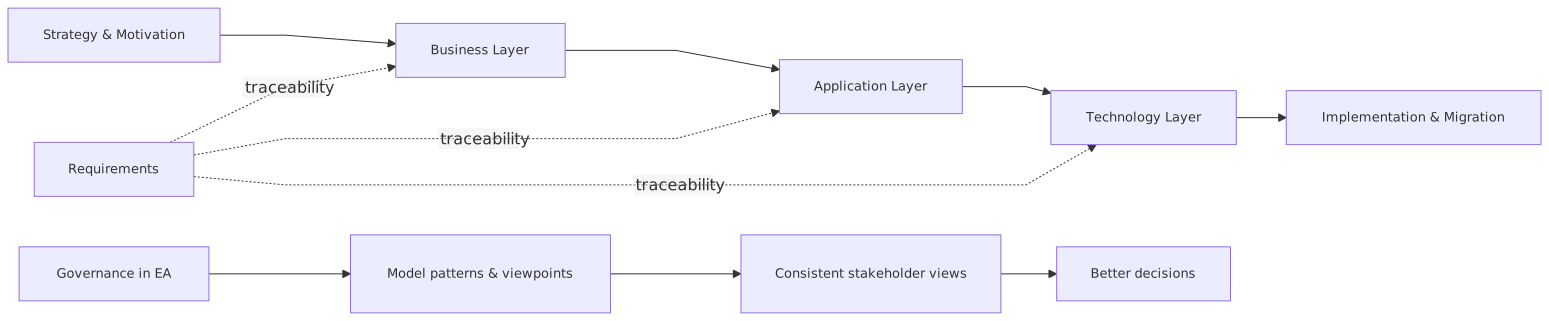
- implementation/migration views for roadmap conversations
One model, multiple views. That is where ArchiMate shines when used properly.
2. Traceability that matters
Not every relationship deserves to exist. But some absolutely do.
For example:
- business process → application service
- application component → data object
- application component → technology service
- application service → IAM dependency
- application component → Kafka topic interaction pattern
- work package → plateau → gap
Those traces let you answer impact questions quickly.
3. Consistent abstraction levels
A very common failure mode in Sparx EA is mixing conceptual, logical, and physical architecture in the same diagram.
You end up with:
- a business capability
- next to an application component
- next to an AWS MSK cluster
- next to a specific API endpoint
- next to a project milestone
That is not richness. That is abstraction collapse.
Good architects maintain separation. They connect levels through relationships, but they do not mash them all into one picture.
4. Repository discipline
If names, ownership, lifecycle status, and viewpoints are inconsistent, Sparx EA becomes untrustworthy. Once trust goes, the repository dies, even if it remains technically available.
5. Architecture linked to change
If your model is disconnected from roadmaps, programs, and implementation planning, it becomes a static reference library. Useful sometimes, yes. But not influential.
The best enterprise models show current state, target state, transition states, and the work packages moving things between them.
The mistake list nobody likes hearing
Let’s get into the common mistakes architects make. Some of these are painfully common.
Common mistakes architects make with ArchiMate in Sparx EA
That table is not theory. It is the pattern.
Sparx EA is powerful, but it will not save you from bad architecture habits
A contrarian thought here: some architects talk about Sparx EA as if the tool is the main blocker. It isn’t. Yes, the user experience can feel dated. Yes, setup choices matter. Yes, there are better-looking tools. But bad modeling in a prettier tool is still bad modeling.
Sparx EA has a few strengths that matter in enterprise environments:
- strong repository-based modeling
- support for large metamodels
- relationship richness
- package structure and reuse
- baseline/version support
- scriptability and automation options
- broad standards support beyond ArchiMate
That said, it also encourages overengineering. Because it can hold so much, teams assume it should hold everything. Wrong instinct.
If you are using ArchiMate in Sparx EA effectively, you are probably doing less than your tool admin thinks you should. ArchiMate in TOGAF ADM
How to structure ArchiMate in Sparx EA without creating chaos
There is no perfect repository structure, and anyone claiming there is should be treated with caution. But there are practical patterns that work.
A reasonable structure often includes:
- Strategy and motivation
- capabilities
- value streams
- drivers
- assessments
- goals
- principles
- requirements
- Business architecture
- business actors
- roles
- processes
- business services
- Application architecture
- application components
- application services
- interfaces
- data objects
- integrations/events
- Technology architecture
- technology services
- nodes
- system software
- platforms/cloud services
- Security architecture
- IAM services
- trust boundaries
- control mappings
- identity providers and policy enforcement points
- Transformation
- work packages
- plateaus
- gaps
- deliverables
Then inside that, you need conventions:
- one canonical object per enterprise thing
- views separated from core object catalogs
- tagged values for owner, lifecycle, criticality, environment, data classification
- relationship patterns agreed in advance
That last one matters more than people think. If one architect uses Serving and another uses Assignment and a third uses Access for basically the same semantic intent, your repository becomes logically inconsistent even if it looks fine diagram by diagram.
Real example: a bank modernizing event-driven architecture and IAM
Let’s make this concrete.
Imagine a mid-sized retail bank. It has:
- mobile banking
- internet banking
- branch systems
- payments processing
- fraud services
- customer onboarding
- an aging IAM stack
- a growing Kafka platform
- workloads split across on-prem and cloud
The bank wants to modernize digital channels, reduce point-to-point integrations, and move more services to cloud. At the same time, regulators are pushing harder on identity assurance, operational resilience, and data lineage.
This is exactly the kind of environment where ArchiMate in Sparx EA can either become very useful or very silly.
The bad way to model this bank
The bad approach is to create giant diagrams labeled “Current State Application Landscape” showing:
- every application
- every integration
- every Kafka topic
- every IAM component
- every cloud service
- every data store
The diagram becomes a wallpaper of boxes and lines. It impresses people for nine seconds and then fails completely.
Worse, the architects then try to keep it all current manually. They can’t. Nobody can.
The effective way to model this bank
Instead, model around real questions.
Question 1: Which customer-facing banking capabilities depend on IAM modernization?
Create a capability map and relate:
- Customer Authentication
- Customer Profile Management
- Payments Authorization
- Digital Onboarding
- Fraud Review
Then connect those capabilities to:
- business processes
- application services
- application components
- IAM services
Now you can show, for example, that:
- mobile banking and internet banking both consume a central authentication service
- onboarding uses a separate identity proofing component
- branch systems still rely on legacy directory integration
- fraud tooling uses inconsistent role models
That is useful. It tells you modernization scope and risk exposure.
Question 2: What depends on Kafka, and how critical is it?
Model Kafka not as some mysterious technical blob but as a technology service or platform service consumed by application components.
Then relate:
- Payments Event Publisher
- Customer Notification Service
- Fraud Detection Engine
- Core Banking Adapter
- Data Lake Ingestion
- AML Monitoring
You can then create a clean view showing:
- which apps publish events
- which apps consume them
- which business services rely on near-real-time event flow
- what happens if the Kafka service degrades
This matters in resilience planning. In banking, “event streaming” is often treated like plumbing until it breaks and suddenly becomes a board-level issue.
Question 3: What changes when workloads move to cloud?
Create a target state view where:
- selected application components move from on-prem hosting to cloud platform services
- IAM control points are redefined
- Kafka deployment model changes, maybe from self-managed cluster to managed cloud streaming service
- trust boundaries and network dependencies are explicitly shown
Now the architecture model supports migration sequencing and control design.
That is enterprise architecture doing actual work.
How to model Kafka sensibly in ArchiMate
Kafka is one of those technologies that architects often model badly because they either oversimplify it into a single box or explode it into implementation detail.
Neither is ideal.
At enterprise level, Kafka is usually best represented as:
- a technology service when you are showing platform capability consumed by applications
- possibly supported by system software and nodes if you need a more infrastructure-aware view
- linked to application components that publish or consume events
- linked conceptually to data objects or business events where relevant
Do not model every topic in enterprise architecture unless there is a specific reason. Most topics are integration design detail, not enterprise architecture assets.
When should you model topics?
- when a topic is business-critical and stable enough to act as a governed enterprise contract
- when data lineage or regulatory controls require visibility
- when platform dependency concentration is a major risk
- when event domains are part of target-state design
Otherwise, keep it at service and dependency level.
A lot of architects over-model Kafka because event-driven architecture feels modern and important. Fine. But if your repository ends up documenting topic naming conventions while nobody can explain which critical banking services depend on the event platform, you have missed the point.
IAM is where ArchiMate either proves its value or gets exposed
Identity and access management is a great test of architectural maturity because it cuts across business, application, technology, security, and compliance.
In many enterprises, IAM is still modeled far too technically:
- Active Directory
- Entra ID
- Ping
- Okta
- LDAP
- MFA service
- token service
Useful, but incomplete.
What matters architecturally is how those components support enterprise services such as:
- workforce authentication
- customer authentication
- privileged access management
- authorization decisioning
- identity proofing
- federation
- access certification
Then you connect those services to:
- customer journeys
- internal business processes
- application components
- control objectives
- target-state roadmaps
In the banking example, this lets you expose things that are often hidden:
- customer auth is modernized, but branch staff still use legacy identity stores
- payment approval uses local authorization logic inconsistent with central policy
- cloud-hosted workloads authenticate centrally but are authorized inconsistently
- fraud tools have broad entitlements with weak recertification
That is real architecture work. It is not glamorous. But it changes decisions.
Cloud architecture: don’t let vendors hijack the model
Another strong opinion: enterprise architecture models become weaker the moment they become cloud product catalogs.
You are not there to draw every AWS, Azure, or GCP icon someone deployed last quarter.
In ArchiMate, cloud should be modeled in terms of:
- platform services consumed
- deployment patterns
- hosting relationships
- resilience and security boundaries
- strategic platform choices
For example, in the bank:
- customer notification service may use managed cloud messaging
- digital onboarding may run on container platform services
- Kafka may move to managed streaming
- IAM federation may span cloud and on-prem
- sensitive payment workloads may remain hybrid due to control requirements
That is enough for enterprise architecture.
If you need subnet-level diagrams, write them somewhere else. Not every technical artifact belongs in Sparx EA as ArchiMate content.
Some architects hate this view because they want one repository to rule everything. I think that is a category error. Enterprise architecture should integrate with detailed engineering artifacts, not absorb them all.
A practical modeling pattern that works
If you want a practical pattern for using ArchiMate in Sparx EA, use this sequence:
1. Start with capabilities and business services
What is the enterprise trying to do?
2. Map the supporting application services and components
Which systems support those capabilities?
3. Add technology services only where they matter
Which platforms are dependencies with decision significance?
4. Add motivation and constraints
Why does this matter? Regulatory driver? Cost pressure? Resilience risk?
5. Add transformation elements
What work packages move current state toward target state?
6. Publish stakeholder-specific views
Do not dump raw model structure on people.
This sequence keeps architecture anchored in enterprise intent rather than technical inventory.
What good ArchiMate diagrams in Sparx EA feel like
Good diagrams feel obvious in hindsight.
You look at them and think:
- I understand the issue
- I know what depends on what
- I can see why the change matters
- I can discuss options
Bad diagrams feel like notation demonstrations.
You look at them and think:
- technically impressive
- but what am I supposed to conclude?
That distinction is everything.
A good diagram usually has:
- one clear purpose
- limited scope
- consistent abstraction level
- 10 to 20 meaningful elements, not 70
- labels people outside architecture can understand
- a title that states the question being answered
For example:
- “Customer Authentication Dependencies Across Digital Channels”
- “Kafka Platform Criticality for Payments and Fraud Services”
- “Target-State IAM Services for Hybrid Cloud Banking Applications”
Those are architecture views. “Application Landscape v17” is not.
Governance matters more than notation purity
You can have a perfect ArchiMate metamodel and still fail if governance is weak.
In Sparx EA, effective governance usually means:
- architecture review cadence
- domain ownership for model sections
- naming and relationship standards
- lifecycle review for core elements
- published viewpoints with quality checks
- controlled use of custom stereotypes and tagged values
And please, be careful with customizations. Sparx EA allows a lot of flexibility, which is useful until teams build local dialects nobody else understands. If your ArchiMate repository requires a tribal elder to interpret it, you’ve gone too far.
Stick close to the standard. Extend sparingly. Explain every extension.
Contrarian thought: not everything needs to be in ArchiMate
This should not be controversial, but somehow it still is.
Not every architecture artifact should be modeled in ArchiMate, even inside Sparx EA.
You may be better off keeping some things elsewhere:
- detailed API schemas
- topic-level event contracts
- cloud deployment scripts
- security control test evidence
- operational runbooks
- solution design details
Reference them. Link to them. Trace to them if useful. But do not force all of them into ArchiMate just because the repository can hold attachments and linked artifacts.
Architecture loses value when it tries to become engineering, delivery management, CMDB, and documentation portal all at once.
How this applies in day-to-day enterprise architecture work
Let’s get practical again.
In daily architecture work, using ArchiMate in Sparx EA effectively helps with:
Investment decisions
Which platforms are strategic? Which apps should be retired? Which dependencies increase modernization cost?
Impact analysis
If the IAM platform changes, which applications, customer journeys, and controls are affected?
Program planning
What work packages need sequencing when moving banking services to cloud while preserving compliance and resilience?
Risk discussions
Which business services depend on Kafka? Where do single points of failure hide behind “shared platform” language?
Stakeholder alignment
Can security, infrastructure, application, and business teams look at the same architecture issue through tailored views?
Rationalization
Where are duplicate services or overlapping capabilities? In banks, this often shows up in identity, notifications, and customer data domains.
That is the difference between architecture as repository maintenance and architecture as enterprise decision support.
A final warning about beauty versus usefulness
Architects love a clean diagram. I do too. But neatness can become a trap.
A beautiful ArchiMate diagram in Sparx EA is not necessarily a useful one. Sometimes the most valuable view is slightly ugly because it reveals uncomfortable truths:
- duplicate customer identity stores
- Kafka dependence far beyond declared critical systems
- cloud migration blocked by old authorization models
- “temporary” adapters that have become core banking dependencies
Architecture should expose reality, not tidy it up for aesthetic comfort.
That’s maybe the most important thing to remember.
Conclusion
Using ArchiMate in Sparx EA effectively is not about mastering every symbol or stuffing the repository with enterprise trivia. It is about disciplined modeling in service of real decisions.
Use ArchiMate to express enterprise structure, dependencies, and change. Use Sparx EA as the governed repository and publishing mechanism. But stay ruthless about scope, abstraction, and audience.
Model the questions that matter.
Keep views purposeful.
Trace what drives decisions.
Avoid turning architecture into documentation theater.
If you do that, ArchiMate in Sparx EA becomes genuinely powerful, especially in complex environments like banking where Kafka, IAM, cloud, risk, and transformation all collide.
If you don’t, you’ll still have diagrams. Lots of them. And almost no architectural influence.
That, sadly, is the more common outcome.
FAQ
1. Is Sparx EA a good tool for ArchiMate, or is it too clunky?
It is a good tool, especially for large repositories and traceability-heavy environments. It is clunky in places, yes. But the bigger problem is usually poor modeling discipline, not the tool itself.
2. Should we model every application integration and Kafka topic in ArchiMate?
No. Model integrations and topics only when they matter for enterprise decisions, resilience, governance, or target-state design. Otherwise you are drifting into solution documentation.
3. How detailed should IAM architecture be in Sparx EA?
Detailed enough to show enterprise services, dependencies, trust boundaries, and control impact. Not so detailed that the model becomes a directory of products and protocols with no business context.
4. What is the most common mistake teams make with ArchiMate in Sparx EA?
Trying to model the whole estate at once. It sounds mature but usually creates a bloated, stale repository. Start with decision-driven scope and expand carefully.
5. How do you keep an ArchiMate repository useful over time?
Assign ownership, enforce naming and lifecycle standards, review core domains regularly, and publish stakeholder-specific views. A repository without governance becomes fiction surprisingly fast.
Frequently Asked Questions
What is enterprise architecture?
Enterprise architecture is a discipline that aligns an organisation's strategy, business processes, information systems, and technology. Using frameworks like TOGAF and modeling languages like ArchiMate, it provides a structured view of how the enterprise operates and how it needs to change.
How does ArchiMate support enterprise architecture practice?
ArchiMate provides a standard modeling language that connects strategy, business operations, applications, data, and technology in one coherent model. It enables traceability from strategic goals through business capabilities and application services to the technology platforms that support them.
What tools are used for enterprise architecture modeling?
The main tools are Sparx Enterprise Architect (ArchiMate, UML, BPMN, SysML), Archi (free, ArchiMate-only), and BiZZdesign Enterprise Studio. Sparx EA is the most feature-rich option, supporting concurrent repositories, automation, scripting, and integration with delivery tools like Jira and Azure DevOps.