⏱ 17 min read
Here’s the blunt version: most enterprise architecture teams do not have a tooling problem, and they do not have a framework problem. They have a thinking problem.
They say “we’re doing TOGAF” when they mean “we have a few PowerPoint standards and an architecture review board.” They say “we use ArchiMate” when they mean “someone drew boxes with a special stencil.” Then six months later they wonder why nobody in engineering cares, why business stakeholders avoid architecture sessions, and why the cloud migration still looks like a plate of spaghetti.
So let’s clear this up properly.
TOGAF and ArchiMate are not competitors. They are not interchangeable. They solve different problems. If you mix them up, your architecture practice gets slow, abstract, and weirdly ceremonial. If you use them well, they can actually help you make decisions, explain trade-offs, and move large organizations without reducing everything to buzzwords.
The simple explanation first
If you want the short SEO-friendly answer:
- TOGAF is an enterprise architecture framework. It tells you how to structure architecture work, especially governance, process, viewpoints, capability development, and architecture lifecycle thinking.
- ArchiMate is a modeling language. It tells you how to describe architecture in a consistent visual and semantic way.
That’s the core distinction.
TOGAF is about method and operating model.
ArchiMate is about representation and communication.
Or even simpler:
- TOGAF = how you run architecture
- ArchiMate = how you draw and model architecture
That’s the answer most articles should give in paragraph one, but too many spend 1,500 words pretending this is mystical.
Now the deeper truth: in real enterprise work, both can be useful, both can be overused, and neither will save a weak architecture team.
Why this confusion happens so often
The confusion exists because enterprise architecture has a bad habit: it likes to package common sense in branded terminology, then act surprised when practitioners roll their eyes.
A new architect joins a large bank. They hear:
- “We use TOGAF.”
- “Our repository is ArchiMate-based.”
- “We do capability mapping.”
- “We align to target state.”
- “We govern through standards.”
What they often discover is:
- no one agrees on the architecture process,
- the diagrams are inconsistent,
- half the models are stale,
- and project teams only engage architecture two days before go-live.
That’s not TOGAF’s fault. And it’s not ArchiMate’s fault. It’s because organizations adopt labels before they adopt discipline. ArchiMate modeling guide
So let’s break the two apart in practical terms.
TOGAF, at its best, is a way to organize enterprise architecture as a management discipline.
People usually associate it with the ADM, the Architecture Development Method. Fair enough. The ADM is the visible part: phases, iteration, baseline and target architectures, migration planning, governance, requirements management. Useful structure. Sometimes too much structure, but useful.
What TOGAF really gives you is a set of ideas:
- architecture should connect business and technology,
- current state and target state should both be understood,
- change should be planned in transitions,
- governance matters,
- architecture decisions need traceability,
- standards and principles should be intentional,
- architecture is not just solution design.
In a decent enterprise architecture practice, TOGAF helps answer questions like:
- How do we move from fragmented IAM platforms to a unified identity strategy?
- How do we define target-state cloud architecture across business units?
- How do we sequence modernization without blowing up operations?
- How do we govern exceptions without creating theatre?
- How do we connect strategy to implementation?
That is where TOGAF belongs.
What TOGAF is not
TOGAF is not:
- a set of mandatory diagram types,
- a guarantee of good architecture,
- a reason to create 200 pages nobody reads,
- an excuse to separate architects from delivery,
- a substitute for engineering understanding.
This is where many teams go wrong. They turn TOGAF into ritual. They produce phase artifacts because the framework suggests them, not because the organization needs them. The result is architecture that is technically compliant and practically irrelevant. ArchiMate in TOGAF ADM
I’ll say it plainly: a lightweight architecture practice with good decision records, strong principles, and clear target-state thinking beats a bloated “full TOGAF” implementation almost every time.
That sounds contrarian only if you’ve never had to rescue a failing architecture function.
ArchiMate is a visual modeling language for enterprise architecture. It gives you concepts and relationships to describe things like:
- business capabilities,
- business processes,
- application services,
- data objects,
- technology nodes,
- devices,
- interfaces,
- flows,
- motivation elements,
- implementation and migration elements.
In theory, this is excellent. Enterprises are complex. If every architect uses different symbols and different meanings for “service,” “application,” “platform,” or “interface,” chaos follows. ArchiMate tries to create a common language. ArchiMate tutorial
And that matters.
If you are mapping:
- customer onboarding in a bank,
- Kafka event flows between core systems,
- IAM dependencies across SaaS and on-prem applications,
- cloud landing zones and shared platform services,
then a standard modeling language can reduce ambiguity.
What ArchiMate is not
ArchiMate is not:
- a strategy,
- a process,
- a governance model,
- a replacement for clear narrative,
- a reason to produce unreadable diagrams.
This is the painful part. Many architects discover ArchiMate, love the rigor, then proceed to create diagrams that look like a subway map designed by a committee during a power outage.
Just because a model is formally correct does not mean it is useful.
A business executive does not need to see every ArchiMate relationship. A product owner does not care that your notation is pure if they still cannot understand the impact of replacing a legacy IAM broker. A platform engineer does not need a motivation layer masterpiece if the actual Kafka topic ownership model is still unresolved.
ArchiMate should clarify architecture, not perform architecture.
That distinction matters more than people admit.
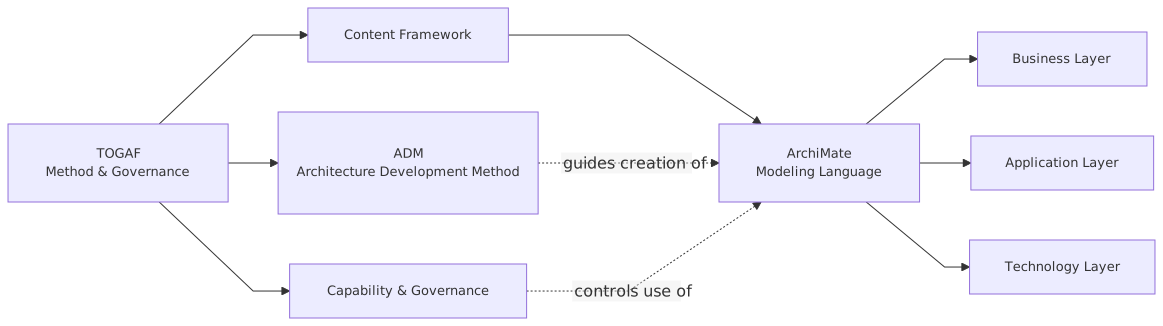
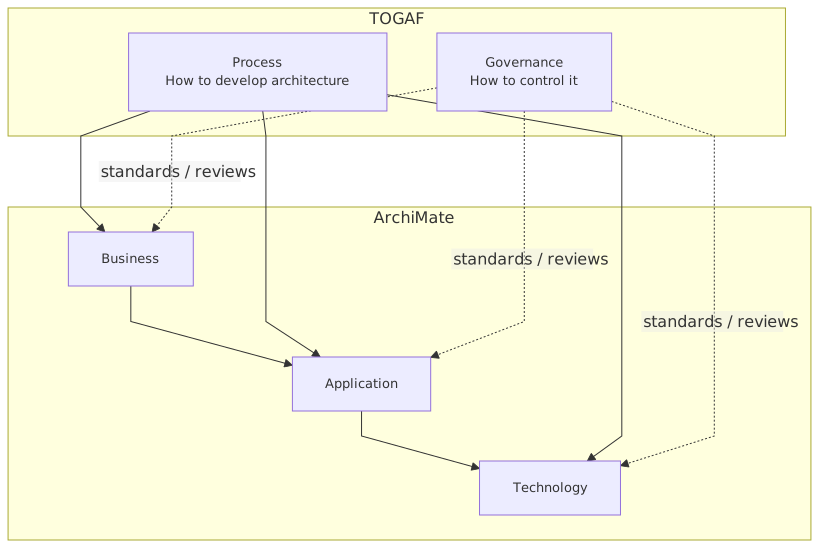
This is the cleanest way to explain it:
That’s the formal answer.
The practical answer is this:
- Use TOGAF to define how architecture engages with strategy, portfolios, programs, delivery teams, and governance.
- Use ArchiMate to model the landscape in a way that supports those conversations.
TOGAF can exist without ArchiMate. Plenty of organizations use TOGAF-ish practices with simple diagrams.
ArchiMate can exist without TOGAF. Plenty of teams use ArchiMate in repositories or tools without running a TOGAF-aligned EA function.
But together, they can work well if you keep them grounded in decisions.
This is where the theory either becomes useful or dies.
In real enterprise architecture work, your job is not to admire frameworks. Your job is to help the organization make better change decisions under constraints.
That means things like:
- reducing platform duplication,
- clarifying ownership,
- sequencing transformation,
- exposing hidden dependencies,
- creating standards that engineering can live with,
- and communicating trade-offs to people who do not share your vocabulary.
TOGAF helps you structure these conversations. ArchiMate helps you visualize them.
Example 1: Banking modernization with Kafka and cloud
Let’s say you’re in a retail bank. You have:
- a legacy core banking platform,
- separate customer, payments, and fraud domains,
- a growing Kafka platform used for event integration,
- hybrid cloud deployment,
- and too many point-to-point integrations pretending to be strategic.
The bank wants:
- faster product launch,
- better fraud detection,
- cloud migration,
- and a more consistent customer identity model.
Where TOGAF helps
TOGAF helps frame the work:
- what is the baseline architecture?
- what is the target state?
- what business capabilities are affected?
- what are the transition architectures?
- what governance principles apply?
- which projects are enablers versus distractions?
- what architecture building blocks are reusable?
You can use a TOGAF-style approach to define:
- target integration principles,
- event-driven architecture standards,
- cloud hosting guardrails,
- IAM target-state principles,
- migration roadmap over 24–36 months.
Where ArchiMate helps
ArchiMate helps model:
- which applications publish to Kafka,
- which business processes consume event-driven services,
- which data objects are shared,
- where IAM services sit in the landscape,
- what cloud platform services support each application,
- where legacy dependencies block migration.
Now you can create different views:
- an executive view showing capability impact,
- an integration view showing Kafka dependencies,
- a security view showing IAM trust relationships,
- a migration view showing transition architectures.
That’s useful. That’s architecture.
What’s not useful is producing one giant “all layers” diagram with every application, event topic, interface, and node in a single page. That is not insight. That is stress as a service.
Example 2: IAM consolidation in a multinational bank
Here’s a more concrete enterprise example.
A multinational bank had grown through acquisition. It ended up with:
- three workforce identity platforms,
- two customer IAM stacks,
- local Active Directory forests,
- inconsistent MFA policies,
- duplicate role models,
- and cloud applications integrated differently in each region.
Everyone agreed it was bad. Nobody agreed what “better” meant.
The architecture problem
This wasn’t just a technology cleanup. It was an enterprise problem:
- compliance risk,
- poor user experience,
- high operating cost,
- weak joiner-mover-leaver processes,
- and delayed SaaS onboarding.
How TOGAF was useful
The architecture team used a TOGAF-like structure to:
- define business drivers and constraints,
- map baseline architecture,
- define target IAM principles,
- create target-state architecture,
- identify transition architectures by region,
- govern exceptions and sequence migration.
The principles were simple and sharp:
- one strategic workforce identity provider,
- one customer IAM control plane per regulatory pattern,
- MFA by risk tier,
- centralized policy management,
- federate where possible, duplicate only where regulation demands it,
- no new direct local authentication unless approved by security architecture.
That is the kind of thing TOGAF supports well: structured architectural thinking, stakeholder alignment, and controlled change.
How ArchiMate was useful
ArchiMate was then used to model:
- business actors and roles,
- IAM services,
- applications consuming identity services,
- technology components,
- trust relationships,
- transition states.
This mattered because the bank had to explain different things to different audiences:
- executives needed business impact,
- security needed control points,
- engineers needed integration dependencies,
- program managers needed migration sequencing.
ArchiMate gave the team a way to produce views tailored to each audience while maintaining a coherent underlying model.
The outcome
The program did not magically become easy. These things never do. But the architecture became discussable. That is more important than people realize.
Because once architecture is discussable, it can be governed, funded, challenged, and implemented.
That’s the practical value of TOGAF plus ArchiMate. Not purity. Not certification trivia. Better conversations leading to better decisions.
Let’s be honest here. Most problems with TOGAF and ArchiMate are self-inflicted.
1. Treating TOGAF like a recipe book
Architects read the framework and assume every artifact must exist. So they generate catalogs, matrices, and deliverables because the method implies them.
Bad move.
The right question is: what does this organization need to make a decision and execute change?
If the answer is a principles deck, a target-state map, two transition architectures, and a governance process, do that. Don’t manufacture weight.
2. Treating ArchiMate like the point of the exercise
This one is common in tool-heavy EA teams.
The repository becomes the product. Model completeness becomes the KPI. Architects spend months refining relationships while engineering teams bypass them and build directly in cloud platforms.
A model is only valuable if it helps people understand reality, decide faster, or reduce risk.
3. Confusing conceptual, logical, and physical views
This is a classic architecture sin.
You ask for a target-state conceptual architecture and get:
- AWS account names,
- Kafka broker clusters,
- IAM product SKUs,
- and subnet details.
Wrong level.
Or the opposite: you ask for implementation dependency clarity and get abstract capability boxes with arrows labeled “enables.”
Also wrong.
TOGAF helps with architecture levels if used well. ArchiMate helps express them if used carefully. But architects still have to think.
4. Building one diagram for everyone
This is probably the most persistent mistake in enterprise architecture.
Executives, product teams, security, operations, and engineers do not need the same view. If you force one diagram to serve all audiences, it will fail all of them.
ArchiMate is strong precisely because it supports viewpoints. Use that. A business capability map is not the same as a Kafka integration dependency view.
5. Overstandardizing language without fixing meaning
I’ve seen architecture teams spend weeks debating whether something is an “application component” or an “application service” while everyone in delivery is still unclear who owns the API gateway.
If your semantics are perfect and your ownership model is fuzzy, congratulations, you have achieved decorative rigor.
6. Ignoring operational reality
Real architecture lives in constraints:
- release windows,
- regulatory deadlines,
- legacy vendor contracts,
- cloud skill gaps,
- data residency rules,
- IAM integration limitations,
- Kafka topic governance disputes.
Frameworks don’t remove that. Good architects absorb it.
The best architects I know use TOGAF and ArchiMate lightly but think deeply. The weaker ones use them heavily and think shallowly.
Yes, that’s a harsh sentence. It’s also true.
TOGAF tends to work well when:
- the organization is large and fragmented,
- architecture governance is weak or inconsistent,
- multiple programs need alignment,
- target-state planning is poor,
- stakeholders need a common operating model for architecture,
- transition roadmaps matter.
For example:
- a bank standardizing cloud landing zones across countries,
- an insurer rationalizing application portfolios,
- a government agency modernizing IAM and citizen services,
- a global manufacturer consolidating ERP and integration patterns.
In these situations, architecture needs structure. TOGAF gives you a vocabulary and process backbone.
But again, use judgment. You do not need to perform every phase like theatre.
ArchiMate shines when:
- the architecture landscape is large,
- many stakeholders need different views,
- traceability matters,
- dependencies are complex,
- architecture repositories need consistency,
- communication across business/application/technology layers is weak.
Good use cases include:
- mapping Kafka producers, consumers, and business services,
- showing how IAM services support workforce and customer journeys,
- tracing cloud platform dependencies,
- modeling transition architectures during modernization,
- linking capability gaps to applications and technology components.
It is especially useful in enterprises where architecture knowledge is tribal and scattered. A consistent modeling language can reduce rework and misunderstanding.
But there is a catch: if your architects cannot simplify, ArchiMate will amplify their worst instincts.
Here’s the operating model I tend to recommend.
Use TOGAF for the architecture practice, not for ceremony
Define:
- architecture principles,
- engagement model,
- governance checkpoints,
- architecture domains,
- target-state methods,
- exception handling,
- roadmap approach.
Keep it lean. Make it real. Tie it to portfolio and delivery decisions.
Use ArchiMate selectively for reusable models
Model the things that matter:
- business capabilities,
- strategic applications,
- integration patterns,
- IAM services,
- cloud platform building blocks,
- transition states,
- critical dependencies.
Do not model everything. Most enterprises drown in low-value detail.
Produce audience-specific views
For example in a banking program:
That is how architecture becomes useful. Not by insisting everyone admire the same canonical diagram.
Let me say something that framework enthusiasts often dislike.
In many organizations, the architecture function would improve immediately if it:
- reduced artifact count by 50%,
- cut review meetings in half,
- replaced generic standards with sharper principles,
- spent more time with engineering leads,
- and modeled only what was actively being changed.
There is this belief in enterprise architecture that maturity means more process, more repository depth, more formalism. Sometimes it does. Often it doesn’t.
Sometimes maturity means knowing what not to model.
If your cloud migration is blocked because application owners don’t know their dependencies, then yes, ArchiMate models can help.
If your IAM strategy is failing because regional security teams reject central standards, then TOGAF-style governance and stakeholder management can help.
But if your architecture team is producing elegant models while product teams route around them, then the issue is not framework selection. It’s relevance.
That’s the part many articles avoid because it’s uncomfortable. Enterprise architecture is full of methods for creating outputs. It has fewer honest conversations about earning influence.
If you are an architect early in your enterprise journey:
- Learn TOGAF first if you need to understand how enterprise architecture is organized in large organizations.
- Learn ArchiMate first if you need to communicate complex architecture landscapes visually and consistently.
If you are working in a real enterprise, eventually you should understand both.
But here’s my stronger opinion: learn architecture thinking before either one.
If you cannot:
- separate strategy from implementation,
- identify constraints,
- clarify decisions,
- reason about trade-offs,
- and communicate at the right level,
then TOGAF will make you procedural and ArchiMate will make you elaborate.
Neither outcome is attractive.
So, ArchiMate vs TOGAF?
It’s the wrong fight.
The real distinction is simple:
- TOGAF helps you run architecture
- ArchiMate helps you express architecture
One gives you process and governance.
The other gives you language and views.
In real enterprise work, especially in banks dealing with cloud migration, Kafka-based integration, IAM consolidation, and regulatory complexity, both can be valuable. But only if they are used to improve decisions, not to decorate architecture with formality.
Use TOGAF to create a practical architecture operating model.
Use ArchiMate to show the landscape, dependencies, and transition states.
Do not let either become an end in itself.
And please, for the love of everyone in delivery, stop presenting giant unreadable diagrams as if complexity itself were a sign of rigor.
Clear architecture beats complicated architecture. Every time.
1. Is ArchiMate part of TOGAF?
Not exactly. They are separate standards from The Open Group, and they complement each other. TOGAF is the framework for enterprise architecture practice; ArchiMate is the modeling language you can use within that practice.
2. Can you use TOGAF without ArchiMate?
Yes, absolutely. Many organizations use TOGAF-style architecture governance, principles, and roadmapping with simple diagrams, capability maps, and decision records instead of formal ArchiMate models.
3. Can you use ArchiMate without TOGAF?
Yes. If your main need is consistent architecture modeling, ArchiMate can be used on its own. This is common in architecture repositories, integration mapping, cloud dependency views, and transformation programs where visual consistency matters more than framework adoption.
4. Which is better for cloud architecture?
Neither is “better” on its own. TOGAF is better for structuring cloud strategy, governance, and migration planning. ArchiMate is better for showing cloud services, platform dependencies, shared capabilities, and transition states. In practice, cloud architecture usually benefits from both.
5. Why do architects struggle with TOGAF and ArchiMate in real projects?
Because they often overcomplicate them. TOGAF becomes bureaucracy. ArchiMate becomes overmodeling. The fix is to focus on decisions, stakeholders, and actual change: for example, Kafka integration ownership, IAM consolidation, or cloud migration sequencing. If the framework or model does not help with those, it is probably being used badly.
Frequently Asked Questions
What is TOGAF used for?
TOGAF (The Open Group Architecture Framework) provides a structured approach to developing, governing, and managing enterprise architecture. Its Architecture Development Method (ADM) guides architects through phases from architecture vision through business, information systems, and technology architecture to migration planning and governance.
What is the difference between TOGAF and ArchiMate?
TOGAF is a process framework — it defines how to develop, govern, and manage enterprise architecture. ArchiMate is a modeling language — it defines how to represent and communicate architecture content. They are designed to work together: TOGAF provides the method, ArchiMate provides the notation for producing TOGAF deliverables.
Is TOGAF certification worth it?
TOGAF certification (Foundation and Practitioner) is widely recognised by employers and is particularly valued in consulting, financial services, government, and large enterprise environments. Foundation validates understanding of TOGAF concepts; Practitioner validates the ability to apply them. Combined with ArchiMate and tool skills (Sparx EA), it significantly strengthens an enterprise architect's profile.