⏱ 19 min read
Most banking architecture is not failing because people lack diagrams. It’s failing because people produce the wrong diagrams for the wrong audience at the wrong level of abstraction, and then pretend the architecture is “documented.”
That’s the uncomfortable truth.
I’ve seen banks with hundreds of application interfaces, Kafka everywhere, IAM bolted onto every channel, cloud landing zones in three providers, and still no shared understanding of how value actually moves through the enterprise. Not because the architects were lazy. Usually the opposite. Too much effort went into diagramming technology and not enough into modeling meaning.
This is where ArchiMate becomes either incredibly useful or completely intolerable.
Used well, ArchiMate gives a bank a common language to connect strategy, products, capabilities, processes, applications, data, technology, and risk. Used badly, it turns into a repository of lifeless boxes that nobody trusts and nobody updates. Both outcomes are common. The notation is not the issue. The discipline is.
So let’s say it simply up front, because this matters for actual architecture work and yes, for search too: ArchiMate is a modeling language for enterprise architecture. In banking, it helps architects describe how business services, banking processes, applications, integrations, data, security controls, and infrastructure fit together. It is especially useful when you need to connect business change to technology change across domains.
That’s the simple explanation.
The deeper explanation is more interesting. In a bank, architecture is not just about systems. It’s about obligations. Regulatory obligations. Identity obligations. Resilience obligations. Customer outcome obligations. ArchiMate works in banking because it can express relationships between things that are usually managed in isolation: a customer onboarding journey, an IAM platform, a sanctions screening service, a Kafka event backbone, a cloud deployment pattern, and the operational processes that keep all of it alive.
And that’s exactly why some architects hate it. It forces you to think clearly.
Why banking architecture needs more than application landscape pictures
Banks are structurally messy. That’s not a criticism. It’s just reality.
You have:
- products that evolved through acquisition
- channels that were modernized unevenly
- core systems that nobody wants to touch
- control functions that quite rightly demand traceability
- integration patterns that span APIs, files, MQ, and Kafka
- IAM models that differ between workforce, customer, and partner access
- cloud ambitions constrained by data residency, resilience, and operational maturity
In that environment, architecture diagrams often collapse into one of two bad extremes:
- Executive wallpaper
Pretty capability maps and target-state pictures with no operational truth.
- Engineering spaghetti
Detailed technical diagrams that explain components but not intent.
ArchiMate, when used properly, sits in the middle. It lets you model enough precision to be useful, without dropping immediately into implementation detail. That middle layer is where enterprise architects should spend most of their time. Not because detail is bad. Because translation is the job.
A bank does not need more diagrams of servers talking to servers. It needs models that answer questions like:
- Which banking capability depends on this IAM service?
- What customer journeys break if this Kafka cluster is unavailable?
- Which applications process customer consent?
- What business process changes when we move payments orchestration to cloud?
- Which controls are compensating for a legacy identity weakness?
- What data objects are exposed through a digital onboarding API?
These are architecture questions. Not just technology questions.
What ArchiMate actually gives you in a banking context
If you strip away the jargon, ArchiMate gives you a way to model a bank from different but connected viewpoints. ArchiMate modeling guide
At a practical level, these layers matter most:
- Business layer: capabilities, business processes, products, business services, actors
- Application layer: applications, application services, data objects, interfaces
- Technology layer: platforms, nodes, system software, networks, technology services
- Motivation/strategy elements: goals, outcomes, requirements, drivers, constraints
- Implementation/migration elements: work packages, plateaus, deliverables
That layered structure matters in banking because every serious change crosses those boundaries.
Take customer onboarding. Sounds simple until it isn’t.
At the business layer, onboarding is a process supporting customer acquisition and account opening capabilities.
At the application layer, it touches CRM, KYC, document verification, case management, IAM, consent management, and product origination.
At the technology layer, maybe it runs partly on cloud, consumes external verification APIs, emits Kafka events, and depends on centralized observability and secrets management.
At the motivation layer, it exists under pressures like digital growth, AML obligations, fraud reduction, and customer experience goals.
Without a language that connects those things, teams fill the gap with assumptions.
And assumptions in banks get expensive fast.
The first mistake architects make: modeling everything
This is probably the most common ArchiMate failure mode. ArchiMate tutorial
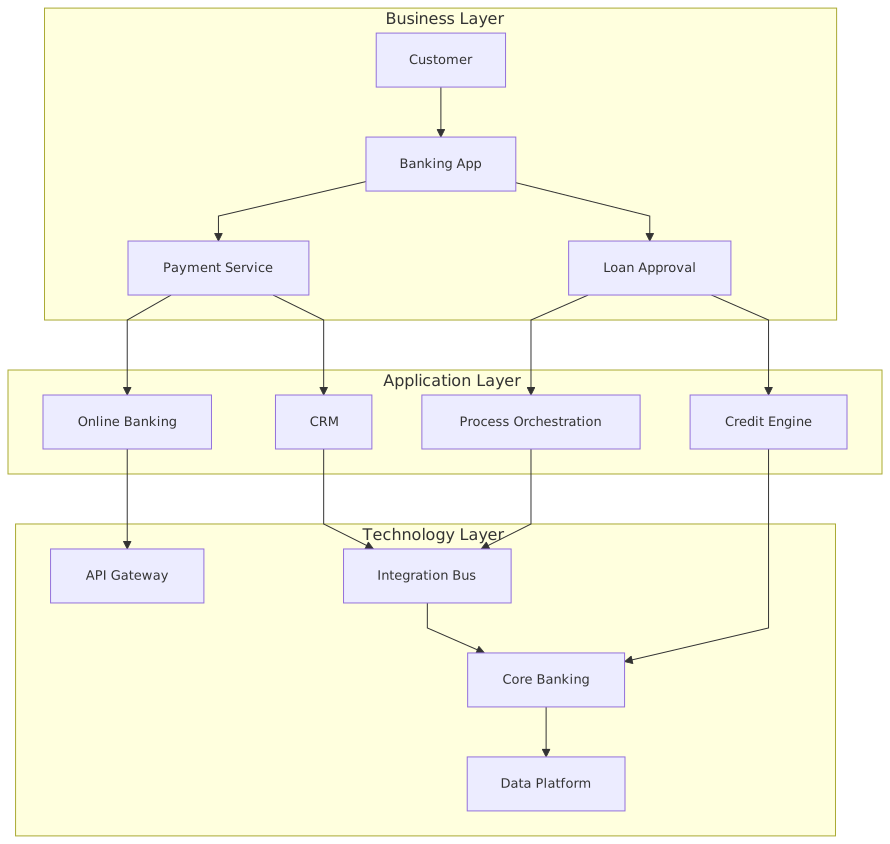
A team discovers the notation and decides to model the whole bank. Every process, every interface, every application component, every technology node. They build a giant repository. Six months later it’s already stale. A year later people are exporting PowerPoint from it because nobody can navigate the model. Two years later the architecture function quietly stops mentioning it.
That is not an ArchiMate problem. That is a scope problem.
Real architecture work is about decision support. If the model does not support a decision, challenge, funding case, control discussion, or delivery dependency, it probably does not need to exist.
My opinion here is strong: enterprise architecture repositories should be opinionated and incomplete by design.
Not sloppy. Selective.
In banking, start with value-bearing and risk-bearing areas:
- customer onboarding
- payments
- lending origination
- fraud and financial crime controls
- identity and access management
- integration backbone
- cloud hosting patterns
- critical data domains
Model what changes. Model what regulators care about. Model what fails in incidents. Model what consumes budget. Leave the rest alone until there is a reason.
Architects who try to model the enterprise as a museum end up curating dead artifacts.
A practical way to use ArchiMate in a bank
Here’s the approach I’ve found works in real organizations.
1. Start with a change problem, not a notation exercise
For example:
- We are modernizing retail onboarding
- We are introducing Kafka as the event backbone for core banking integration
- We are centralizing IAM across mobile, web, branch, and partner channels
- We are moving customer-facing services to cloud under stricter resilience controls
Pick one problem. Architecture is easier when it has a reason to exist.
2. Model the business context first
Before drawing applications, identify:
- the capability involved
- the business service being delivered
- the process steps
- the actors or roles
- the products affected
- the key controls and constraints
This matters because otherwise the architecture gets trapped in implementation language too early. Banks are full of technical solutions searching for a business explanation after the fact.
3. Add application services, not just applications
This is another common mistake. Architects model boxes called “CRM,” “Core Banking,” “IAM,” “Kafka,” and “Data Lake,” then connect them with arrows and call it architecture.
That’s inventory, not architecture.
What matters is the service each application exposes:
- Customer Identity Verification
- Consent Management
- Account Opening Orchestration
- Event Publication
- Access Token Issuance
- Customer Profile Retrieval
Application services are where technology starts becoming meaningful to the business.
4. Model relationships with discipline
In banking, sloppy relationships destroy trust in the model. If everything is just “connected to” everything else, the model says nothing.
Use relationships to answer specific questions:
- What serves what?
- What realizes what?
- What accesses what?
- What triggers what?
- What depends on what?
- What is assigned to whom?
You don’t need perfection. But you do need consistency.
5. Create viewpoint-specific diagrams
One master diagram is usually a terrible idea.
A CIO wants to see capability impact and investment alignment.
A domain architect wants application collaboration and data flow.
A security architect wants IAM dependencies and trust boundaries.
A platform team wants deployment patterns and technology services.
An operational risk lead wants critical service dependencies and failure concentration.
Same model, different views.
That is where ArchiMate earns its keep.
Where Kafka fits in an ArchiMate banking model
Banks love saying they are “event-driven” now. Many are not. Many have just installed Kafka and renamed some integration patterns.
Contrarian thought: Kafka does not make your bank event-driven. It makes event-driven architecture possible, if your domains, ownership model, and data contracts are mature enough. That’s a much harder thing.
In ArchiMate, Kafka should not just appear as a technical node in the technology layer, although yes, it exists there as infrastructure or platform capability. More importantly, it often supports application services and integration patterns that have business significance.
A practical banking example:
- A customer updates their address in mobile banking
- The customer profile service validates and persists the change
- An event is published to Kafka
- Downstream consumers update AML monitoring, correspondence preferences, branch systems, and loan servicing records
Now the architecture question is not “where is Kafka deployed?”
The architecture question is “what business processes and control points depend on event propagation?”
That means your ArchiMate model should show:
- the business process step that triggers the event
- the application service that publishes it
- the event or data object involved
- the consuming application services
- the technology service provided by Kafka
- the resilience or security constraints around the pattern
This matters in real work. During incident review, migration planning, or control assessments, you need to know whether Kafka is just transport or whether it has become a critical dependency in customer servicing and compliance processes.
In many banks, the answer is the latter. And surprisingly few architecture models make that explicit.
IAM is where ArchiMate becomes genuinely useful
Identity and access management is one of those domains that everyone agrees is critical and almost nobody models well.
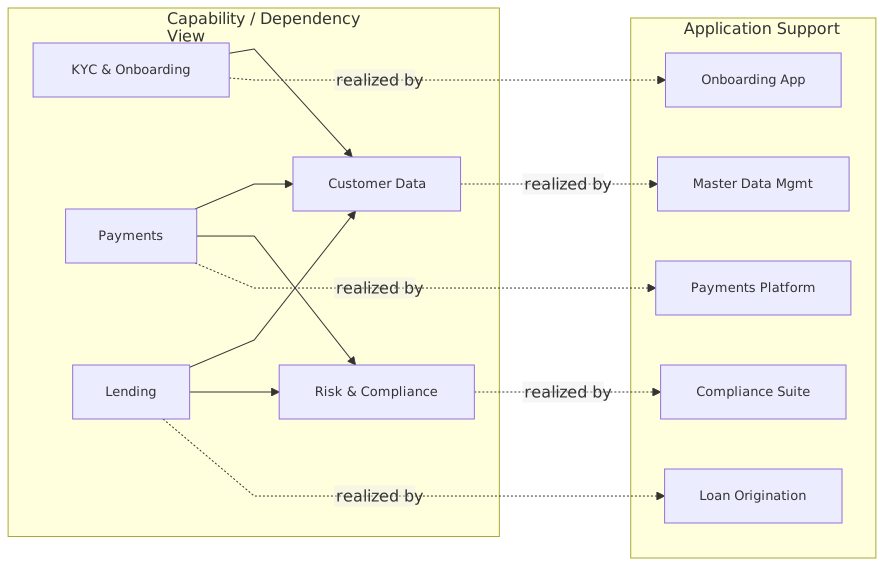
Banks usually have at least three identity worlds:
- workforce identity
- customer identity
- machine/service identity
Sometimes partner identity too.
Each has different trust models, lifecycle rules, authentication patterns, entitlements, and regulatory implications. Yet architecture diagrams often reduce all of this to one box called IAM.
That’s not good enough.
In ArchiMate, IAM can be modeled as business services, application services, and technology services depending on the audience and purpose. That flexibility is exactly right for banking.
For example:
- Business service: Secure Customer Access
- Application services: Authentication, Authorization, Consent Management, Identity Proofing, Token Issuance
- Technology services: Directory, Key Management, Secrets Management, Federation Runtime
Why does this matter? Because real architecture decisions sit between those layers.
Suppose a bank wants to unify authentication across retail web, mobile banking, and a new SME portal in cloud. The issue is not just SSO. It is:
- customer identity proofing standards
- MFA policy differences by transaction risk
- consent capture and delegation
- integration with fraud signals
- token propagation into APIs
- service-to-service identity for downstream systems
- auditability for regulatory review
ArchiMate helps you connect all of that without collapsing into pure security notation or pure business abstraction.
And here’s a hard truth: many enterprise architects avoid IAM because it exposes weaknesses in their architecture. Identity forces precision. It reveals where channels are inconsistent, where access models are duplicated, where APIs trust too much, and where cloud migration assumptions are naive.
That is exactly why you should model it.
Cloud architecture in banking: stop drawing “the cloud” as a destination
Another pet peeve. Banks still produce target-state diagrams with a giant cloud icon as if architecture ends once workloads move there.
Cloud is not a destination. It is an operating model change.
In ArchiMate, cloud should be represented in terms that matter:
- technology services consumed
- deployment and hosting patterns
- application placement
- security controls
- resilience zones
- operational ownership boundaries
- constraints such as data residency or encryption requirements
For a bank, “move onboarding to cloud” is meaningless unless the model shows:
- which business services are affected
- which applications are rehosted, refactored, or replaced
- where IAM responsibilities shift
- what Kafka or API integration patterns bridge cloud and on-prem
- how customer data objects are handled
- what technology services are required for observability, secrets, networking, and recovery
The useful architecture conversation is never “are we on cloud?”
It is:
- what moved
- why it moved
- what dependencies changed
- what controls changed
- what risks were introduced or removed
That is what ArchiMate can make visible.
A real enterprise example: retail customer onboarding modernization
Let’s make this concrete.
A mid-sized universal bank wants to modernize retail customer onboarding. Current onboarding is fragmented:
- web onboarding uses a legacy portal
- branch onboarding uses a separate workflow tool
- mobile onboarding is partially digital but still falls back to manual review
- KYC screening is batch-oriented
- IAM for customer access is separate from onboarding identity proofing
- customer data replication to downstream systems happens through overnight jobs
Leadership wants:
- faster account opening
- lower abandonment
- stronger AML and fraud controls
- reusable onboarding across channels
- cloud-based scalability
- near real-time downstream updates
This is exactly the kind of change where ArchiMate is useful.
Business view
You model:
- Capability: Customer Onboarding
- Business services: Account Opening, Identity Verification, Customer Access Provisioning
- Business processes: Capture Application, Verify Identity, Screen Customer, Approve Account, Provision Access
- Drivers: Growth, compliance, customer experience
- Requirements: real-time screening, omni-channel consistency, auditability
Application view
You model:
- Digital Onboarding Platform
- CRM
- KYC/AML Screening Service
- Fraud Decisioning
- Customer IAM Platform
- Product Origination Engine
- Document Management
- Notification Service
- Customer Master
Then model application services such as:
- Identity Proofing
- Screening Decision
- Account Origination
- Credential Enrollment
- Customer Event Publication
Integration/Kafka view
You model Kafka-backed event publication for:
- CustomerCreated
- KYCStatusUpdated
- AccountOpened
- CredentialsProvisioned
Consumers include:
- customer master
- analytics/fraud monitoring
- notifications
- branch servicing systems
- data platform
Technology/cloud view
You model:
- cloud-hosted onboarding services
- managed Kafka or self-managed cluster strategy
- IAM federation components
- API gateway
- observability stack
- secrets management
- network segmentation and resilience zones
What the model reveals
Now architecture becomes useful.
You can see that:
- branch and digital channels share only part of the process
- IAM provisioning is downstream of account opening, causing delays
- KYC screening is a bottleneck because of batch dependencies
- Kafka introduces a new critical dependency for servicing updates
- cloud migration is feasible for onboarding, but customer master remains on-prem and constrains latency
- fraud decisioning should be invoked before account creation, not after
- audit obligations span multiple systems and need a traceable event chain
That is a real architecture outcome. Not a prettier diagram. Better decisions.
Common mistakes architects make with ArchiMate in banks
Here’s the blunt version.
1. They model applications but not services
This leads to landscapes, not architecture. Banks run on services delivered through applications, not on application names.
2. They ignore the business layer because it feels “non-technical”
Then they wonder why executives don’t care about the model.
3. They over-model technology infrastructure
A full technology model is tempting, especially in cloud programs. But if the business impact and application dependency are unclear, nobody outside platform engineering will use it.
4. They don’t model controls and constraints
In banking, architecture without controls is fantasy. IAM, encryption, segregation, resilience, retention, screening, consent—these are not side notes.
5. They confuse ArchiMate with documentation completeness
The goal is decision quality, not repository density.
6. They make one diagram for everyone
A sure way to satisfy no one.
7. They never connect architecture to delivery
If the model doesn’t feed roadmaps, transition states, work packages, and investment choices, it becomes decorative. TOGAF roadmap template
A useful modeling structure for banking teams
Here is a practical structure that works better than the usual “let’s model everything” approach.
This kind of structure keeps the repository focused and useful.
How this applies in real architecture work
Let’s get very practical, because this is where many architecture articles become vague.
During investment planning
ArchiMate helps show which capabilities and services a proposed investment improves, what dependencies it introduces, and which legacy constraints remain. That makes business cases less hand-wavy.
Example: a proposal to centralize IAM for retail channels can be tied to customer access capability, fraud reduction goals, MFA requirements, and application changes in mobile, web, API gateway, and customer servicing systems.
During solution review
Enterprise architects can use ArchiMate views to challenge solution designs:
- Does this service duplicate an existing application service?
- Does this Kafka topic create hidden coupling?
- Is this cloud deployment introducing a single-region dependency?
- Where does identity proofing actually occur?
- Which business process step owns the exception path?
That beats arguing from opinion alone.
During regulatory or audit discussions
Banks are constantly asked to explain process, control, and system relationships. ArchiMate can provide traceability from business obligation to application behavior to technology dependency.
No, it won’t replace detailed control documentation. It shouldn’t. But it does give a coherent architecture narrative, which many banks badly lack.
During incident analysis
When a Kafka outage delays downstream customer updates, or an IAM token service failure blocks onboarding, ArchiMate views can show affected services, processes, channels, and dependencies. That helps prioritize remediation based on business impact, not just technical severity.
During target-state definition
Most target states are too clean to be true. ArchiMate is useful because it can model transition states and coexistence. And banking transformations almost always involve coexistence:
- legacy core plus digital wrapper
- old IAM plus new federation layer
- file-based integration plus Kafka eventing
- on-prem customer master plus cloud onboarding
Real target states are messy for years. Your architecture should admit that. ArchiMate in TOGAF ADM
A contrarian view: ArchiMate is not too abstract for engineers
People often say ArchiMate is too abstract for delivery teams. I think that’s half true at best.
It is too abstract when enterprise architects use it lazily. When they produce generic boxes and relationships with no meaningful service definitions, yes, engineers tune out. Fair enough.
But when modeled well, ArchiMate gives engineering teams something they usually struggle to get from enterprise architecture: context with boundaries.
It answers:
- why this component exists
- what service it provides
- what upstream and downstream dependencies matter
- what business process it supports
- what constraints shape the design
That’s not too abstract. That’s architecture.
The problem is not that ArchiMate cannot support engineering conversations. The problem is that many enterprise architects stop one level too high and call it done.
What good looks like
A good ArchiMate practice in a bank usually has these characteristics:
- a small set of agreed modeling conventions
- clear ownership of domains and views
- service-oriented modeling, not just application inventory
- explicit treatment of IAM, integration, and controls
- traceability from business change to technology impact
- transition-state modeling for real programs
- diagrams tailored to stakeholders
- repository governance light enough to survive reality
And maybe most important: the models are used in meetings where decisions happen.
If nobody opens the model during funding review, architecture board, control design, or program planning, then however elegant it is, it’s not working.
Final thought
ArchiMate is not magic. It will not rescue a weak architecture function, unclear ownership, or a bank that confuses standards with strategy.
But in banking, where change crosses business, control, application, integration, and infrastructure boundaries constantly, it remains one of the best tools available for making complexity discussable.
That sounds modest. It isn’t.
Making complexity discussable is half the job.
My strong view is this: banks should use ArchiMate less as a documentation standard and more as a thinking discipline. If you do that, it becomes practical very quickly. If you don’t, it becomes shelfware with better notation.
And banking has enough shelfware already.
FAQ
1. Is ArchiMate too complicated for banking stakeholders outside architecture?
Not if you use stakeholder-specific views. Executives do not need full notation depth. They need capability, service, dependency, and outcome views. Engineers may need more detail. Same model, different presentation.
2. How detailed should an ArchiMate model be for a bank?
Detailed enough to support decisions, not detailed enough to mirror implementation line by line. Focus on capabilities, business services, application services, critical data objects, IAM dependencies, integration patterns like Kafka, and technology services that shape risk or delivery.
3. How do you model Kafka in ArchiMate for banking?
Model it at both technology and application relevance. Show Kafka as a technology service/platform dependency, but also model the application services publishing and consuming events, the business processes triggering them, and the data or event objects involved. Otherwise you miss business impact.
4. Where does IAM belong in ArchiMate?
Across layers. In banking, IAM is not just infrastructure. It supports business services like secure customer access, application services like authentication and authorization, and technology services like directory, federation, and key management. If you keep it in one layer only, the model will be misleading.
5. Can ArchiMate help with cloud transformation in banks?
Yes, especially when used to connect cloud deployment decisions to business services, control requirements, IAM shifts, resilience patterns, and integration impacts. It is most useful when modeling hybrid states, because that is where most banks actually live.
Frequently Asked Questions
How is ArchiMate used in banking architecture?
ArchiMate is used in banking to model regulatory compliance (Basel III/IV, DORA, AML), integration landscapes (core banking, payment rails, channels), application portfolio rationalisation, and target architecture for transformation programs. Its traceability capabilities make it particularly valuable for regulatory impact analysis.
What enterprise architecture challenges are specific to banking?
Banking faces unusually complex EA challenges: decades of legacy core systems, strict regulatory change requirements (DORA, Basel IV, PSD2), fragmented post-M&A application landscapes, high-stakes integration dependencies, and the need for real-time operational resilience views. Architecture must be both accurate and audit-ready.
How does Sparx EA support banking enterprise architecture?
Sparx EA enables banking architects to model the full DORA ICT asset inventory, maintain integration dependency maps, track application lifecycle and vendor EOL, and generate compliance evidence directly from the model. Integration with CMDB and Jira keeps the model current without manual maintenance.