⏱ 23 min read
Most enterprise architecture governance fails for a boring reason: the architecture exists in PowerPoint, while the decisions happen somewhere else.
That is the uncomfortable truth.
Teams say they “use TOGAF” because they have an Architecture Review Board, a few principles, and a stack of templates no one reads. They say they “use ArchiMate” because they drew some boxes in a repository tool three years ago and still pay the license. But governance is not a meeting, and modeling is not decoration. If your architecture method and your architecture models are not connected, you do not have formal governance. You have theater.
And yes, that sounds harsh. Good. It should.
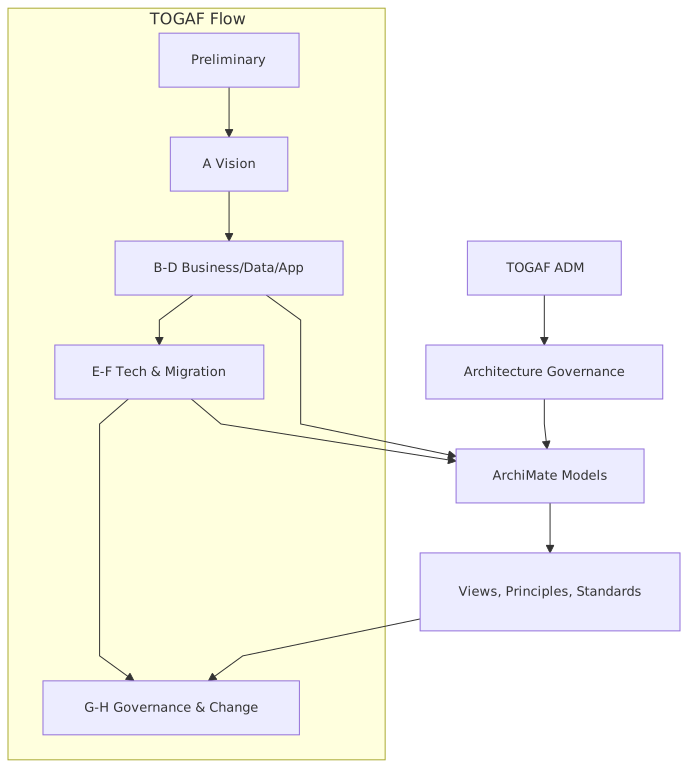
The real value comes when TOGAF gives you the governance structure—how decisions are made, what gets approved, what standards apply, who owns what—and ArchiMate gives you the formal language to express those decisions in a way that is testable, reviewable, and reusable. Put simply: ArchiMate modeling guide
TOGAF tells you how to govern architecture. ArchiMate gives you a precise way to model what is being governed.
That is the integration. Not mystical. Not academic. Just necessary.
A lot of organizations keep these two things apart. They run TOGAF as process and ArchiMate as a niche modeling exercise. That split is exactly why architecture often feels disconnected from delivery. The process sits with enterprise architects. The models sit with one modeling enthusiast. The engineers sit in Jira and Terraform and Kafka configs. Nobody sees one coherent system of decision-making.
This article is about fixing that. Not in a textbook way. In the way real architects need it fixed: governance that actually influences cloud design, IAM decisions, Kafka platform standards, banking controls, and delivery outcomes.
The simple version first: what ArchiMate and TOGAF each do
Let’s get the basics out early.
TOGAF is a framework for developing and governing enterprise architecture. It gives you structure: phases, governance, capability thinking, architecture principles, stakeholder management, and a way to move from strategy to implementation.
ArchiMate is a modeling language for enterprise architecture. It gives you notation and semantics to describe business processes, applications, data, technology, motivation, implementation, and relationships between them.
If I strip it down even more:
- TOGAF = method and governance
- ArchiMate = model and language
That’s why they belong together.
TOGAF without ArchiMate often becomes vague. Lots of words, weak traceability, endless interpretation.
ArchiMate without TOGAF often becomes sterile. Nice diagrams, no decision rights, no lifecycle, no consequence.
The integration matters because enterprise governance needs formal representations. Not just “the target state should improve customer onboarding.” Fine, but what application service changes? Which IAM domain owns authorization? What Kafka topics are system-of-record events versus integration convenience events? What cloud platform service is mandated? What regulatory control maps to which process and technology node?
You cannot govern architecture seriously if those questions are answered in hallway conversation.
Formal governance through modeling: what that actually means
“Formal governance through modeling” sounds a bit grand. Let’s make it practical.
It means architecture governance is not based only on documents and opinions. It is based on models that represent the enterprise in a structured way, so decisions can be reviewed against a consistent baseline.
In real work, that means things like:
- Architecture principles are linked to solution building blocks
- Business capabilities are linked to applications and data objects
- Security requirements are linked to IAM services and control points
- Technology standards are linked to deployment patterns in cloud environments
- Transition architectures are linked to implementation work packages
- Exceptions are visible, not buried in email threads
That is where ArchiMate becomes useful. It provides enough semantic discipline to make governance less subjective.
Not perfectly objective, by the way. Architects who pretend architecture is purely objective are usually hiding politics behind notation. Governance still involves judgment. But a formal model reduces the amount of nonsense that can survive review.
For example, if your bank says:
- customer identity must be centrally governed,
- privileged access must be segregated,
- event publishing must use approved Kafka patterns,
- customer data may not be replicated into uncontrolled cloud services,
then those are not just policy statements. They should appear in the architecture model as requirements, constraints, principles, services, application components, data objects, technology services, and implementation elements. Then when a new solution comes forward, you can assess it against a known model, not against whoever talks loudest in the review meeting.
That is the point.
Why most organizations get this wrong
I’ll say it plainly: many architecture teams overcomplicate TOGAF and underuse ArchiMate. ArchiMate tutorial
They turn TOGAF into a compliance bureaucracy and ArchiMate into diagram art. Then they wonder why engineering ignores them.
Here are the common failure patterns.
1. Treating TOGAF as a waterfall process
Teams still act like they must march through every ADM phase in a rigid sequence before delivery can begin. That is not architecture governance. That is procedural cosplay.
In modern enterprises, especially with cloud platforms and event-driven systems, architecture evolves iteratively. You still need TOGAF’s structure, but you apply it proportionally. A Kafka platform decision does not need a six-month architecture cycle. A core banking modernization probably does. ArchiMate in TOGAF ADM
2. Modeling everything
This is the classic ArchiMate mistake. Someone discovers the language, gets excited, and starts modeling every interface, every process step, every server, every dependency. The repository becomes an archaeological site.
Formal modeling is not about maximum detail. It is about decision-useful abstraction.
If the model does not support governance, planning, risk management, or stakeholder communication, it is probably unnecessary.
3. No traceability between principles and implementation
This one is deadly. Architects define principles like “reuse enterprise IAM services” or “event contracts are canonical and governed.” Then solution teams build local identity stores and publish random Kafka payloads with no ownership model.
Why? Because the principles were never connected to architecture building blocks, standards, and implementation work packages in a way that governance could enforce.
4. Separating business architecture from technology reality
Some enterprise architecture teams still operate at a strategic altitude so high they can’t see the cloud bill.
Real architecture governance must connect business capability outcomes to technology design. If customer onboarding is a strategic capability, then the architecture model should show the process, the application services, the IAM dependency, the eventing pattern, the customer master data flow, and the cloud deployment constraints.
Otherwise it is not enterprise architecture. It is motivational speaking.
5. Confusing repository completeness with architectural control
A full repository does not mean you have control. It may just mean you have metadata.
Control comes from using the model in governance decisions:
- standards approval
- project review
- exception management
- roadmap planning
- risk escalation
- technology lifecycle decisions
If no one uses the model to make these calls, the repository is just furniture.
The integration approach that actually works
The best way to integrate ArchiMate and TOGAF is not to ask, “How do I model the whole enterprise?” That question leads to paralysis.
Ask instead:
What governance decisions do we need to make repeatedly, and what minimum set of models would make those decisions more rigorous?
That changes everything.
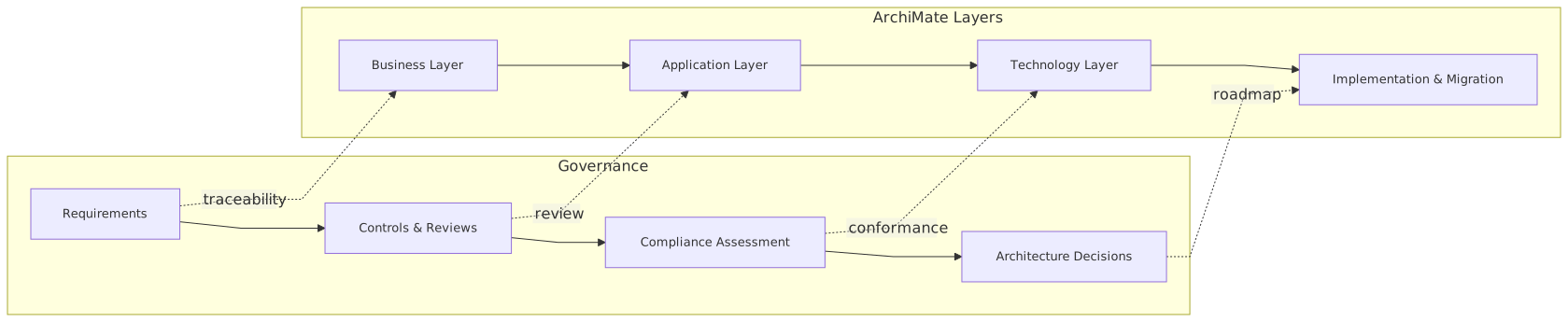
TOGAF gives you the governance mechanics:
- architecture principles
- architecture contracts
- compliance assessments
- governance boards
- capability-based planning
- target and transition architectures
- requirements management
ArchiMate gives you the representations needed to support those mechanics:
- motivation elements for principles, requirements, constraints
- business layer for capabilities, processes, actors, services
- application layer for components, services, interfaces, data
- technology layer for platforms, nodes, system software, networks
- implementation and migration layer for work packages, plateaus, deliverables
- strategy layer where useful for capability and resource views
The practical integration pattern looks like this:
- Define governance concerns
- security
- integration
- cloud hosting
- data ownership
- resilience
- regulatory controls
- Map concerns to review decisions
- approve, reject, exception, conditional approval, standard update
- Create ArchiMate viewpoints that support those decisions
- capability-to-application mapping
- application-to-data ownership view
- IAM trust and authorization model
- Kafka event flow and ownership view
- cloud deployment and control boundary view
- transition roadmap view
- Use those models as mandatory review artifacts in TOGAF governance
- not optional attachments
- not “nice to have”
- actual evidence
- Maintain traceability from principle to implementation
- principle → requirement/constraint → architecture building block → work package → delivered solution
That is formal governance through modeling.
Not every architect likes that level of discipline. Some prefer broad principles and flexible interpretation. I understand the instinct. Over-formalization can slow delivery. But under-formalization creates architecture drift, duplicated capabilities, fractured IAM, and data sprawl. In large enterprises, especially banks, that cost is far worse.
A practical table: TOGAF governance artifacts and their ArchiMate counterparts
Here’s a useful way to think about the integration.
This table is more important than it looks. If your team cannot map governance needs to model elements, your modeling effort will drift into irrelevance.
How this works in real architecture work
Now let’s get concrete. Because this is where architecture either earns respect or loses it.
Scenario 1: Banking customer onboarding modernization
A retail bank wants to modernize customer onboarding across mobile, branch, and partner channels. The business goal is simple enough: reduce onboarding time, improve conversion, meet KYC/AML controls, and reuse identity verification across products.
Without integrated governance, what happens?
- Channel teams build their own onboarding flows
- IAM is bolted on differently in each path
- Customer data gets copied into multiple systems
- Kafka events are published inconsistently
- Cloud services are chosen ad hoc
- Compliance reviews happen late and painfully
With TOGAF and ArchiMate integrated, the architecture team can govern this as a coherent system.
Step 1: Model the business capability and process context
Using ArchiMate, you model:
- business capability: Customer Onboarding
- business processes: Identity Verification, KYC Screening, Consent Capture, Account Opening
- business actors/roles: Customer, Branch Agent, Compliance Analyst
- business services delivered to channels
This is not just business architecture vanity. It creates the anchor for governance. Everyone can see what capability is being changed and which processes are in scope.
Step 2: Model application and data ownership
You then model:
- onboarding orchestration service
- IAM platform
- customer master
- KYC screening service
- document capture service
- event broker platform using Kafka
- data objects such as Customer Profile, Consent Record, Verification Status
Now governance gets real. The model can show:
- which application owns the Customer Profile
- which services can update it
- where Consent Record is authoritative
- what events are published from onboarding into Kafka
- which downstream systems consume those events
That matters in banking because data ownership is often where architecture collapses. Every team wants a local copy “for performance” or “for flexibility.” Before long, you have five customer records and no one trusts any of them.
Step 3: Apply constraints and principles formally
In the motivation layer, you model:
- principle: Customer identity is enterprise-managed
- constraint: PII data storage must comply with residency controls
- requirement: All onboarding authentication flows must use enterprise IAM
- requirement: Customer lifecycle events must be published through approved Kafka schemas
- assessment: Current branch onboarding flow violates centralized consent model
Now a governance review is no longer abstract. The review can test the proposed solution against explicit modeled requirements and constraints.
Step 4: Model cloud deployment boundaries
The technology layer shows:
- cloud landing zone
- managed Kafka service or self-managed Kafka cluster
- IAM integration points
- encryption/key management services
- network segmentation
- private connectivity to core banking systems
This is where many enterprise architects get uncomfortable because it feels “too technical.” That’s nonsense. If your architecture governance does not reach cloud deployment boundaries in a regulated bank, then it is not governing risk. It is just narrating intent.
Step 5: Link to roadmap and work packages
Finally, the implementation and migration layer can show:
- work package: Centralize identity verification
- work package: Decommission branch-local onboarding store
- work package: Introduce canonical customer onboarding event schema
- plateau: current fragmented onboarding
- plateau: target unified onboarding platform
Now TOGAF governance can manage the transition, not just the target vision.
That is what real architecture work looks like.
Kafka is where weak governance gets exposed fast
Let’s talk about Kafka because event-driven architecture is one of the fastest ways to reveal whether an enterprise has real governance or just slogans.
Every organization says they want reusable events, decoupled systems, and domain ownership. Fine. Then you look closer and find:
- no event taxonomy
- no topic ownership
- no retention standards
- no schema governance
- no distinction between business events and technical events
- no IAM integration model for producers and consumers
- no cloud network/security policy around the platform
And somehow they still call it “enterprise event architecture.”
This is where integrating ArchiMate and TOGAF is extremely useful.
In TOGAF terms, you define governance around:
- eventing principles
- reusable platform building blocks
- standards and contracts
- compliance review for event producers/consumers
- lifecycle and exception management
In ArchiMate, you model:
- application services exposing events
- application interfaces to Kafka
- data objects represented by event payloads
- serving relationships between Kafka platform and consuming apps
- constraints on topic design and data classification
- implementation work packages for migration from point-to-point integration
A contrarian point here: many architects overuse “domain-driven” language to justify event chaos. Not every team should freely invent events because “they own the domain.” In large enterprises, especially banks, event governance must be stronger than that. A domain team can own a service. It should not unilaterally redefine enterprise customer identity semantics because it likes a cleaner JSON structure.
Formal modeling helps because it exposes semantic overlap. If the ArchiMate model shows three applications claiming authority over customer status, your governance issue is visible before it becomes operational pain.
IAM is the best test of whether your architecture governance is serious
If you want to know whether an enterprise architecture function has grown up, look at IAM.
Identity and access management cuts across business, application, data, technology, compliance, and operations. It is exactly the kind of concern TOGAF was meant to govern and ArchiMate was meant to clarify.
A good integrated model can show:
- business roles and actors
- application services requiring authentication and authorization
- IAM services such as identity provider, access gateway, authorization engine, privileged access management
- data objects such as identity profile, entitlement, role assignment
- technology services for token issuance, directory services, secrets management
- constraints such as segregation of duties and regulatory controls
In real architecture work, this matters because IAM decisions are often made too late. A cloud-native application gets built, then someone asks:
- Will it use enterprise SSO?
- Where are service identities managed?
- How are Kafka clients authenticated?
- How are machine-to-machine permissions governed?
- Does customer consent affect authorization decisions?
- Can branch staff access customer onboarding records across regions?
If those questions come at the end, governance has already failed.
The integrated approach means IAM is modeled early as a core architecture dependency, not treated as a platform team afterthought.
And yes, architects make a common mistake here too: they model IAM only as a technology component. That is too narrow. IAM is also business policy, operating model, control structure, and user experience. If your model does not connect those layers, you will design access patterns that satisfy auditors and annoy everyone else—or worse, satisfy neither.
Cloud architecture needs governance models, not just landing zone diagrams
Cloud has made architecture more dynamic, but also more fragmented.
Every team can provision services. Every platform promises guardrails. Every provider has native IAM, networking, eventing, storage, and observability. That speed is useful. It also creates a perfect environment for architectural drift.
This is why formal governance through modeling matters more in cloud-heavy enterprises than it did in old static infrastructure environments.
A useful integrated governance model in cloud should answer questions like:
- Which workloads may use which cloud services?
- What data classifications are allowed in managed services?
- Where are control boundaries?
- Which IAM services are enterprise-mandated versus cloud-native?
- How do Kafka services integrate across hybrid environments?
- What is the approved deployment pattern for regulated workloads?
TOGAF gives you the governance mechanisms to define standards, approve patterns, and manage exceptions.
ArchiMate gives you views that show:
- business criticality
- application dependencies
- data sensitivity
- technology deployment
- control ownership
- migration path
One strong opinion: enterprise architects who stop at “cloud principles” are not doing enough. Principles like “use managed services first” or “prefer platform engineering” are fine. But unless those principles are represented in a model that can be applied to solution designs, they remain vague aspirations.
Cloud governance without formal modeling tends to devolve into one of two extremes:
- central architecture blocks everything
- federated teams do whatever they want
Both are bad. The whole point is to create enough formal structure that teams can move quickly within governed patterns.
What architects commonly mess up when integrating ArchiMate and TOGAF
Let’s be blunt. The tools are not the problem. The habits are.
Mistake 1: Using ArchiMate as an output, not a working instrument
They create diagrams for architecture documents, then never update them. That kills trust immediately.
If the model is not maintained through governance checkpoints and delivery changes, it becomes fiction.
Mistake 2: Modeling from the framework inward
They start from TOGAF phases and ArchiMate layers and ask, “How do we fill all of this out?” Wrong direction.
Start from decisions and risks. Model only what supports those.
Mistake 3: Ignoring motivation and implementation layers
Many teams model applications and infrastructure but skip principles, requirements, constraints, assessments, plateaus, and work packages.
That means they model structure but not governance or change. Which defeats the purpose of integration.
Mistake 4: No ownership model for the architecture repository
Who updates business capability maps? Who owns application lifecycle metadata? Who approves data ownership semantics? Who records exceptions?
If the answer is “the EA team,” that is often too centralized to scale. Architecture governance needs federated stewardship with central control.
Mistake 5: Making models too polished
This sounds odd, but it is real. Some architects polish diagrams so heavily they become static presentation artifacts. Real architecture models should be useful, not beautiful. A little roughness is fine if the semantics are sound and the governance value is high.
Mistake 6: Forgetting that engineers need to see themselves in the model
If your model cannot connect to APIs, Kafka topics, IAM roles, cloud resources, deployment patterns, and operational controls, engineers will ignore it. Fair enough, honestly.
Enterprise architecture is not above implementation. It is supposed to shape it.
A realistic enterprise example: bank-wide event and identity modernization
Let me give a fuller example that looks like the kind of thing many large banks are doing right now.
A regional bank has grown through acquisitions. It has:
- three customer channels
- multiple IAM stacks
- a legacy core banking platform
- a new cloud-native integration platform
- Kafka introduced by one digital team and now spreading fast
- inconsistent customer identity and consent handling
The executive ask sounds clean: “Create a unified digital customer platform.”
That phrase usually hides a mess.
What the architecture team did wrong at first
They created a target-state TOGAF architecture document.
It had:
- principles
- capability maps
- reference architectures
- migration waves
All reasonable. But delivery teams still built inconsistent solutions because the governance artifacts were not formalized in a shared model.
One team used cloud-native IAM directly.
Another created a local customer profile store.
Another published onboarding events to Kafka with no approved schema.
Security reviews happened late.
The Architecture Review Board spent meetings debating basics that should already have been settled.
Classic enterprise waste.
What changed
The bank moved to a formal governance-through-modeling approach.
They used ArchiMate to create a shared architecture repository centered on a few critical viewpoints:
- Customer capability view
- customer onboarding
- customer servicing
- consent management
- fraud and risk interaction
- Identity and access view
- enterprise identity provider
- customer authentication service
- employee access management
- authorization decision point
- privileged access controls
- Customer data ownership view
- customer master
- consent record
- onboarding case
- KYC status
- event ownership and publishing rights
- Event platform view
- Kafka platform service
- producer applications
- consumer applications
- schema governance
- trust/authentication boundaries
- Cloud deployment control view
- landing zones
- regulated workload boundaries
- encryption and key management
- network segmentation
- logging and monitoring controls
- Transition roadmap
- decommission duplicate IAM stores
- centralize consent
- establish canonical customer events
- move onboarding orchestration to cloud platform
- retire branch-specific integration services
How TOGAF governance then became real
Now architecture reviews used the model as evidence:
- Does the proposed app consume customer identity from the approved IAM service?
- Is it publishing a governed customer event or inventing a local one?
- Does it store customer profile data despite not being the system of record?
- Is the cloud deployment pattern inside the approved regulated landing zone?
- What transition architecture does this release belong to?
The review board was no longer arguing from memory or from static slides. It was reviewing traceable architecture facts and constraints.
What outcomes improved
Not magically. But materially.
- Fewer duplicate customer data stores
- Faster security review because IAM patterns were pre-modeled
- Better Kafka topic discipline
- Cleaner migration planning
- Clearer exception management when teams needed temporary deviations
- Less architecture churn between design and implementation
And maybe the biggest one: enterprise architecture regained credibility with engineering because the models helped solve delivery problems instead of creating paperwork.
That is what success looks like. Not perfect diagrams. Better decisions.
Contrarian view: not every architecture team should model deeply
Now for a slightly uncomfortable opinion.
Some organizations should not go deep on ArchiMate and TOGAF integration yet.
If your architecture function has no authority, no repository discipline, no delivery engagement, and no stakeholder trust, adding formal models may just produce better-looking irrelevance.
You need a minimum level of architecture operating maturity first:
- governance forums that actually decide things
- standards that matter
- solution engagement with delivery teams
- some metadata discipline
- named owners for domains and platforms
Without that, formal modeling can become a coping mechanism. Architects retreat into notation because they cannot influence reality.
So yes, I strongly believe in formal governance through modeling. But I do not believe every enterprise should start with a giant repository initiative. Start with the highest-friction areas:
- IAM
- Kafka/eventing
- customer data ownership
- cloud control boundaries
Model those well. Tie them to governance. Prove value. Expand from there.
That is the grown-up path.
A practical adoption path
If you want to implement this in a real enterprise architecture function, here is the simplest sensible sequence.
Phase 1: Pick governance hotspots
Choose 2–3 areas where architecture decisions are repeatedly painful:
- IAM
- cloud deployment patterns
- Kafka/event governance
- regulated data flows
Phase 2: Define required governance questions
For each hotspot, write the actual review questions.
Example for Kafka:
- Who owns the event?
- What data classification is in the payload?
- What schema standard applies?
- What IAM/authentication pattern is used?
- Is this a business event or integration event?
Phase 3: Create minimum ArchiMate viewpoints
Do not model the universe. Model enough to answer those questions consistently.
Phase 4: Embed the models into TOGAF governance
Make them mandatory in architecture review, transition planning, and exception management.
Phase 5: Establish stewardship
Business, application, security, platform, and data owners must maintain their parts of the model.
Phase 6: Link to delivery artifacts
Connect the model to API catalogs, Kafka schema registries, IAM service definitions, CMDB/platform metadata, and cloud patterns where possible.
This last part matters. If your architecture model never touches operational reality, it will decay.
Final thought
The integration of ArchiMate and TOGAF is not about framework purity. It is about making enterprise architecture governable, visible, and useful.
TOGAF on its own can become process-heavy and vague.
ArchiMate on its own can become precise and irrelevant.
Together, used properly, they let architects do something the enterprise desperately needs: turn architecture from opinion into a managed system of decisions.
And that is the real job.
Not drawing pretty target states. Not quoting principles. Not running meetings.
Making sure the bank does not build five identity models, ten Kafka event taxonomies, and three cloud control regimes while everyone claims alignment.
Formal governance through modeling sounds dry. In practice, it is one of the few ways to keep a large enterprise coherent while it changes.
That coherence is not a luxury. It is the difference between modernization and expensive fragmentation.
FAQ
1. Is ArchiMate required to use TOGAF effectively?
No, but TOGAF works better with a formal modeling language. Without one, governance often relies too much on prose, interpretation, and tribal knowledge. ArchiMate is the natural fit because it covers business, application, technology, motivation, and implementation in one language.
2. How much should we model before starting governance?
Less than you think. Start with the minimum set of views needed to support recurring governance decisions—often IAM, data ownership, eventing, and cloud boundaries. Do not wait for a complete enterprise model.
3. How does this help engineering teams instead of just architects?
If done properly, it gives engineers clear standards, reusable patterns, approved platform services, and fewer late-stage review surprises. In areas like Kafka, IAM, and cloud deployment, that can remove a lot of rework.
4. What is the biggest mistake when integrating ArchiMate and TOGAF?
Treating modeling as documentation rather than as governance evidence. If models are not used in architecture review, exception handling, and roadmap planning, they will become stale and ignored.
5. Is this approach only useful in regulated industries like banking?
No, but banking makes the value obvious because governance failures hurt quickly. Any large enterprise dealing with shared platforms, identity, cloud sprawl, data ownership, or event-driven integration can benefit from formal governance through modeling.
Frequently Asked Questions
What is architecture governance?
Architecture governance is the set of practices, processes, and standards that ensure architectural decisions are consistent, traceable, and aligned to organisational strategy. It includes architecture review boards (ARBs), modeling standards, lifecycle management, compliance checking, and exception handling.
How do you set up architecture governance in a large organisation?
Start with clear principles and a lightweight metamodel. Establish an Architecture Review Board with defined remit and cadence. Implement decision records (ADRs). Use a tool like Sparx EA to make governance evidence model-based rather than slide-based. Federate ownership — enterprise architects set standards, domain architects maintain their areas.
What is the role of ArchiMate in architecture governance?
ArchiMate supports governance by providing a standard language that makes architecture proposals comparable and reviewable. Governance decisions, principles, and compliance requirements can be modeled as Motivation layer elements and traced to the architectural choices they constrain — enabling reviews based on evidence, not opinion.