⏱ 20 min read
Most enterprise architecture teams are still too slow for DevOps, and a lot of them did it to themselves.
That’s the uncomfortable truth.
They bought ArchiMate, built polished diagrams, set up architecture review boards, and then acted surprised when product teams ignored them and shipped around them. The problem was never the notation. ArchiMate is not the villain here. The real issue is that many architects use it like a museum catalog when the business needs a navigation system.
If your architecture models can’t help a team decide how to release a Kafka-based payments service safely, how to enforce IAM across cloud workloads, or how to understand the blast radius of a change before Friday night deployment, then your model is decorative. Maybe expensive. Maybe beautifully color-coded. Still decorative.
And in a DevOps and Continuous Delivery world, decorative architecture is dead weight.
The simple version first
Here’s the plain-English explanation.
ArchiMate is a modeling language for describing how a business, its applications, technology, and change initiatives fit together.
DevOps and Continuous Delivery are ways of working that aim to deliver changes quickly, safely, and repeatedly through automation, collaboration, and feedback.
The alignment matters because modern delivery teams move fast, and architecture has to move with them. ArchiMate can help if it is used to model things delivery teams actually care about: ArchiMate modeling guide
- which business capabilities depend on which systems
- which applications use which APIs, events, and data stores
- where IAM policies are enforced
- which cloud services support which products
- what changes are in flight
- what breaks if a component is changed or retired
- what controls must exist in the release path
That’s the basic point.
Use ArchiMate to make delivery safer and clearer. Not to produce abstract diagrams nobody uses.
Now let’s get into the part architects usually avoid: what this looks like in real work.
Why architects struggle with DevOps alignment
A lot of enterprise architects say they support DevOps. Fewer actually do.
They say things like:
- “We support product-centric delivery.”
- “We’re enabling platform thinking.”
- “We’ve defined target-state architecture.”
- “We have standards for CI/CD.”
Fine. But can a delivery team answer these questions from your architecture repository in under ten minutes?
- Which customer journeys are affected by this Kafka topic change?
- Which IAM roles are tied to this cloud deployment pipeline?
- Which applications still depend on this legacy identity provider?
- Which controls are mandatory before promoting to production?
- Which business capability is at risk if this event stream is delayed?
Usually the answer is no.
That’s because traditional architecture practice optimized for governance ceremonies, not delivery flow. ArchiMate got trapped in that culture. It became a language for annual roadmaps and “as-is / to-be” decks instead of a working model for continuous change. ArchiMate tutorial
And that’s where the tension shows up.
DevOps values speed, feedback, and automation.
Traditional EA values consistency, control, and traceability.
These are not enemies, but they do clash if the architecture function is built around approval gates rather than decision support.
A contrarian view: most enterprise architecture teams should do less review and more modeling of operational reality. Less PowerPoint. More dependency maps. Less target-state preaching. More release-aware architecture.
ArchiMate is actually a good fit for DevOps. If you stop using half of it
I’ll say something that annoys some architecture purists: you do not need to model everything.

In fact, trying to model everything is one of the fastest ways to make ArchiMate irrelevant to delivery teams.
For DevOps and Continuous Delivery, ArchiMate is useful because it can connect several layers that teams often keep separate:
- Business layer: products, capabilities, processes, value streams
- Application layer: services, APIs, event producers/consumers, data objects
- Technology layer: cloud services, clusters, IAM infrastructure, networks
- Strategy and motivation elements: goals, outcomes, constraints, principles
- Implementation and migration: work packages, releases, plateaus, gaps
That cross-layer traceability is exactly what delivery organizations need. But only if the model is pragmatic.
What should be modeled?
Model the things that affect delivery, risk, ownership, and change impact.
For example:
- business capabilities like Payments Processing, Customer Onboarding, Fraud Detection
- product/application services like Payment Authorization API, Customer Profile Service
- event streams and integrations like Kafka topics for transaction events
- identity and access controls like IAM roles, policies, federation points
- technology platforms like Kubernetes clusters, cloud accounts, managed databases
- deployment relationships and environments
- release increments and migration work packages
- ownership and accountability
What should probably not be modeled in great detail?
- every internal class and component unless there’s a real architecture reason
- every sprint artifact
- decorative process decomposition nobody will maintain
- duplicate CMDB content with no delivery use case
- fantasy target-state diagrams disconnected from funded work
That’s where many architects lose the room. They model architecture as if completeness is the goal. In DevOps, usefulness is the goal.
What alignment really means
Aligning ArchiMate with DevOps and Continuous Delivery does not mean drawing a CI/CD pipeline in ArchiMate and calling it transformation.
That’s the shallow version. And yes, people do that.
Real alignment means using ArchiMate to support these five architectural outcomes:
1. Make change impact visible
Teams need to know what a change touches.
If a bank changes the schema of a Kafka topic carrying card authorization events, that’s not just an application concern. It may impact fraud models, reconciliation systems, customer notifications, observability dashboards, and regulatory reporting downstream.
ArchiMate can show:
- the application component producing the event
- the application services consuming it
- the business processes and capabilities supported
- the technology services hosting the workloads
- the migration work package implementing the change
That is architecture serving delivery.
2. Make control points explicit without killing flow
DevOps is not anti-control. It is anti-stupid-control.
Architecture should identify where controls matter:
- IAM policy enforcement
- segregation of duties in deployment
- encryption and key management
- approval requirements for production release
- resilience and recovery requirements
- auditability for regulated workloads
In ArchiMate, these can be represented as constraints, requirements, services, and relationships to the systems and processes that must satisfy them.
That matters because control points should be designed into the delivery model, not stapled on afterward by committees.
3. Link business capability to platform reality
A lot of architects still separate “business architecture” from “technical delivery” like it’s 2009.
In reality, if your cloud IAM design blocks developer autonomy, that is a business problem. If your Kafka platform cannot guarantee event durability for payments, that is a business problem. If your release process takes 14 days, that is definitely a business problem.
ArchiMate is useful because it can connect business capabilities directly to the enabling technology and operational services.
4. Support product ownership and team boundaries
Good DevOps organizations are built around clear ownership.
Bad ones are built around shared confusion.
ArchiMate can help define:
- what a team owns
- what services they expose
- what events they publish
- what platforms they consume
- what dependencies they have
- what they are not allowed to change
This matters more than many architects admit. Team topology is architecture. If your models ignore ownership, they ignore delivery reality. ArchiMate in TOGAF ADM
5. Make transformation incremental
Continuous Delivery means architecture changes are not giant one-off migrations. They are a sequence of safe, observable steps.
ArchiMate’s implementation and migration concepts are underrated here. Work packages, plateaus, and gaps can help show how a legacy estate moves toward a cloud-native or event-driven model without pretending the transition is clean.
Enterprises do not transform in a straight line. They accumulate hybrids.
Architects who can model the hybrid state honestly are far more useful than those who only draw the future state.
How this applies in real architecture work
Let’s make this practical.
In real enterprise architecture work, aligning ArchiMate with DevOps usually shows up in three kinds of conversations.
1. Portfolio and funding conversations
Senior leaders want to know where money goes and what risk is reduced.
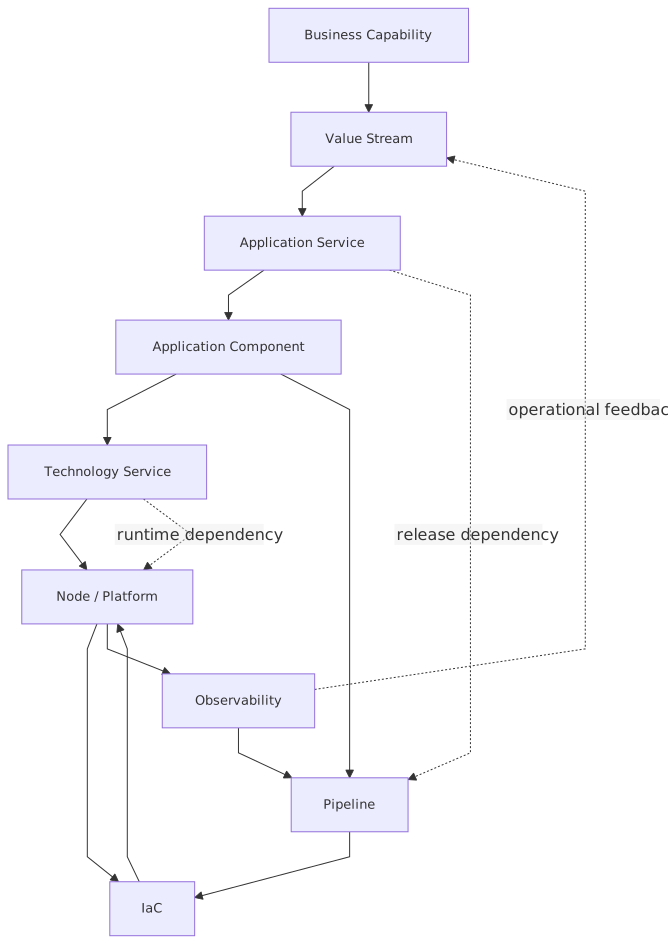
If you can use ArchiMate to show that a cloud IAM modernization initiative supports customer onboarding, fraud controls, and developer self-service for multiple product teams, you get a much stronger investment case than “we need to improve identity architecture.”
The architecture model becomes a way to connect platform investment to business value.
2. Delivery planning and dependency management
Product teams want to move fast, but they are often blocked by hidden dependencies.
A good architecture model can show:
- which Kafka topics are shared and version-sensitive
- which applications still rely on a central IAM broker
- which cloud landing zones host regulated workloads
- which releases can proceed independently and which cannot
That is not theory. That is planning ammunition.
3. Risk and governance conversations
Risk, security, and compliance teams are not going away. In banking, they absolutely should not.
The challenge is to avoid making governance a manual drag on delivery. ArchiMate for governance
ArchiMate helps when it maps controls to the architecture itself:
- where identity is authenticated
- where authorization happens
- where data is encrypted
- where logs are retained
- where production release approvals apply
- where resilience patterns are mandatory
Then your governance discussion becomes more factual and less theatrical.
A real enterprise example: retail banking modernization
Let’s take a realistic example.
A retail bank is modernizing its payments and customer servicing platforms. It has:
- legacy core banking systems on-prem
- a growing cloud footprint on AWS and Azure
- Kafka used as the event backbone for transactions and customer activity
- a central IAM platform federating with Active Directory and cloud identity providers
- multiple product teams delivering APIs and digital channels
- strict regulatory and audit requirements
The problem
The bank says it has adopted DevOps. In reality:
- teams have different release patterns
- architecture reviews happen late
- Kafka topics are created inconsistently
- IAM roles are over-permissioned
- cloud environments are provisioned by ticket
- dependencies on legacy systems are poorly understood
- architecture diagrams exist, but they don’t help release decisions
Classic enterprise mess. Not unusual.
What the architecture team did wrong first
They modeled the estate in ArchiMate as a mostly static landscape:
- business processes
- application inventory
- target-state platform diagrams
- migration roadmaps
Looks impressive. Barely useful.
The delivery teams still didn’t know:
- who owned which event contracts
- which applications consumed a given transaction topic
- which IAM trust relationships existed between cloud workloads
- which releases had operational risk due to shared dependencies
So the architecture team changed approach.
The better approach
They reorganized the ArchiMate repository around change and operational dependency.
They modeled:
- Business capabilities: Payments Processing, Account Management, Customer Identity, Fraud Monitoring
- Application services: Payment Initiation API, Transaction Ledger Service, Customer Authentication Service
- Event flows: Kafka topics for payment events, fraud alerts, customer profile updates
- Technology services: managed Kafka clusters, Kubernetes platforms, cloud IAM, secrets management, observability stack
- Constraints and requirements: strong customer authentication, audit retention, role separation, encryption, RTO/RPO targets
- Implementation work packages: topic versioning rollout, IAM least-privilege remediation, cloud landing zone migration, canary deployment enablement
The key was not just documenting systems. It was documenting how changes moved through the estate.
What they discovered
- A “simple” schema change to a payment event topic would affect eight consuming services across fraud, notifications, reconciliation, and analytics.
- The customer onboarding journey depended on an IAM federation path that had no resilient failover in one cloud region.
- Several product teams thought they owned release decisions, but production deployment still depended on a centralized integration service team nobody had modeled as a bottleneck.
- A cloud migration initiative was technically complete for hosting, but not for operational responsibility. Logging, IAM policy ownership, and recovery procedures were still centralized.
These are the kinds of insights architecture should produce.
What changed in practice
The bank used ArchiMate views tailored to different audiences:
- Executive view: capability impact, risk hotspots, initiative alignment
- Platform view: IAM, Kafka, cloud services, shared controls
- Product team view: dependencies, owned services, event contracts, release impact
- Risk/compliance view: control placement, auditability, segregation of duties
And yes, they integrated the architecture repository with delivery metadata where possible. Not perfectly. Enough to matter.
Result:
- fewer surprise dependencies in release planning
- clearer ownership of Kafka topics and IAM policies
- better prioritization of platform work
- architecture reviews moved earlier and became shorter
- teams started using the models because they answered real questions
That last part is the real test.
If engineers voluntarily use your architecture model, you’re doing architecture.
If only architects use it, you’re doing archaeology.
A practical mapping: ArchiMate to DevOps concerns
Here’s a simple way to think about the alignment.
That table is simple on purpose. Enterprise architecture gets better when it stops pretending complexity always needs complicated explanation.
Common mistakes architects make
This is where I’m going to be blunt.
1. They model the organization chart, not the delivery system
A lot of architecture repositories mirror management structures rather than how value is delivered.
If your model shows departments but not product teams, platform ownership, release dependencies, and service boundaries, it’s already drifting away from reality.
2. They treat DevOps as a tooling topic
DevOps is not Jenkins, GitHub Actions, or Argo CD.
It’s an operating model for change.
Architects who only model pipelines and deployment tools miss the bigger issue: ownership, dependency, control placement, and feedback loops.
3. They ignore runtime relationships
Static application interaction diagrams are not enough.
In modern enterprises, runtime architecture matters:
- which service calls which
- which Kafka topic is consumed by whom
- where identities are asserted
- where secrets are resolved
- which cloud service is a runtime dependency
If you don’t model runtime reality, your architecture won’t help with release risk.
4. They separate security architecture from delivery architecture
This is one of the worst habits in big organizations.
IAM, secrets, token flows, role boundaries, privileged access, audit controls — these are not side topics. They are core delivery architecture.
In cloud-native environments, identity is the new perimeter. If your ArchiMate model treats IAM as an isolated infrastructure concern, you are modeling the wrong century.
5. They worship target state
Target-state architecture has become a kind of corporate fiction. It comforts executives and irritates engineers.
The real work is in the transition state:
- hybrid identity
- partial cloud migration
- dual-write event patterns
- temporary API mediation
- coexistence of legacy and modern controls
Architects need to model the mess honestly. Continuous Delivery happens in the mess.
6. They produce one view for everyone
Executives, engineers, platform teams, and risk officers do not need the same diagram.
One of ArchiMate’s strengths is view customization. Use it.
A single giant “enterprise view” is usually a sign the architect wanted to impress peers rather than help stakeholders.
7. They don’t maintain the model close to delivery
An architecture repository updated every quarter is mostly a historical artifact.
I’m not saying every deployment should update ArchiMate automatically. That fantasy can become its own expensive distraction. But the model must be close enough to reality that teams trust it.
Trust is the currency. Without it, architecture is just branded opinion.
The contrarian bit: not everything should be in ArchiMate
Some architects hear “align ArchiMate with DevOps” and conclude that ArchiMate should become the master model for everything.
Bad idea.
ArchiMate should not replace:
- observability tooling
- service catalogs used by engineers every day
- IaC repositories
- cloud native topology graphs
- security policy engines
- CI/CD pipeline telemetry
- Kafka schema registries
It should complement them.
The architecture model should answer cross-domain questions that those tools individually cannot answer well:
- what business capability is affected by this platform issue?
- what customer journey depends on this event stream?
- what control requirements apply to this deployment path?
- what initiatives are changing the same dependency chain?
- what ownership gaps exist across product and platform boundaries?
That is where ArchiMate earns its keep.
Trying to force it into operational systems-of-record territory usually ends in stale models and frustrated teams.
A practical modeling approach that works
If I were setting this up in a large enterprise today, I would keep it disciplined.
Start with these anchor objects
Model these first:
- business capabilities
- products or value streams
- application services
- application components
- major event streams / Kafka topics
- APIs and integration points
- IAM domains and trust boundaries
- cloud platform services and runtime environments
- teams/owners
- key constraints and controls
- active transformation work packages
That gives you enough to answer meaningful delivery questions.
Then define a few standard views
For example:
- Capability-to-service view
Shows which services support which business capabilities.
- Service dependency view
Shows APIs, Kafka topics, upstream/downstream dependencies.
- Identity and access view
Shows authentication providers, federations, IAM roles, policy boundaries.
- Cloud deployment view
Shows environments, clusters, managed services, network boundaries, observability dependencies.
- Transformation view
Shows current state, transition state, target state, and funded work packages.
If you standardize these views, teams know where to look.
Keep ownership explicit
Every meaningful object should have an owner:
- product team
- platform team
- security team
- infrastructure team
- external vendor
No owner usually means no accountability. And no accountability means DevOps theater.
Focus on decision support
Before adding any model content, ask:
What decision will this help someone make?
If there is no answer, don’t model it yet.
That question alone would improve most architecture repositories overnight.
Banking, Kafka, IAM, and cloud: where alignment gets serious
These domains expose whether your architecture practice is serious or cosmetic.
In banking
You have regulatory pressure, audit obligations, resilience concerns, and high change sensitivity. Continuous Delivery still matters, maybe more than anywhere, because delay creates operational risk too.
Architecture must show:
- which capabilities are critical
- where controls are enforced
- where manual approvals remain
- where shared dependencies threaten resilience
- how modernization reduces risk, not just cost
With Kafka
Architects often under-model event-driven architecture. They draw a box labeled “event bus” and move on.
That is lazy.
In reality, you need to understand:
- topic ownership
- event contract lifecycle
- producer and consumer dependencies
- replay and retention implications
- data classification
- resilience and ordering assumptions
Kafka turns hidden coupling into fast coupling. If you don’t model those relationships, delivery teams discover them the hard way.
With IAM
IAM is architecture, not plumbing.
In cloud-native enterprises, every workload identity, trust relationship, role assignment, and federation path affects security and delivery speed. Overly broad IAM slows audits and increases risk. Overly centralized IAM slows teams and creates ticket queues.
A good architecture model can expose both failure modes.
With cloud platforms
Cloud changed the shape of architecture work.
Now the questions are:
- which platform services are standardized?
- what guardrails exist?
- which workloads can self-serve?
- where are the policy boundaries?
- what operational services are mandatory?
- what is the blast radius of a cloud account or cluster failure?
These are architecture questions. They are not just infrastructure questions.
Final thought
ArchiMate does not need to be reinvented for DevOps and Continuous Delivery. It needs to be used with more honesty.
Less enterprise theater.
Less target-state fantasy.
Less modeling for model’s sake.
More ownership.
More runtime dependency.
More control visibility.
More transition-state realism.
More alignment to how teams actually deliver change.
That is the shift.
If architecture wants a seat in modern delivery organizations, it has to stop acting like the historian of systems and start acting like the cartographer of change.
That’s what ArchiMate can do well, if architects let it.
FAQ
1. Can ArchiMate really help DevOps teams, or is it mainly for enterprise architects?
Yes, it can help DevOps teams, but only if the model is focused on things they care about: dependencies, ownership, IAM boundaries, event flows, environments, and release impact. If it becomes a generic enterprise repository, engineers will ignore it.
2. How detailed should ArchiMate models be for Continuous Delivery?
Detailed enough to support decisions, not so detailed that nobody maintains them. Model services, dependencies, Kafka topics, IAM trust boundaries, cloud runtime environments, and key controls. Don’t try to turn ArchiMate into source code or a CMDB clone.
3. How do you model Kafka in ArchiMate?
Usually as application-layer interaction or flow-oriented relationships between producers and consumers, with topics and event objects represented explicitly enough to show ownership and dependency. The important thing is not perfect notation purity. The important thing is making event-driven coupling visible.
4. Where does IAM fit in an ArchiMate model?
Across multiple layers. IAM can appear as technology services, application services, constraints, and requirements depending on what you’re showing. In practical architecture work, model identity providers, federation paths, role boundaries, trust relationships, and policy enforcement points.
5. What is the biggest mistake when aligning architecture with DevOps?
Treating architecture as an approval function instead of a decision-support function. Once architects become gatekeepers first, teams route around them. The best architecture work reduces uncertainty and clarifies change. It doesn’t just slow it down.
Frequently Asked Questions
How is ArchiMate used for cloud transformation?
ArchiMate models cloud transformation by comparing baseline and target architectures across all layers. Cloud platforms appear as Technology Services, workloads as Application Components assigned to Technology Nodes. The Implementation and Migration layer models transition plateaus, work packages, and migration events — producing a traceable cloud roadmap.
How does ArchiMate align with DevOps practices?
ArchiMate supports DevOps by modeling the CI/CD pipeline as Application Behavior elements, infrastructure as code as Technology Artifacts, and deployment topology as Technology Nodes. Traceability from requirements through design to deployed infrastructure helps DevOps teams understand architectural constraints and governance requirements.
What cloud architecture patterns can be modeled in ArchiMate?
ArchiMate can model cloud-native patterns including: multi-region active-active deployments, event-driven integration via messaging platforms, API-led integration architectures, zero-trust network topology, container orchestration (Kubernetes), and hybrid cloud connectivity. Each pattern maps to specific Technology and Application layer elements.