⏱ 21 min read
Most enterprise architecture decks fail for one very boring reason: they describe systems better than they describe the business’s ability to win.
That sounds harsh. It is harsh. But it’s true.
A lot of architecture work still starts in the wrong place. Teams map applications, interfaces, clouds, APIs, event streams, controls, and operating models—then act surprised when executives ask, “So what capability are we actually improving?” Or worse: “Why are we funding this again?”
Capability-based modeling in ArchiMate 3.x is supposed to solve exactly that problem. Not by adding more boxes. Not by creating a prettier repository. But by forcing strategy, change, and technology into one line of sight. When done properly, it gives architecture work a backbone. When done badly, it becomes another abstract layer that nobody trusts.
Here’s the simple explanation up front: a capability in ArchiMate is what the business needs to be able to do, independent of how it is organized or which systems implement it. Capability-based modeling means you organize architecture around those abilities first, then connect them to value streams, resources, applications, processes, and transformation initiatives. That’s the short version. It matters because strategy is usually vague, and capabilities are one of the few ways to make it concrete.
Now the deeper part: ArchiMate 3.x gives us a formal way to express strategy through capabilities, resources, courses of action, and value streams. That sounds elegant—and it is—but architects often make it too theoretical. The point is not to admire the metamodel. The point is to answer hard enterprise questions:
- What do we need to be good at?
- How good do we need to be?
- What’s weak today?
- Which systems, teams, and platforms support that ability?
- What should we fund first?
- And what should we stop pretending is strategic?
That’s where capability-based modeling becomes real architecture work, not framework theater.
What capability-based modeling actually means in ArchiMate 3.x
Let’s strip away the ceremony.
In ArchiMate 3.x, the Capability element sits in the Strategy layer. It represents an ability that an active structure element—like the business as a whole, a business unit, or a partner ecosystem—possesses to achieve some outcome.
The important thing is what a capability is not:
- It is not an application.
- It is not a process.
- It is not an org chart function.
- It is not a project.
- It is definitely not just a renamed department.
A capability is something like:
- Customer Onboarding
- Fraud Detection
- Identity and Access Management
- Real-Time Event Processing
- Credit Risk Assessment
- Regulatory Reporting
These are business abilities. They exist even if the organization changes. They exist even if technology changes. They exist even if the process is redesigned.
That stability is why capabilities are useful. Processes change all the time. Applications come and go. Cloud platforms get rebranded every six months. Capabilities endure longer, so they make better anchors for strategy and roadmaps.
ArchiMate 3.x formalizes this with a few strategy concepts that are often underused:
- Capability: what the enterprise can do
- Resource: what it uses to do it
- Course of Action: an approach chosen to configure capabilities and resources
- Value Stream: how value is delivered to stakeholders through stages
This is where the model becomes powerful. A strategic goal like “reduce onboarding time from 5 days to 15 minutes” should not jump straight into “buy a new IAM tool” or “put Kafka in the middle.” That’s solution bias. Instead, you model the affected capabilities—say, Customer Onboarding, Identity Verification, Consent Management, Access Provisioning—and then assess what needs to change.
That’s strategy formalization. Not vague aspiration. Not random platform spending. Formalization.
Why architects should care more than they usually do
Because capability modeling is one of the few architecture techniques that survives contact with both executives and engineers.
Executives understand the language of business ability. Engineers understand the need to trace those abilities to systems and constraints. Capability maps, if done well, sit in the middle. That’s rare. Most architecture artifacts don’t.
There’s also a political truth here. Enterprise architecture often gets dismissed when it appears too technical for the business and too abstract for delivery teams. Capability-based modeling reduces that trap. It gives you a neutral language that is not owned by one tower—business, security, platform, data, or application. That matters in real organizations where every domain thinks its own concerns should dominate the roadmap. ArchiMate in TOGAF ADM
And yes, I’ll say the contrarian part plainly: capability modeling is often more useful than process modeling in early strategic work. BPM people may not love hearing that. But process models are too close to current operations. They drag today’s inefficiencies into tomorrow’s design. Capabilities let you ask a cleaner question: what ability must exist, at what maturity, and with what differentiating quality?
Processes matter later. Capabilities matter first.
The ArchiMate strategy layer is better than people think
A lot of architects avoid the Strategy layer because they think it’s fluffy. They prefer the comfort of Application, Technology, and maybe Business layers. Those are easier to defend. More concrete. More “architectural.”
That’s a mistake.
The Strategy layer in ArchiMate 3.x is exactly where architecture earns its right to influence investment. It lets you model: ArchiMate modeling guide
- strategic intent
- target capabilities
- supporting resources
- execution approaches
- value creation logic
Without that layer, many architecture models become inventory catalogs with arrows.
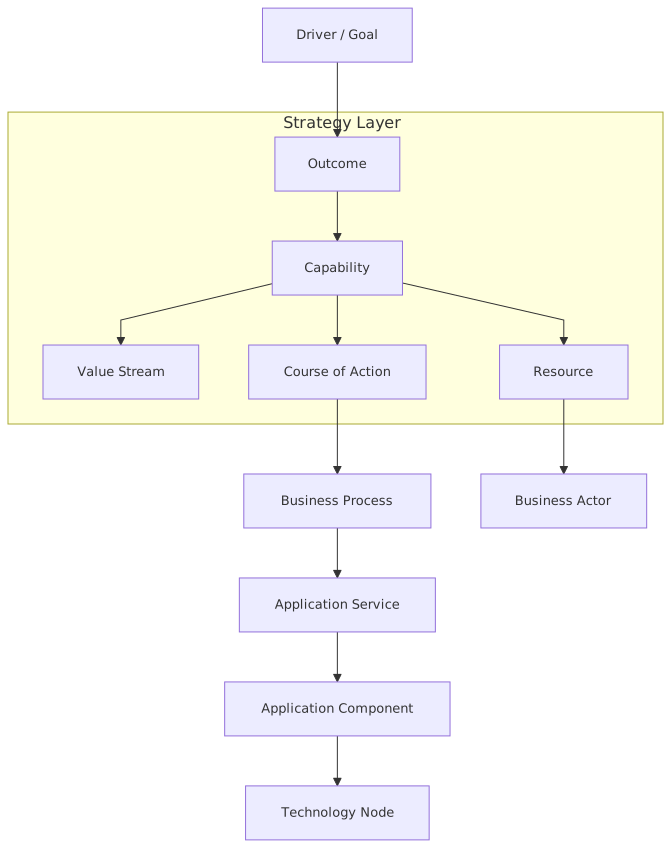
The trick is not to overcomplicate it. A practical strategy-oriented ArchiMate view often looks like this: ArchiMate tutorial
- Driver / Goal / Outcome
- Capability
- Value Stream
- Course of Action
- Resource
- trace to Business Process, Application Component, Technology Service, and Work Package
This creates a chain from “why” to “what” to “how” to “with what” to “what changes.” That is architecture.
A simple modeling pattern that actually works
Here’s a pattern I’ve seen work repeatedly in enterprise settings.
Capability-based strategy mapping pattern
This is not the only pattern. But it is one of the least confusing.
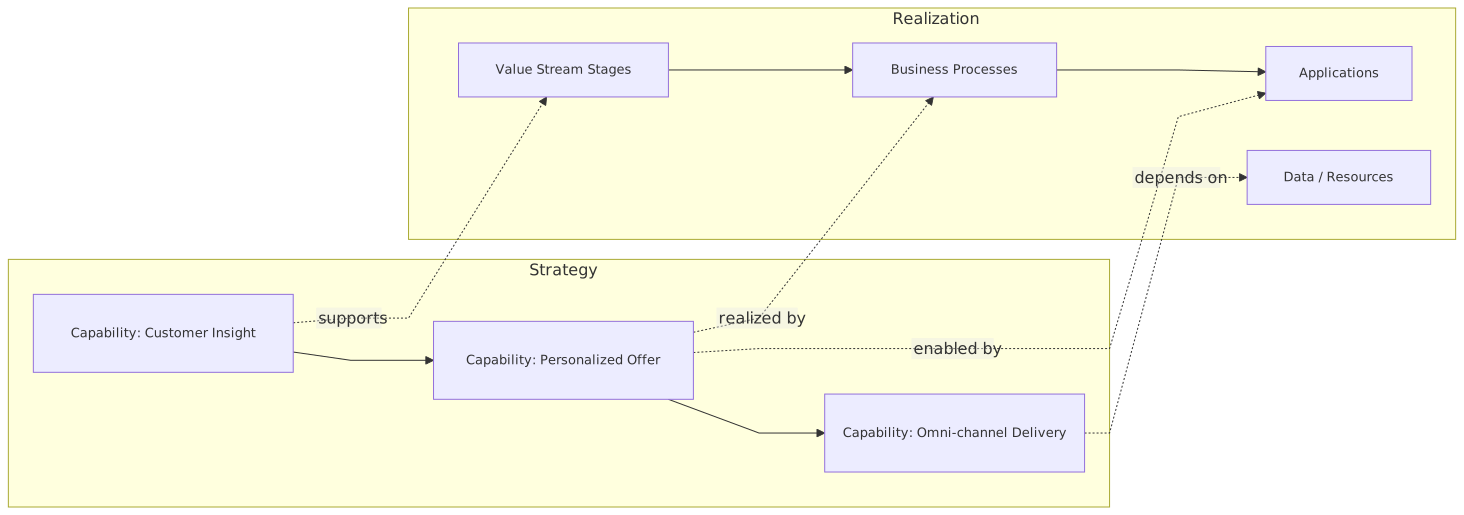
Notice what’s missing: giant all-in-one diagrams. Those are ego artifacts. Nobody needs a single view with 180 elements proving you know the notation. Split the concerns. One view for strategy. One for capability realization. One for transition. One for risk and dependencies. Architecture should clarify, not overwhelm.
How this applies in real architecture work
Let’s get practical, because this is where many articles go soft.
In real enterprise architecture work, capability-based modeling is useful in at least six situations:
1. Strategy translation
The board says, “We need to become a digital-first bank.” Fine. That statement means almost nothing on its own.
An architect translates it into affected capabilities:
- Digital Customer Onboarding
- Identity and Access Management
- Fraud Detection
- Customer Communication Management
- Real-Time Decisioning
- Consent and Privacy Management
Now you can discuss maturity, ownership, dependencies, and investment. Strategy becomes discussable.
2. Investment prioritization
If ten programs all claim to be strategic, capability maps help sort noise from signal.
Maybe three initiatives touch “Customer Onboarding,” but only one materially improves the capability. The others just modernize local applications. Useful perhaps, but not strategic in the same sense. Capability-based modeling helps expose that difference.
3. Application rationalization
Most estates are bloated. Especially in banks. You’ll find five onboarding tools, two IAM stacks, duplicate notification engines, and a Kafka platform used as both event backbone and accidental integration bus. Capability mapping lets you ask: which applications genuinely enable which capabilities? Which are redundant? Which are temporary? Which are “core” only because someone senior likes them?
4. Operating model design
A capability model helps separate stable business abilities from unstable organizational structures. That’s gold during reorganizations. Instead of designing around current silos, you design around enduring capabilities and assign accountability more cleanly.
5. Transformation roadmapping
Capabilities can be baseline-assessed and target-defined. That makes them excellent anchors for phased transformation. You can model current capability maturity, target state, gaps, and transition plateaus without pretending everything changes at once.
6. Architecture governance
This one is underrated. Capability-based models give review boards a sharper way to evaluate proposals:
- Which capability does this change improve?
- By how much?
- Is it removing technical debt or actually strengthening business ability?
- Is there overlap with existing capability enablement?
- Does it align with target operating and platform strategy?
Those are better governance questions than “Does it use approved middleware?”
A real enterprise example: retail banking, Kafka, IAM, and cloud
Let’s make this concrete.
Imagine a mid-sized retail bank trying to compete with digital challengers. Their executive strategy says:
- reduce customer onboarding from days to minutes
- improve fraud control without increasing friction
- support partner-driven product distribution
- move major customer platforms to cloud-native architecture over three years
This is typical modern banking strategy: part growth, part compliance, part platform modernization.
The wrong way to respond
The wrong architecture response is common:
- launch a cloud migration program
- expand Kafka everywhere
- buy a new IAM platform
- ask each domain to “modernize”
- produce dozens of solution architectures
- hope strategic coherence appears later
It won’t.
That approach creates motion, not direction.
The better capability-based response
Start by identifying the strategic capabilities involved:
- Customer Onboarding
- Identity Proofing
- Access Management
- Fraud Detection
- Product Origination
- Partner Integration
- Event-Driven Customer Interaction
- Compliance Reporting
Then ask some uncomfortable questions.
Customer Onboarding
Is this a single enterprise capability, or fragmented across channels and products? In many banks it’s fragmented beyond reason: retail, SME, credit card, mortgage, and mobile app onboarding all behave like separate empires.
Identity Proofing
Is identity verification a sub-capability of onboarding, or a reusable enterprise capability? Usually the latter. If you don’t model it that way, every channel rebuilds it badly.
Access Management
Is IAM treated as a technical utility, or recognized as a strategic business capability enabler? In digital banking, it’s not just plumbing. Strong customer authentication, delegated access, consent, privileged admin control—these are strategic.
Event-Driven Customer Interaction
Why is Kafka being introduced? Because there is a capability need for real-time event processing and decoupled interaction? Or because the platform team likes Kafka? Be honest. In many firms, Kafka is a solution in search of a strategic question.
That honesty matters.
How the model might look
At the strategy level:
- Driver: competitive pressure from digital banks
- Driver: regulatory pressure on KYC/AML and strong customer authentication
- Goal: onboarding in under 15 minutes
- Goal: reduce fraud loss rate by 20%
- Goal: enable partner channel onboarding
- Capability: Customer Onboarding
- Capability: Identity and Access Management
- Capability: Fraud Detection
- Capability: Partner Integration
- Capability: Real-Time Event Processing
- Value Stream: Acquire Customer
- Course of Action: standardize digital identity and access controls across channels
- Course of Action: adopt event-driven onboarding orchestration
- Resource: IAM platform
- Resource: Kafka event backbone
- Resource: cloud-native onboarding services
- Resource: fraud analytics models
Then trace to realization:
- Business Process: Verify Identity
- Business Process: Assess Risk
- Business Process: Open Account
- Application Component: Onboarding Orchestrator
- Application Component: IAM Service
- Application Component: Fraud Scoring Engine
- Application Component: Partner API Gateway
- Technology Service: Managed Kafka
- Technology Service: Cloud Container Platform
- Technology Service: Secrets Management
- Work Package: Consolidate customer IAM
- Work Package: Introduce onboarding event model
- Work Package: Migrate onboarding services to cloud
- Work Package: Integrate fraud scoring into event flow
Now you have a model that can support planning, governance, and funding discussions.
What the model reveals
This is the part executives usually find most useful.
The capability model often reveals that the real bottleneck is not “legacy core banking” in general. It’s more specific:
- fragmented IAM policies across channels
- duplicate identity proofing vendors
- onboarding process variation by product line
- Kafka introduced, but no enterprise event taxonomy
- cloud migration happening without capability ownership
- fraud controls bolted on after onboarding instead of embedded in the flow
That is a much sharper diagnosis than “we need digital transformation.”
And yes, this happens constantly. Organizations buy strategic technologies before they define the capability operating model needed to use them coherently. Kafka is a classic example. It can be a fantastic enabler of real-time capabilities. It can also become a very expensive pile of topics with no semantic discipline, unclear ownership, and accidental coupling. Capability-based modeling helps prevent that by tying the platform to business ability, not just technical enthusiasm.
Common mistakes architects make
Let’s be candid. Capability-based modeling is simple in concept and surprisingly easy to butcher.
Mistake 1: Confusing capabilities with processes
This is the big one.
“Customer onboarding” can be a capability. “Validate proof of address and route exception to ops team” is a process step, not a capability.
If your capability map reads like a process decomposition, you’re doing process architecture with different labels.
Mistake 2: Modeling the org chart
If your top-level capabilities look suspiciously like department names—Sales, Operations, IT Security, Compliance—you are not modeling capabilities. You are memorializing politics.
Capabilities should survive reorganization. Departments usually don’t.
Mistake 3: Going too abstract to be useful
Some architects swing the other way and create capability maps so generic they say nothing.
- Manage Customer
- Manage Risk
- Manage Technology
- Manage Data
Thanks. Very helpful. That tells us almost nothing about investment choices.
A capability model needs the right granularity. Stable enough to last. Specific enough to guide decisions.
Mistake 4: Treating every platform as a capability
Cloud is not a capability. Kafka is not a capability. IAM tooling is not a capability.
They are resources, or technology services, or application components depending on your viewpoint. The capability is the business ability they enable.
This matters because once technology names creep into capability maps, strategy gets distorted by vendor architecture.
Mistake 5: No assessment of capability strength
A list of capabilities is not a strategic model.
You need to assess them somehow:
- maturity
- performance
- strategic importance
- pain level
- risk exposure
- differentiation potential
Otherwise the map is decorative.
Mistake 6: No traceability to implementation
This is where architecture teams lose delivery teams. If capabilities never link to actual applications, data, integration, security controls, and work packages, the model becomes a management wallpaper.
Capabilities must trace down to execution.
Mistake 7: Pretending all capabilities are equally strategic
They are not.
Some capabilities are differentiating.
Some are mission-critical but non-differentiating.
Some are commodity.
Some should probably be outsourced or standardized.
Architects who refuse to make these distinctions create bland roadmaps and spread investment too thin.
That sounds impolite. It is. But architecture should discriminate. Not everything deserves equal design energy.
A practical way to structure capability maps
In real organizations, I prefer a three-level capability structure:
Level 1: Enterprise capabilities
Broad, stable abilities.
Examples:
- Customer Management
- Risk Management
- Identity and Access Management
- Payments Processing
Level 2: Domain capabilities
More decision-useful.
Examples:
- Customer Onboarding
- Customer Authentication
- Fraud Detection
- Access Provisioning
- Consent Management
- Event Processing
Level 3: Specialized capabilities
Only where necessary for planning.
Examples:
- Step-Up Authentication
- Privileged Access Control
- Device Risk Assessment
- Real-Time Topic Governance
- Partner Identity Federation
This is usually enough. Once people start demanding six levels, the model is drifting toward taxonomy addiction.
Also: not every capability needs the same depth. Strategic problem areas deserve more decomposition. Commodity areas often don’t.
Capability, value stream, and course of action: the trio people underuse
One of ArchiMate’s better ideas is not capability alone. It’s the relationship between Capability, Value Stream, and Course of Action.
This matters because capabilities can otherwise become static inventory. Value streams show where value is experienced. Courses of action show what leadership has chosen to do about it.
Take the banking example.
The Value Stream might be:
- Discover Product
- Apply
- Verify Identity
- Assess Risk
- Open Account
- Activate Access
- Start Using Service
The capabilities supporting those stages include:
- Product Origination
- Customer Onboarding
- Identity Proofing
- Fraud Detection
- IAM
- Event Processing
Then the Course of Action could be:
- standardize onboarding across all retail products
- introduce reusable identity verification service
- implement managed Kafka for event-driven orchestration
- centralize IAM policies and delegated authorization
- migrate onboarding journey services to cloud-native runtime
Now the strategy is not just “be digital.” It has shape.
This is exactly the kind of formalization that helps architecture support portfolio management. You can test whether initiatives align to a chosen course of action or whether they are just local optimizations dressed up as transformation.
Where cloud fits—and where it doesn’t
Cloud is a good example of why capability-based thinking matters.
A lot of organizations describe cloud adoption as strategy. It usually isn’t. It’s an enabling direction. Sometimes an important one. But not a business strategy by itself.
Cloud should be linked to capability outcomes such as:
- faster product launch
- elastic fraud analytics
- resilient digital onboarding
- improved partner integration
- secure identity services at scale
If you cannot connect cloud migration to capability improvement, then what you have is infrastructure modernization. That may still be worthwhile. But say what it is.
Too many architects blur these categories because “strategic cloud transformation” sounds better in steering committees than “we’re replacing old hosting patterns.” Again, honesty helps.
The same goes for IAM modernization. IAM is one of those domains that gets underestimated because people think of it as security plumbing. In reality, in digital enterprises—especially banks—it is deeply tied to customer experience, fraud control, partner enablement, and regulatory trust. If your capability model treats IAM as a back-office technical service only, you will underinvest in the business architecture around identity, consent, authentication journeys, and authorization models.
How to use capability modeling in workshops without boring everyone to death
This matters more than method purists admit.
Capability workshops often fail because architects arrive with a giant template and ask business leaders to debate definitions for three hours. That’s not strategy formalization. That’s hostage-taking.
A better workshop sequence is:
- Start with strategic outcomes and pain points.
- Ask what business abilities are weak, fragmented, or missing.
- Cluster those into candidate capabilities.
- Test each capability with a simple question: “Would this still exist if we reorganized or replaced systems?”
- Rate strategic importance and current effectiveness.
- Identify major enabling resources and systems.
- Agree a small number of target improvements.
That sequence gets better engagement because people can connect it to real problems.
And don’t insist on perfect naming in the first session. Architects sometimes fetishize taxonomy precision too early. Get the substance right first. Clean up labels later.
A useful assessment view for prioritization
Here’s a simple prioritization table that works well in practice.
You don’t need fake mathematical precision. Relative scoring is enough to drive meaningful discussion.
Strong opinion: capability maps are not enough
This is where I part company with some architecture teams.
A capability map by itself is not architecture. It is a starting point.
If you stop there, you’ve produced a strategic poster. Useful, maybe. But incomplete.
Real architecture work requires at least three additional moves:
- realization mapping: which processes, applications, platforms, and data actually support the capability
- health assessment: how well the capability performs today and why
- transformation design: what changes in capability, operating model, and technology are required over time
Without those, capability-based modeling becomes a polite way of avoiding hard design choices.
So yes, use capability maps. But don’t worship them.
What good looks like
A good capability-based ArchiMate model has a few visible qualities:
- strategic goals clearly linked to capabilities
- value streams showing where capabilities matter
- enabling resources explicitly modeled
- realization traced to business and technology architecture
- target state and roadmap represented through plateaus and work packages
- enough abstraction to stay stable, enough detail to drive decisions
And maybe most importantly, good models help people argue productively.
That’s underrated. Architecture should create better arguments. Better trade-offs. Better prioritization. Not just prettier diagrams.
In the banking example, a good capability model helps settle debates like:
- Do we centralize IAM first, or modernize onboarding journeys first?
- Where does Kafka add actual strategic value, and where is simple API orchestration enough?
- Which onboarding variations are justified by product rules, and which are just legacy habits?
- What should move to cloud first based on capability impact, not just technical ease?
- Which capabilities are differentiating versus standardizable?
Those are real enterprise questions. Capability-based modeling should help answer them.
Final thought
The value of capability-based modeling in ArchiMate 3.x is not that it gives architects another notation to master. We have enough notation already.
Its value is that it forces strategy to become structurally visible.
That’s the real win.
It lets you describe what the enterprise must be able to do, how value is delivered, what resources matter, which systems enable the ability, and what transformation is actually worth funding. In a world full of cloud slogans, platform hype, and endless modernization programs, that kind of discipline is rare.
And needed.
If you’re doing enterprise architecture in a bank—or really anywhere with complexity, regulation, legacy, and too many competing priorities—capability-based modeling is one of the best tools you have for making strategy operational. Not perfect. Not magic. Easy to misuse. But still one of the best.
Use it to challenge vague strategy. Use it to expose weak spots. Use it to stop technology-first thinking from masquerading as business design.
And please, for the love of architecture, don’t start with Kafka.
FAQ
1. What is the difference between a capability and a business process in ArchiMate?
A capability is an ability the business possesses, independent of how it is organized or executed. A business process is the sequence of behavior used to realize that ability. “Customer Onboarding” can be a capability; “Validate ID and create account” is a process.
2. How detailed should a capability model be?
Detailed enough to drive investment and architecture decisions, but not so detailed that it becomes process decomposition. In practice, 2–3 levels are usually sufficient for enterprise planning. Go deeper only in strategically important or troubled areas.
3. Is IAM really a business capability or just a technical service?
Both, depending on the viewpoint. In ArchiMate, IAM tooling may be modeled as a resource, application component, or technology service. But the enterprise ability to authenticate users, manage access, enforce consent, and support secure digital interaction is absolutely a business-relevant capability.
4. Where does Kafka fit in capability-based modeling?
Kafka is not a capability. It is a resource or enabling technology used to support capabilities such as real-time event processing, fraud detection, or event-driven customer onboarding. If you model Kafka itself as strategy, you’re already drifting into solution bias.
5. How do capability models help with cloud transformation?
They help distinguish between generic infrastructure migration and capability improvement. Instead of moving workloads to cloud because “cloud-first” is policy, you can prioritize migrations based on which business capabilities need resilience, scalability, speed, or integration improvement most urgently.
Capability-Based Modeling in ArchiMate 3.x
Frequently Asked Questions
What is enterprise architecture?
Enterprise architecture is a discipline that aligns an organisation's strategy, business processes, information systems, and technology. Using frameworks like TOGAF and modeling languages like ArchiMate, it provides a structured view of how the enterprise operates and how it needs to change.
How does ArchiMate support enterprise architecture practice?
ArchiMate provides a standard modeling language that connects strategy, business operations, applications, data, and technology in one coherent model. It enables traceability from strategic goals through business capabilities and application services to the technology platforms that support them.
What tools are used for enterprise architecture modeling?
The main tools are Sparx Enterprise Architect (ArchiMate, UML, BPMN, SysML), Archi (free, ArchiMate-only), and BiZZdesign Enterprise Studio. Sparx EA is the most feature-rich option, supporting concurrent repositories, automation, scripting, and integration with delivery tools like Jira and Azure DevOps.