⏱ 7 min read
How to Implement ArchiMate in a Large Organization
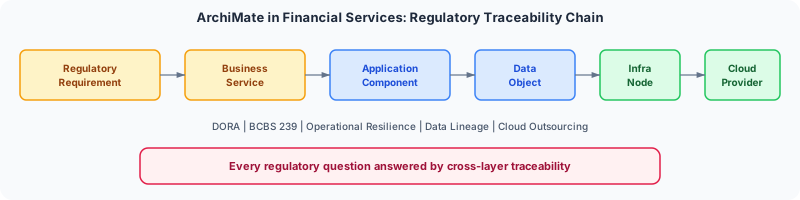
A Practical Field Guide for Regulated Financial Institutions
When working with a large European financial services organization, the architectural pressure did not come from digital ambition alone.

It came from regulation.
Supervisory authorities were asking increasingly complex questions:
- How do you ensure capital adequacy calculations are correct?
- Can you demonstrate full data lineage for regulatory reports?
- What are your critical business services under operational resilience frameworks?
- What happens if a cloud provider becomes unavailable?
- Can you prove structural control of outsourced services?
Each of these questions required cross-layer visibility across business, application, data, and infrastructure domains.
Before adopting enterprise modeling properly, answering them required: - Manual document collection - Multi-department workshops - Conflicting system diagrams - Long audit preparation cycles
The organization did not lack documentation.
It lacked structural coherence.
That is where ArchiMate became transformational --- not as a diagramming tool, but as a shared architectural language. ArchiMate tutorial for enterprise architects
1. The Real Purpose of ArchiMate in Large Enterprises
ArchiMate is often misunderstood as a modeling notation. ArchiMate layers explained
In large regulated institutions, it serves a deeper purpose:
It creates structural traceability across strategy, business, IT, and infrastructure.
Large organizations suffer from three primary types of complexity:
- Structural complexity --- systems, integrations, cloud, legacy
- Organizational complexity --- silos, acquisitions, overlapping functions
- Change complexity --- transformation programs, regulatory change, modernization
Without structural modeling:
- Impact analysis becomes subjective
- Regulatory traceability becomes painful
- Portfolio governance becomes political
- Redundancies remain hidden
- Risk concentration becomes invisible
ArchiMate provides: ArchiMate relationship types
- A shared vocabulary
- Layer separation
- Explicit relationships
- End-to-end traceability
In regulated finance, this becomes governance infrastructure.
2. Implementation Principles for Large Organizations
Before diving into regulatory modeling examples, it is important to understand the structural implementation principles that make ArchiMate succeed at scale. ArchiMate modeling best practices
2.1 Start With a Burning Question
Do not introduce ArchiMate as a framework. ArchiMate viewpoints
Introduce it as an answer to a strategic problem.
Examples:
- "Which systems support our regulatory reporting obligations?"
- "What are our critical ICT dependencies?"
- "What breaks if we decommission System X?"
Tie modeling to executive urgency.
2.2 Scope Before You Scale
Attempting to model the entire enterprise from day one leads to collapse.
Start with:
- One value stream
- One regulatory domain
- One transformation initiative
Scale horizontally once governance stabilizes.
2.3 Restrict the Meta-Model
Large organizations do not need the full ArchiMate language immediately.
Use a controlled subset:
Business Layer: - Business Capability - Business Service - Business Process - Business Actor - Business Role
Application Layer: - Application Component - Application Service - Application Function (limited use)
- Data: - Data Object
- Technology Layer: - Node - Technology Service
- Strategy Anchors (when needed): - Requirement - Goal - Driver
- Relationships: - Realization - Serving - Assignment - Access - Flow - Deployment
- Simplicity preserves semantic integrity.
3. Regulatory Modeling Examples
The following use cases demonstrate how ArchiMate becomes a regulatory governance instrument.
3.1 Regulatory Reporting Traceability (Capital Adequacy)
Regulatory Question:
"Show us how your capital adequacy report is produced from source data to final submission."
Business Layer
- Business Capability: Regulatory Reporting
- Business Process: Capital Adequacy Calculation
- Business Actor: Finance Reporting Team
Relationships: - Process realizes Capability - Actor assigned to Process
This establishes ownership and operational responsibility.
Application Layer
- Application Component: Core Banking System
- Application Component: Risk Calculation Engine
- Application Component: Regulatory Reporting Platform
- Application Service: Capital Calculation Service
Relationships: - Application Service serves Business Process - Risk Engine accesses Loan Exposure Data
Now traceability becomes visible:
Business Process → Application Component → Data Object
Data Layer
- Loan Exposure
- Counterparty Risk Rating
- Risk-Weighted Asset
- Capital Ratio Output
Flow example:
Loan Exposure → Risk Engine → Risk-Weighted Asset → Reporting Platform → Capital Ratio Output
This satisfies BCBS 239-style lineage visibility.
Technology Layer
- Node: Private Cloud Cluster
- Node: Database Server
- Technology Service: High Availability Service
- Technology Service: Backup Service
Deployment: - Risk Engine deployed on Cloud Cluster - Database Server provides Data Storage Service
Impact scenario:
Database failure → Risk Engine unavailable → Capital calculation delayed → Regulatory reporting risk
Architecture becomes evidence.
3.2 Operational Resilience (DORA / ICT Risk)
Regulatory Question:
"Identify your critical business services and supporting ICT resources."
Business Service
- Real-Time Payment Processing
Supporting Applications
- Payment Gateway
- Fraud Detection System
- Core Ledger
Infrastructure
- Cloud Payment Cluster
- On-Prem Data Center
- Failover Service
Traceability:
Business Service → Applications → Infrastructure Nodes
This allows explicit modeling of:
- Recovery Time Objectives
- Redundancy structures
- Single points of failure
- Concentration risks
Operational resilience becomes structurally demonstrable.
3.3 Data Governance and Lineage (BCBS 239)
Regulatory Question:
"Demonstrate aggregation accuracy and data ownership."
Ownership
- Business Role: Chief Data Officer
- Business Role: Data Owner (Credit Risk)
Assignment: - Data Owner assigned to Data Object: Customer Exposure
Data Flow
Core Banking → Data Warehouse → Risk Engine → Reporting Tool
Transformation logic modeled via Application Function.
This shows:
- Where aggregation occurs
- Who owns data quality
- Which systems transform data
- Where potential errors may arise
3.4 Outsourcing and Third-Party Risk
Regulatory Question:
"Which critical functions depend on external providers?"
External Actor
- Business Actor: Cloud Provider
Provided Service
- Business Service: Infrastructure Hosting
Internal Dependency
- Application Component: Risk Engine uses Hosting Service
This reveals:
- Critical external dependencies
- Service concentration risk
- Impact scope if provider fails
This is essential for cloud governance.
3.5 Change Impact Assessment
- When replacing a legacy system:
- Trace:
- Application → Business Process → Business Capability → Regulatory Obligation
- This allows:
- Structured decommission planning
- Controlled transition architecture
- Audit transparency
4. Embedding ArchiMate into TOGAF Governance
ArchiMate and TOGAF together create structural governance.
Phase A -- Architecture Vision
High-level capability map aligned to regulatory drivers.
Phase B -- Business Architecture
Model capabilities, services, and processes supporting compliance.
Phase C -- Information Systems Architecture
Map reporting systems, data lineage, transformation logic.
Phase D -- Technology Architecture
Model resilience, hosting, redundancy, outsourcing.
Phase E/F -- Migration Planning
Model baseline vs target state.
Phase G -- Implementation Governance
Require traceability positioning in enterprise model.
Phase H -- Change Management
Use model-based impact analysis for regulatory updates.
Together:
TOGAF provides process. ArchiMate provides structure.
5. Measuring Success
After structured implementation, organizations typically observe:
- Reduced audit preparation time
- Faster impact analysis
- Clearer investment decisions
- Reduced system duplication
- Improved resilience visibility
- Stronger regulatory confidence
More importantly:
Conversations shift from:
"What system does this?"
To:
"Which capability and regulatory obligation does this support?"
That is architectural maturity.
6. Final Reflection
- In regulated financial institutions, complexity cannot be eliminated.
- But unmanaged complexity creates regulatory exposure.
- ArchiMate converts regulatory pressure into structural clarity.
- When aligned with TOGAF governance:
- Architecture becomes evidence
- Models become control mechanisms
- Traceability becomes structural
- Risk becomes visible
And that is when enterprise architecture evolves from documentation to decision infrastructure.
For expert guidance on enterprise architecture, explore our enterprise architecture consulting, architecture capability development, and Sparx EA consulting. Get in touch.
Frequently Asked Questions
What is enterprise architecture?
Enterprise architecture is a discipline that aligns an organisation's strategy, business operations, information systems, and technology infrastructure. It provides a structured framework for understanding how an enterprise works today, where it needs to go, and how to manage the transition.
How is ArchiMate used in enterprise architecture practice?
ArchiMate is used as the standard modeling language in enterprise architecture practice. It enables architects to create consistent, layered models covering business capabilities, application services, data flows, and technology infrastructure — all traceable from strategic goals to implementation.
What tools are used for enterprise architecture modeling?
Common enterprise architecture modeling tools include Sparx Enterprise Architect (Sparx EA), Archi, BiZZdesign Enterprise Studio, LeanIX, and Orbus iServer. Sparx EA is widely used for its ArchiMate, UML, BPMN and SysML support combined with powerful automation and scripting capabilities.