⏱ 19 min read
Most ArchiMate models don’t fail because the notation is too weak. They fail because architects can’t resist “improving” it.
That’s the uncomfortable truth.
Somewhere along the way, a team decides the standard language is too generic for their enterprise. “Application Component” feels vague. “Business Object” feels abstract. “Technology Service” feels too broad. So they start specializing everything. They create custom element types for Kafka Topic, IAM Role, Cloud Landing Zone, Payment API, Customer Domain Event, Zero Trust Policy, and twenty-seven other things. The model starts looking smart. Detailed. Tailored. Enterprise-ready.
And then six months later nobody can read it consistently, tooling starts fighting back, stakeholders interpret the same concept three different ways, and the so-called architecture language becomes a local dialect.
That is the real issue with extending ArchiMate via specialization: not whether you can do it, but whether you can do it without quietly breaking the purpose of architecture.
The simple explanation first
ArchiMate allows specialization so you can create more specific versions of standard concepts while preserving their meaning. In plain English: you can take a standard ArchiMate element or relationship and define a more specific subtype for your enterprise.
For example:
- You can specialize Application Component into Kafka Cluster
- You can specialize Application Service into Identity Verification Service
- You can specialize Data Object into Customer Consent Record
- You can specialize Node into Kubernetes Worker Node
- You can specialize Business Actor into Retail Customer or Fraud Analyst
That sounds reasonable. And it is. Up to a point.
Specialization is useful when a standard ArchiMate concept is too generic to support communication in your organization. It helps make models more meaningful for practitioners. A cloud architect understands “Landing Zone” faster than a generic “Technology Collaboration.” A security architect understands “IAM Role” faster than a generic access-related abstraction.
But specialization is supposed to refine, not replace, the core metamodel. If your specialization starts changing the semantics of ArchiMate, mixing layers carelessly, or turning your architecture repository into a private notation system, you are no longer extending the language. You are fragmenting it.
And yes, that happens all the time.
Why architects reach for specialization
There are good reasons.
Real enterprises are messy. A bank doesn’t run on neat textbook abstractions. It runs on event streams, IAM platforms, cloud control planes, batch jobs nobody wants to admit still exist, and governance terms that carry legal consequences. In that environment, generic ArchiMate can feel too blunt. ArchiMate modeling guide
A banking architecture team might need to distinguish between:
- a Kafka topic used for payment events
- a Kafka consumer group supporting fraud detection
- an IAM role assumed by cloud workloads
- a customer identity proofing service
- a regulatory data retention policy
- an AWS landing zone hosting regulated workloads
If you model all of those as broad generic concepts with no specialization, the diagrams become technically correct and practically useless. Stakeholders squint at the model and say, “Fine, but what am I actually looking at?”
That is why specialization exists. It helps bridge the gap between formal language and operational reality.
Still, there is a trap here. Architects often think more specificity automatically means more value. It does not. More specificity often just means more model governance work, more ambiguity, and more debate over labels. ArchiMate for governance
Sometimes a generic ArchiMate element with a good name is enough. Actually, often it is. ArchiMate tutorial
What specialization in ArchiMate really means
Let’s get precise.
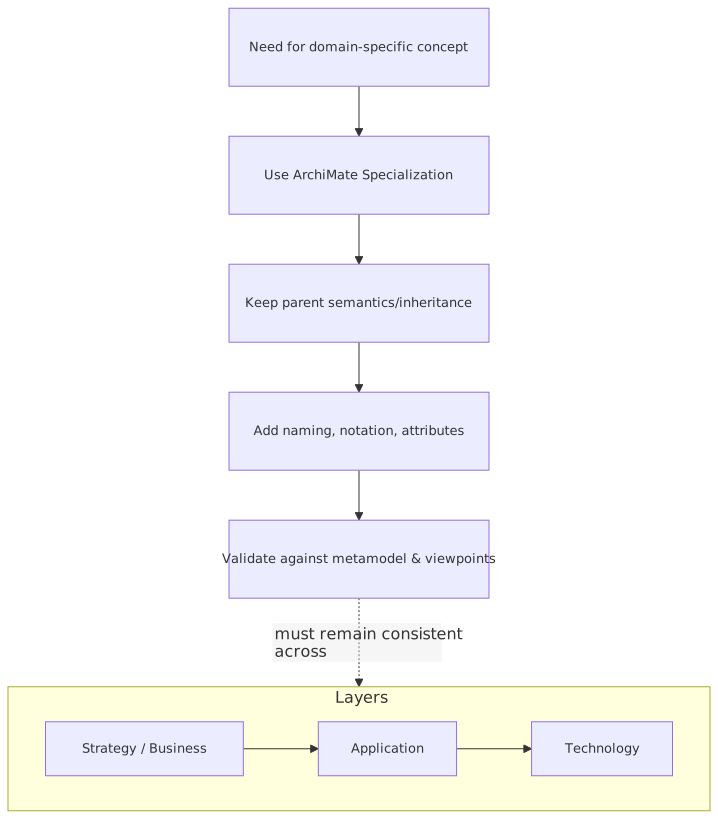
A specialization says: this thing is a more specific kind of an existing ArchiMate concept and inherits its meaning and allowed usage.
That inheritance part matters. It is the constraint many teams ignore.
If you specialize Application Component into Kafka Broker, you are saying a Kafka Broker is still an Application Component in architectural terms. It should behave like one in the model. It should participate in relationships that make sense for an Application Component. It should not suddenly become a deployment node, a data object, and a policy construct depending on who draws the diagram.
Likewise, if you specialize Data Object into Event Message, you are making a claim: an event message is being treated as a data object in your enterprise architecture language. That may be acceptable in some contexts. In others, it may flatten important distinctions between transient messaging, persistent records, and business information concepts.
This is why specialization is not just visual decoration. It is a semantic commitment.
Many teams treat it like tagging with better icons. That is lazy architecture.
The first hard constraint: preserve meaning
The biggest rule is simple:
A specialization must preserve the meaning of the parent concept.
If it does not, don’t call it specialization. Call it confusion.
Here are some examples.
Good specialization
- Application Component → IAM Platform
- Technology Service → Managed Kafka Service
- Business Object → Loan Agreement
- Node → Cloud Compute Node
These are sensible because the specialized concept still behaves like the parent concept.
Bad specialization
- Data Object → Kafka Topic
- Business Process → Microservice
- Application Interface → IAM Policy
- Node → Customer Domain
These are category errors. They may sound practical in a local conversation, but they damage the integrity of the model.
A Kafka topic is not a data object in the same sense as a business record. It may carry data, yes. That does not make the topic itself a data object. A microservice is not a business process. An IAM policy is not an application interface. A customer domain is not a node. If you need these concepts, model them using the closest valid abstraction and document your conventions.
This is where architects need discipline. Not creativity. Discipline.
The second hard constraint: specialization does not excuse poor abstraction
A lot of specialization is really a symptom of architects refusing to think at the right level.
They model too low, too soon.
If you are creating specialized ArchiMate elements for:
- Kafka partition
- Kafka offset
- IAM session token
- Kubernetes sidecar
- VPC route table
- object storage lifecycle rule
then maybe you are not doing enterprise architecture. Maybe you are doing infrastructure inventory with better fonts.
There is nothing wrong with technical detail. But enterprise architecture models need to support decisions, alignment, impact analysis, and communication across stakeholders. If your specialization only helps one platform engineer but confuses everyone else, it probably belongs in another modeling layer, another repository, or another tool entirely.
This is one of the most common mistakes architects make: they use ArchiMate to absorb every technical concept because they can.
You should be asking instead:
- Does this concept matter to architecture decisions?
- Does it recur enough to justify a language extension?
- Will multiple teams interpret it consistently?
- Does it improve traceability across business, application, technology, and security concerns?
If not, leave it out.
That is not under-modeling. That is restraint.
The third hard constraint: tooling and exchange are less tolerant than you think
Architects love to say, “Our repository supports custom specializations.” Fine. But that is not the same as saying your ecosystem supports them well.
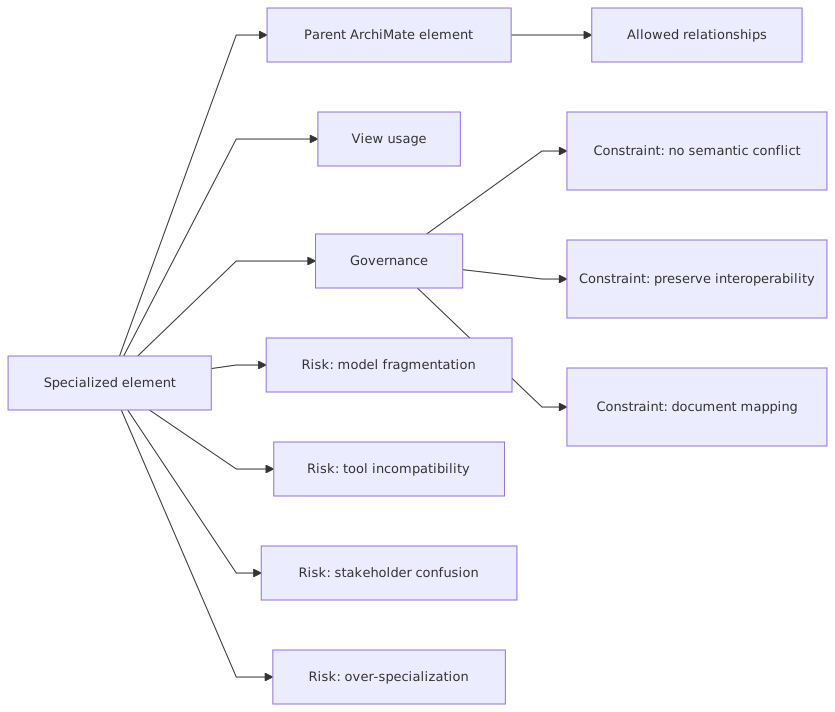
The moment you start exporting models, integrating with other repositories, publishing standards, onboarding new architects, or sharing views with external partners, specialized types become friction points.
Tool support for specialization varies. Some tools treat specialized concepts elegantly. Others flatten them into labels. Others preserve appearance but lose semantics in export. Some reports ignore custom types entirely. Some APIs return the parent type only. Some governance workflows break because they were designed around the standard metamodel. EA governance checklist
So the question is not only “Can I define a specialization?” It is also:
- Can I govern it?
- Can I search for it?
- Can I report on it?
- Can I exchange it across tools?
- Can a new architect understand it without tribal knowledge?
If the answer is shaky, be careful.
This matters in large enterprises more than people admit. In a bank, architecture rarely lives inside one neat repository. You have application portfolios, CMDBs, cloud metadata, IAM catalogs, data lineage tools, integration registries, and risk systems. If your ArchiMate extension only makes sense inside one modeling team’s tool, it is probably not enterprise architecture. It is local optimization.
A practical table: when specialization helps and when it hurts
This is really the heart of it. Specialization helps when it sharpens communication around stable concepts that matter across teams. It hurts when it turns the model into a technical scrapbook.
Real architecture work: where specialization is actually useful
Let’s leave theory and talk about actual work.
In real enterprise architecture, specialization is most useful in three situations.
1. When a concept is repeatedly important across many views
If every cloud architecture review talks about landing zones, then “Landing Zone” may deserve to be a specialization of a standard technology structure concept.
If every security architecture review depends on distinguishing authentication services from broader IAM capabilities, specialization may help.
The keyword is repeatedly. Not “this came up in one project.”
2. When the specialized concept carries governance implications
In banking, a Customer Consent Record is not just “some data.” It may have legal retention rules, audit requirements, and usage restrictions. Making it a specialization of Data Object can be useful because it signals governance importance and enables traceability.
Similarly, an Identity Proofing Service may have higher assurance requirements than a generic application service. Specializing it can support policy alignment.
3. When a shared enterprise vocabulary already exists
This is the strongest case.
If your enterprise already has stable definitions for terms like:
- payment initiation event
- privileged access role
- regulated workload zone
- fraud decision service
- customer master record
then ArchiMate specialization can align the model with business and technology language people already use.
What does not work is inventing specialized types first and hoping the enterprise will adopt them later. That is architecture vanity.
Common mistakes architects make
Let’s be blunt. These are the mistakes I see again and again.
Mistake 1: confusing naming with specialization
You do not need specialization every time you want a better label.
“AML Screening Service” can simply be an Application Service with a meaningful name. You only need specialization if “AML Screening Service” belongs to a reusable category with distinct architectural significance.
Otherwise, just name the thing properly and move on.
Mistake 2: creating specializations with no written semantics
If you define Kafka Topic as a specialization, where is the rulebook?
What is it specialized from?
What relationships are expected?
What is specifically excluded?
How is it different from Data Object, Artifact, or Application Interface in your modeling practice?
If you cannot answer those questions in writing, you are not defining a metamodel extension. You are doodling.
Mistake 3: specializing to mirror vendor products
This happens constantly in cloud architecture.
Architects create special types for:
- AWS IAM Role
- Azure Managed Identity
- GCP Pub/Sub Topic
- Confluent Cluster
- EKS Node Group
Now the architecture language is tied to vendor implementation. That may be unavoidable in some infrastructure views, but at enterprise level it often kills portability and comparison.
A better approach is usually to specialize to enterprise-relevant patterns first:
- Workload Identity
- Event Streaming Platform
- Managed Container Platform
- Privileged Access Role
Then map vendor constructs underneath.
Mistake 4: mixing conceptual and physical levels
A classic Kafka example: teams model Event, Topic, Message, Schema, Stream Processor, and Broker with no separation of abstraction levels.
Now nobody knows whether the diagram is about business information, logical integration, or physical platform design.
ArchiMate can handle multiple abstraction levels, but specialization makes this worse if you are sloppy. You need clear conventions for what lives where.
Mistake 5: letting every domain invent its own extensions
Security adds ten custom types. Data adds twelve. Cloud adds fifteen. Integration adds eight. Suddenly the enterprise repository contains a taxonomy zoo.
This is one of the fastest ways to destroy coherence. The architecture language becomes federated in the worst possible way.
Local needs are real, yes. But extension governance must be centralized enough to protect shared meaning.
Mistake 6: assuming more detail equals more rigor
It doesn’t. Sometimes it means the opposite.
A model with ten stable concepts used consistently is more rigorous than a model with sixty specialized types used inconsistently. Architects often confuse granularity with precision. They are not the same thing.
A real enterprise example: retail bank modernization with Kafka, IAM, and cloud
Let me give you a realistic scenario.
A retail bank is modernizing its customer servicing platform. It is moving from a tightly coupled set of legacy applications to a cloud-based architecture using managed Kubernetes, Kafka for event streaming, and a centralized IAM platform integrated with workforce and customer identity services.
The architecture team wants traceability from business capabilities to platform controls. Reasonable goal.
They start with standard ArchiMate concepts:
- Business Capability
- Business Process
- Application Component
- Application Service
- Data Object
- Node
- Technology Service
So far so good.
Then the platform architects push for specialization because generic types aren’t enough for operational reviews. Also fair.
They propose:
- Event Streaming Platform as a specialization of Application Component
- Customer Event as a specialization of Data Object
- Authentication Service and Authorization Service as specializations of Application Service
- Privileged Access Role as a specialization of Business Role or perhaps a representation linked to access control concepts
- Regulated Workload Zone as a specialization of Node or grouped technology structure
- Customer Consent Record as a specialization of Data Object
This can work.
Now here is where the team nearly goes wrong.
One domain architect wants:
- Kafka Topic
- Kafka Partition
- Consumer Group
- Schema Registry Subject
- IAM Policy
- Service Account Token
- Kubernetes Namespace
- Security Group Rule
all as specialized ArchiMate elements.
That would have been a mess.
Why? Because those concepts belong to different layers, different lifecycles, and different architecture audiences. Some are runtime platform constructs. Some are governance artifacts. Some are deployment details. Some are security policy definitions. Making them all first-class specialized element types inside the shared enterprise metamodel would overload the language and confuse analysis.
The team eventually imposes a rule:
Enterprise-level specialization only for concepts that meet all four conditions
- They are used across multiple domains
- They affect architecture decisions, not just implementation
- They support cross-layer traceability
- They can be defined unambiguously in one sentence
That is a very good rule, by the way.
Under that rule, the bank keeps:
- Event Streaming Platform
- Authentication Service
- Authorization Service
- Customer Event
- Customer Consent Record
- Regulated Workload Zone
It rejects:
- Kafka Partition
- Consumer Group
- IAM Policy Statement
- Kubernetes Namespace
Those remain in supporting technical documentation or platform design repositories.
The result is better than either extreme. The model is still recognizable as ArchiMate. Stakeholders can still understand it. But it now carries enterprise-relevant vocabulary tied to real governance concerns.
That is what good specialization looks like in practice. Not maximal detail. Selective precision.
The uncomfortable contrarian view: sometimes don’t specialize at all
Here’s the part many architects won’t like.
A lot of ArchiMate specialization work is unnecessary theater.
People enjoy extending the language because it feels like sophisticated architecture. It feels like building an enterprise ontology. It feels strategic. But often the actual problem is much simpler:
- element names are weak
- viewpoints are poorly chosen
- abstraction levels are mixed
- stakeholders were not the audience for the model
- governance is absent
In those cases, specialization is lipstick on a broken model.
I’ve seen teams spend weeks debating whether “API Product” should specialize Application Service, Application Interface, Product, or Representation. Meanwhile nobody had clarified who owned the service, what business process depended on it, or what resilience target it needed. That is not architecture. That is notation cosplay.
If your models are failing to communicate, the answer is not always more metamodel. Sometimes it is better naming, fewer concepts, cleaner viewpoints, and stronger facilitation.
The standard ArchiMate language is more capable than many teams think. They just haven’t used it well.
Governance for specialization: if you won’t govern it, don’t do it
This is probably the most practical advice in the article.
If your enterprise wants to extend ArchiMate via specialization, create a lightweight but real governance process. Not a giant committee. Just enough control to prevent entropy.
At minimum, every specialization should have:
- parent ArchiMate concept
- plain-language definition
- rationale for why naming alone is insufficient
- examples of correct usage
- examples of incorrect usage
- allowed viewpoints or contexts
- owner responsible for maintaining the definition
- review date
Yes, this sounds bureaucratic. It is still less painful than cleaning up a repository full of custom types that nobody understands.
Also, retire specializations that don’t get used. Architects are terrible at this. They love adding language, hate removing it. But an enterprise metamodel should be curated, not accumulated.
A useful metric is this:
If a specialization has not been used consistently in at least three meaningful models over a year, challenge whether it should exist.
Brutal, but healthy.
How this applies in day-to-day architecture work
Let’s make this concrete.
In solution architecture
Use specialization sparingly to make diagrams understandable to delivery and platform teams. For example, showing Authentication Service and Event Streaming Platform can add clarity without drowning the view in implementation trivia.
In domain architecture
Specialization can be powerful if it reflects stable domain concepts like Customer Consent Record or Payment Event. But keep the domain model coherent. Don’t let every squad create its own type system.
In security architecture
This is where people over-specialize fastest. IAM, policy, trust boundaries, credentials, roles, entitlements — all important, all easy to model badly. Use specialization only where it supports enterprise governance, such as differentiating authentication and authorization services or regulated identity stores. Do not try to force every access control artifact into the shared EA metamodel.
In cloud architecture
Specialize around operating model concepts, not every cloud resource. Regulated Workload Zone may matter. Managed Container Platform may matter. Object Storage Bucket Policy Statement usually does not belong in enterprise ArchiMate.
In portfolio and governance work
Specialization is useful when it improves traceability for risk, cost, resilience, or compliance. If it does not improve one of those, ask why it exists.
That is the test I like:
Can this specialized concept help us make or govern an enterprise decision?
If not, be suspicious.
A few opinionated rules of thumb
Here are mine. You don’t have to like them.
- Prefer good naming over specialization.
Most teams should cut their custom types in half.
- Never specialize a concept you cannot define in one sentence.
If it takes a paragraph, your abstraction is muddy.
- Do not model vendor products as enterprise language unless the vendor is strategically unavoidable.
Even then, be careful.
- If a specialized type only appears in one program, it is probably not enterprise architecture.
It may still be useful, just not as a shared language extension.
- Specialization should reduce ambiguity, not increase expressiveness for its own sake.
Enterprise architecture is not poetry.
- If your stakeholders need a glossary to read every diagram, you have already lost.
Strong opinions, yes. But they come from seeing too many repositories collapse under well-intentioned cleverness.
Final thought
Extending ArchiMate via specialization is legitimate. Sometimes necessary. In banking, cloud, Kafka-heavy integration landscapes, and IAM-centric security models, the standard vocabulary can be too broad to carry the enterprise’s real concerns.
But specialization is not free. It introduces semantic obligations, governance overhead, tool friction, and the constant risk of building a private notation no one else can use properly.
The trick is not to avoid specialization entirely. The trick is to use it with restraint and with a very clear reason.
Good architects know how to model more.
Better architects know when not to.
And honestly, enterprise architecture needs more of the second kind.
FAQ
1. When should I specialize an ArchiMate element instead of just renaming it?
Specialize only when the concept is reused across multiple models, has distinct architectural meaning, and needs explicit governance. If it is just a clearer label for one instance, renaming is enough.
2. Is it okay to create ArchiMate specializations for Kafka concepts like Topic or Consumer Group?
Usually not at enterprise level. Those are often too implementation-specific unless they directly affect enterprise decisions or governance. A broader specialization like Event Streaming Platform or Customer Event is more defensible.
3. How should IAM concepts be handled in ArchiMate specialization?
Carefully. Services like Authentication Service and Authorization Service are usually good candidates. Policies, tokens, and low-level entitlement artifacts often belong in security design documentation rather than the shared enterprise metamodel.
4. What is the biggest risk of extending ArchiMate too much?
You create a language that only your team understands. That breaks consistency, onboarding, reporting, and cross-team communication. The model gets richer locally and weaker enterprise-wide.
5. How do I govern custom ArchiMate specializations in a large enterprise?
Use a small formal process: define the parent concept, meaning, rationale, usage rules, examples, owner, and review cycle. If a specialization is rarely used or inconsistently applied, retire it.
Frequently Asked Questions
What is enterprise architecture?
Enterprise architecture is a discipline that aligns an organisation's strategy, business processes, information systems, and technology. Using frameworks like TOGAF and modeling languages like ArchiMate, it provides a structured view of how the enterprise operates and how it needs to change.
How does ArchiMate support enterprise architecture practice?
ArchiMate provides a standard modeling language that connects strategy, business operations, applications, data, and technology in one coherent model. It enables traceability from strategic goals through business capabilities and application services to the technology platforms that support them.
What tools are used for enterprise architecture modeling?
The main tools are Sparx Enterprise Architect (ArchiMate, UML, BPMN, SysML), Archi (free, ArchiMate-only), and BiZZdesign Enterprise Studio. Sparx EA is the most feature-rich option, supporting concurrent repositories, automation, scripting, and integration with delivery tools like Jira and Azure DevOps.