⏱ 21 min read
Most enterprise architecture models fail for a boring reason: they confuse drawing boxes with making meaning.
That’s the uncomfortable truth.
Teams buy a repository tool, agree on a notation, create a few capability maps, maybe a couple of solution overviews, and then declare they “do architecture.” Six months later nobody trusts the model, business stakeholders ignore it, delivery teams work around it, and architects quietly go back to PowerPoint. The diagrams were technically correct. The architecture was still useless.
Why? Because the metamodel was treated as diagram grammar, not as enterprise semantics.
That is where ArchiMate gets underestimated. People see ArchiMate as a modeling language with a lot of boxes, layers, and relationships. Fair enough. But if you stop there, you miss the important thing: the ArchiMate metamodel can be used as an enterprise ontology. Not a perfect one. Not a mathematically pristine one. But a practical, formal enough ontology for describing what exists in an enterprise, how those things relate, and what kinds of statements are valid.
That distinction matters more than most architects admit. EA governance checklist
The simple version first
Let’s make this plain early.
If you are searching for a simple answer, here it is:
The ArchiMate metamodel is an enterprise ontology because it gives you a formal set of concepts and allowed relationships for describing an enterprise consistently.
It tells you:
- what kinds of things exist in an enterprise model,
- how those things can relate,
- and what kinds of claims are legitimate.
So instead of saying:
- “this application sort of supports that process and maybe owns this data,”
you can say:
- Application Component X serves Application Service Y
- Business Process A uses Application Service Y
- Data Object Z is accessed by Application Component X
- Node N hosts Application Component X
That’s ontology behavior. You are not just drawing. You are asserting facts in a controlled vocabulary with explicit semantics.
Is ArchiMate a full formal ontology in the academic sense? Not really. It’s not OWL-first, and it does not pretend to encode every enterprise truth with strict logical completeness. But in enterprise practice, that objection is often academic theater. What matters is whether the metamodel gives enough formal structure to reason over architecture, improve consistency, support impact analysis, and reduce ambiguity. It does.
And frankly, that’s already more formal discipline than most enterprises have.
Why “enterprise ontology” is not just fancy language
Architects love overloaded words. “Capability.” “Service.” “Platform.” “Domain.” “Product.” Half the meetings in large enterprises are really about people using the same word to mean different things.
Ontology is the antidote to that mess.
An ontology, in practical architecture terms, is a structured model of meaning:
- a set of concepts,
- definitions for those concepts,
- relationship types,
- and some constraints on what can be said.
If your enterprise has no ontology, it has no stable meaning layer. It only has documents.
That’s a problem because modern enterprises are too complex to run on narrative alone. In banking, for example, one team says “customer” and means a legal party. Another means a retail account holder. Another means an IAM principal. Another means a Kafka event key. Another means a CRM golden record. They are all “right,” and that’s exactly the issue.
ArchiMate helps because it forces classification. It asks, in effect:
- Is this thing behavior, structure, or information?
- Is it business, application, or technology?
- Is it active, passive, or behavioral?
- Is this relationship serving, realizing, triggering, accessing, composing, assigning, or flowing?
That kind of discipline is not bureaucratic overhead. It is what stops architecture from collapsing into vague storytelling.
The formal perspective: not pure, but useful
Now let’s go deeper.
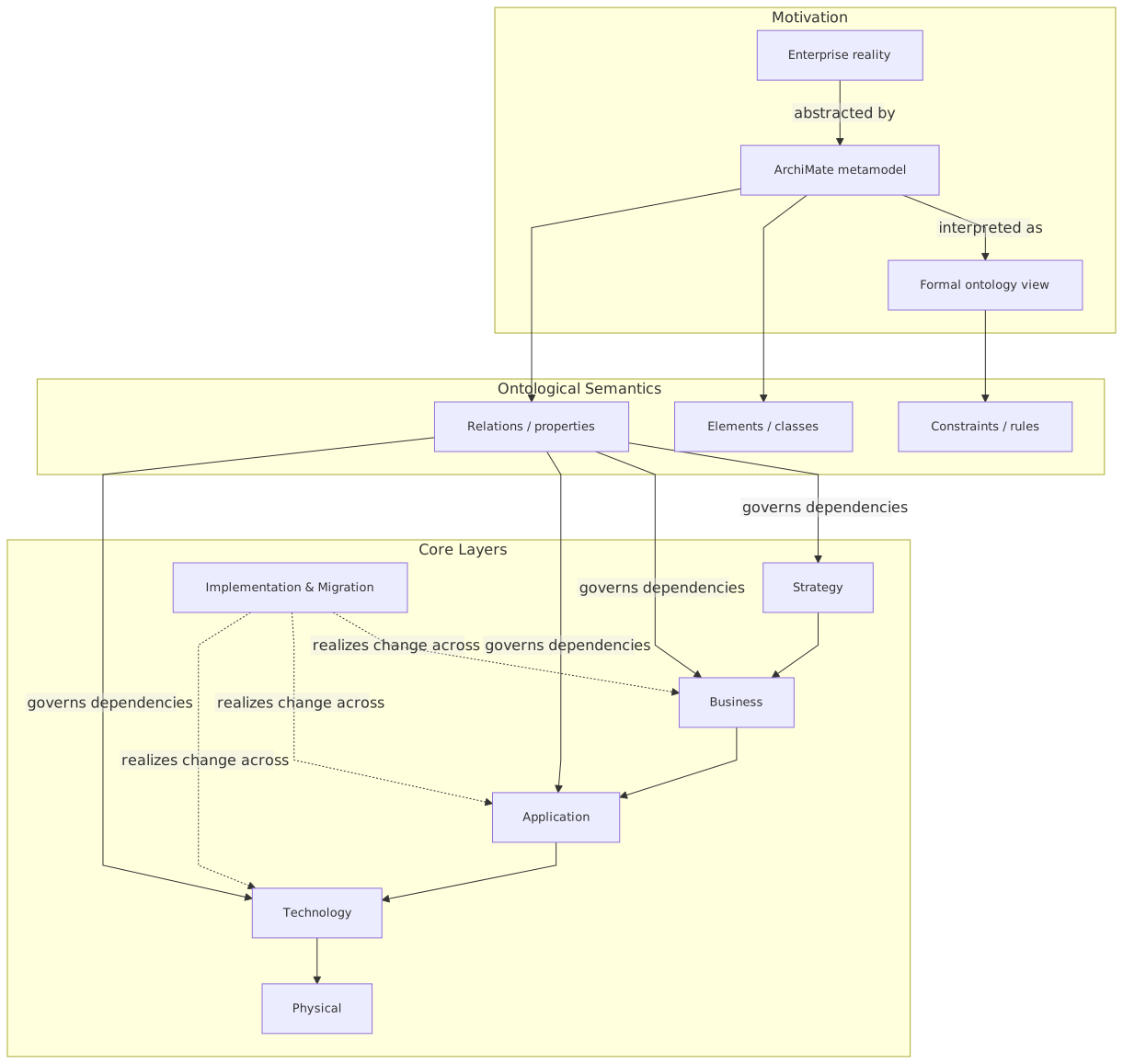
When I say the ArchiMate metamodel can be treated as an enterprise ontology, I do not mean it behaves like a complete formal logic system. It doesn’t. There are limitations:
- some semantics are intentionally broad,
- specializations are often enterprise-specific,
- many important constraints live outside the standard,
- and real meaning often depends on governance, not just syntax.
Still, ArchiMate has the core properties of a useful ontology:
1. It defines classes of things
Examples:
- Business Actor
- Business Role
- Business Process
- Application Component
- Application Service
- Data Object
- Technology Service
- Node
- Device
- Artifact
These are not random visual symbols. They are ontological categories.
2. It defines valid relation types
Examples:
- Assignment
- Serving
- Realization
- Access
- Triggering
- Flow
- Aggregation
- Composition
- Association
This means not every statement is equally valid. You can’t just connect anything to anything and still claim semantic rigor.
3. It enables inference-like reasoning
Not formal theorem proving in most tools, but practical reasoning:
- If a business process uses an application service,
- and that service is realized by an application component,
- and that component is hosted on a node in a cloud region,
- then an outage in that node has traceable business impact.
That is architecture reasoning. Primitive compared to academic knowledge representation, yes. But highly valuable in enterprise work.
4. It supports abstraction and specialization
This is critical.
Real enterprises rarely model only with vanilla ArchiMate. They specialize: ArchiMate modeling guide
- “Identity Provider” as a specialization of Application Component
- “Event Stream” as a specialization of Application Service or a modeled pattern around data/event structures
- “Retail Customer Onboarding” as a specialization of Business Process
- “PCI Zone Kubernetes Cluster” as a specialization of Node
This is exactly how ontologies become useful in practice: a stable core, then domain-specific extension.
The mistake architects make: they treat ArchiMate as notation, not semantics
This is the biggest failure mode I see.
Architects obsess over whether to use the right icon. They spend hours debating whether something is an Application Function or Application Service. Meanwhile the actual semantic model is inconsistent, duplicated, and full of hand-waving.
The point is not visual purity. The point is controlled meaning.
A lot of architecture teams still work like this:
- business architecture has one glossary,
- integration architects have another,
- IAM has a third,
- cloud platform has its own service catalog,
- data architecture has a fourth interpretation of “entity,”
- and nobody reconciles them.
Then they publish “target architecture” diagrams and wonder why delivery teams don’t trust them.
If you use the ArchiMate metamodel as an ontology, you do something different: ArchiMate tutorial
- define your enterprise concepts once,
- map them to ArchiMate classes,
- constrain allowed relationships,
- and govern the model as a semantic asset.
That changes the game.
What formal means in real architecture work
Let’s keep this grounded. “Formal perspective” can sound academic and useless. In enterprise architecture, formal means three practical things.
Formal means consistency
If one architect models IAM as a business capability, another as an application service, and a third as a platform product, that may all be true at different viewpoints. But unless you govern the distinctions, your repository becomes semantically polluted.
Formal thinking forces you to ask:
- What is the primary ontological identity of this thing?
- What viewpoint is being expressed?
- What relationships are valid from that viewpoint?
Formal means traceability
A model is formal enough when you can follow impact across layers without inventing meaning every time.
For example:
- Customer Authentication as a Business Process
- uses Identity Verification Service as an Application Service
- realized by IAM Platform as an Application Component
- hosted on Kubernetes Cluster EU-West-1 as a Node
- depends on Kafka Audit Event Topic as an event distribution mechanism or information flow pattern
- accesses Identity Profile as a Data Object
Now you can reason:
- what breaks if the cluster fails?
- what changes if we replace the IAM vendor?
- what data is touched during authentication?
- what controls apply in regulated markets?
That is formal architecture paying rent.
Formal means constraint
This is the part many architects avoid because it feels restrictive.
But architecture without constraint is just decorated opinion.
If your metamodel says:
- only application behavior serves business behavior through application services,
- data objects are accessed, not “owned” in three different undocumented ways,
- infrastructure hosts deployable software elements through defined patterns,
then your repository becomes analysable.
Not perfect. But usefully constrained.
A contrarian thought: most architecture repositories are lying
Let me be blunt. Many enterprise repositories are full of category errors.

Examples:
- An API modeled as an Application Component instead of an Application Service.
- Kafka modeled as just “middleware,” with no distinction between platform capability, cluster runtime, topic structures, producer applications, and event contracts.
- IAM represented as one giant box called “Identity,” as if authentication, authorization, provisioning, federation, policy decision, and audit are the same thing.
- Cloud represented as “AWS” or “Azure,” which says almost nothing architecturally.
These are not harmless shortcuts. They destroy semantic precision.
A model that cannot distinguish between:
- a system,
- a service exposed by that system,
- data managed by that system,
- infrastructure hosting that system,
- and behavior executed through that system,
is not architecture. It’s landscape art.
ArchiMate gives you enough structure to avoid that. If you use it seriously.
ArchiMate metamodel as ontology in banking: a real enterprise example
Let’s work through a realistic banking case.
Scenario
A retail bank is modernizing customer onboarding and authentication. It has:
- a legacy core banking platform,
- a CRM,
- a cloud-based IAM platform,
- Kafka for event streaming,
- mobile and web channels,
- and a hybrid cloud deployment.
The bank wants to answer questions like:
- Which business processes depend on IAM?
- Which applications publish customer lifecycle events to Kafka?
- Which data objects are regulated personal data?
- What is the impact of moving authentication services to a different cloud region?
- Where are segregation-of-duty and access control policies enforced?
This is exactly where an ontological use of ArchiMate matters.
Step 1: classify the things properly
Business layer
- Customer Onboarding — Business Process
- Customer Authentication — Business Process
- Fraud Review — Business Process
- Retail Banking Operations — Business Function
- Customer — Business Actor or Business Role contextually, depending on viewpoint
- Compliance Officer — Business Role
Application layer
- Digital Banking Portal — Application Component
- Mobile Banking App Backend — Application Component
- IAM Platform — Application Component
- CRM Platform — Application Component
- Customer Event Publisher — Application Component
- Authentication API — Application Service
- Customer Profile Service — Application Service
- Access Policy Decision Function — Application Function
- Kafka Event Streaming Service — Application Service or Technology Service depending on modeling convention and abstraction level
Information concepts
- Customer Profile — Data Object
- Identity Credential — Data Object
- Access Policy — Data Object
- Onboarding Event — Data Object or event payload representation
- Authentication Audit Record — Data Object
Technology layer
- EKS Cluster EU-West-1 — Node
- Kafka Cluster — Node or System Software/Technology collaboration pattern depending on depth
- IAM SaaS Tenant Runtime — often abstracted as a Technology Service consumed externally
- Cloud Load Balancer — Technology Service
- Secrets Manager — Technology Service
Already the benefit is obvious. The bank can stop saying “the onboarding system uses Kafka and IAM in the cloud” as a mushy sentence, and start making structured assertions.
Step 2: define meaningful relationships
Examples:
- Customer Onboarding uses Customer Profile Service
- Customer Authentication uses Authentication API
- Authentication API is realized by IAM Platform
- IAM Platform accesses Identity Credential
- Customer Event Publisher flows Onboarding Event to Kafka Event Streaming Service
- Fraud Review uses Authentication Audit Record
- IAM Platform is hosted on or provided through cloud runtime services
- Digital Banking Portal uses Authentication API
- CRM Platform accesses Customer Profile
Once modeled this way, impact analysis is not magic. It is just graph traversal over a controlled ontology.
Where Kafka exposes weak ontology fast
Kafka is a great test case because it punishes sloppy architecture thinking.
In many enterprises, Kafka is modeled as a single integration box. That is a mistake.
Kafka can appear in the architecture as several different ontological things depending on viewpoint:
- a Technology Service providing event transport,
- a Node/System Software cluster runtime,
- a set of Application Services for domain event publication/consumption patterns,
- a carrier for Data Objects or event payloads,
- a dependency in application interaction,
- and an operational risk concentration point.
If you model all of that as one “Kafka” box, you lose the ability to answer real questions:
- Which customer events cross domain boundaries?
- Which services are tightly coupled through topic schemas?
- Which regulated data appears in event payloads?
- Which business processes depend on event delivery timeliness?
- Which applications are producers versus consumers?
A better ArchiMate-based ontology would distinguish:
- Kafka Platform Service — Technology Service
- Kafka Cluster Prod-EU — Node/System Software context
- CustomerOnboarded Event — Data Object
- Customer Event Publisher — Application Component
- Fraud Monitoring Consumer — Application Component
- Event Publication — Application Behavior or interaction pattern
- Retail Customer Lifecycle Streaming — Application Service if exposed as reusable platform capability
That may feel more complex. It is. Reality is complex. The job of architecture is not to hide complexity by flattening meaning.
IAM is another place architects get ontology wrong
IAM is infamous for semantic laziness.
People say “IAM” as if it is one thing. It isn’t. In enterprise architecture, IAM usually spans:
- identity proofing,
- authentication,
- authorization,
- policy administration,
- policy decision,
- provisioning,
- federation,
- privileged access,
- secrets handling,
- audit,
- and lifecycle governance.
Those are different concerns. Often different systems too.
In ArchiMate terms, you should separate:
- business processes like User Access Request or Customer Authentication
- application services like Authentication Service, Token Issuance Service, Authorization Decision Service
- application components like Identity Provider, Access Governance Platform, PAM Solution
- data objects like User Account, Role Assignment, Access Policy, Audit Record
- technology services like Secrets Storage, Key Management, Container Runtime, Cloud Identity Directory
Without this separation, every IAM discussion turns into policy fog.
And in banking, that is dangerous. Regulatory controls, auditability, and segregation of duties depend on precise understanding of where decisions happen and what data is involved.
A practical comparison: notation mindset vs ontology mindset
This is the core argument. If your ArchiMate practice stays at notation level, its value plateaus quickly. If you elevate it to ontology, it becomes operational.
Common mistakes architects make
Let’s not be polite about these.
1. Modeling solutions before defining enterprise semantics
Teams rush into application landscape modeling without defining what terms mean. Then “service,” “interface,” “platform,” and “component” become interchangeable. That poison spreads everywhere.
2. Treating every relationship as association
Association is the aspirin of weak modeling. When architects don’t know the real semantics, they draw an association and move on. If half your repository is association, your ontology is probably underdeveloped.
3. Confusing behavior with structure
A process is not a system. A service is not a component. A data object is not a database. Cloud is not a node. These sound obvious, yet repositories are full of these mistakes.
4. Ignoring specialization
Vanilla ArchiMate is rarely enough on its own. If you do not define enterprise-specific specializations for things like API Gateway, Identity Provider, Kafka Topic Pattern, PCI Workload Zone, or Customer Master Record, your model stays generic and weak.
5. Over-modeling everything equally
Another trap. Some architects discover formal modeling and then try to model every queue, every secret, every lambda, every role assignment. That produces semantic exhaust. Ontology is not maximal detail. It is useful structure at the right level.
6. Mixing viewpoints without declaring them
An architect models “Customer” once and expects it to satisfy business, data, IAM, CRM, and eventing perspectives simultaneously. It won’t. You need viewpoint discipline and explicit semantic boundaries.
7. Failing to connect architecture to decisions
If the ontology does not support real decisions—cloud migration, IAM redesign, Kafka decoupling, control assurance, cost rationalization—then the repository becomes a museum.
How this applies in real architecture work
This is where the article either earns its keep or becomes theory.
Using the ArchiMate metamodel as an enterprise ontology helps in at least five concrete architecture activities.
1. Impact analysis
Suppose a bank wants to migrate its IAM workloads from a vendor-managed region to a bank-controlled cloud tenancy.
If your model is ontologically sound, you can trace:
- business processes using authentication and authorization services,
- applications consuming those services,
- data objects affected,
- Kafka-based audit event flows,
- operational dependencies on cloud runtime services,
- and control points tied to compliance obligations.
Without that, you are back to interviews and guesswork.
2. Regulatory and control mapping
Banking architecture is full of non-functional obligations:
- access control,
- auditability,
- data residency,
- resilience,
- segregation of duties.
If your ontology distinguishes:
- where business responsibilities sit,
- where application services are consumed,
- where data objects are stored or accessed,
- and where technology services are delivered,
then control mapping becomes explicit rather than narrative.
3. Platform architecture
Cloud and platform teams often struggle to explain what they provide.
An ontology-driven model can distinguish:
- platform business value,
- reusable application services,
- technology services,
- deployment nodes,
- operational ownership,
- and consumer dependencies.
That is how a cloud platform stops being “just infrastructure” and starts being modeled as an enterprise capability system.
4. Domain architecture and event-driven design
Kafka-heavy environments need semantic discipline. Event-driven architecture without ontology becomes tribal folklore.
By modeling event payloads as data objects, producers and consumers as application components, and event transport as technology/application service depending on abstraction, you can reason about coupling, ownership, and data exposure much more clearly.
5. Investment decisions
When executives ask, “Why are we funding IAM modernization?” a proper ontology gives a better answer than “security is important.”
You can show:
- which business processes are exposed,
- which channels depend on brittle services,
- which customer journeys are delayed,
- which data and controls are at risk,
- and which technology concentration points create systemic fragility.
That’s real enterprise architecture.
How to operationalize this without becoming a modeling cult
There is a practical middle path here.
You do not need a philosophy seminar. You need architecture discipline.
A workable approach
- Define a small enterprise semantic core
- capability
- business process
- business service
- application component
- application service
- data object
- technology service
- node
- product/platform if needed as governed specialization
- Map those concepts explicitly to ArchiMate
Don’t leave interpretation to individual architects.
- Create specialization patterns
For example:
- API Gateway
- Identity Provider
- Event Producer
- Event Consumer
- Kafka Platform Service
- Cloud Landing Zone
- Customer Master Data Store
- Limit relationship usage
Ban lazy overuse of association. Define when to use serving, realization, access, flow, assignment, composition.
- Model for decisions
Every metamodel extension should support a known use case:
- cost transparency,
- resilience analysis,
- compliance traceability,
- migration planning,
- platform dependency management.
- Review semantics, not just diagram aesthetics
Architecture review boards spend too much time on whether a picture is clean and too little on whether the assertions are valid.
Another contrarian point: ArchiMate is often more valuable than custom “EA taxonomies”
Some enterprises build their own metamodel from scratch because they think ArchiMate is too generic. Usually that ends badly.
Custom taxonomies often become:
- inconsistent,
- undocumented,
- tool-specific,
- and impossible to benchmark or train against.
A standard metamodel with disciplined specialization is usually the smarter path. ArchiMate is not perfect, but it gives you a robust semantic backbone. Reinventing that because a few terms feel awkward is classic enterprise overconfidence.
That said, blind ArchiMate purity is also silly. Real architecture needs pragmatic extensions. The trick is to extend deliberately, not casually.
The limit case: where ArchiMate is not enough
Let’s be fair.
There are cases where ArchiMate alone is not enough as an enterprise ontology:
- deep data semantics and canonical information models,
- legal entity and contractual ontologies,
- detailed IAM policy logic,
- cloud resource policy enforcement,
- software engineering-level event schema governance.
In those cases, ArchiMate should not replace specialized models. It should anchor them.
Think of it as the enterprise semantic spine:
- broad enough to connect domains,
- formal enough to support traceability,
- simple enough to govern,
- but not detailed enough to model everything.
That’s fine. In fact, that’s healthy.
Architects get into trouble when they expect one metamodel to do all jobs.
The real payoff
If you treat the ArchiMate metamodel as an enterprise ontology, three things improve noticeably.
First, architecture conversations get sharper. Less hand-waving. Less overloaded language.
Second, repositories become useful beyond pretty diagrams. You can query them, trace change, assess impact, and support governance. ArchiMate for governance
Third, architecture regains credibility with engineering and operations. Delivery teams can tolerate formalism if it actually clarifies dependencies and decisions. They hate it when it’s just decorative governance.
That is why this topic matters.
The metamodel is not the boring appendix to architecture. It is the architecture’s meaning system.
Ignore that, and your enterprise models will keep drifting into diagram theater.
Use it properly, and ArchiMate becomes something far more powerful than notation: a formal, practical ontology for navigating enterprise complexity.
Not perfect. Not complete. But absolutely worth taking seriously.
FAQ
1. Is ArchiMate really an ontology, or is that overstating it?
It depends on how strict you want to be. In an academic sense, ArchiMate is not a fully expressive formal ontology system. In enterprise practice, though, it absolutely functions as an ontology: it defines concepts, relations, and constraints for describing enterprise reality consistently.
2. How is this different from just using ArchiMate correctly?
Using ArchiMate “correctly” often means drawing valid diagrams. Using it as an ontology means governing meaning across the enterprise: clear definitions, controlled specializations, constrained relationships, and semantic consistency across viewpoints and domains.
3. How does this help with Kafka and event-driven architecture?
It forces you to distinguish platform runtime, services, producers, consumers, event payloads, and flow relationships. That makes dependency analysis, data governance, and coupling assessment much more reliable than a generic “Kafka” box on a slide.
4. What is the biggest modeling mistake in IAM architecture?
Treating IAM as a single thing. Authentication, authorization, provisioning, federation, policy management, privileged access, and audit are different architectural concerns. If you collapse them into one box, you lose clarity, traceability, and control understanding.
5. Should every enterprise create its own ArchiMate specialization set?
Yes, but carefully. You need enterprise-specific specializations for real usefulness—especially in banking, cloud, integration, and IAM. But they should be governed, minimal, and tied to concrete decision-making needs, not invented ad hoc by every architecture team.
1) ArchiMate metamodel as an enterprise ontology
2) Dependency and traceability flow for architects
Frequently Asked Questions
What is the ArchiMate metamodel?
The ArchiMate metamodel formally defines all element types (Business Process, Application Component, Technology Node, etc.), relationship types (Serving, Realisation, Assignment, etc.), and the rules about which elements and relationships are valid in which layers. It is the structural foundation that makes ArchiMate a formal language rather than just a drawing convention.
How does the ArchiMate metamodel support enterprise governance?
By defining precisely what each element type means and what relationships are permitted, the ArchiMate metamodel enables consistent modeling across teams. It allows automated validation, impact analysis, and traceability — turning architecture models into a queryable knowledge base rather than a collection of individual diagrams.
What is the difference between using ArchiMate as notation vs as an ontology?
Using ArchiMate as notation means drawing diagrams with its symbols. Using it as an ontology means making formal assertions about what exists and how things relate — leveraging the metamodel's semantic precision to enable reasoning, querying, and consistency checking across the enterprise model.