⏱ 20 min read
Most enterprise governance fails for a boring reason: the architecture is not wrong, it’s just too vague to govern.
That’s the part people don’t like saying out loud. We spend months writing principles, target states, transition roadmaps, and review checklists. Then a product team proposes a new Kafka event mesh, a cloud team rolls out another IAM pattern, and suddenly governance turns into opinion theater. Everyone has slides. Nobody has a shared structure. The “architecture decision” becomes whichever senior person talks last.
This is where ArchiMate and TOGAF actually matter. Not as certification wallpaper. Not as method religion. And definitely not as another repository nobody updates. They matter because together they can formalize governance through the metamodel — meaning, through a clear structure of architectural concepts and relationships that lets you govern change with evidence instead of taste.
If you want the simple version early: TOGAF tells you how to organize architecture work and governance. ArchiMate gives you a modeling language to represent the enterprise in a structured way. The metamodel is the bridge. It defines what kinds of things exist in your architecture, how they relate, and therefore what can be reviewed, traced, approved, or rejected. That’s the practical value.
And yes, I have a strong opinion here: if your governance process is not anchored in a metamodel, it is not architecture governance. It’s committee governance. Those are not the same thing.
The real problem: governance without structure
In most enterprises, governance is framed as process:
- submit architecture documents
- attend review board
- align with principles
- get sign-off
- implement controls
Sounds reasonable. Usually fails.
Why? Because process alone does not create consistency. Process just creates meetings. Consistency comes from shared semantics. You need everyone to mean roughly the same thing when they say “business capability,” “application service,” “event stream,” “identity provider,” “data owner,” “platform component,” or “control.”
Without that, one team models Kafka as infrastructure, another as middleware, another as a product, another as a shared service. One team sees IAM as a security tool, another as a business-critical identity platform, another as a compliance boundary. Then governance reviews become impossible to compare. Every exception is “special.” Every diagram is custom. Every decision is local.
This is exactly where the metamodel enters. Not as academic overhead. As discipline.
A metamodel says: these are the types of things we recognize in our architecture, and these are the relationships that matter. If you define those clearly, governance becomes much more concrete:
- What business capability does this change support?
- What application service exposes it?
- What data objects are created, consumed, or mastered?
- What technology services host it?
- What IAM controls protect it?
- What cloud platform dependencies does it introduce?
- What existing standards does it realize, duplicate, or violate?
That is governance you can scale.
TOGAF gives you the governance frame. ArchiMate gives you the language.
There’s a lot of confusion here because people treat TOGAF and ArchiMate as competing things. They aren’t.
TOGAF is a framework for doing enterprise architecture. It gives you method, governance concepts, content ideas, capability thinking, and ways to structure architecture work. It helps answer questions like:
- How do we organize architecture across strategy, business, data, application, and technology?
- How do we govern projects and change?
- How do we manage architecture building blocks?
- How do we move from baseline to target through transitions?
ArchiMate is a modeling language. It helps answer:
- How do we represent the enterprise in a consistent way?
- How do we visualize dependencies across layers?
- How do we trace strategy to implementation?
- How do we express impact, realization, serving, assignment, access, flow, and composition?
Put bluntly: TOGAF without a formal modeling discipline becomes PowerPoint architecture. ArchiMate without a governance context becomes diagram art. Together, they can actually do work.
The metamodel is where they meet. TOGAF has content metamodel ideas and architecture repository concepts. ArchiMate has a formal set of elements and relationships. A mature enterprise team aligns the two, then tailors them for the company’s operating model. ArchiMate modeling guide
That tailoring matters. The standard metamodel is not the final answer. It is the starting point.
What “formalizing governance through the metamodel” really means
This phrase sounds more abstract than it is.
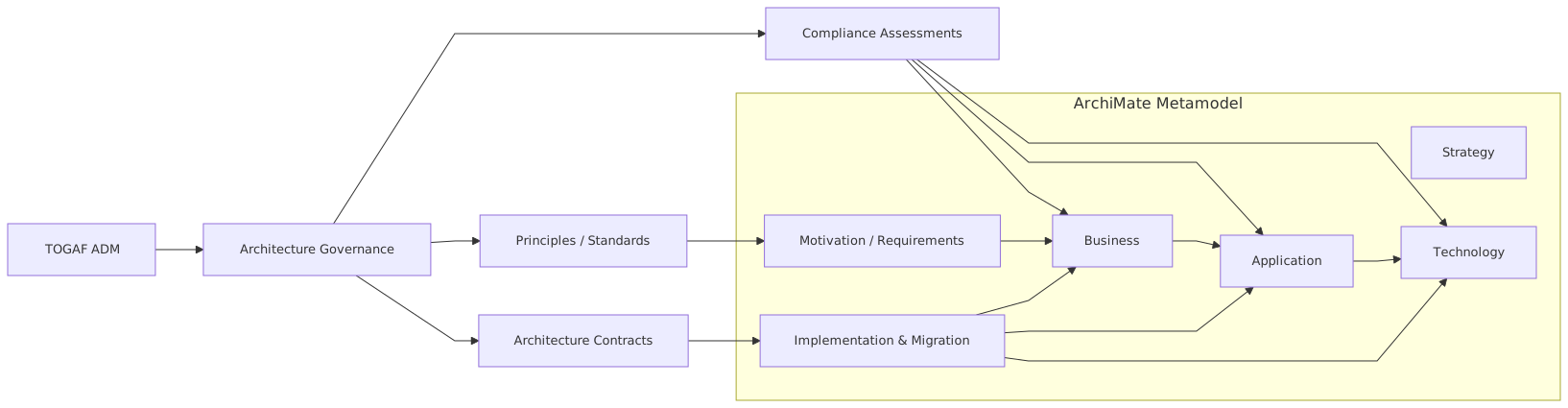
It means you define a set of architectural object types and relationship rules that governance will use as its evidence model. In plain English: if a team wants approval, they don’t just bring a narrative. They bring architecture mapped to the enterprise metamodel.
For example, in a bank you might define these object types as mandatory in governance:
- Business capability
- Business process
- Product / value stream
- Application component
- Application service
- Data object / system of record
- Event / message topic
- IAM role / identity provider / trust relationship
- Technology service
- Cloud platform / landing zone / network boundary
- Control / policy / standard
- Risk / regulatory obligation
Now governance can ask structured questions:
- Which capability is changing?
- Which application service is impacted?
- Which Kafka topics are introduced or altered?
- Which customer data objects cross trust boundaries?
- Which IAM control pattern is used?
- Which cloud tenancy and network zone are involved?
- Which standards are realized?
- What risks and obligations are affected?
That is not bureaucratic for the sake of it. That is how you stop architecture reviews from becoming subjective.
The metamodel is not a repository schema. It’s a decision model.
This is one of the biggest mistakes architects make. They think the metamodel exists to populate an EA tool. So they spend a year arguing about attributes, IDs, naming standards, synchronization jobs, and dashboard colors. The repository gets heavier. Governance gets weaker.
The metamodel is not primarily a data administration exercise. It is a decision model.
Its purpose is to support decisions such as:
- approve or reject a new platform service
- allow or prohibit direct database access
- determine whether a Kafka topic is enterprise, domain, or application scoped
- decide if a cloud-native IAM pattern complies with enterprise trust policy
- identify when an application duplicates an existing capability
- determine whether a project is changing a business process, just replacing technology, or both
If your metamodel cannot support decisions like that, it is too abstract or too bloated.
This is where I’ll be slightly contrarian: a lot of enterprise architecture teams over-model because they are insecure about under-governing. They create huge taxonomies, every relationship type imaginable, and a repository nobody can explain. That’s not rigor. That’s avoidance.
A good metamodel is opinionated. It forces useful simplification.
A simple practical structure
If you’re trying to operationalize this in a real enterprise, especially one with banking, cloud, Kafka, and IAM complexity, start with a simple layered structure.
This is enough to make governance real. Not perfect. Real.
A banking example: where this becomes painfully practical
Let’s take a realistic case.
A retail bank wants to modernize customer onboarding. The current flow is fragmented across branch systems, a web application, a document management platform, and a core banking package. The target is event-driven onboarding using Kafka, cloud-hosted digital channels, and centralized IAM with stronger customer and workforce identity separation.
Sounds familiar, because every bank has some version of this mess.
The proposal from delivery teams often looks like this:
- expose onboarding APIs in the digital channel platform
- publish customer events to Kafka
- consume events in AML screening and account origination services
- integrate with enterprise IAM for staff access
- use cloud-native identity for service-to-service auth
- store onboarding documents in cloud object storage
- sync selected customer data to core banking
At the project level, this looks modern and sensible. But governance needs to answer harder questions:
- Is Kafka the right integration mechanism for every step, or are some interactions still transactional and synchronous?
- Which customer data object is authoritative at each stage?
- Is the onboarding event schema enterprise-governed or product-team local?
- Does the cloud IAM pattern align with enterprise trust and segregation requirements?
- Are we creating another customer profile outside the master data model?
- Which business capability is actually being improved: customer acquisition, KYC, account opening, or case management?
- Does the architecture reduce complexity, or just move it into event choreography?
Without a metamodel, those questions get answered informally. With one, you can trace the proposal.
What the metamodel would show
At the strategy and business levels:
- Capability: Customer Onboarding
- Capability: Identity and Access Management
- Process: Retail Customer Account Opening
- Policy: KYC and AML compliance obligations
- Outcome: Reduce onboarding time by 40%, improve straight-through processing
At the application level:
- Application component: Digital Onboarding Portal
- Application service: Customer Application Submission
- Application component: Kafka Event Platform
- Application service: Customer Onboarding Event Distribution
- Application component: AML Screening Service
- Application component: Core Banking Origination Adapter
- Application component: Document Management Service
At the data level:
- Data object: Customer Application
- Data object: Customer Profile
- Data object: KYC Verification Result
- Data object: Account Opening Request
- Data classification: PII / regulated financial data
At the security level:
- IAM pattern: Workforce SSO via enterprise IdP
- IAM pattern: Customer CIAM federation
- IAM pattern: Service-to-service auth via workload identity
- Control: Segregation of duties
- Control: Least privilege
- Control: Audit trail for regulated decisions
At the technology level:
- Cloud landing zone: Regulated workloads
- Kafka cluster: Enterprise managed event streaming platform
- Runtime: Kubernetes platform
- Network boundary: private integration zone
- Storage service: encrypted object store
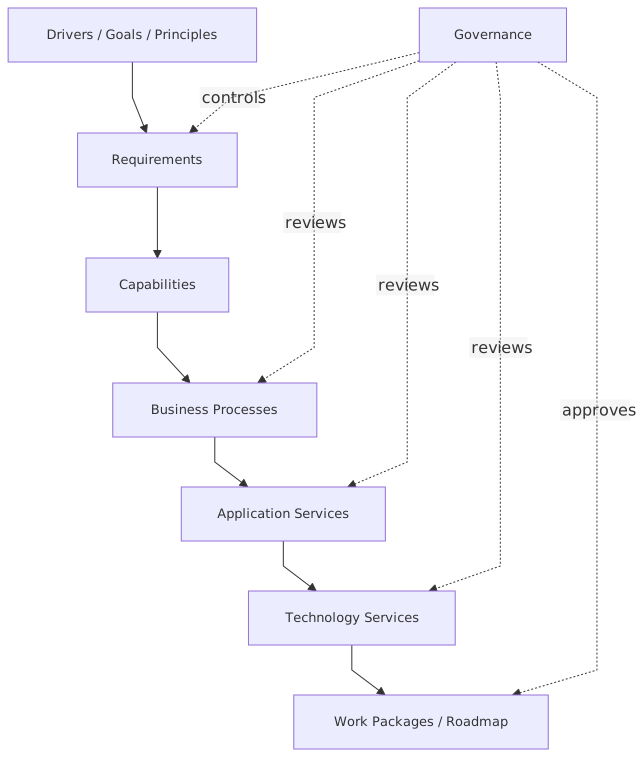
Now governance can review relationships, not just components:
- The onboarding process uses the submission service.
- The submission service realizes the customer application handling needed by the capability.
- The Kafka platform serves multiple application components, but the customer profile data object is still owned by the customer master domain.
- IAM controls constrain the service interfaces and operational roles.
- Cloud platform services host the workloads within a regulated zone.
- AML screening accesses KYC-relevant data objects under policy constraints.
This gives governance something much better than a solution diagram. It gives them traceability.
Why this matters in real architecture work
Because architecture in the real world is mostly about saying “no,” “not yet,” or “yes, but under conditions.” And you can’t do that well if your models are inconsistent.
Here’s how this applies in day-to-day enterprise architecture work.
1. Standards become enforceable
Most standards are written as prose. “Use enterprise Kafka for asynchronous integration.” Fine. But what counts as asynchronous integration? What is enterprise Kafka versus product Kafka? What’s the boundary between domain events and integration events?
If your metamodel includes application services, event topics, platform services, ownership, and interface relationships, then standards can bind to those objects. Governance can detect when a team is introducing unmanaged topics, duplicating platform capabilities, or bypassing approved IAM patterns.
That is a massive improvement over checklist compliance.
2. Impact analysis stops being guesswork
A change to IAM in a bank is never “just security.” It affects workforce access, service trust, auditability, customer experience, and often cloud deployment design.
When IAM patterns are explicit in the metamodel, you can trace:
- which applications rely on a given identity provider
- which cloud workloads trust it
- which APIs depend on token claims
- which regulated processes require stronger controls
That turns impact analysis from tribal knowledge into actual architecture work.
3. Project governance connects to enterprise strategy
One of the most common complaints from delivery teams is that enterprise architecture feels detached from delivery reality. They’re often right. A lot of architecture governance focuses on standards and ignores outcomes.
A metamodel fixes some of that by linking project design to capabilities, value streams, and outcomes. It becomes easier to show whether a proposed cloud migration actually improves resilience for a critical banking process, or just rehosts the same operational mess in a more expensive place.
4. Exceptions become visible debt
Architecture exceptions are not inherently bad. Some are necessary. The problem is hidden exceptions.
When the metamodel captures standards, controls, and deviations, you can model an exception as a first-class governance object. That means you can trace what it affects, who approved it, and when it should expire.
This is especially useful with cloud and Kafka. Enterprises accumulate “temporary” event topics, IAM shortcuts, and bespoke network rules that become permanent because nobody models them as debt.
Common mistakes architects make
Let’s be honest. The tools and standards are not the main reason this goes wrong. Architects are.
Mistake 1: treating ArchiMate like a drawing notation
A lot of architects use ArchiMate as if it were Visio with fancier icons. They create nice diagrams, but they don’t care about semantic consistency. Elements are used differently in every view. Relationships are chosen for visual convenience. The model says very little. ArchiMate tutorial
If you do that, governance gets no benefit. ArchiMate only becomes useful when the model behind the view is disciplined.
Mistake 2: treating TOGAF like a mandatory sequence
TOGAF is often applied as if the enterprise must march through all phases in textbook order before anything useful happens. That’s nonsense in modern delivery environments.
Use TOGAF as a governance and capability frame, not as a bureaucratic script. In practice, architecture work is iterative, partial, and driven by change demand. The metamodel gives continuity even when the process is messy.
Mistake 3: over-modeling technology and under-modeling business
Architects love infrastructure because it feels precise. Kafka clusters, cloud accounts, IAM providers, Kubernetes namespaces — all easy to talk about. Business capability ownership, policy constraints, and process accountability are harder. So they get skipped.
Then governance becomes technical review, not enterprise governance.
If your metamodel is 80% technology and 20% business, you are not governing architecture. You are governing platforms.
Mistake 4: confusing ownership with implementation
In many enterprises, the team that builds something claims to own it. That’s not always true.
A product team may implement a Kafka topic, but the data carried in it may belong to an enterprise domain. A cloud squad may host an IAM service, but identity policy ownership may sit with security governance. A core banking team may expose customer data, but the business owner may be elsewhere.
Your metamodel must distinguish implementation responsibility, service ownership, and information ownership. If not, governance arguments become political very quickly.
Mistake 5: building a metamodel nobody can use
This one is common in large banks. The architecture office designs a beautiful enterprise metamodel with dozens of object types and relationship rules. Delivery teams hate it. Solution architects bypass it. Governance boards complain about missing data. Everyone loses.
The metamodel has to be usable under delivery pressure. If a project can’t map its architecture in a few hours, you’ve made it too heavy.
Contrarian view: not every relationship deserves governance attention
Architecture people love traceability. I do too. But let’s not pretend every trace is valuable.
You do not need governance review on every single relationship in the model. That creates paralysis. What you need is to identify the relationships that are decision-relevant.
For example, in a regulated bank, these relationships usually matter a lot:
- business capability to application service
- application service to data object
- data object to classification and ownership
- application component to IAM pattern
- workload to cloud platform boundary
- event/topic to ownership and schema control
- control/policy to process or service
These often matter less at governance level:
- low-level internal component composition
- every runtime artifact
- every deployment unit
- every non-material interaction between internal services
A metamodel should support detail, yes. But governance should focus on architectural significance, not model completeness.
That’s an important distinction. Many architecture teams forget it.
How to operationalize this without drowning in theory
Here’s a practical approach that works better than grand framework launches.
Step 1: define your governance questions first
Before you define your metamodel, list the recurring governance decisions your enterprise struggles with.
Examples:
- When can a team create a new Kafka topic versus reuse an existing one?
- When is direct access to customer data allowed?
- Which IAM patterns are approved for workforce, customer, and workload identity?
- Which cloud services are approved for regulated workloads?
- How do we detect duplicate application services across domains?
Those questions should shape the metamodel, not the other way around.
Step 2: define a minimum viable metamodel
Start with 12–20 object types max. Add only what supports actual decisions. Resist the temptation to model the universe.
For a bank modernizing to cloud and event-driven integration, I’d start with:
- capability
- process
- application component
- application service
- data object
- event/topic
- platform service
- IAM pattern
- control
- policy/standard
- owner
- risk/obligation
That is enough to govern a lot.
Step 3: create opinionated mapping rules
Don’t just say “use ArchiMate.” Define how your enterprise uses it.
For example:
- Kafka is modeled as a technology or platform service, not as an application component, unless a domain-specific event product is being governed.
- Event topics are modeled as application-level interaction or event objects with explicit ownership and schema lifecycle.
- IAM is represented across business, application, and technology layers depending on what is being governed: policy, service, or platform.
- Cloud landing zones are technology structures with attached controls and regulatory constraints.
These conventions matter more than syntax purity.
Step 4: tie governance artifacts to metamodel objects
Architecture principles, standards, risk controls, and exceptions should be linked to the model. That way, a review is not “does this feel aligned?” It is “which standards and controls constrain these components and relationships?”
This is how governance becomes less personal.
Step 5: use views for audiences, not separate truths
Executives, risk teams, platform engineers, and solution architects need different views. Fine. But they should come from the same underlying model.
One of the worst habits in enterprise architecture is maintaining separate diagram universes for each audience. That destroys consistency. Different views are good. Different truths are not.
What a mature governance model looks like
In a mature setup, governance is not a board that reads documents. It is a capability supported by a metamodel and a small set of high-value controls.
For example, in the banking onboarding case:
- A project submits a proposed architecture mapped to capability, process, application services, data objects, IAM patterns, and cloud boundaries.
- Automated checks validate naming, ownership, standard platform usage, and whether regulated data crosses prohibited zones.
- Architects review only the meaningful issues: duplicate services, unclear data ownership, non-standard IAM trust, risky Kafka event design.
- Exceptions are modeled, approved with expiry, and tracked as debt.
- Changes to enterprise standards update the governance rules tied to the metamodel, not just a PDF on SharePoint.
That is what people mean when they say architecture should be “living” and “actionable.” Usually they say it vaguely. This is the concrete version.
Where ArchiMate helps more than people admit
Some architects dismiss ArchiMate because they think it’s too formal or too disconnected from agile delivery. I think that criticism is often lazy.
ArchiMate helps because it forces distinctions that enterprises usually blur:
- behavior versus structure
- service versus component
- business actor versus application component
- data object versus technology artifact
- strategy intent versus implementation realization
Those distinctions are exactly what governance needs.
And no, you do not need to model every sprint artifact in ArchiMate. That’s another straw man. You need enough model discipline to support enterprise decisions. That’s very different.
Where TOGAF helps more than its critics admit
TOGAF gets mocked because it’s often implemented badly. Fair. But the answer is not to abandon it. The answer is to stop using it as a ceremony engine.
TOGAF is useful because it reminds enterprises that architecture is a governed capability, not just a set of diagrams. It gives you concepts for governance, repository thinking, building blocks, and transition management. Those are still relevant, especially in large regulated organizations.
The trick is to use TOGAF lightly and deliberately. Bring the governance structure. Don’t bring the dead weight.
Final thought: governance should reduce ambiguity, not create it
That’s the standard I use.
If your use of TOGAF and ArchiMate creates more ambiguity, more documentation theater, more disconnected diagrams, and more review meetings without clearer decisions, then stop. You are doing framework cosplay. ArchiMate in TOGAF ADM
But if you use the metamodel to define what matters, how it relates, and how governance decisions are made, then architecture becomes much more than documentation. It becomes operational control over enterprise change.
And in a world of cloud fragmentation, Kafka sprawl, IAM complexity, and banking regulation, that control is not optional.
It’s the job.
FAQ
1. What is the difference between TOGAF and ArchiMate in simple terms?
TOGAF is an enterprise architecture framework. It helps organize architecture work, governance, and change. ArchiMate is a modeling language. It helps represent architecture in a consistent way. TOGAF gives the governance frame; ArchiMate gives the formal expression.
2. What does “formalizing governance through the metamodel” mean?
It means defining the core architecture objects and relationships your enterprise will use to evaluate change. Instead of reviewing documents subjectively, governance reviews architectures mapped to a shared model: capabilities, services, data, controls, platforms, ownership, and so on.
3. How does this help with Kafka, IAM, and cloud governance?
It makes those things visible in relation to business and risk. You can trace which application services use Kafka topics, which data objects move through them, which IAM patterns secure them, and which cloud boundaries host them. That supports enforceable standards and clearer impact analysis.
4. What is the most common mistake when using ArchiMate for governance?
Using it as a diagramming style instead of a semantic model. If teams create pretty pictures without consistent object definitions and relationship rules, governance gets no real value. The model has to mean something, not just look structured.
5. Do you need a full enterprise repository before this works?
No. In fact, waiting for a perfect repository is a mistake. Start with a minimum viable metamodel tied to your real governance questions. Model only what supports decisions. Grow from there. The goal is better governance, not a bigger tool implementation.
Frequently Asked Questions
What is the ArchiMate metamodel?
The ArchiMate metamodel formally defines all element types (Business Process, Application Component, Technology Node, etc.), relationship types (Serving, Realisation, Assignment, etc.), and the rules about which elements and relationships are valid in which layers. It is the structural foundation that makes ArchiMate a formal language rather than just a drawing convention.
How does the ArchiMate metamodel support enterprise governance?
By defining precisely what each element type means and what relationships are permitted, the ArchiMate metamodel enables consistent modeling across teams. It allows automated validation, impact analysis, and traceability — turning architecture models into a queryable knowledge base rather than a collection of individual diagrams.
What is the difference between using ArchiMate as notation vs as an ontology?
Using ArchiMate as notation means drawing diagrams with its symbols. Using it as an ontology means making formal assertions about what exists and how things relate — leveraging the metamodel's semantic precision to enable reasoning, querying, and consistency checking across the enterprise model.