⏱ 24 min read
ArchiMate Capability Map Example: Practical Guide for Enterprise Architects
Explore an ArchiMate capability map example with practical guidance for modeling business capabilities, aligning strategy, and improving enterprise architecture communication. ArchiMate tutorial for enterprise architects
ArchiMate capability map example, ArchiMate capability mapping, capability map ArchiMate, ArchiMate business capabilities, enterprise architecture capability map, ArchiMate example, business capability model, enterprise architecture modeling, ArchiMate tutorial, capability-based planning ArchiMate layers explained
Introduction
A capability map is one of the most durable business views in enterprise architecture. In ArchiMate, a Capability represents what an organization is able to do, independent of the processes, applications, teams, or technologies used to deliver it. That separation is important. Operating models, platforms, and organization charts can change quickly; core business abilities usually do not. Capability mapping therefore gives architects a stable layer between strategy and implementation.
That stability is useful because business and technology stakeholders rarely describe the enterprise in the same terms. Executives speak about growth, resilience, customer experience, compliance, and efficiency. Delivery teams talk about systems, projects, releases, and roadmaps. A capability map provides a common frame. It describes the enterprise in terms of business abilities that leaders recognize and architects can connect to value streams, processes, applications, data, and technology. In practice, it becomes a reference point for transformation planning, portfolio decisions, and investment discussions.
A capability map is not just a classification diagram. Once capabilities are defined and organized, they can be assessed for strategic importance, maturity, cost, risk, performance gaps, or degree of automation. Those overlays turn a static model into a decision tool. A capability may be strategically critical while still depending on fragmented applications, poor-quality data, or manual workarounds. The map makes that mismatch visible in business terms. For example, an architecture board may approve funding to standardize Customer Onboarding after seeing that it is rated high in strategic importance but low in maturity across several regions.
Capability mapping also improves how organizations define scope. Programs often start with a department, a platform, or a project boundary. That can reinforce silos. Capabilities cut across those boundaries. A capability such as customer onboarding, pricing management, or regulatory reporting may involve multiple business units, channels, and technologies. Framing change at the capability level encourages a broader, outcome-focused view of transformation.
In ArchiMate, the capability map also works as a layering mechanism. At a high level, it provides an executive view of the business. At lower levels, it can be decomposed and linked to supporting architecture elements. The same model can therefore serve different audiences without losing coherence. Leaders can focus on strategic gaps; architects and domain teams can trace those gaps into operational and technical impacts. ArchiMate relationship types
This article explains what a capability map is in ArchiMate, why it matters, how its structure should be designed, and how to build one step by step. It also uses a practical example to show how capability maps support interpretation, analysis, and governance. The central idea is straightforward: a capability map gives the enterprise a stable way to describe what it must be able to do and a practical basis for guiding change. ArchiMate modeling best practices
What a Capability Map Is in ArchiMate
In ArchiMate, a capability map is a structured representation of the business capabilities an enterprise has, or needs, to realize its strategy. The core concept is the Capability element, defined as an ability that an active structure element, such as an organization or business unit, possesses. The emphasis is on the ability itself, not on its current implementation.
That point is easy to state and surprisingly easy to lose in practice. A capability map describes what the enterprise must be able to do, not how work happens today. That is why capability maps remain useful when processes are redesigned, systems are replaced, or reporting lines are reorganized.
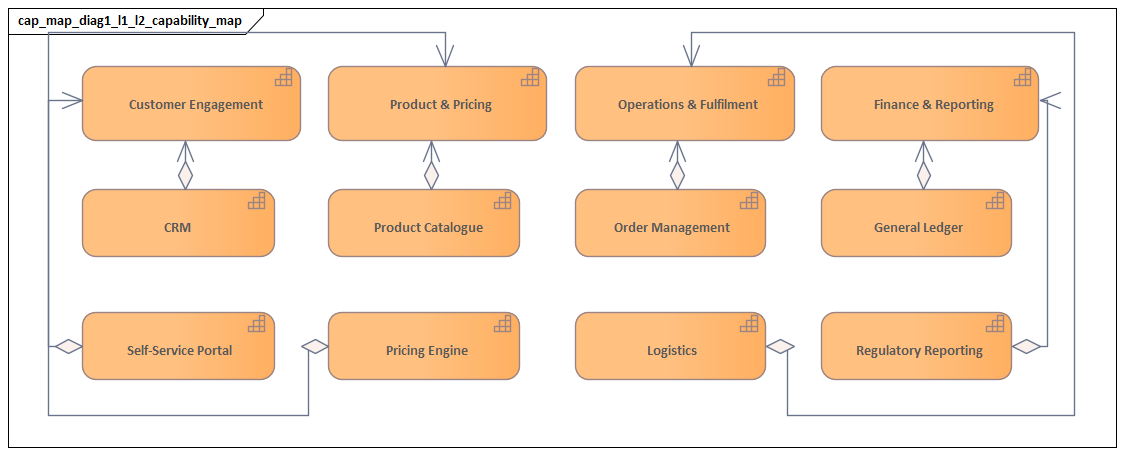
Most capability maps are hierarchical. At the top level are broad enterprise abilities such as customer management, product management, operations, finance, or risk management. These can then be decomposed into more specific capabilities such as customer onboarding, pricing management, service resolution, or regulatory reporting. The hierarchy matters because it controls abstraction. If the map is too abstract, it becomes generic and hard to use. If it goes too deep, it starts to resemble a process model or an application inventory.
A capability map is also not a workflow diagram. A process shows how work is performed through ordered activities. A capability expresses the organization’s ability to achieve a result. Order fulfillment as a process may differ by region, channel, or sourcing model; the capability to fulfill orders remains a stable business need. Keeping that distinction clear is one of the disciplines that makes a capability map durable.
Its value increases when it is connected to the wider architecture model. In ArchiMate, capabilities can be related to outcomes to show why they matter, value streams to show where they contribute to stakeholder value, and resources or supporting structures to show what enables them. These links let architects move from strategic discussion to traceable architecture analysis without jumping immediately into projects or solutions. For instance, an IAM modernization initiative can be traced to Identity and Access Management, Customer Onboarding, and Compliance Management, making clear that the change supports both user experience and control objectives.
A well-formed capability map also creates a basis for ownership and assessment. Capabilities can be assigned business owners, grouped into domains, and evaluated for maturity or strategic importance. At that point, the map is no longer just a conceptual artifact. It becomes a management instrument for discussing where the enterprise is strong, where it is weak, and where architecture effort should be focused.
Why Capability Mapping Matters in Enterprise Architecture
Capability mapping matters because it organizes change around enduring business need rather than temporary delivery constructs. Most enterprises describe themselves through departments, products, systems, or projects. Those views are useful, but they are unstable and often siloed. A capability map offers a more neutral planning structure by asking three practical questions: what business ability do we need, how strong is it, and where should we invest?
That is what makes capability maps effective between strategy and execution. Strategy is usually expressed in broad ambitions: improve customer experience, reduce cost-to-serve, increase resilience, strengthen compliance. Those ambitions are too general to guide architecture choices directly. Capability mapping translates them into business abilities that can be assessed and improved. If customer experience is strategic, the discussion can move into capabilities such as customer insight, onboarding, interaction management, and service resolution.
Capability maps also expose imbalance across the enterprise. Investment does not always align with strategic importance. Some capabilities receive disproportionate attention because they are historically visible or tied to large systems. Others remain weak even though they are central to future performance. By overlaying strategic importance, maturity, cost, risk, or technical debt onto the capability map, architects can show where the enterprise is over-supported, under-supported, or fragile.
This becomes particularly useful in portfolio planning. Project portfolios are often assembled incrementally, with each initiative justified on its own merits. A capability-based view makes it easier to see whether those initiatives collectively strengthen the right parts of the business. It may reveal that several projects target the same capability, that a strategically important capability has little investment, or that technology modernization is proceeding without a clear business outcome. In one realistic scenario, three teams may independently propose event-driven integration work. A capability review shows that all three efforts support Event Processing and Order Fulfillment, allowing the architecture board to consolidate them around a shared Kafka platform instead of funding three separate patterns.
Capability mapping also sharpens transformation scope. Programs framed around a single department or system often miss cross-functional dependencies. Programs framed too broadly become difficult to govern. Capabilities provide a useful middle ground: meaningful to the business, structured enough for analysis, and stable enough for sequencing.
It also strengthens accountability. Once capabilities are explicit, organizations can assign ownership, define target maturity, and track improvement over time. Governance then has a firmer basis than reviewing solution designs in isolation. Instead of asking only whether a project is on budget or technically sound, leaders can ask whether it improves a target capability and whether that improvement supports enterprise priorities.
For that reason, capability mapping is not just a modeling technique. It is a practical mechanism for aligning strategy, investment, and governance around a shared view of what the enterprise must do well.
Core Elements of an ArchiMate Capability Map
Once the purpose is clear, the next question is structural: what makes a capability map useful rather than merely presentable? A good map is more than a set of boxes labeled as capabilities. It relies on several elements that make it coherent, analyzable, and maintainable.
1. Capability hierarchy
The first element is the hierarchy itself. Capabilities should be organized from broad to specific in a way that reflects how the enterprise understands its business abilities. A top-level map usually contains a manageable set of enterprise capabilities, while lower levels add decomposition where precision is needed.
The hierarchy also has to sit at the right level of abstraction. If top-level capabilities are too vague, they do not help with prioritization. If lower-level capabilities become too detailed, the map starts drifting into process modeling. The purpose of the hierarchy is to support useful conversations at different levels of the organization.
2. Clear capability definitions
Each capability should have a clear name, a concise description, and an agreed scope. In many cases, this matters more than the diagram itself. Weak definitions create confusion quickly, especially where terms overlap. A good capability definition is outcome-oriented and stable. It should describe what the enterprise must be able to do, not who performs the work or which system supports it.
For example, Pricing Management is a capability if defined as the ability to establish, maintain, and govern prices across products and channels. It stops being a capability if it is described as “the pricing team’s monthly rate-setting process in SAP.” The first is stable; the second is an implementation detail.
3. Domain grouping
Capabilities are often grouped into domains such as customer, product, operations, finance, risk, or corporate services. These groupings improve readability and support ownership. In large organizations, domain grouping becomes essential because a flat list of capabilities is hard to navigate and harder to govern.
The grouping does not need to impose an artificial structure, but it should help stakeholders orient themselves. That becomes particularly valuable during portfolio reviews or federated architecture governance, where different teams need to understand where a capability sits and who is responsible for its evolution.
4. Relationships to other architecture elements
A capability map becomes far more useful when connected to other ArchiMate elements. Capabilities can be linked to outcomes, value streams, resources, organizational structures, and courses of action. These relationships allow the architect to answer not only what the business must be able to do, but also why it matters, what enables it, and what change is planned.
Those links are what turn a capability map from a workshop artifact into part of an enterprise architecture repository. They do not all need to appear in one diagram, but they should exist in the model. A capability that cannot be connected to strategic intent or operational support is often either too vague or poorly defined.
5. Assessment overlays
The base map shows structure. The analytical value comes from overlays such as maturity, strategic importance, pain points, risk exposure, cost, or investment focus. These overlays need to be applied with restraint. Too many colors, symbols, and scoring methods make the map harder to read and easier to ignore.
A better approach is to create several focused views of the same map, each answering a specific question for a specific audience. One view might show strategic importance; another might show application fragmentation; a third might highlight technologies approaching end of life. The structure remains stable while the analytical lens changes.
6. Ownership and maintenance
Finally, an effective capability map requires governance. Someone must decide who can add or change capabilities, how decomposition is approved, how assessments are refreshed, and how the map is used in planning cycles. Without maintenance rules, capability maps either become outdated or multiply into competing versions.
A simple example is technology lifecycle governance. If a messaging product is marked for retirement in 18 months, the affected capabilities can be reviewed to decide whether to migrate, tolerate, or invest. That kind of traceability is only possible if the map is governed as a living asset rather than a one-time deliverable.
Together, these six elements provide the foundation for the example and method discussed in the next sections.
ArchiMate Capability Map Example: Structure and Interpretation
A capability map example is most useful when treated as a planning and diagnostic view rather than a decorative grid. Consider a typical enterprise map with top-level capabilities such as:
- Customer Management
- Product and Service Management
- Operations Management
- Partner Management
- Finance Management
- Risk and Compliance Management
- Enterprise Support
Each of these can then be decomposed into more specific capabilities. For example:
Customer Management
- Customer Insight
- Customer Onboarding
- Account Administration
- Customer Support
- Interaction Management
Product and Service Management
- Product Design
- Pricing Management
- Portfolio Management
- Service Configuration
Operations Management
- Order Fulfillment
- Service Delivery
- Exception Handling
- Performance Monitoring
- Event Processing
This example illustrates the core principle: the map describes business abilities, not workflows or systems. Customer Onboarding is a capability because it expresses the enterprise’s ability to onboard customers. The onboarding process, channels, controls, and applications may vary by market or product line.
How to interpret the structure
Interpretation begins with the hierarchy. A top-level capability should be broad enough to remain stable, while lower-level capabilities should be specific enough to support ownership, assessment, or investment decisions. If stakeholders say customer experience is weak, the map helps determine whether the problem sits in customer insight, onboarding, support, or interaction management. That distinction matters because each area may require a different response.
The structure can also reveal imbalance. If the customer domain is highly decomposed while supplier or regulatory capabilities remain vague, the map may be reflecting current organizational attention rather than actual enterprise need. This is a useful review technique: the shape of the map often shows where the organization has clarity, where it has blind spots, and where more discovery is required.
A retail bank, for example, may have detailed decomposition for digital sales capabilities but only a thin treatment of Regulatory Reporting and Records Retention. That usually signals more than a modeling gap. It often points to weak ownership, fragmented controls, or limited architectural visibility in governance-heavy areas.
Core, enabling, and governing capabilities
A strong example also distinguishes between the different roles capabilities play:
- Core capabilities directly create external value, such as product design or service delivery.
- Enabling capabilities support the core, such as workforce management, data management, identity and access management, or technology support.
- Governing capabilities protect enterprise integrity, such as compliance oversight, audit management, policy management, or technology lifecycle governance.
This distinction helps stakeholders avoid treating every capability as strategic in the same way. Some capabilities differentiate the enterprise in the market. Others need to be reliable, compliant, and efficient but are not sources of competitive advantage.
In a healthcare provider, Care Coordination may be a core capability, Master Data Management an enabling capability, and Privacy Compliance Management a governing capability. All three matter, but they are governed differently and improved for different reasons.
Adding analytical overlays
The example becomes more useful when overlays are applied. Suppose the enterprise marks strategic importance and current maturity on the map:
- Customer Insight: high importance, low maturity
- Customer Onboarding: high importance, medium maturity
- Pricing Management: high importance, low maturity
- Regulatory Reporting: high importance, high risk
- Identity and Access Management: high importance, low maturity
- Workforce Administration: medium importance, adequate maturity
That immediately creates a planning view. It highlights where strategic ambition and current strength are out of line. This is where capability mapping becomes a decision-support tool. If identity controls are fragmented across channels, for instance, the architecture board may prioritize IAM modernization because the issue affects both onboarding experience and audit performance.
A second overlay might focus on application fragmentation. Pricing Management could be supported by one pricing engine in e-commerce, another in wholesale, and spreadsheets in regional operations. The capability itself is singular; the implementation is not. That contrast often provides the business case for standardization.
Connecting the example to the broader model
The example becomes stronger when capabilities are linked to outcomes, value streams, and enabling resources:
- Outcome: improved customer retention
- Value stream stage: customer acquisition and service
- Capability: customer insight
- Enablers: customer data platform, analytics team, governance rules
Or:
- Outcome: faster order visibility
- Value stream stage: fulfillment
- Capability: event processing
- Enablers: Kafka platform, event schema standards, integration team
A third example might look like this:
- Outcome: reduced audit findings
- Value stream stage: policy execution and control
- Capability: identity and access management
- Enablers: centralized directory, privileged access tooling, control library
That traceability allows architects to move from strategic outcomes to capability gaps and then into supporting architecture concerns. It is what makes the capability map useful in transformation planning rather than merely descriptive.
How to Create a Capability Map in ArchiMate Step by Step
The example above shows what a useful map looks like. The next question is how to create one in a disciplined way. The method below builds on the ideas already covered: stable business abilities, a clear hierarchy, relationships to other architecture elements, and focused analytical use.
Step 1: Define the purpose and audience
Start by clarifying why the map is being created. Is it for strategic planning, portfolio management, application rationalization, transformation scoping, merger integration, or regulatory remediation? The answer shapes the required level of detail and the overlays that will later be applied.
Also define the audience. Executives typically need a concise enterprise view. Domain architects may need deeper decomposition in selected areas. Trying to satisfy every audience with a single level of detail usually produces a map that serves none of them well.
Step 2: Set the scope
Decide what part of the enterprise the map covers: the whole organization, a business unit, a value chain, or a transformation domain. Scope control is essential. Without it, the map becomes bloated, inconsistent, and difficult to govern.
A practical way to set scope is to anchor it in strategy documents, operating model descriptions, and major value streams. That keeps the map tied to business context rather than turning it into a generic template.
Step 3: Identify candidate capabilities
Derive capabilities from multiple sources:
- strategic objectives
- business services
- value streams
- policy and regulatory obligations
- business unit charters
- process landscapes
Workshops with business leaders and domain specialists are particularly valuable because they reveal the language the organization naturally uses. At this stage, keep applying the basic rule: capabilities should describe enduring business abilities, not departments, systems, or current projects.
One practical test is substitution. If the phrase still makes sense after a reorganization or platform replacement, it is probably a capability. Claims Assessment survives both. Claims team workflow in Guidewire does not.
Step 4: Organize the hierarchy
Group capabilities into domains and decompose broad capabilities into more specific ones. Use the hierarchy to support meaningful decisions. If a capability is too broad to assess or too narrow to govern, it is probably at the wrong level.
This is also the point to remove overlaps, duplicates, and inconsistent naming. Those issues become much harder to fix once the map is published and embedded in governance.
Step 5: Define each capability
Create a short definition for each capability. Include the intended outcome, scope, and, where useful, indicative ownership. This step often exposes hidden disagreement. Two groups may use the same term but mean different things. Resolving that early improves model quality and later governance.
A good definition is brief but specific. For example, Exception Handling might be defined as “the ability to identify, route, resolve, and learn from operational exceptions across service and fulfillment processes.” That is clearer and more stable than a description tied to one ticketing tool or support team.
Step 6: Relate capabilities to the broader ArchiMate model
Once the structure is stable, connect capabilities to relevant outcomes, value streams, resources, organizational elements, and courses of action. This is what turns the map into an enterprise architecture asset rather than a workshop output.
Not every relationship needs to be shown in one diagram. What matters is that the repository supports traceability. If a roadmap initiative claims to improve resilience, it should be possible to trace that claim to the capabilities affected, the value streams supported, and the enabling changes required.
Step 7: Apply focused assessments
Add overlays only for the questions the map is meant to answer. Common overlays include:
- strategic importance
- current maturity
- cost
- risk exposure
- technical debt
- investment focus
Keep the views focused. One map showing everything is usually less useful than several maps showing one thing clearly.
For example, an application rationalization exercise may overlay duplicate systems by capability, while a transformation steering committee may look at strategic importance versus maturity. The structure stays the same; the management question changes.
Step 8: Validate with stakeholders
Review the map with business and architecture stakeholders. Test it against real questions:
- Can current strategic priorities be located on the map?
- Can major pain points be expressed as capability issues?
- Can initiatives be traced to capabilities?
- Does the hierarchy make sense to both business and architecture teams?
If the answer is no, revise the structure before formalizing it. Validation is less about diagram aesthetics than decision usefulness.
Step 9: Publish and govern
Finally, establish maintenance rules. Define who approves changes, how often assessments are refreshed, and how the map is used in planning and governance cycles. A capability map becomes valuable when it is reused in portfolio, roadmap, and investment conversations.
A common practice is to review capability heatmaps quarterly alongside technology lifecycle status. If a critical platform is approaching end of support, the affected capabilities can be assessed for business impact and migration urgency. That keeps the map connected to real decisions.
Common Challenges, Best Practices, and Practical Use Cases
Once a capability map is in use, several recurring challenges tend to appear. Most of them come from drifting away from the principles outlined above.
Common challenges
1. Confusing capabilities with adjacent concepts
Teams often label processes, services, functions, or departments as capabilities because those are the concepts they already use. That weakens the map and makes it unstable. The distinction between “what the enterprise must be able to do” and “how work is performed” has to be maintained consistently.
2. Inconsistent granularity
Some domains become highly detailed because one architect knows them well, while others remain vague. The result is an uneven map that is difficult to compare across the enterprise. A consistent decomposition logic is essential, even if not every domain is modeled to the same depth at the same time.
3. Building the map in isolation from decisions
Many organizations create a capability map once, place it in a slide deck, and rarely use it again. In that case, the map becomes decorative. It should be tied to recurring decisions such as planning, portfolio governance, target-state design, and transformation intake.
4. Overengineering
Trying to capture every relationship, score, and dependency from the start makes the model difficult to maintain. A better approach is iterative: establish the structure first, then add focused overlays for specific decisions.
5. Weak governance
If capability ownership and update rules are unclear, multiple versions of the map emerge and confidence declines. Governance is not an optional extra; it is part of what makes the model useful.
Best practices
Several practices consistently improve capability mapping quality:
- Use stable, outcome-oriented names.
- Keep definitions short and explicit.
- Group capabilities into readable domains.
- Apply decomposition only where it supports real analysis.
- Maintain traceability to outcomes, value streams, and enabling resources.
- Create separate views for different analytical questions.
- Use the map regularly in governance so it remains current and relevant.
These practices are simple, but they are often what separates a durable enterprise asset from a one-off modeling exercise.
Practical use cases
Capability maps are particularly effective in several common architecture scenarios.
Transformation scoping
Capabilities provide a business-centered scope that cuts across organizational silos. Instead of launching disconnected changes in product, sales, and operations, an enterprise can frame work around a capability such as pricing management or customer onboarding.
Application rationalization
Capabilities help identify where multiple systems support the same business ability and whether that duplication is justified. They also help distinguish between fragmentation in strategic capabilities and fragmentation in commodity capabilities.
Investment prioritization
By comparing strategic importance with current capability strength, decision-makers can see where funding should be concentrated. This remains one of the most common and most valuable uses of capability maps.
Post-merger integration
Capabilities provide a neutral structure for comparing two organizations without defaulting immediately to one side’s org chart or application portfolio. They allow architects to ask which business abilities overlap, which differ, and which should become part of the combined target state.
Target-state architecture and roadmapping
Because capabilities are stable, they provide a useful anchor for sequencing change over time. The enterprise can decide which capabilities to strengthen first, which to standardize, and which to maintain as commodity.
A practical merger example illustrates the point. After an acquisition, both companies may have strong Order Fulfillment capabilities but very different enabling stacks. One relies on a modern event backbone; the other depends on batch integration and manual exception handling. The capability map helps the integration team compare business ability separately from implementation and define the target state on that basis.
Used well, the capability map becomes a durable reference for coordinating architecture work across business and technology domains.
Conclusion
An ArchiMate capability map is most valuable when it becomes part of how the enterprise plans and governs change, not just part of how the architecture team documents the business. Its strength lies in providing a stable decision frame that survives reorganizations, platform replacements, and shifting delivery models.
As shown throughout this article, that value depends on a few disciplines. A capability map must describe enduring business abilities rather than processes or systems. It must be structured hierarchically, defined clearly, grouped in a way stakeholders can navigate, and linked to the broader architecture model. It becomes genuinely useful when it supports analysis through focused overlays and when it is maintained as a living asset.
The practical benefits are substantial. Capability maps help translate strategy into actionable business abilities, expose gaps between importance and investment, improve transformation scoping, and strengthen governance. They also provide a common language for executive, business, and technology stakeholders. That is why they are useful in decisions as varied as approving an IAM modernization roadmap, consolidating event architecture on Kafka, or planning the retirement of aging platforms.
The example and step-by-step method in this article show how capability mapping works best: not as a static taxonomy, but as a reusable architecture instrument. Treated that way, the capability map helps the enterprise focus investment, clarify accountability, and guide transformation around a stable view of what the business must be able to do well.
Frequently Asked Questions
What is a capability map in enterprise architecture?
A capability map is a structured view of what a business must be able to do — independent of how it is currently organised or which applications support it. Capabilities are grouped by domain and linked to strategic goals, helping architects prioritise investment and identify gaps.
How do capabilities relate to applications in ArchiMate?
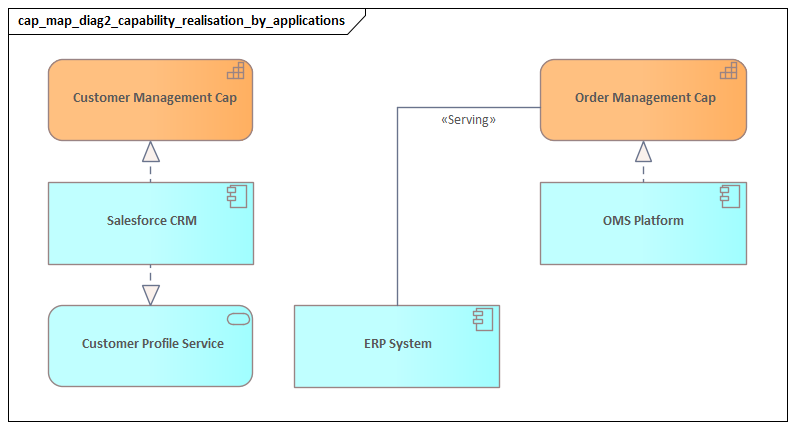
In ArchiMate, Application Components realise Business Capabilities through Realisation relationships. This traceability shows which systems support which capabilities, enabling portfolio analysis, rationalisation decisions, and investment planning linked directly to business outcomes.
What is capability-based planning?
Capability-based planning is a strategic approach where investment decisions are driven by the capabilities the organisation needs to develop or improve, rather than by project requests. It aligns IT investment to business strategy by making the capability gap explicit and measurable.