⏱ 19 min read
Most architecture governance fails for a boring reason: the architecture exists, but nobody can use it when decisions actually need to be made. ArchiMate for governance
That’s the uncomfortable truth.
Enterprises spend money on frameworks, repositories, review boards, standards catalogs, and polished capability maps. Then a delivery team asks a simple question — can we expose customer identity events from IAM into Kafka and process them in cloud analytics without violating policy? — and suddenly the “architecture” collapses into PowerPoint archaeology, tribal knowledge, and somebody’s opinion shouted loudest in a meeting.
This is where ArchiMate can be either incredibly useful or completely useless.
My strong opinion: ArchiMate is not valuable because it helps you draw architecture. It’s valuable because it helps you govern change with traceability. If you’re using it just to make prettier diagrams, you are missing the point. Worse, you’re probably making governance slower.
So let’s be practical.
What ArchiMate is, in simple terms
For the SEO version, and for anyone who has suffered through overcomplicated framework explanations:
ArchiMate is a modeling language for enterprise architecture. It gives you a consistent way to describe business processes, applications, data, technology, security, and their relationships.
That’s it.
It’s not a methodology. It’s not governance by itself. It’s not a magic compliance engine. It’s a language. EA governance checklist
Why does that matter for architecture governance?
Because governance is really about answering a handful of recurring questions:
- What exists today?
- What is changing?
- What does this change impact?
- Which standards, risks, controls, and principles apply?
- Who needs to approve it?
- What is the target state?
- Are we moving toward it or just creating more enterprise noise?
ArchiMate helps structure those answers in a way that is repeatable, connected, and inspectable.
And that last part — connected — is the difference between architecture as theatre and architecture as a working management discipline.
The real governance problem
A lot of governance models still behave like it’s 2008. They assume architecture governance means:
- a review board
- a giant reference architecture
- a standards PDF
- a solution design template
- and a red/amber/green decision at the end
This is not governance. This is a delayed meeting with diagrams.
Real governance happens continuously, inside delivery flow:
- during funding decisions
- during platform selection
- during security review
- during data integration design
- during cloud landing zone onboarding
- during exception handling
- during production incident learning
- during decommissioning
If your architecture descriptions cannot support those moments, they are decorative.
ArchiMate becomes practical when you use it to connect governance decisions to the architecture elements they affect:
- principles to capabilities
- policies to applications
- risks to technology services
- controls to data objects
- standards to platform components
- transformation work packages to target architecture gaps
That’s where the language earns its keep.
ArchiMate for governance: the practical idea
Here is the practical implementation model I’ve seen work:
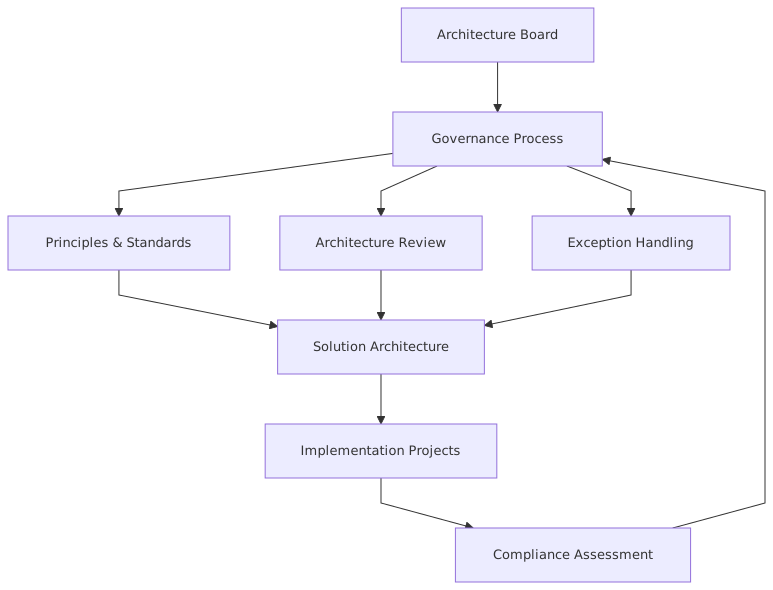
Use ArchiMate as the backbone for decision traceability.
Not as a giant enterprise model of everything. That path leads to repository obesity and despair.
Instead, model just enough to answer governance questions across four levels:
That’s the core pattern.
If you model these layers consistently, governance becomes less subjective. Not perfect. Just less dependent on memory and politics.
And in most enterprises, “less subjective” is a major upgrade.
Why architects struggle with this
Because many architects secretly want one of two bad outcomes.
The first bad outcome: the perfect model.
The second bad outcome: no model at all, just “experienced judgment.”
Both are wrong.
The perfect model never arrives. And “experienced judgment” without visible structure turns governance into personality-driven decision making.
A practical architect accepts that the model will be incomplete, but still useful.
This is the mindset shift:
- Don’t model everything.
- Don’t wait for repository purity.
- Don’t force every team into enterprise meta-model debates.
- Model the decisions that matter, and the relationships needed to govern them.
That is how ArchiMate becomes operational.
What architecture governance actually needs from ArchiMate
In real enterprise work, architecture governance usually needs five things.
1. A common vocabulary
Without a shared language, every review becomes semantic warfare.
One team says “service” and means an API. Another means a business capability. Another means a Kubernetes workload. A security team says “identity service” and means an IAM platform. A cloud team says “service” and means a managed AWS or Azure product.
ArchiMate doesn’t eliminate ambiguity automatically, but it gives you a structure to define terms and relationships. That alone reduces a lot of enterprise nonsense.
2. Cross-layer traceability
This is the most important one.
If a bank wants to stream customer onboarding events through Kafka, governance needs to know:
- which business process produces the event
- which application owns the source data
- what data classification applies
- what IAM controls govern access
- what cloud environment hosts brokers or managed streaming
- what downstream consumers are in scope
- what retention, encryption, and audit requirements apply
Without traceability, every review starts from scratch.
3. A way to express target state and transition
Governance is not just “is this compliant now?” It’s also “is this moving us toward the target operating model?”
ArchiMate’s implementation and migration concepts are underrated here. Most architects barely use them. That’s a mistake.
Plateaus, gaps, work packages, and deliverables are exactly what governance needs to distinguish:
- tactical exception
- strategic investment
- tolerated legacy
- target state alignment
4. A mechanism for standards and constraints
Architecture principles written in a wiki and never tied to anything are basically motivational posters.
Useful governance needs principles and constraints attached to actual architecture elements:
- “Customer identity data must be mastered in IAM-authoritative systems”
- “Event integration for domain-scale streaming must use Kafka-compatible platform services”
- “Production workloads handling regulated banking data must run in approved cloud landing zones”
- “Privileged access must integrate with enterprise IAM and centralized logging”
Those are not abstract statements. They should be linked to applications, interfaces, nodes, data objects, and work packages.
5. Views for different stakeholders
The board does not want your full ArchiMate repository. Nor does the delivery squad. Nor does the CISO.
Governance works when the same underlying model can produce different views:
- executive view: capability impact, risk, investment
- design authority view: application and integration dependencies
- security view: identity flows, trust boundaries, control coverage
- cloud review view: deployment, hosting, resilience, jurisdiction
- delivery view: transition states and implementation impact
If your repository cannot produce audience-specific views, your governance process will fall back to slide decks. It always does.
A real enterprise example: retail banking, Kafka, IAM, and cloud
Let’s make this concrete.

A retail bank wants to modernize customer onboarding and fraud monitoring. Today, onboarding is handled by a monolithic customer platform in the bank’s private data center. IAM is partly centralized but fragmented. Fraud systems receive batch feeds overnight. Cloud adoption is underway, but regulated workloads require approved patterns and identity integration.
The target architecture ambition sounds familiar:
- event-driven onboarding
- near-real-time fraud detection
- centralized identity and access governance
- cloud-based analytics
- reduced point-to-point integrations
Classic enterprise ambition. Also classic enterprise danger.
The change initiative
The bank proposes:
- customer onboarding events published to Kafka
- downstream fraud and analytics services consuming those events
- customer identity lifecycle integrated with enterprise IAM
- selected event processing workloads running in cloud
- access to event topics governed through role-based and policy-based controls
Now, if governance is weak, the review becomes chaotic:
- security asks whether PII is flowing into cloud
- data asks who owns the canonical customer event
- platform asks who runs Kafka and where
- IAM asks whether service identities are governed
- operations asks about replay, retention, and audit
- risk asks if the architecture creates a new critical dependency
- delivery says they need a decision this week
This is where ArchiMate is useful if used properly.
How to model it practically
You do not start by modeling the entire bank.
You start with the change slice.
At the business layer, model:
- Customer Onboarding Process
- Fraud Monitoring Process
- Customer Management Capability
- Identity and Access Management Capability
- Regulatory Compliance Driver
- Faster Fraud Detection Goal
At the application layer, model:
- Onboarding Platform
- IAM Platform
- Kafka Event Platform
- Fraud Detection Service
- Customer Analytics Service
- API Gateway if relevant
- Event Producer and Consumer interfaces
At the data / information perspective, model:
- Customer Identity Record
- Onboarding Event
- Fraud Alert
- Access Policy
- Audit Log
At the technology layer, model:
- Kafka cluster or managed streaming service
- Cloud landing zone
- IAM runtime components
- Encryption/key management service
- Monitoring/logging platform
- Network zones / trust boundaries
At the motivation layer, link:
- Principle: Identity is authoritative and centrally governed
- Requirement: Regulated customer data must use approved cloud controls
- Constraint: Event topics carrying PII require encryption and restricted consumer registration
- Assessment: Current batch fraud feed causes detection delay
- Risk: Event platform creates concentration risk if not resilient
At the implementation layer, model:
- Baseline plateau: batch-based onboarding and fraud handoff
- Target plateau: event-driven onboarding with governed cloud analytics
- Gap: no governed customer event contract
- Gap: service identity lifecycle unmanaged for event consumers
- Work packages: event schema governance, Kafka platform rollout, IAM integration, fraud consumer modernization
Now governance can ask intelligent questions using the model.
What the model reveals
A decent ArchiMate governance model quickly exposes things people usually miss:
- The real bottleneck is not Kafka. It’s event ownership.
Banks love arguing about platforms. But governance often finds the actual issue is ownership of the customer onboarding event and its schema lifecycle.
- IAM is not a supporting detail. It is central to the architecture.
Every producer, consumer, operator, and support process needs identity, authentication, authorization, and audit. Yet teams still bolt IAM on late, as if machine identity and topic access are just implementation details. They are not.
- Cloud approval is not binary.
The question isn’t “can customer data go to cloud?” The real question is: which data objects, under what controls, in which services, with what residency and logging guarantees?
- Fraud detection value depends on end-to-end latency and trust.
If events are delayed, malformed, over-redacted, or unaudited, the business outcome fails even if the technology stack looks modern.
This is exactly what architecture governance should surface early.
What this looks like in actual governance meetings
A lot of articles stop at “create views.” Fine. But what happens in the real room?
In a practical architecture governance forum, you use ArchiMate views to answer decision questions. ArchiMate modeling guide
For the banking example, a review might run like this:
View 1: Business-to-application traceability
Shows:
- Customer Onboarding Process
- Fraud Monitoring Process
- supporting applications
- event interactions
- target outcomes
This helps answer:
- Does the proposed change support the right business capability?
- Are we creating duplicate onboarding logic?
- Who owns the process and system of record?
View 2: Information and control view
Shows:
- customer identity data
- onboarding event payload
- access policy objects
- audit trail
- classification and constraints
This helps answer:
- Is the event carrying regulated data?
- Is there a canonical event contract?
- Which controls are mandatory?
View 3: IAM and integration governance view
Shows:
- producers and consumers
- service identities
- access roles
- policy enforcement points
- trust boundaries
This helps answer:
- How are Kafka topic permissions governed?
- How are machine identities provisioned and revoked?
- Is there end-to-end accountability?
View 4: Technology and cloud deployment view
Shows:
- managed Kafka or self-hosted cluster
- cloud landing zone
- monitoring stack
- encryption/key services
- network segmentation
This helps answer:
- Is deployment aligned to cloud standards?
- Is resilience sufficient for a banking workload?
- Are there unsupported technology choices?
View 5: Transition roadmap view
Shows:
- baseline
- target
- gaps
- work packages
- dependencies
This helps answer:
- Is this a strategic move or a tactical patch?
- What exceptions are temporary?
- Which sequencing risks exist?
That is practical governance. Not abstract framework worship.
Common mistakes architects make with ArchiMate in governance
Let’s be blunt. Architects often sabotage their own governance model.
Mistake 1: Modeling too much, too early
This is the classic failure mode. The team decides to build “the enterprise model” before using it for anything.
Six months later:
- half the applications are missing
- names are inconsistent
- nobody trusts the repository
- delivery teams have moved on
- governance still runs on slides
The fix: model around active decisions and strategic domains first.
Mistake 2: Treating ArchiMate like a drawing standard
If your use of ArchiMate begins and ends with notation correctness, you have confused syntax with value. ArchiMate tutorial
I’ve seen repositories where relationship semantics were immaculate and governance was still useless because no principles, constraints, risks, or transition states were connected.
A technically correct empty model is still empty.
Mistake 3: Ignoring motivation and implementation elements
Many architects only model business, application, and technology layers. That’s not enough for governance.
Governance needs:
- why the change exists
- what principles apply
- what constraints matter
- what risks are accepted
- what roadmap stage the design belongs to
If you leave that out, your model is descriptive, not governable.
Mistake 4: No ownership for model maintenance
A repository without ownership becomes stale in weeks.
Someone has to own:
- naming conventions
- relationship rules
- update cadence
- quality checks
- integration with project lifecycle
- archival and decommission updates
Not forever by hand, ideally. But someone must own the operating model.
Mistake 5: Separating architecture governance from delivery governance
This is a huge one.
If architecture review happens separately from platform onboarding, security review, data governance, and funding decisions, ArchiMate will become a side artifact.
Governance only works when architecture information is pulled into real delivery checkpoints.
Mistake 6: Using generic views for every decision
One-size-fits-all diagrams are almost always bad.
A cloud review needs different architecture evidence than an IAM review. A board investment discussion needs a different level again.
Architects who insist on one “master view” usually create confusion, not clarity.
Mistake 7: Pretending standards are universal when they are actually contextual
This is a contrarian point, and I stand by it: enterprise standards are often overclaimed.
Not every integration should use Kafka. Not every workload belongs in cloud. Not every identity pattern should be centralized in the same way. Governance gets stupid when standards become ideology.
ArchiMate can help by modeling where standards apply, and where exceptions are valid.
That is much more honest architecture.
How to implement this in a real enterprise, step by step
Here’s the implementation path I recommend.
Step 1: Start with governance use cases, not repository ambition
Define the decisions your architecture function must support in the next 6–12 months.
Examples:
- cloud workload approval
- event platform adoption
- IAM integration review
- critical system modernization
- regulated data movement review
If you can’t name the decision use cases, don’t start modeling yet.
Step 2: Define a minimum meta-model
Keep it lean.
For most enterprises, a practical governance meta-model includes:
- capabilities
- business processes
- application components
- data objects / business objects
- interfaces / services
- technology nodes / platform services
- principles
- requirements
- constraints
- risks/assessments
- plateaus
- gaps
- work packages
That’s enough to deliver value fast.
Step 3: Pick one high-friction domain
Use a domain where governance pain is obvious.
Banking examples:
- customer identity
- payment integration
- fraud event streaming
- cloud migration for regulated workloads
Do not start with a low-stakes back-office domain just because it’s easier. You need visible business value.
Step 4: Build decision-oriented views
For each governance forum, design 2–4 standard views.
For example:
This is where many architecture teams wake up. They realize the value is not the full model. The value is reusable views built from a common model.
Step 5: Connect model updates to delivery lifecycle
This is non-negotiable.
Tie updates to:
- architecture initiation
- solution outline approval
- detailed design review
- production readiness
- go-live
- decommissioning
If updates depend on goodwill, the model dies.
Step 6: Integrate with standards and exception handling
A good governance model must show:
- what standard applies
- where the design conforms
- where it doesn’t
- whether the exception is temporary or structural
- who accepted the risk
This is one of the strongest practical uses of ArchiMate.
Step 7: Measure usefulness, not model size
Do not report success using:
- number of elements
- number of diagrams
- percentage of estate modeled
Those are vanity metrics.
Use:
- review cycle time
- number of repeated architecture questions avoided
- exception traceability
- impact analysis accuracy
- target-state alignment in funded initiatives
That’s what executives actually care about.
Contrarian view: sometimes ArchiMate is the wrong tool
Let’s not get religious about this.
Sometimes ArchiMate is overkill.
If a team needs a quick deployment topology for a narrow cloud service review, a simpler notation may be better. If product teams are moving fast and only need local design clarity, forcing full enterprise ArchiMate can be bureaucratic nonsense. If your organization has no appetite for model discipline, ArchiMate will not save you.
Also, some architects use ArchiMate to avoid making hard decisions. They model ambiguity beautifully.
That said, for enterprise architecture governance, especially in regulated environments like banking, the alternative is usually worse:
- fragmented diagrams
- inconsistent terms
- no traceability
- weak decision memory
- poor impact analysis
So yes, ArchiMate can be heavy. But unmanaged architecture sprawl is heavier.
What “good” looks like
A mature practical implementation of ArchiMate for governance usually has these characteristics:
- A small, enforced core meta-model
- Views tailored to governance decisions
- Architecture principles linked to actual elements
- Transition states visible, not implied
- Standards and exceptions modeled explicitly
- Repository updates embedded in delivery process
- Enough automation to reduce admin overhead
- Clear ownership for critical domains like IAM, data, integration, and cloud platform
And importantly:
- teams can answer real questions quickly
For example:
- Which banking applications publish customer identity events to Kafka?
- Which consumers process regulated PII?
- Which service identities are governed through enterprise IAM?
- Which cloud-hosted components are approved under current policy?
- Which projects are creating new strategic debt against the target state?
If your architecture model can answer those questions in minutes, governance is working.
If it takes two weeks and three meetings, it isn’t.
Final thought
Architecture governance is not about saying no with better notation.
It’s about making enterprise change legible.
That’s why ArchiMate matters. Not because it is elegant. Not because standards bodies like it. Not because enterprise architects enjoy layered diagrams.
It matters because enterprises are full of hidden dependencies, policy collisions, and accidental complexity. Governance fails when those things stay invisible until too late.
Used well, ArchiMate gives you a disciplined way to expose them early, connect them to business intent, and guide change with less guesswork.
Used badly, it becomes another repository nobody trusts.
So the practical question is not “should we adopt ArchiMate?”
The practical question is:
are we willing to use architecture models to govern real decisions, or do we just want better-looking architecture artifacts?
That’s the line.
And in banking, cloud, Kafka, IAM, and every other messy enterprise domain, that line decides whether architecture is useful or ornamental.
FAQ
1. Is ArchiMate too complex for architecture governance in agile delivery?
It can be, if you model everything. For agile governance, keep a small core meta-model and produce decision-focused views. The issue is rarely ArchiMate itself; it’s architects overengineering the repository.
2. How does ArchiMate help with Kafka governance specifically?
It helps link business events, producing applications, topic ownership, data objects, IAM controls, consumer dependencies, and deployment platforms. That traceability is what governance needs for event-driven architecture in enterprise settings.
3. Should IAM be modeled as a separate architecture domain in ArchiMate?
Usually yes, especially in regulated enterprises. IAM cuts across business access, application integration, machine identity, policy enforcement, and audit. Treating it as a side note is a common and costly mistake.
4. Can ArchiMate support cloud governance, or is it too enterprise-centric?
It supports cloud governance well if you use technology, application, motivation, and implementation layers together. The model can show approved deployment patterns, data constraints, trust boundaries, and transition from legacy hosting to cloud platforms.
5. What is the biggest mistake when implementing ArchiMate for governance?
Trying to build a complete enterprise model before solving any real governance problem. Start with active decisions, high-friction domains, and reusable views. Value comes from governing change, not documenting the universe.
Frequently Asked Questions
What is architecture governance?
Architecture governance is the set of practices, processes, and standards that ensure architectural decisions are consistent, traceable, and aligned to organisational strategy. It includes architecture review boards (ARBs), modeling standards, lifecycle management, compliance checking, and exception handling.
How do you set up architecture governance in a large organisation?
Start with clear principles and a lightweight metamodel. Establish an Architecture Review Board with defined remit and cadence. Implement decision records (ADRs). Use a tool like Sparx EA to make governance evidence model-based rather than slide-based. Federate ownership — enterprise architects set standards, domain architects maintain their areas.
What is the role of ArchiMate in architecture governance?
ArchiMate supports governance by providing a standard language that makes architecture proposals comparable and reviewable. Governance decisions, principles, and compliance requirements can be modeled as Motivation layer elements and traced to the architectural choices they constrain — enabling reviews based on evidence, not opinion.