⏱ 5 min read
Introduction
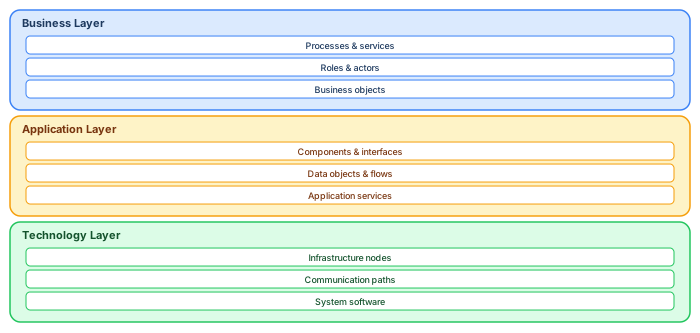
ArchiMate is a powerful open standard for modeling enterprise architecture, widely adopted by organizations seeking structured, consistent ways to represent business, application, and technology layers. While the specification provides a rich metamodel, real-world effectiveness hinges on the ability to apply reusable modeling patterns that scale across teams, domains, and systems.
1. Why Modeling Patterns Matter
Large enterprises struggle with fragmented documentation, inconsistent representations, and a lack of architectural traceability. Patterns solve this by:
- Promoting reuse and standardization
- Accelerating onboarding and alignment across teams
- Supporting compliance and architecture governance
- Improving communication between architects and stakeholders
2. Business Layer Patterns
Capability Mapping Pattern
This pattern connects Capabilities to Business Functions, Roles, and Goals. It supports strategic alignment and transformation planning.
- Use: Portfolio Rationalization, Gap Analysis
- Views: Capability Map View, Strategy-to-Capability View
Value Stream Decomposition
Break down Value Streams into Value Stages, linking them to Business Processes and Actors. Common in customer journey design.
3. Application Layer Patterns
Service-Oriented Mapping
Link Application Services to consuming Business Processes and providing Application Components. This pattern promotes modularity and reuse.
- Use: Application Portfolio Management (APM), Integration Design
Data Object Catalog Pattern
Catalog Data Objects and link to Application Functions and Business Processes. Useful in data flow and lineage visualizations.
4. Technology Layer Patterns
Platform Stack Pattern
Model Technology Components grouped into platforms (e.g., Kubernetes, SQL Server, SAP). Aligns infrastructure with supported applications and capabilities.
Deployment View Pattern
Map Nodes, System Software, and Artifacts to reflect physical deployment of solutions—particularly useful in hybrid cloud environments.
5. Cross-Layer Patterns
End-to-End Service Traceability
Trace a Customer Goal through capabilities, services, components, and infrastructure to understand impact and dependencies.
Regulatory Compliance Pattern
Attach Requirements and Principles to affected layers (business, app, infra), enabling transversal risk management and auditability.
6. Governance and Reusability
To scale these patterns across the organization:
- Use viewpoints to enforce modeling standards
- Create model libraries for patterns and reusable fragments
- Automate validations with scripts (e.g., check missing links or naming compliance)
- In Sparx EA, enforce usage via MDG Technologies and Prolaborate dashboards
7. Tooling Tips for Sparx EA
- Create reusable pattern templates using EA’s Model Pattern feature
- Use Relationship Matrix for coverage checks across layers
- Deploy Prolaborate to visualize models and drive collaborative reviews
- Version control pattern libraries via Pro Cloud Server or Git
Conclusion
ArchiMate provides the syntax; real-world patterns provide the semantics. By institutionalizing modeling patterns, large enterprises gain clarity, agility, and resilience in their architecture practices. Whether you're designing services, mapping capabilities, or ensuring compliance, consistent patterns help translate complexity into actionable insights across domains.
ArchiMate Modeling Patterns, ArchiMate Best Practices, Capability Map ArchiMate, Enterprise Architecture Modeling, ArchiMate for Large Enterprises, EA Modeling Standards, Service Mapping ArchiMate, Sparx EA Patterns, Business Application Technology Views, Compliance Modeling ArchiMate ArchiMate tutorial for enterprise architects
If you’d like hands-on training tailored to your team — Sparx Enterprise Architect, BPMN, SysML or the Archi tool — or modelling coaching in ArchiMate and TOGAF-aligned governance, you can reach us via our contact page.
Applying these patterns in practice
The value of ArchiMate modeling is realized not through comprehensive coverage of every element type, but through disciplined application of a few core patterns that answer recurring stakeholder questions. Three patterns account for the majority of architecture communication needs. ArchiMate layers explained
The Layered View pattern shows how business processes depend on applications, and how applications depend on infrastructure. Build this view by placing Business Processes at the top, Application Components in the middle, and Technology Nodes at the bottom. Connect them with Serving and Realization relationships. This single view demonstrates cross-layer traceability — when a server is decommissioned, trace upward to see which applications and business processes are affected.
The Cooperation View pattern shows how application components interact through interfaces and data flows. Place the core application in the center and its integration partners around it, connected by Flow relationships labeled with the data exchanged. This view reveals integration dependencies that are otherwise buried in technical documentation.
The Motivation View pattern connects strategic goals to architecture decisions. Stakeholder concerns drive Goals, Goals are realized by Outcomes, Outcomes are enabled by Capabilities, and Capabilities are realized by Application Components. This chain answers the question executives always ask: "Why are we building this?"
Frequently Asked Questions
What is enterprise architecture?
Enterprise architecture is a discipline that aligns an organisation's strategy, business operations, information systems, and technology infrastructure. It provides a structured framework for understanding how an enterprise works today, where it needs to go, and how to manage the transition.
How is ArchiMate used in enterprise architecture practice?
ArchiMate is used as the standard modeling language in enterprise architecture practice. It enables architects to create consistent, layered models covering business capabilities, application services, data flows, and technology infrastructure — all traceable from strategic goals to implementation.
What tools are used for enterprise architecture modeling?
Common enterprise architecture modeling tools include Sparx Enterprise Architect (Sparx EA), Archi, BiZZdesign Enterprise Studio, LeanIX, and Orbus iServer. Sparx EA is widely used for its ArchiMate, UML, BPMN and SysML support combined with powerful automation and scripting capabilities.