⏱ 18 min read
Most ArchiMate models are technically correct and practically useless.
That’s the problem.
Not because ArchiMate is bad. And not because Sparx Enterprise Architect is a weak tool. Both are fine. In the right hands, they’re genuinely powerful. The problem is that too many architecture teams use ArchiMate in Sparx EA like a diagramming exercise with governance theatre wrapped around it. They produce pretty views, overloaded metamodel purity, and exactly zero help for the people making hard delivery decisions.
If that sounds harsh, good. It should.
Because when you use ArchiMate effectively in Sparx Enterprise Architect, it becomes something very different: a working language for enterprise change. Not just “what systems do we have,” but “what is changing, why, what depends on it, what risk are we carrying, and where will this break first.” ArchiMate modeling guide
That’s the real job.
The simple version first
Let’s keep the early explanation plain.
ArchiMate is a modeling language for describing an enterprise across business, application, technology, and strategy layers. It helps you show relationships between things like capabilities, processes, applications, services, data, technology platforms, and change initiatives.
Sparx Enterprise Architect is the repository and modeling tool where you create, organize, relate, and govern those models.
Used together properly, they help architecture teams do four things well:
- Describe the current landscape clearly
- Show the target state without fantasy
- Trace change from strategy to implementation
- Make impact analysis less guesswork and more evidence
That’s the SEO-friendly summary. Fine. But that’s not where the value really sits.
The value comes when the model stops being an artifact and starts becoming a decision instrument.
The first hard truth: ArchiMate is not the architecture
I’ve seen teams spend months debating whether a thing is an Application Service or an Application Function, while nobody can answer a basic question like:
“If we move IAM to the cloud and introduce Kafka for event-driven onboarding, what breaks in the bank’s customer servicing journey?”
That’s architecture work. The notation debate is not.
ArchiMate is a language. Sparx EA is a repository. Neither of them will save you from poor architectural thinking. In fact, if you’re not careful, they’ll amplify it. Sparx especially. It’s powerful, but it will absolutely let you build a giant formalized swamp if you don’t impose discipline.
So let’s be blunt:
- If your model doesn’t help teams make decisions, it’s overhead.
- If your repository can’t answer impact questions, it’s a museum.
- If your ArchiMate views are only understandable by architects, you’ve failed half the audience already.
That’s the baseline.
What “effective” actually looks like
Using ArchiMate effectively in Sparx EA means you model just enough structure to support real enterprise work.
Not every relationship.
Not every abstract concept.
Not every possible view.
Just enough to support questions like:
- Which capabilities depend on this application?
- What customer journeys are affected by IAM changes?
- Which Kafka topics are critical to payment processing?
- What cloud services introduce concentration risk?
- Which controls are tied to regulated banking processes?
- What transition architectures are realistic over 12–18 months?
That’s the point.
In practice, effective use usually means five things.
1. Model for decisions, not completeness
This is where many teams get lost. They think architecture repositories should be complete. They won’t be. Ever.
The real goal is decision-grade completeness in areas that matter.
If your bank is modernizing customer onboarding, you need strong traceability across:
- Business capability: Customer Onboarding
- Business process: KYC, identity verification, account opening
- Application services: onboarding API, case management, IAM services
- Data objects: customer profile, identity evidence, risk score
- Technology services: Kafka event streaming, cloud identity platform, container platform
- Risks and constraints: regulatory retention, privileged access, third-party dependency
That’s enough to support architecture decisions. You do not need a universal model of every HR process and printer queue in the enterprise before you can be useful.
2. Separate repository truth from stakeholder views
This is one of the most important habits in Sparx EA.
Your repository model should be structured, reusable, and fairly rigorous.
Your diagrams should be opinionated, simplified, and audience-specific.
Too many architects put everything on one view because they’re trying to prove rigor. What they actually prove is that they don’t understand communication.
A CIO does not need the same ArchiMate view as a platform engineer. ArchiMate tutorial
A risk manager does not need the same view as a product owner.
A delivery team certainly does not need a strategy map with twenty motivation elements thrown in for flavor.
In Sparx, create one underlying model, then derive different views from it:
- Executive view: capability impact, investment, risk
- Domain architecture view: applications, services, integrations
- Security view: IAM dependencies, trust zones, control points
- Platform view: cloud services, messaging backbone, runtime hosting
- Transition view: current, interim, target
That’s where Sparx is useful. Not as a giant whiteboard. As a controlled source for multiple coherent views.
3. Use ArchiMate layers properly, but don’t become religious about them
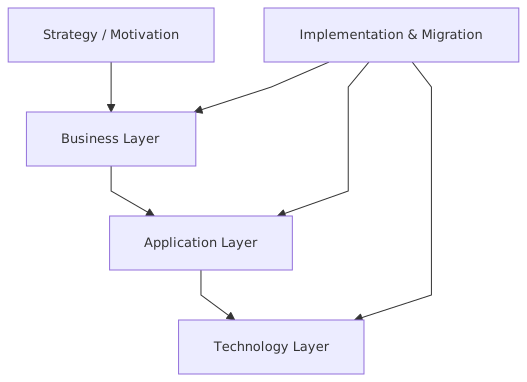
ArchiMate’s layered structure is useful because it forces discipline:
- Business: what the enterprise does
- Application: software behavior and systems
- Technology: infrastructure and platform
- Strategy/Motivation: why change exists
- Implementation/Migration: how change gets delivered
That structure matters.
But here’s the contrarian bit: some architects become so devoted to clean layer separation that they model reality badly.
Reality is messy. A cloud IAM platform is not just “technology.” It has application behavior, business significance, operational constraints, and strategic consequences. Kafka is not just middleware. In many enterprises it becomes a critical business nervous system. A banking payment event topic can be as operationally important as the payment engine itself.
So yes, use the layers. But don’t let the layers blind you to operational importance.
A practical way to structure ArchiMate in Sparx EA
Here’s a pattern that works in actual enterprise environments.
Recommended repository structure
This doesn’t need to be your exact package structure. But if your repository is just “Current State,” “Target State,” and a graveyard called “Misc,” you’re asking for pain.
Real architecture work: a banking example
Let’s make this concrete.
Imagine a mid-sized retail bank. It’s replacing fragmented customer authentication and identity proofing with a centralized IAM platform, introducing Kafka for event-driven integration, and moving selected workloads to cloud-managed services.
On paper, this sounds modern and tidy. In reality, it’s a nest of dependencies.
The business problem
The bank has:
- separate login systems for retail and business customers
- inconsistent MFA policies
- duplicated customer identity records
- brittle onboarding integrations
- delayed downstream updates because systems exchange nightly files
- audit findings around privileged access and joiner/mover/leaver processes
The target state is:
- centralized IAM for customer and workforce identity
- event-driven onboarding and profile updates through Kafka
- cloud-hosted digital channels and API services
- stronger access governance and traceability
Now, where does ArchiMate in Sparx EA help?
It helps you model the change as a connected enterprise problem, not three separate technology projects.
What the model should show
At the business layer:
- Capability: Customer Identity Management
- Capability: Customer Onboarding
- Capability: Access Governance
- Business process: Open Account
- Business process: Authenticate Customer
- Business process: Investigate Fraud Alert
At the application layer:
- Application component: Digital Banking Portal
- Application component: IAM Platform
- Application component: CRM
- Application component: Onboarding Service
- Application component: Fraud Monitoring
- Application service: Authentication Service
- Application service: Authorization Service
- Application service: Identity Verification Service
- Application service: Customer Profile Update Service
At the technology layer:
- Technology service: Kafka Event Streaming
- Node/system software: managed Kubernetes or container platform
- Technology service: Cloud Key Management
- Technology service: Managed Database
- Technology service: API Gateway
- Technology service: Central Logging/Monitoring
At the motivation/risk side:
- Driver: Regulatory compliance
- Driver: Faster onboarding
- Assessment: fragmented identity increases fraud and support cost
- Constraint: customer data residency
- Requirement: MFA for high-risk actions
- Requirement: event traceability for audit
At the implementation layer:
- Work package: IAM consolidation phase 1
- Work package: Kafka integration backbone
- Work package: Workforce privileged access remediation
- Plateau: current state
- Plateau: interim hybrid identity state
- Plateau: target identity-centric architecture
This is where Sparx becomes useful: not because you can draw these, but because you can relate them consistently and query the impacts.
For example:
- The Open Account process uses Identity Verification Service
- The Identity Verification Service is realized by Onboarding Service
- The Onboarding Service uses Kafka Event Streaming
- Kafka Event Streaming is hosted on cloud-managed infrastructure
- The Customer Profile Update Service triggers changes in CRM and Fraud Monitoring
- Authentication Service is subject to MFA requirements and audit constraints
Now a delivery lead can ask:
“If Kafka is unavailable for four hours, what business processes degrade?”
That’s a meaningful architecture question. Your model should answer it.
Common mistakes architects make in Sparx EA with ArchiMate
This is where I’ll be a bit opinionated, because these mistakes are widespread.

Mistake 1: Modeling everything at the same level of detail
This is probably the most common failure.
Architects put business capabilities, applications, APIs, servers, and implementation work packages all on one diagram with equal visual weight. It creates noise, not insight.
Different concerns need different views.
A capability map is not an integration view.
An IAM trust model is not a transformation roadmap. TOGAF roadmap template
A Kafka deployment topology is not a customer journey map.
Use the same repository elements, yes. But create focused views.
Mistake 2: Treating ArchiMate relationships like a compliance exam
People obsess over whether a relationship should be Serving, Used-By, Access, Assignment, Realization, or Association. Sometimes that matters. Often it matters less than they think.
The real issue is not “is this relationship theoretically perfect?”
The real issue is “does the relationship support understanding and traceability?”
I’m not saying be sloppy. I am saying don’t let metamodel anxiety kill momentum.
My advice:
- Be strict on a small set of core relationship conventions
- Be pragmatic elsewhere
- Document your team’s usage rules
- Apply them consistently
Consistency beats theoretical elegance.
Mistake 3: Building target-state fantasy models
Enterprise architects love target states. Some love them too much.
They create polished future models where all identity is centralized, all events are canonical, all cloud services are governed, all applications consume standard APIs, and all technical debt has quietly disappeared.
That is not architecture. That is aspiration art.
Real architecture work requires transition architectures. Especially in banking, where legacy systems, regulatory obligations, procurement timelines, and operational risk all slow the clean path.
In the IAM and Kafka example, the realistic interim state may include:
- legacy authentication still active for some channels
- dual-write or sync patterns during migration
- partial event adoption, with some file-based integration retained
- cloud-hosted services while core banking remains on-prem
- manual access certification for systems not yet integrated with IGA
If your Sparx repository only contains current and idealized target, it’s missing the most operationally important part: the messy middle.
Mistake 4: Confusing applications with services
This one causes endless confusion.
An application is not the same thing as the service it provides.
For example:
- IAM Platform is an application component
- Authentication Service is an application service
- MFA Challenge API may be an application interface
- Customer Credential Store may be a data object or artifact depending on context
Why does this matter? Because impact analysis depends on it.
If a business process depends on “authentication,” it depends on a service, not necessarily on one specific product. If you tie business usage directly to products too early, you make change analysis brittle.
Model the service separately. Then show which component realizes it.
Mistake 5: Letting the repository decay
A stale architecture repository is worse than no repository, because people trust it just long enough to make bad decisions.
Sparx EA needs operating discipline:
- ownership for domains
- review cadence
- naming standards
- lifecycle status
- change triggers from projects
- retirement of obsolete elements
- lightweight governance, not bureaucracy
If your Kafka cluster was replaced six months ago and the model still points to the old topology, your architecture practice has a credibility problem.
How to use ArchiMate views effectively in Sparx EA
The best teams don’t just create models. They curate a small set of high-value views.
Here are the ones I think matter most.
1. Capability-to-application view
Use this to show which applications support which business capabilities.
In banking, this quickly reveals over-dependence and fragmentation. For example, if Customer Identity Management is supported by five overlapping systems, you’ve found a simplification opportunity and probably a risk issue.
2. Process-to-service view
This is underrated.
Map business processes to application services, not directly to technical products. It improves traceability and keeps the model business-relevant.
For example:
- Open Account → Identity Verification Service
- Authenticate Customer → Authentication Service
- Investigate Fraud Alert → Case Retrieval Service, Access Review Service
3. Integration/event view
This is where Kafka comes in.
Do not model Kafka as a magic box in the middle with lines to everything. That’s lazy architecture.
Instead, show:
- producing applications
- consuming applications
- key event flows
- critical topics or event domains
- operational dependencies where relevant
You don’t need to model every topic in enterprise architecture. Thank God. But you should model the important event patterns tied to business-critical flows.
4. IAM trust and control view
Especially in regulated enterprises, IAM is not just another platform.
Show:
- identity providers
- relying applications
- privileged access boundaries
- workforce vs customer identity separation
- control points for MFA, provisioning, certification, logging
This is the kind of view risk, security, and operations teams can actually use together.
5. Transition roadmap view
This is often the most valuable executive view.
Show:
- current state plateau
- interim states
- major work packages
- dependencies
- business outcomes unlocked at each stage
Executives do not need every ArchiMate nuance. They need a credible path.
A note on cloud modeling: don’t overdo vendor detail
Another contrarian view.
A lot of teams using Sparx EA get intoxicated by cloud detail. They model every managed service, subnet, and platform feature directly in enterprise architecture views. Usually because they can.
You should resist that.
Enterprise architecture is not the same as solution deployment design.
At EA level, model cloud in terms of:
- hosting patterns
- platform dependencies
- resilience boundaries
- data residency constraints
- identity/security dependencies
- strategic concentration risk
For instance, in the banking example, what matters at enterprise level is not every cloud resource. It’s questions like:
- Which customer-facing capabilities now depend on a single cloud IAM provider?
- Which regulated data flows cross regions?
- Which Kafka services are managed by cloud vendor vs self-managed?
- What is the failover posture for authentication during cloud outage?
- Are access logs centralized and retained to policy?
That’s architecture value.
A lightweight governance model that actually works
Architecture teams often ruin Sparx by making contribution too hard.
If every model update requires a two-week review, people stop updating the repository. Then architects complain that projects bypass architecture. Well, yes. Obviously.
A workable governance approach looks more like this:
The repository needs standards. But not ceremonial suffering.
What good looks like in day-to-day architecture work
Let’s bring this back to the real world.
You’re in a bank architecture review. A program wants to introduce a new customer notification service, fed by Kafka events, authenticated through centralized IAM, deployed on cloud-managed containers.
Without a useful ArchiMate model in Sparx, the conversation becomes tribal memory:
- someone thinks CRM already publishes those events
- someone else says fraud needs a copy
- security says notifications for high-risk actions need stronger auth
- infrastructure says the cloud landing zone isn’t approved for that data class
- operations says there’s no end-to-end observability
- nobody is sure which customer journeys are affected
With a good repository and the right views, the conversation changes.
You can see:
- which capabilities are affected
- which processes consume the service
- which IAM services are reused
- which Kafka event streams already exist
- what cloud controls are mandated
- what transition state constraints still apply
- which systems are in scope for audit logging and data residency
Now architecture is not “the team that says no.”
It’s the team that helps people see the whole move.
That’s the real payoff.
Practical modeling tips for Sparx Enterprise Architect
A few specific habits make a difference.
Use stereotypes and tagged values sparingly
Sparx gives you endless customization options. That is both its strength and its trap.
Do not create a taxonomy so elaborate that only the repository administrator understands it. ArchiMate in TOGAF ADM
Add metadata only when it supports real use:
- lifecycle status
- criticality
- system owner
- data classification
- cloud hosting status
- regulatory scope
If you’re adding fifteen tagged values nobody reports on, stop.
Create reusable reference elements
For recurring concepts, create reusable patterns:
- IAM service pattern
- API mediation pattern
- event-driven integration pattern
- regulated workload cloud pattern
- privileged access control pattern
This improves consistency and speeds up modeling.
Maintain one canonical element per thing
This sounds obvious. It isn’t.
In bad Sparx repositories, the same application appears six times with slightly different names:
- IAM Platform
- Identity Platform
- CIAM
- Auth Service
- Customer IAM
- New IAM
That destroys trust.
One canonical element. Many views.
Use diagrams as narratives
A diagram should tell a story:
- what exists
- what matters
- what changes
- what to worry about
If a view has no narrative, it’s probably just a dump of connected boxes.
The uncomfortable truth about ArchiMate maturity
A lot of organizations claim ArchiMate maturity because they’ve adopted the notation. That’s not maturity.
Real maturity is when the repository helps answer uncomfortable questions:
- Why do we still have three authentication patterns in retail banking?
- What business capabilities would be impaired by Kafka backbone failure?
- Which cloud dependencies create systemic resilience risk?
- Where is privileged access still unmanaged?
- Which target-state assumptions are blocked by legacy vendor contracts?
That’s when ArchiMate in Sparx becomes more than architecture admin.
And yes, this takes discipline. It takes architects who understand business operations, integration patterns, security constraints, and delivery reality. Not just notation.
Frankly, some teams should use less ArchiMate until they can think more clearly.
There, I said it.
Because a smaller, sharper model is far more valuable than a sprawling “enterprise knowledge base” that nobody trusts and everyone avoids.
Final thought
ArchiMate is useful. Sparx Enterprise Architect is useful. But neither is automatically effective.
They become effective when you stop treating architecture as a library of diagrams and start treating it as a managed model of enterprise change.
In real work, that means:
- model what drives decisions
- connect business, application, technology, and security concerns
- show transition states, not just current and fantasy target
- maintain one repository truth with multiple stakeholder views
- keep the model alive through delivery
- be pragmatic, not doctrinaire
If you do that, ArchiMate in Sparx EA becomes a force multiplier.
If you don’t, it becomes what it too often is already: expensive wallpaper.
FAQ
1. Is Sparx Enterprise Architect a good tool for ArchiMate?
Yes, if you use it as a repository and analysis tool, not just a drawing tool. It’s strong for traceability, reuse, and structured views. It’s weaker when teams let the repository become overcomplicated and poorly governed.
2. How much ArchiMate detail should an enterprise architect model?
Only enough to support decisions and impact analysis. Model the parts of the enterprise that matter for the change in front of you. Don’t aim for universal completeness.
3. How should I model Kafka in ArchiMate?
Usually as a technology service or platform component in the technology layer, then connect it to the application services or components that publish and consume events. Focus on business-critical event flows, not every topic in the platform.
4. What’s the biggest mistake when modeling IAM in ArchiMate?
Treating IAM as just another application box. IAM affects business processes, security controls, audit, customer experience, and platform architecture. Model the services, dependencies, trust boundaries, and control requirements, not only the product.
5. Should cloud services be modeled in enterprise architecture views?
Yes, but selectively. Model cloud dependencies, hosting patterns, data residency, resilience boundaries, and security implications. Don’t turn enterprise architecture views into low-level deployment diagrams unless that detail is genuinely needed for a decision.
ArchiMate in Sparx EA: Practical Layering
Effective Usage Flow in Sparx EA
Frequently Asked Questions
What is enterprise architecture?
Enterprise architecture is a discipline that aligns an organisation's strategy, business processes, information systems, and technology. Using frameworks like TOGAF and modeling languages like ArchiMate, it provides a structured view of how the enterprise operates and how it needs to change.
How does ArchiMate support enterprise architecture practice?
ArchiMate provides a standard modeling language that connects strategy, business operations, applications, data, and technology in one coherent model. It enables traceability from strategic goals through business capabilities and application services to the technology platforms that support them.
What tools are used for enterprise architecture modeling?
The main tools are Sparx Enterprise Architect (ArchiMate, UML, BPMN, SysML), Archi (free, ArchiMate-only), and BiZZdesign Enterprise Studio. Sparx EA is the most feature-rich option, supporting concurrent repositories, automation, scripting, and integration with delivery tools like Jira and Azure DevOps.