⏱ 18 min read
Most enterprise architecture diagrams lie.
Not because architects are dishonest. Usually it’s the opposite. They’re trying to simplify. They’re trying to make the landscape understandable. But in that simplification, they cut the very thing that makes architecture useful: the dependency chain from why we are doing something to what gets deployed on Monday morning at 2 a.m.
That’s the real problem with cross-layer dependencies in ArchiMate. If your model cannot connect a business motivation like “reduce fraud losses” to an application service, a Kafka event stream, an IAM policy, and a cloud runtime, then you do not have architecture. You have decorated inventory.
That sounds harsh. Good. It should. Too much enterprise architecture still floats at 30,000 feet, producing glossy capability maps and target-state posters while delivery teams are drowning in integration, security, and platform constraints. Cross-layer modeling is where ArchiMate either becomes a serious language or a pretty one. ArchiMate modeling guide
So let’s say it simply, early, and clearly: cross-layer dependencies in ArchiMate are the relationships that connect motivation, strategy, business, application, technology, and implementation elements so you can trace how business intent becomes operational reality. That traceability matters because systems fail at the seams, not inside the boxes.
And yes, this applies in real architecture work every week. Especially in banks. Especially when Kafka is involved. Especially when IAM is treated as “some security team thing” and cloud is treated as “just infrastructure.” Those are not side concerns. They are often the architecture.
Why cross-layer dependencies matter more than most architects admit
A lot of architecture teams model layers as if they are polite neighbors. Business over here. Applications over there. Technology somewhere lower down. Motivation maybe in another repository folder nobody opens after the strategy workshop.
That’s not how enterprises actually behave.
In real organizations, a regulatory requirement changes a business process. That process requires a new application service. That service emits events to Kafka. Those events trigger downstream decisions. The consumers need identity-based access. IAM changes token scopes and machine identities. Security insists on workload isolation in cloud. Cloud networking now affects latency and topic design. Kafka partitioning now affects fraud scoring timeliness. And suddenly your “business requirement” is a very technical problem with executive consequences.
That is a cross-layer dependency.
The reason this matters is simple: architecture risk travels vertically. A bad implementation choice can undermine a strategic objective. A vague motivation can create nonsense in solution design. If you don’t model those links, people will still make the decisions, just blindly.
The contrarian point here is this: many architects overvalue abstraction. Abstraction is useful, but too much of it becomes evasion. If your ArchiMate model never touches implementation and migration, it is often because the architecture is not ready to be challenged by reality. ArchiMate tutorial
The simple version of cross-layer dependencies in ArchiMate
Before we go deeper, here’s the practical explanation.
ArchiMate has layers and aspects:
- Motivation: drivers, goals, outcomes, requirements, constraints
- Strategy: capabilities, resources, courses of action
- Business: processes, functions, actors, services
- Application: application components, services, data objects, interactions
- Technology: nodes, system software, technology services, networks
- Physical: equipment, facilities, distribution networks
- Implementation & Migration: work packages, deliverables, plateaus, gaps
Cross-layer dependencies are how you connect these into a chain. For example:
- A driver like regulatory pressure influences a goal
- That goal is realized through a capability
- The capability is enabled by a business process
- The business process uses an application service
- The application service is realized by an application component
- That component runs on a technology node
- The rollout happens via a work package
That’s the clean textbook version. Useful, but not enough.
In real architecture work, the value is not just showing that links exist. It is showing where the dependencies are fragile, overloaded, hidden, or politically inconvenient.
What architects usually get wrong
Let me be blunt. There are a few recurring mistakes, and they show up in almost every large enterprise.
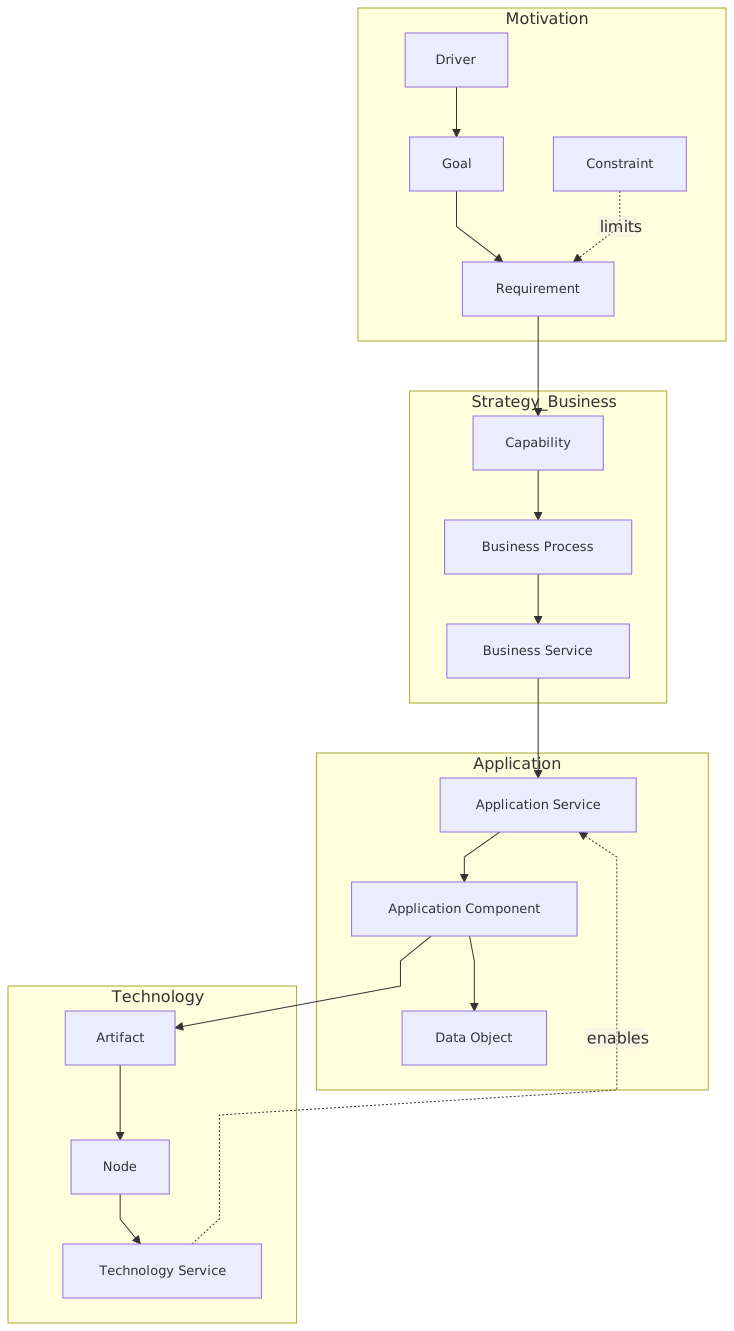
1. Treating layers as presentation zones instead of dependency zones
A lot of ArchiMate diagrams are organized by layer visually but not connected semantically. Business boxes on top. Application boxes below. Technology boxes under that. Maybe some lines. Maybe not enough lines. It looks neat. It says almost nothing.
If there is no explicit relationship from motivation to implementation, the model is not helping decision-making.
2. Modeling only “happy path” realization
Architects love realization chains because they look orderly:
Goal → Capability → Process → Application Service → Component → Node
Fine. But reality is uglier. There are constraints, assessments, risk, requirements, and influence relationships that matter just as much. Security controls, data residency constraints, IAM dependencies, cloud landing zone standards, Kafka retention policies — these are not side notes. They shape the architecture.
3. Ignoring IAM as a cross-layer concern
This one is chronic. IAM gets shoved into “non-functional requirements” or “security architecture” and then disappears from enterprise models. But in modern enterprises, especially cloud-first ones, IAM is a first-order architectural dependency.
Who can access what, under which identity, with what token, from which workload, across which trust boundary — that affects business operations, customer journeys, auditability, and integration design. If your model does not show IAM dependencies, you are missing one of the most operationally important cross-layer threads.
4. Treating Kafka as plumbing
Kafka is not just middleware. In many enterprises, Kafka is effectively part of the operating model. It shapes event ownership, data propagation, recovery patterns, latency expectations, and organizational boundaries.
If architects model Kafka only as a technology component, they miss the application and business implications. Event streams often embody business facts. Topic ownership reflects domain ownership. Consumer groups reflect operational responsibilities. This is not just technology.
5. Confusing traceability with bureaucracy
Some architects hear “cross-layer traceability” and respond with massive repositories nobody can maintain. That is also a mistake.
Traceability is not about documenting every atom. It is about making the critical dependencies explicit enough to support decisions, impact analysis, and governance. If your model becomes a compliance ritual, people stop trusting it. ArchiMate for governance
The relationships that actually matter
ArchiMate gives you many relationship types, but in practice a few of them carry most of the weight in cross-layer dependency modeling.
Here’s a useful summary.
The common anti-pattern is to overuse realization because it feels architecturally elegant. But influence, access, and triggering are often where the truth lives.
For example, in a bank’s fraud detection initiative:
- Regulatory scrutiny influences fraud reduction goals
- Fraud reduction goal is realized by a real-time risk scoring capability
- Payment screening process is served by a fraud scoring application service
- Fraud engine accesses transaction and customer risk profile data
- Payment event publication in Kafka triggers scoring and alerting
- IAM platform serves authentication and authorization to fraud services
- Cloud landing zone constraints influence deployment topology
That is already more useful than most architecture decks I see.
A real enterprise example: retail banking fraud modernization
Let’s make this concrete.
Imagine a mid-sized retail bank. It has:
- card payments
- account-to-account transfers
- mobile banking
- online banking
- branch-originated payments
- an aging fraud platform that runs batch scoring every 30 minutes
The executive mandate is straightforward: reduce fraud losses by 20%, improve customer experience by reducing false positives, and satisfy tighter regulator expectations around suspicious transaction monitoring.
Classic architecture problem. Also classic trap. Many teams would produce:
- a target capability map
- a conceptual event-driven architecture
- a cloud migration roadmap
- a security principles slide
All good. None sufficient.
Step 1: Start with motivation, but don’t stop there
In ArchiMate terms, you might model:
- Driver: Increased fraud sophistication
- Driver: Regulatory pressure on transaction monitoring
- Assessment: Current batch scoring creates delayed intervention and high false positives
- Goal: Reduce fraud losses by 20%
- Goal: Cut false-positive transaction blocks by 15%
- Requirement: Real-time fraud scoring for high-risk payment events
- Constraint: Personally identifiable information must remain within approved cloud regions
- Constraint: Strong service-to-service authentication required for all fraud-related integrations
This is where many architecture teams stop and congratulate themselves for “aligning with strategy.” But the useful work starts when you push those elements downward.
Step 2: Connect goals to capabilities and business processes
The bank needs capabilities like:
- Real-time fraud detection
- Customer identity verification
- Transaction monitoring and alert management
- Case investigation
- Consent and access governance
Then map business behavior:
- Payment initiation
- Beneficiary creation
- Transaction authorization
- Fraud review
- Customer notification
- Analyst case management
Now the important part: the payment initiation process is not just “supported by IT.” It is served by application services, and those services are constrained by IAM, messaging, and cloud topology.
Step 3: Model Kafka as part of application architecture, not only tech
This bank chooses Kafka for event streaming. Fine. But where does Kafka sit in the model?
A lazy model puts Kafka cluster under technology and ends there. A better model shows:
- Application Event / Business Event: Payment Initiated
- Application Component: Payment Orchestration Service publishes event
- Application Component: Fraud Scoring Service consumes event
- Application Component: Alerting Service consumes risk outcome
- Data Object: Transaction Context
- Technology Service: Event Streaming Service
- System Software / Node: Managed Kafka platform on cloud
This matters because Kafka is carrying business-significant events. Topic design and retention affect audit, replay, investigation, and customer impact. That’s not infrastructure trivia.
Step 4: Bring IAM into the center of the picture
Now for the part architects often dodge.
The fraud scoring service needs to consume payment events. Who authorizes that? Under what identity? How are downstream services trusted? How do analysts access fraud cases? How do customer support agents get scoped visibility? How are machine identities managed in cloud?
A serious ArchiMate model includes:
- Requirement: Fine-grained authorization for fraud data access
- Application Service: Token issuance / identity federation
- Application Component: IAM platform
- Business Role: Fraud Analyst
- Business Role: Customer Support Agent
- Application Interface: Analyst portal access API
- Constraint: Segregation of duties for investigation and case closure
- Technology Service: Secrets management / workload identity
- Node: Cloud Kubernetes cluster or serverless runtime
This is not “security detail.” This is operational architecture. If IAM is wrong, fraud analysts cannot work, customer support sees the wrong data, or worse, unauthorized services consume sensitive streams. In banking, that becomes an audit finding very fast.
Step 5: Cloud is not the bottom layer. It is an active dependency
Suppose the bank runs fraud services in cloud, with managed Kafka, Kubernetes, and a centralized IAM integration layer.
Now cloud decisions matter:
- Multi-region deployment affects event ordering and latency
- Private networking affects integration patterns with on-prem core banking
- Managed Kafka service quotas affect throughput
- IAM federation with legacy directory affects token issuance
- Encryption key management affects data access and incident response
These are technology-layer concerns, yes. But they directly shape business outcomes like transaction approval time and fraud intervention speed.
That is the essence of cross-layer dependency.
What this looks like in actual architecture work
This is where the theory either earns its keep or doesn’t.

In real architecture work, cross-layer dependency modeling helps with five things.
1. Impact analysis that is not fantasy
If the regulator changes requirements for suspicious activity reporting, you can trace:
- impacted goals
- impacted capabilities
- impacted business processes
- impacted application services
- impacted data objects
- impacted IAM controls
- impacted cloud deployment constraints
- impacted migration work packages
Without that trace, impact analysis becomes a meeting culture.
2. Better decision records
When choosing between batch and event-driven fraud scoring, or between self-managed Kafka and managed cloud Kafka, the model can show what is actually affected:
- business timeliness
- operating model
- service boundaries
- IAM design
- cloud networking
- resilience requirements
This avoids the usual fake neutrality where technology choices are presented as isolated engineering decisions.
3. Governance with substance
Architecture governance often degenerates into standards policing. Cross-layer models let you ask better questions:
- Which business goal is this service actually realizing?
- Which requirement justifies this data replication?
- Which IAM dependency makes this cloud deployment pattern mandatory?
- Which process owns the event schema lifecycle?
Those are governance questions worth asking.
4. Migration planning that respects dependencies
Implementation and migration in ArchiMate is underrated. Architects talk endlessly about target state and far too little about dependency-aware transition.
For the bank, you might define plateaus like:
- Current batch fraud platform
- Hybrid event-driven scoring for card transactions only
- Unified real-time scoring across all payment channels
- Full integrated fraud case management with IAM role segmentation
Then work packages:
- Deploy managed Kafka foundation
- Introduce payment event publication
- Implement fraud scoring microservice
- Integrate IAM token and policy enforcement
- Migrate analyst portal to cloud
Now sequencing becomes explicit. For example, there is no point launching fraud microservices before machine identity and authorization patterns are in place. Yet teams do this all the time.
5. Exposing ownership gaps
Cross-layer modeling reveals who owns what and, more importantly, what nobody owns.
In many enterprises:
- business owns the goal
- app teams own services
- platform team owns Kafka
- security owns IAM
- cloud team owns landing zone
And nobody owns the dependency chain between them.
That gap is where architecture should operate.
A practical dependency chain for the banking example
Here’s a simplified version of the dependency chain an architect might model.
This table is simple on purpose. In the real model, you would also include data objects, constraints, assessments, and risk elements. But even this basic chain is enough to anchor serious conversations.
Contrarian thought: not every dependency should be modeled
Here’s where I’ll push against some architecture orthodoxy.
You do not need to model every dependency. That way madness lies. Repositories become archaeological sites. Teams stop updating them. Trust collapses.
Model the dependencies that are:
- decision-relevant
- risk-heavy
- cross-team
- likely to change
- expensive to discover late
For example, in the banking fraud case, I would absolutely model:
- regulatory drivers to fraud goals
- goals to fraud capability
- payment process to fraud scoring service
- fraud scoring service to Kafka eventing
- fraud services to IAM controls
- IAM and cloud constraints to deployment architecture
- migration work packages and plateaus
I would probably not model every internal class-level software dependency or every cloud subnet rule in ArchiMate. That belongs elsewhere.
ArchiMate is not there to replace all design artifacts. It is there to connect concerns across enterprise layers. If you try to make it your only artifact, you will hate it, and your teams will quietly ignore you.
Common modeling patterns that work
Over time, some patterns prove useful.
Pattern 1: Goal-to-control chain
Use this when security or compliance is central.
Example:
- Goal: Protect sensitive payment data
- Requirement: Enforce least-privilege access
- Constraint: Customer PII restricted to approved regions
- Application Service: Authorization decision service
- Technology Service: IAM federation and key management
- Node: Cloud identity platform and encryption service
This pattern works especially well in banking and healthcare.
Pattern 2: Event-to-outcome chain
Use this in Kafka-heavy architectures.
Example:
- Business Event: Payment initiated
- Application Event: PaymentCreated event published
- Application Component: Fraud scoring consumer
- Business Process: Risk assessment
- Outcome/Goal: Faster fraud intervention, lower false positives
This keeps event streaming tied to business value, instead of becoming a middleware diagram.
Pattern 3: Capability-to-platform chain
Useful for cloud transformations.
Example:
- Capability: Digital onboarding
- Business Process: Customer verification
- Application Service: Identity proofing
- Application Component: Onboarding service
- Technology Service: Cloud API gateway, IAM, container runtime
- Work Package: Migrate onboarding to cloud-native platform
This is how you stop cloud architecture from becoming a detached platform story.
What good architects do differently
The best architects I know do three things consistently.
They model tension, not just structure
A weak model shows what exists. A strong model shows what is in conflict:
- speed vs control
- event consistency vs operational simplicity
- cloud standardization vs legacy integration reality
- analyst access vs segregation of duties
ArchiMate can represent these tensions through assessments, constraints, requirements, and influence relationships. Use them. Architecture is not a catalog. It is managed trade-off.
They connect ownership to dependencies
A line on a diagram is only useful if someone can act on it.
If Kafka topic ownership affects fraud scoring reliability, that ownership should be explicit. If IAM policy design blocks analyst workflows, the responsible team should be visible. Cross-layer dependencies become actionable when ownership is attached.
They accept that implementation is architecture
This is another contrarian point, though it should not be. Too many enterprise architects still behave as if implementation detail is beneath them. That mindset is obsolete.
In cloud-native, security-heavy, event-driven enterprises, implementation choices are often architecture choices. Managed Kafka versus self-hosted. Token propagation model. Workload identity pattern. Multi-region active-active versus active-passive. These are not afterthoughts.
If your ArchiMate model cannot absorb those choices without collapsing into vagueness, improve the model.
A few practical rules for modeling cross-layer dependencies
If I were coaching an architecture team, I’d give them these rules.
Rule 1: Start from pain, not from framework completeness
Begin with a real problem:
- fraud losses
- access audit failures
- cloud migration delays
- Kafka topic sprawl
- customer onboarding friction
Then model the dependency chain around that problem. Don’t start by trying to populate every ArchiMate layer for its own sake.
Rule 2: Use motivation elements aggressively
Many architects underuse the motivation layer. Big mistake.
Drivers, assessments, goals, requirements, and constraints are what justify architecture. Without them, lower-layer models become technical storytelling with no strategic anchor.
Rule 3: Model security and identity explicitly
Do not bury IAM in notes. Identity is now a primary dependency across business, application, and technology layers. Especially in distributed cloud environments.
Rule 4: Separate core traceability from detailed design
Keep the enterprise-level dependency chain visible and manageable. Link out to solution design, API specs, event schemas, infra-as-code, or IAM policy repositories where needed. Don’t jam everything into one ArchiMate view.
Rule 5: Use implementation and migration views early
Not at the end. Early.
If your target architecture requires a dependency sequence that the organization cannot execute, then the target architecture is fiction.
Final thought
Cross-layer dependencies are where ArchiMate stops being decorative and starts being useful.
The real job of enterprise architecture is not to produce abstract harmony. It is to expose the chain of consequences from business intent to operational implementation. In a bank, that means connecting fraud goals to payment processes, Kafka event flows, IAM enforcement, and cloud deployment realities. In any serious enterprise, it means admitting that the seams matter more than the boxes. TOGAF roadmap template
And that’s the uncomfortable truth: most architecture failures are dependency failures. Not because the application was bad. Not because the cloud platform was wrong. Not because the strategy was unclear. Because the relationship between them was invisible, misunderstood, or hand-waved away.
ArchiMate gives you a language for those relationships. Use it like an architect, not a diagrammer.
If the model cannot tell me why a business goal depends on a Kafka topic, an IAM policy, and a cloud runtime, I’m not interested in the model.
You shouldn’t be either.
FAQ
1. What are cross-layer dependencies in ArchiMate in simple terms?
They are the links between layers like motivation, business, application, technology, and implementation. They show how a business objective or requirement ends up affecting systems, platforms, and delivery work.
2. Why are cross-layer dependencies important in enterprise architecture?
Because most real risks and delays happen between layers, not inside them. If you cannot trace from strategy to implementation, you cannot do reliable impact analysis, governance, or migration planning.
3. How should Kafka be modeled in ArchiMate?
Not only as technology. Kafka should usually appear as part of the application interaction pattern too, especially when topics carry business-significant events. Model the event flow, publisher and consumer components, and the underlying technology service.
4. Where does IAM fit in ArchiMate?
Across multiple layers. IAM may appear as motivation requirements and constraints, business roles, application services for authentication/authorization, and technology services or platforms for identity federation, secrets, and policy enforcement.
5. What is the biggest mistake architects make with ArchiMate layers?
Treating them as stacked boxes instead of connected dependencies. A layered picture without meaningful cross-layer relationships may look tidy, but it is weak architecture.
Frequently Asked Questions
What is enterprise architecture?
Enterprise architecture is a discipline that aligns an organisation's strategy, business processes, information systems, and technology. Using frameworks like TOGAF and modeling languages like ArchiMate, it provides a structured view of how the enterprise operates and how it needs to change.
How does ArchiMate support enterprise architecture practice?
ArchiMate provides a standard modeling language that connects strategy, business operations, applications, data, and technology in one coherent model. It enables traceability from strategic goals through business capabilities and application services to the technology platforms that support them.
What tools are used for enterprise architecture modeling?
The main tools are Sparx Enterprise Architect (ArchiMate, UML, BPMN, SysML), Archi (free, ArchiMate-only), and BiZZdesign Enterprise Studio. Sparx EA is the most feature-rich option, supporting concurrent repositories, automation, scripting, and integration with delivery tools like Jira and Azure DevOps.