⏱ 19 min read
Most enterprise architecture decks lie.
Not always intentionally. But they lie in a very predictable way: they show an elegant strategy on slide 8, a clean capability map on slide 12, a target application landscape on slide 23, and then a completely unrelated implementation roadmap at the end. Everything looks aligned. Nothing actually is. EA governance checklist
That gap is where architecture usually fails.
If you want one blunt opinion up front, here it is: an ArchiMate model that does not trace strategy down to implementation is not architecture, it is illustration. Pretty, maybe useful in a workshop, but still illustration.
And yes, this is exactly where cross-layer traceability matters.
What cross-layer traceability in ArchiMate actually means
Let’s keep the early explanation simple.
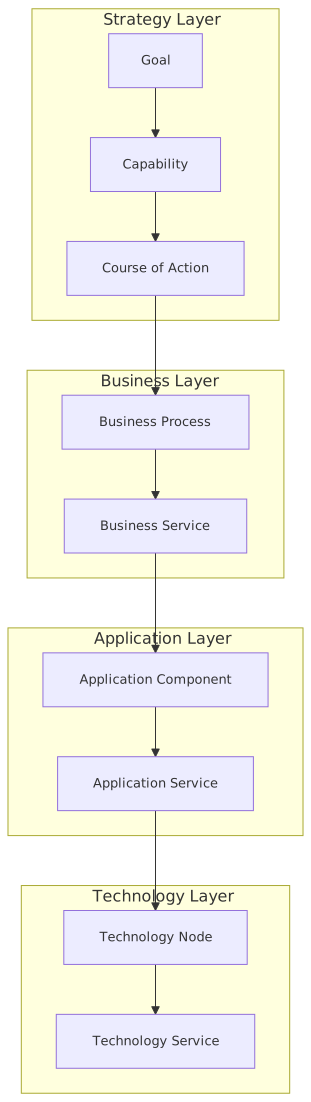
Cross-layer traceability in ArchiMate means showing how a strategic idea becomes operational and then technical reality. You connect motivation and strategy elements to business behavior, then to applications, then to technology, and finally to implementation and migration work.
In plain English:
- Why are we doing this?
- What business outcome or capability changes?
- Which processes and services are affected?
- What applications support that?
- What technology enables it?
- What projects, work packages, and transitions make it happen?
That is the thread.
ArchiMate is one of the few enterprise architecture languages that is actually built for this. It gives you layers and relationships that let you move from goal to capability to business process to application service to technology service to work package. If used properly, it becomes a chain of evidence.
And that phrase matters: chain of evidence.
Because architecture is not just describing an estate. It is proving that the chosen implementation supports the intended strategy.
Why architects get this wrong so often
Because many architects model by domain, not by decision.
They produce:
- a strategy view
- a business process view
- an application cooperation view
- a technology deployment view
All technically valid. All disconnected.
The issue is not lack of modeling skill. Usually it is the opposite. People know the notation, but they stop at layer boundaries because that is how organizations are structured. Strategy team over here. Business architecture over there. Platform architects somewhere else. Delivery teams in Jira. Security in a separate spreadsheet, naturally.
So the model mirrors the org chart. Which means it inherits the org chart’s fragmentation.
The result is familiar:
- executives cannot see how investments realize goals
- product teams cannot see why a requirement exists
- delivery teams implement local optimizations
- cloud programs become infrastructure modernization with no business relevance
- IAM turns into a security project instead of a business enabler
- Kafka becomes a fashionable integration backbone with no traceable business event model
This is the heart of it. Cross-layer traceability is not a modeling luxury. It is how architecture prevents expensive drift.
ArchiMate is at its best when it links intent to evidence
A lot of people use ArchiMate like Visio with stricter symbols. That is a waste.
The real power of ArchiMate is not just that it can represent business, application, and technology. The power is that it can connect them with enough semantic precision that you can ask hard questions: ArchiMate modeling guide
- Which strategic goal is this cloud migration actually serving?
- Which capabilities improve if we centralize IAM?
- Which customer journeys depend on Kafka event streaming?
- Which implementation work package realizes the target application service?
- What technology nodes are critical for a regulated banking process?
- What requirement is not traced to any strategic driver and should probably be challenged?
That last one is brutal in portfolio reviews. And very useful.
Because in mature architecture work, traceability is not there to make diagrams look comprehensive. It is there to expose nonsense.
The practical traceability path: from strategy to implementation
Let’s make this concrete.
A simple cross-layer traceability chain in ArchiMate often looks like this: ArchiMate tutorial
- Driver / Assessment / Goal / Outcome
- Capability
- Value Stream or Business Process
- Business Service
- Application Component / Application Service / Data Object
- Technology Node / Technology Service / Artifact
- Work Package / Deliverable / Plateau / Gap
You do not always need every element. In fact, over-modeling is one of the classic sins. But you do need enough linkage that someone can navigate from “why” to “what changed” to “what we built.”
Here is a useful way to think about it:
That table looks obvious. Good. It should. The problem in real enterprises is not that people do not understand the concept. The problem is they do not maintain the links.
A real enterprise example: retail banking modernization
Let’s use a realistic banking example, because banking exposes architectural dishonesty quickly. Regulation, customer expectations, legacy complexity, security pressure, all in one place.
Imagine a retail bank with this strategy statement:
> “Increase digital customer acquisition by 30% while reducing onboarding fraud and cutting account opening time from 2 days to under 10 minutes.”
Classic executive ambition. Sounds good in a town hall. Means very little until traced.
Step 1: Strategy and motivation
In ArchiMate, we might model:
- Driver: Competitive pressure from digital-first banks
- Driver: Regulatory obligations for identity verification and auditability
- Assessment: Current onboarding is fragmented, manual, fraud-prone
- Goal: Increase digital acquisition by 30%
- Goal: Reduce onboarding fraud by 20%
- Outcome: Account opening completed in under 10 minutes
- Capability: Digital Customer Onboarding
- Capability: Identity and Access Management
- Course of Action: Event-driven onboarding platform in cloud
Already, this is more useful than most strategy papers because it separates pressure, diagnosis, target, and response.
Step 2: Business layer
Now we ask what actually changes in operations.
- Value Stream: Acquire and Onboard Customer
- Business Process: Capture Application
- Business Process: Verify Identity
- Business Process: Screen for AML/KYC
- Business Process: Create Customer Profile
- Business Service: Customer Onboarding Service
- Business Actor: Customer
- Business Role: Fraud Analyst
- Business Object: Onboarding Case
This matters because strategy is never realized directly by applications. It is realized by changed business behavior.
And here is where many architects make mistake number one: they jump straight from capability to system. No. Capabilities are not applications. Capabilities are what the business can do. Systems support them.
Step 3: Application layer
Now we model the application support:
- Application Component: Digital Onboarding Portal
- Application Component: IAM Platform
- Application Component: Fraud Decision Engine
- Application Component: KYC Screening Service
- Application Component: Customer Master Service
- Application Component: Event Streaming Platform
- Application Service: Identity Verification API
- Application Service: Access Token Issuance
- Application Service: Customer Profile Creation
- Data Object: Customer Identity Record
- Data Object: Onboarding Event
- Data Object: Access Policy
Here Kafka enters the picture. But note the discipline: Kafka is not the architecture. It is one enabling component in a traceable service chain.
A lot of teams get seduced by technology brands. “We’re doing Kafka.” Fine. For what business event model? Which value stream stage? Which process latency issue? Which control objective? If you cannot answer those, you are buying distributed complexity because it sounds modern.
Step 4: Technology layer
Now the supporting technology:
- Node: Managed Kubernetes Cluster
- Node: Cloud VPC / Network Segment
- System Software: Kafka Runtime
- System Software: IAM Runtime
- Technology Service: Event Streaming Service
- Technology Service: Secrets Management
- Technology Service: Observability Platform
- Artifact: IAM Policy Bundle
- Artifact: Event Schema Registry
- Artifact: Container Image
This is where cloud choices should become traceable to business need. Not every business goal needs cloud-native eventing, and not every workload belongs on managed Kubernetes. Another contrarian point: sometimes the right architecture decision is boring. If a stable batch integration solves the problem with lower operational risk, use it. Kafka should earn its place.
Step 5: Implementation and migration
Finally, how do we move?
- Work Package: Establish cloud landing zone for regulated workloads
- Work Package: Implement centralized IAM for onboarding channels
- Work Package: Introduce onboarding event stream and schema governance
- Work Package: Integrate fraud engine with real-time onboarding events
- Work Package: Decommission legacy branch onboarding workflow
- Deliverable: Target onboarding operating model
- Deliverable: Event contract catalog
- Plateau: Current-state onboarding
- Plateau: Hybrid onboarding with centralized IAM
- Plateau: Real-time digital onboarding target state
- Gap: No shared identity model
- Gap: Manual fraud review bottleneck
- Gap: Legacy onboarding interface tied to branch systems
Now we have a traceable architecture story:
- strategic goals drive capability change
- capability change affects business processes
- business processes require application services
- application services rely on technology services
- work packages realize the target state
That is architecture.
What this looks like in real architecture work
Real architecture work is less elegant than the metamodel suggests.

You are usually dealing with partial truth, legacy systems nobody fully understands, product owners with urgent deadlines, and executives who want confidence without complexity. So cross-layer traceability has to be practical, not academic.
Here is how it applies day to day.
1. Investment decisions become testable
When a bank proposes a new IAM modernization program, you can ask:
- Which capabilities improve?
- Which business services depend on stronger authentication or delegated authorization?
- Which customer journeys are blocked today because identity is fragmented?
- Which applications consume the new IAM services?
- What technology changes are required in cloud and on-prem?
- What work packages realize the transition?
- What measurable outcomes justify the spend?
Without traceability, IAM becomes “security uplift.” With traceability, it becomes a business enabler for digital onboarding, partner access, workforce controls, and auditability.
2. Platform decisions stop floating above business reality
Kafka is a good example. In many enterprises, Kafka gets introduced as a strategic platform. Fine. But strategic platforms often become cost centers unless tied to business scenarios.
A traceable ArchiMate model can show:
- business process emits onboarding events
- fraud detection consumes identity verification events
- customer master service consumes approved onboarding events
- notification service consumes account-created events
- event streaming service supports low-latency orchestration
- schema registry and policy controls support audit and governance
Now Kafka is not just “our event backbone.” It is linked to customer onboarding performance, fraud reduction, and operational decoupling.
3. Roadmaps become less fictional
Most architecture roadmaps are optimistic collages. Cross-layer traceability forces sequencing logic. ArchiMate in TOGAF ADM
For example:
- you cannot decommission legacy onboarding until IAM federation is in place
- you should not launch event-driven fraud checks before event contracts and data ownership are defined
- cloud deployment of regulated identity services may depend on policy controls, key management, and logging baselines
- application teams cannot consume centralized IAM if entitlement models remain local and inconsistent
This is where implementation and migration modeling in ArchiMate is often underused. Architects love target-state diagrams. They are less enthusiastic about plateaus and gaps because those expose trade-offs and transitional mess. But the migration path is where architecture earns credibility.
Common mistakes architects make
Let’s be honest. Some of these are modeling mistakes. Most are thinking mistakes.
Mistake 1: Treating traceability as documentation overhead
Wrong mindset.
Traceability is not there for compliance teams or repository enthusiasts. It is there to support decisions. If a relation does not help a decision, maybe do not model it. But if you are making major investment choices without traceability, you are guessing with expensive nouns.
Mistake 2: Confusing correlation with realization
Just because an application appears in the same initiative as a strategic goal does not mean it realizes that goal.
This happens constantly:
- cloud migration is said to improve customer experience
- IAM consolidation is said to reduce fraud
- Kafka adoption is said to increase agility
Maybe. But show the causal path.
Cloud migration alone does not improve customer onboarding. It may improve scalability or deployment speed, but only if application and process changes exploit that. Otherwise it is just hosting relocation with better marketing.
Mistake 3: Modeling everything
A complete model is usually a dead model.
Cross-layer traceability does not mean every process step must be linked to every container and every policy artifact. You need enough model detail to answer enterprise questions. Not enough to simulate the universe.
A good architect knows where to stop.
Mistake 4: Ignoring business semantics in technical models
This is rampant with event-driven architecture.
Teams model Kafka topics, producers, consumers, clusters, and ACLs. Great. But what is the business event? What changed in the business state? Who owns the event meaning? What process or capability depends on it?
If your topic names are more precise than your business event definitions, your architecture is upside down.
Mistake 5: Treating IAM as infrastructure only
IAM is not just a technical control stack. In modern enterprises it shapes:
- customer onboarding
- employee access to regulated functions
- partner integration
- consent and delegation
- segregation of duties
- audit evidence
Architects who keep IAM in the technology layer miss half the picture. Identity has business meaning, application meaning, and technology implementation. It is a perfect case for cross-layer traceability.
Mistake 6: No ownership for the traceability chain
This one kills repositories.
Strategy team owns goals. Process team owns process maps. Solution architects own application views. Platform team owns tech diagrams. PMO owns work packages. Nobody owns the links.
Then six months later the architecture repository is “outdated,” which is a polite way of saying structurally abandoned.
Cross-layer traceability requires explicit stewardship. Usually by domain or value stream, not by notation specialist.
A more opinionated take: architecture should be traceable or it should stay quiet
Here is the contrarian view.
A lot of enterprise architecture still survives by speaking in abstractions nobody can disprove. “Enable agility.” “Standardize platforms.” “Improve resilience.” “Drive digital transformation.” This language is tolerated because it sounds strategic.
But traceability makes architecture falsifiable, and that is exactly why some people avoid it.
If you show the chain from strategic goal to implementation, then people can challenge it:
- Why does this capability require a new platform?
- Why is Kafka needed instead of managed messaging?
- Why does IAM modernization need three phases?
- Why is cloud migration sequenced ahead of data remediation?
- Why is this work package not linked to any measurable outcome?
Good. That challenge is healthy. Architecture should withstand scrutiny.
If your architecture cannot be traced, maybe it is not mature enough to influence investment.
How to model this without creating a monster
A practical pattern I recommend is the decision slice.
Instead of trying to model the whole enterprise end to end, create traceability slices around a change theme:
- digital onboarding
- payment fraud controls
- workforce access recertification
- cloud-native integration for customer notifications
Each slice should include:
- 2–4 strategic goals or outcomes
- relevant capabilities
- key business processes or value stream stages
- impacted application services and components
- critical technology services and nodes
- work packages, plateaus, and gaps
That is enough to make the architecture useful.
You can then connect slices over time into a broader enterprise knowledge base. But start where decisions are active.
A focused example: IAM and Kafka in a bank onboarding flow
Let’s make the example more operational.
A bank wants to support:
- customer onboarding from mobile and web
- real-time fraud scoring
- secure partner identity proofing
- cloud deployment for elasticity and faster release cycles
The target architecture includes:
- centralized IAM for customer authentication and token issuance
- Kafka for event distribution across onboarding steps
- fraud engine subscribing to identity and application events
- customer master service creating accounts after approval
- cloud observability and audit logging for compliance
A traceability chain might look like this:
This is the kind of table executives understand, delivery teams can act on, and architects can defend.
What “good” looks like in practice
A good cross-layer ArchiMate model has a few characteristics.
It is selective
It models what matters for change, not every dependency in existence.
It is navigable
Someone can start at a goal and follow links downward, or start at a work package and trace upward to rationale.
It is explicit about realization
Not every relation is vague association. Use realization, serving, assignment, triggering, access, and composition with intent.
It includes migration
Target state without transition state is fantasy.
It survives contact with delivery
If product teams and engineers cannot recognize their world in the architecture, the model is too abstract to be useful.
It supports governance without becoming governance theater
The model should help architecture review boards ask better questions, not generate ritualized checklists.
A note on repositories and tooling
Tooling matters less than people think, but some habits matter a lot.
If you are using an EA repository, define a minimal traceability standard:
- every strategic initiative links to at least one goal or outcome
- every work package links to impacted capabilities and target services
- every platform component used in a strategic program links to a business scenario
- every decommission work package links to the capability or cost objective it supports
Do not wait for perfect metamodel purity. That way lies paralysis.
And one more opinion: spreadsheets are not evil. Early traceability often starts in rough form. Better a living spreadsheet with decision logic than a dead repository with immaculate notation. The trick is to move from ad hoc to governed before scale breaks you.
Why this matters more in cloud-era architecture
Cloud made one thing easier and one thing worse.
It made infrastructure change easier. It made architecture drift faster.
When teams can provision services quickly, implementation choices multiply. Without traceability, those choices detach from strategic intent very quickly:
- duplicate IAM patterns emerge across channels
- Kafka gets used where simple APIs would do
- cloud services proliferate without capability alignment
- security controls become retrofitted after delivery
- decommission plans disappear because temporary states become permanent
Cross-layer traceability is one of the few mechanisms that keeps speed from turning into entropy.
And no, architecture does not need to slow delivery to do this. It needs to clarify intent so teams can move faster with fewer contradictions.
Final thought
Enterprise architecture is not a collection of views. It is an argument.
A good argument has logic, evidence, and a path from premise to conclusion. In ArchiMate terms, that means a path from strategy to implementation.
If your model shows goals but not work packages, it is incomplete.
If it shows applications but not business outcomes, it is hollow.
If it shows technology modernization but not capability impact, it is probably vanity.
If it shows implementation plans without strategic traceability, it is PMO wallpaper.
Cross-layer traceability is the discipline that turns architecture from descriptive art into operational reasoning.
And honestly, in a bank spending millions on cloud, Kafka, and IAM transformation, operational reasoning is the least we should demand.
FAQ
1. What is cross-layer traceability in ArchiMate in simple terms?
It is the ability to follow a line from business strategy all the way down to the systems, infrastructure, and implementation work that make it real. For example: a fraud reduction goal links to onboarding capability changes, then to fraud processes, then to IAM and Kafka-enabled application services, then to cloud deployment and project work packages.
2. Do I need to model every ArchiMate layer for traceability to work?
No. You need enough layers to support the decision you are making. For some changes, strategy-to-business-to-application is enough. For others, especially cloud, IAM, or regulated banking scenarios, you usually need technology and implementation layers too. The point is useful traceability, not exhaustive modeling.
3. How does this help in real architecture governance?
It gives architecture review boards and portfolio teams something concrete to test. Instead of asking “is this aligned to strategy?” in a vague way, they can inspect whether a work package actually realizes a capability, whether a platform decision supports a business process, and whether a cloud investment ties back to measurable outcomes.
4. What is the most common mistake when using ArchiMate for strategy-to-implementation modeling?
The most common mistake is creating separate views with no maintained relationships between them. Architects model strategy, business, applications, and technology as isolated diagrams. The notation is correct, but the reasoning chain is missing. That is where the value gets lost.
5. Is Kafka or IAM a good starting point for cross-layer traceability?
Only if you avoid starting as a technologist. Start with the business problem first. In banking, that might be faster onboarding, lower fraud, better auditability, or secure partner integration. Then trace which application and technology services are needed. Kafka and IAM are often important, but they should appear as responses to business needs, not as architecture goals in themselves.
Frequently Asked Questions
What is enterprise architecture?
Enterprise architecture is a discipline that aligns an organisation's strategy, business processes, information systems, and technology. Using frameworks like TOGAF and modeling languages like ArchiMate, it provides a structured view of how the enterprise operates and how it needs to change.
How does ArchiMate support enterprise architecture practice?
ArchiMate provides a standard modeling language that connects strategy, business operations, applications, data, and technology in one coherent model. It enables traceability from strategic goals through business capabilities and application services to the technology platforms that support them.
What tools are used for enterprise architecture modeling?
The main tools are Sparx Enterprise Architect (ArchiMate, UML, BPMN, SysML), Archi (free, ArchiMate-only), and BiZZdesign Enterprise Studio. Sparx EA is the most feature-rich option, supporting concurrent repositories, automation, scripting, and integration with delivery tools like Jira and Azure DevOps.