⏱ 21 min read
Most enterprise architecture models fail for a boring reason: they are not wrong enough to be challenged, and not precise enough to be useful.
That sounds harsh, but if you’ve been in architecture long enough, you’ve seen it. Big repositories full of boxes and arrows. Capability maps nobody uses. Application landscapes that are out of date before the workshop notes are even filed. Glossy diagrams for steering committees, then complete confusion when delivery teams ask the obvious question: what does this thing actually mean?
This is where people underestimate the ArchiMate metamodel.
A lot of architects treat ArchiMate as just a notation. A drawing language. A nicer way to make architecture slides look serious. I think that misses the point completely. The real value of the ArchiMate metamodel is that it behaves like an ontology for enterprise architecture. Not a perfect formal ontology in the academic semantic-web sense, no. But absolutely an ontology in the practical architect sense: a structured way to define what kinds of things exist in the enterprise, how they relate, and what claims are valid.
That distinction matters. A lot.
Because if you use ArchiMate as just notation, you get prettier pictures. If you use the metamodel as an ontology, you get better reasoning. ArchiMate modeling guide
And enterprise architecture desperately needs better reasoning.
First, the simple version
Let’s make this plain early.
The ArchiMate metamodel is the set of concepts and relationships that define what an enterprise architecture model can contain. It tells you things like:
- a business process serves a business service
- an application component realizes an application service
- a technology node hosts system software or applications
- a capability can be realized by behavior and resources
- a requirement can influence design decisions
- a flow, serving, realization, assignment, and access relationship all mean different things
That is the mechanics.
But the more important idea is this:
The metamodel acts as a semantic backbone. It lets architects say:
- these are the kinds of things we recognize
- these relationships are meaningful
- these other relationships are sloppy, ambiguous, or invalid
- if we model consistently, we can trace impact, ownership, dependency, and change across the enterprise
That is ontology territory.
Not philosophy for philosophy’s sake. Operational meaning.
If your bank says “our IAM platform supports customer onboarding through Kafka events into cloud-native risk services,” the metamodel gives you a disciplined way to represent that claim. It separates:
- business intent
- process behavior
- application interactions
- data objects
- infrastructure deployment
- motivation and constraints
Without that separation, architecture slides become fiction.
Why “ontology” is the right word, even if it annoys people
Some architects hear “ontology” and immediately think of semantic web projects that went nowhere, triple stores, and workshops that smelled faintly of grant funding. Fair enough. The word can trigger eye-rolls.
But in enterprise architecture, the ontology idea is useful because it forces a question many teams avoid:
What are we actually claiming exists in the enterprise?
Not what’s on the org chart. Not what the vendor brochure says. Not what one platform team insists is “the target state.” What exists, at what level of abstraction, and in what relationship to other things?
If you model a Kafka platform as an application component in one diagram, a technology service in another, and a product in a third, you don’t just have inconsistency. You have ontological confusion. You are changing the nature of the thing depending on audience and convenience.
That is incredibly common.
And it breaks traceability fast.
The ArchiMate metamodel helps because it constrains your choices. Not perfectly. ArchiMate still gives enough flexibility to create nonsense if you really want to. But it reduces ambiguity. It says, in effect, “if you mean behavior, model behavior; if you mean structure, model structure; if you mean motivation, don’t smuggle it in as implementation.” ArchiMate tutorial
This is one of the few places where a standard actually improves thinking instead of just standardizing mediocre habits.
Architecture has a semantics problem, not a diagram problem
I’ll say this bluntly: most EA teams do not have a visualization problem. They have a semantics problem.
They think if they improve notation, they improve architecture. Usually they just improve diagram aesthetics.
The hard part is not drawing a business service. The hard part is deciding whether the thing people call a “service” is:
- a customer-facing business service,
- an internal application service,
- a technical API,
- a product capability,
- or just a team name pretending to be architecture.
The metamodel matters because it forces categorization.
And categorization is uncomfortable. It exposes hand-waving.
For example:
- “Identity and Access Management” is often modeled as one giant blob.
- In reality, it spans business processes, application services, data objects, policies, technology components, external SaaS dependencies, and compliance requirements.
- If you don’t distinguish those, every roadmap discussion turns into vague platform worship.
The ontology perspective says: break the blob into meaningful entities and relationships.
That’s what real architects do. Or should.
What the ArchiMate metamodel actually gives you
Let’s go a level deeper.
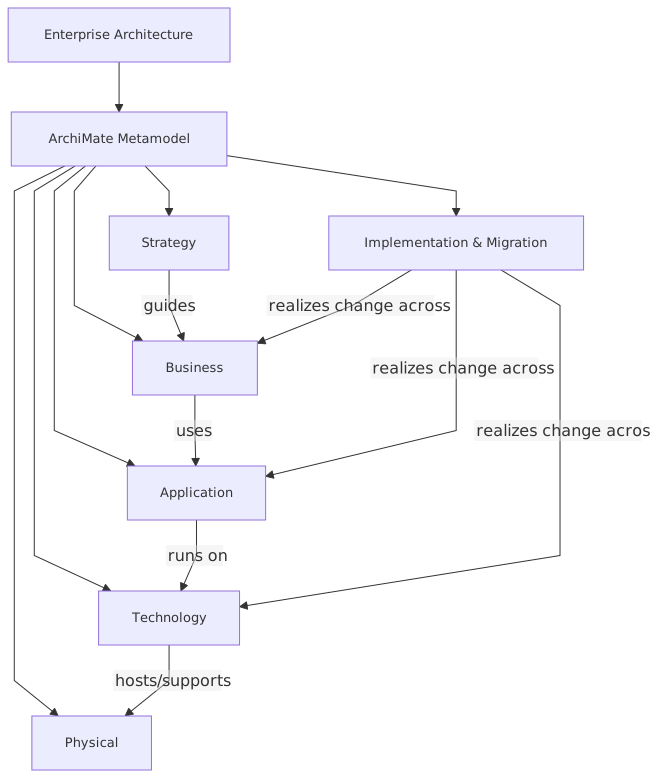
ArchiMate structures the enterprise into layers and aspects. Again, most people know this at a surface level. Business, application, technology, motivation, strategy, implementation, physical, and so on. Fine.
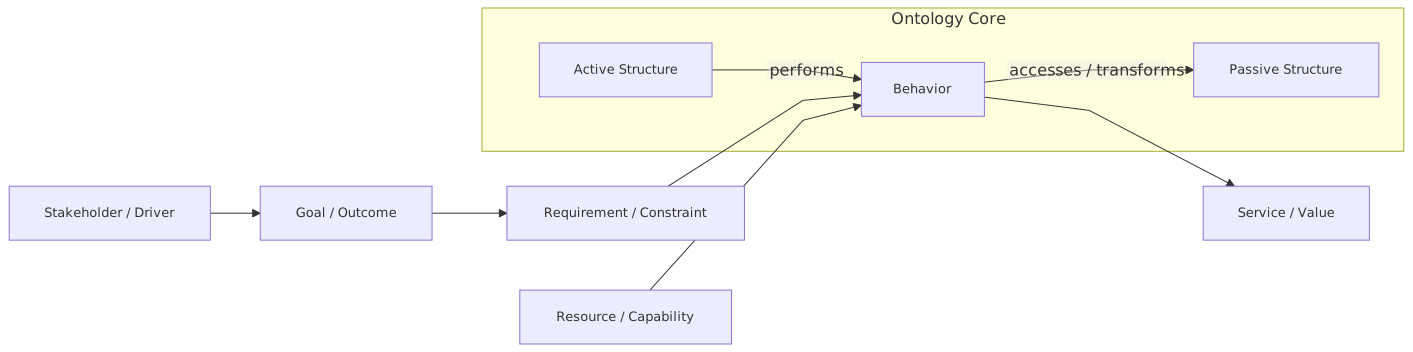
But the real power is in the metamodel’s grammar:
- active structure elements: actors, roles, components, nodes
- behavior elements: processes, functions, interactions, events
- passive structure elements: business objects, data objects, artifacts
- motivation elements: stakeholders, drivers, goals, outcomes, requirements, constraints
- strategy elements: capabilities, resources, value streams, courses of action
- implementation/migration elements: work packages, deliverables, plateaus, gaps
The grammar matters because enterprises are not just collections of systems. They are systems of:
- intent,
- behavior,
- structure,
- information,
- and change.
A metamodel-based ontology gives you a way to express all of those without collapsing them into one category.
That sounds dry until you’re doing impact analysis on a major cloud migration.
Then it becomes very practical.
A practical view: what this looks like in real architecture work
Let’s take a concrete enterprise scenario.
Imagine a retail bank modernizing customer onboarding.
Current state:
- legacy branch onboarding system
- online onboarding portal
- fragmented IAM stack
- Kafka introduced as an event backbone
- fraud and AML checks moved to cloud-hosted services
- customer data spread across core banking, CRM, and onboarding databases
Leadership wants:
- faster onboarding
- stronger identity proofing
- less manual intervention
- cleaner auditability
- lower operational cost
This is where a lot of architecture teams produce a “target architecture” with five domains and some arrows. Everyone nods. Nothing gets clearer.
Using the ArchiMate metamodel as an ontology changes the exercise.
Business layer
You identify:
- Business actor: Retail Customer
- Business role: Onboarding Agent, Compliance Officer
- Business process: Customer Onboarding
- Business service: Account Opening Service
- Business event: Application Submitted, Identity Verification Failed
- Business object: Customer Application, KYC Record
Strategy and motivation
You capture:
- Driver: Regulatory pressure, customer abandonment rates
- Goal: Reduce onboarding time to under 10 minutes
- Outcome: Increased conversion, improved compliance evidence
- Requirement: MFA for high-risk journeys, immutable audit trail
- Constraint: PII residency in approved cloud regions
- Capability: Identity Verification Capability, Event Processing Capability
Application layer
You model:
- Application component: Digital Onboarding Portal
- Application component: IAM Platform
- Application component: Fraud Decision Engine
- Application component: Customer Master Service
- Application service: Authentication Service, Identity Proofing Service, Customer Profile Service
- Data object: Identity Assertion, Customer Profile, Risk Assessment
Technology layer
You distinguish:
- Node: Kubernetes cluster, managed Kafka cluster, cloud database service
- System software: Kafka brokers, IAM runtime, API gateway
- Technology service: Event Streaming Service, Container Hosting Service, Secrets Management Service
- Artifact: deployment package, container image, configuration bundle
Relationships
And here is the point: the relationships become disciplined.
- Customer Onboarding serves Account Opening Service
- IAM Platform realizes Authentication Service
- Fraud Decision Engine accesses Risk Assessment data
- Managed Kafka cluster realizes Event Streaming Service
- Digital Onboarding Portal uses Authentication Service
- Requirement for MFA influences IAM design choices
- Work package “Cloud IAM Migration” realizes part of the transition plateau
That structure is not bureaucracy. It is clarity.
Now you can ask useful questions:
- Which business services depend on Kafka directly, and which only depend on application services that happen to use Kafka?
- Which requirements are motivating IAM controls, and are they regulatory or internal policy?
- What breaks if the cloud fraud service is unavailable?
- Which data objects cross residency boundaries?
- What capabilities are weak because they rely on brittle legacy process steps?
Without a metamodel acting as ontology, those questions become arguments over diagram interpretation.
A useful table: the difference between vague architecture and metamodel-driven architecture
That table is the difference between architecture as decoration and architecture as reasoning.
The Kafka problem: where architects get sloppy fast
Kafka is a great example because people project whatever they want onto it.
In many enterprises, Kafka becomes:
- an integration strategy,
- a product,
- a platform,
- a middleware runtime,
- an event architecture style,
- and somehow also a governance answer.
That is too much semantic weight for one word.
In ArchiMate terms, you need to decide what exactly you are modeling at a given viewpoint.
For example:
- The managed Kafka cluster may be a node or part of technology infrastructure.
- The event streaming capability exposed to teams may be a technology service.
- The messaging platform team may be a business actor or role.
- The topic-based event flow supporting customer onboarding may be represented through behavior and flow relationships.
- The customer-created event schema may be a data object or artifact depending on perspective.
If you just put “Kafka” in the middle with arrows, you’ve explained nothing.
And this matters in real delivery. I’ve seen banks where one team thought Kafka guaranteed replayable audit history, another assumed it was just transient integration plumbing, and a third assumed ownership of message semantics sat with the platform team. Three entirely different ontologies. Same word. Predictable chaos.
The metamodel doesn’t solve politics. Let’s not romanticize it. But it does expose ambiguity early enough that you can force the conversation.
That alone is worth the effort.
IAM is where ontology becomes survival
Identity and access management is another area where architecture gets dangerously fuzzy.
People say “IAM” as if it is one thing. It is not.
In a bank, IAM may include:
- workforce identity
- customer identity and access
- privileged access management
- authentication services
- authorization services
- consent and delegation
- identity proofing
- directory services
- policy administration
- audit and certification processes
If your architecture repository models all of that as one application component called “IAM,” you are not simplifying. You are hiding risk.
The ArchiMate metamodel helps you decompose this correctly.
For customer onboarding, for instance:
- Capability: Customer Identity Assurance
- Business process: Verify Applicant Identity
- Application service: Authentication Service
- Application service: Identity Proofing Service
- Data object: Identity Assertion
- Requirement: Strong customer authentication for high-risk transactions
- Constraint: Identity evidence retained according to jurisdictional policy
- Technology service: Key management, secrets management, logging
Now the architecture can answer real questions:
- Which applications consume authentication versus authorization?
- Which controls are policy-driven versus product-driven?
- Which identity data objects are system-of-record versus derived?
- Which change initiatives impact customer experience and which are invisible back-end improvements?
That is architecture work. Not catalog maintenance.
Common mistakes architects make with the ArchiMate metamodel
Let’s be honest about the failure modes.
1. Treating the metamodel like a compliance checklist
This is probably the most common mistake. Teams think “using ArchiMate” means every model must include every type of element. So they produce diagrams that look methodologically correct and practically useless.
The metamodel is an ontology, not a scavenger hunt.
Use the concepts that clarify the problem. Don’t spray the canvas with every legal relationship.
2. Confusing abstraction levels
Architects often mix strategy, design, and implementation in one view. A capability sits next to a Kubernetes cluster, next to a project work package, next to a user journey. It happens all the time.
Can that be done intentionally? Yes. Should it be done casually? No.
The metamodel allows cross-layer traceability, but traceability is not the same as collapsing levels of abstraction.
3. Modeling products instead of enterprise meaning
A vendor tool is not automatically the architectural concept that matters.
For example, “Okta,” “Ping,” or “ForgeRock” are not your ontology. They are products participating in your ontology.
Real architecture should model:
- the services provided,
- the roles assigned,
- the data accessed,
- the requirements fulfilled,
- the constraints imposed,
- and the dependencies created.
Product-centric models age badly.
4. Using relationships lazily
If every arrow is just “connects to,” your model is dead on arrival.
The difference between:
- serving
- realization
- assignment
- access
- triggering
- flow
- influence
is not pedantic. It’s the whole point.
A process triggering another process is not the same as an application service serving a business process. If your repository doesn’t preserve those distinctions, automated analysis becomes garbage.
5. Pretending the metamodel removes the need for judgment
This is the contrarian bit some people don’t like.
The ArchiMate metamodel does not make architecture objective. It does not magically resolve domain ambiguity. It does not guarantee useful models. Bad architects can hide behind standards just as easily as they hide behind PowerPoint.
You still need judgment. You still need to decide where the enterprise boundary is. You still need to define modeling conventions. You still need to challenge false precision.
The metamodel is a discipline aid, not a substitute for thinking.
A real enterprise example: a bank modernizing event-driven onboarding in the cloud
Let’s make this more concrete.
A mid-sized bank I’ll describe in generic terms had a familiar mess:
- branch onboarding on a legacy workflow platform
- digital onboarding in a separate web stack
- IAM split between workforce AD, customer auth platform, and custom authorization logic
- point-to-point integrations into AML and fraud tools
- a strategic push to cloud and event-driven architecture using Kafka
The architecture team initially documented the target state in the usual way:
- channels
- shared services
- integration layer
- data layer
- cloud platform
Looked clean. Did not survive first contact with delivery.
Why? Because the model didn’t distinguish what was being claimed.
For example:
- Was Kafka a replacement for all integration or only for event publication?
- Was the IAM target for workforce, customer, or both?
- Was cloud adoption a hosting decision, an operating model change, or a resilience strategy?
- Who owned customer identity data after onboarding?
- Which services were synchronous and which were event-driven?
The reset happened when the team reworked the architecture around the metamodel.
They mapped:
- goal: reduce abandonment and improve compliance evidence
- capabilities: customer onboarding, identity assurance, event processing, fraud decisioning
- business processes: capture application, verify identity, perform screening, open account
- application services: authentication, identity proofing, application submission, event publication, risk scoring
- data objects: customer application, identity assertion, onboarding event, screening result
- technology services: event streaming, container hosting, managed database, centralized logging
- constraints: data residency, encryption standards, vendor exit requirements
- work packages: migrate auth flows, introduce onboarding event model, retire branch workflow dependency
That changed conversations immediately.
The bank discovered three important things.
First: Kafka was over-scoped
Teams had assumed Kafka would become the default mechanism for all integration. The metamodel-driven analysis showed that several critical fraud and IAM interactions were request/response services with strict latency and transactional semantics. Eventing was useful for state propagation and analytics, not as a universal hammer.
That sounds obvious now. It wasn’t obvious in the program.
Second: IAM ownership was blurred
By separating business process, application service, and data object responsibilities, the bank realized customer identity proofing, authentication, and authorization had different owners and different change cadences. One “IAM roadmap” had been hiding three separate architectures.
Again, common problem.
Third: cloud migration was not one thing
Some onboarding services moved cleanly to cloud-native containers. Others depended on regional data constraints and mainframe-adjacent systems. Modeling constraints and implementation plateaus properly stopped the team from pretending there was one neat migration wave.
The result wasn’t a perfect target state. Those don’t exist. But the architecture became much more honest. And honest architecture is far more valuable than elegant fiction.
The contrarian view: ArchiMate is useful partly because it is incomplete
Here’s a view that may annoy standards purists: ArchiMate works in practice partly because it is not a fully closed formal ontology.
If it were too rigid, most enterprises couldn’t use it. Real organizations are messy. Meanings shift. Boundaries are negotiated. Architecture often needs controlled ambiguity early on.
So yes, call the metamodel an ontology—but a pragmatic one.
It gives enough semantic structure to support:
- consistency,
- traceability,
- impact analysis,
- and communication,
without forcing architects into an academic formalism nobody in delivery will tolerate.
That balance matters.
Some architects want enterprise modeling to become mathematically precise. I understand the appeal. But most transformation work is constrained less by logic than by organizational incoherence. You need a model that can survive contact with budget owners, security teams, cloud engineers, and compliance officers.
ArchiMate can do that if used well.
Not because it is perfect, but because it is disciplined enough.
How to use the metamodel as an ontology in day-to-day EA practice
If you want this to work in real architecture work, do a few things consistently.
Define local modeling conventions
ArchiMate gives you the metamodel, but your enterprise still needs interpretation rules.
For example:
- when do we model a platform as an application component versus technology service?
- how do we distinguish business service from application service in executive-facing views?
- how do we represent externally managed SaaS?
- what relationships are mandatory for traceability between goals, capabilities, applications, and work packages?
If you don’t define these, teams will improvise. Improvisation kills semantic consistency.
Model for questions, not for completeness
Start with the decision you need to support.
Examples:
- What is impacted if IAM authentication changes?
- Which onboarding steps rely on Kafka events?
- Which cloud services create regulatory constraints?
- Which capabilities are not adequately supported by current applications?
Then build the minimum metamodel-consistent view that answers the question.
Separate canonical repository from communication views
This is crucial.
Your repository should preserve semantic rigor. Your stakeholder views should simplify aggressively.
Executives do not need every relationship type. Delivery teams do not need motivational theory in every session. But the simplified views must be derived from a disciplined model, not invented from scratch each time.
Use the metamodel to challenge language
When someone says:
- “the platform does onboarding”
- “Kafka is our integration architecture”
- “IAM owns customer identity”
- “the cloud solves resilience”
pause and ask what kind of thing they mean.
That’s not pedantry. It is architecture hygiene.
Trace change explicitly
One of the most underused parts of ArchiMate is linking implementation and migration concepts back to the rest of the model.
If your work packages, plateaus, and gaps are disconnected from capabilities, requirements, services, and components, your roadmap is just project inventory. ArchiMate in TOGAF ADM
A real architecture roadmap should be semantically traceable.
What good looks like
A good metamodel-driven enterprise architecture repository is not necessarily huge. In fact, smaller is often healthier.
What good looks like is:
- key concepts used consistently
- relationship semantics respected
- abstraction levels intentional
- stakeholder views derived from a stable core
- capability-to-service-to-application-to-technology traceability where it matters
- goals and constraints visibly connected to design choices
- implementation work linked to actual architecture change
And maybe most importantly:
- models that people can disagree with productively
That last one matters. Good ontology doesn’t eliminate debate. It improves the quality of debate.
Instead of arguing vaguely about “the target platform,” people argue specifically about whether a service is realized by one application component or several, whether a requirement genuinely influences a design, or whether an event is business-significant or merely technical.
That is progress.
Final thought
The ArchiMate metamodel is not just a schema for architecture tools and not just a notation behind pretty diagrams. Used properly, it is a practical ontology for enterprise architecture.
And enterprise architecture needs that more than it needs another framework poster.
Because the core failure in many architecture practices is not lack of artifacts. It’s lack of semantic discipline. Too many models say everything and mean nothing.
The metamodel gives architects a way to define enterprise reality with more precision:
- what exists,
- what depends on what,
- what serves what,
- what realizes what,
- what changes,
- and why.
In banking, in IAM, in Kafka-heavy integration landscapes, in cloud transformation, this becomes very real very quickly. It helps separate business intent from platform fashion. It exposes where language is masking risk. It makes impact analysis less theatrical and more credible.
Is ArchiMate enough on its own? No. Of course not.
You still need judgment, modeling discipline, and the courage to tell people their favorite architecture slogan does not survive semantic scrutiny.
But if you start treating the ArchiMate metamodel as an ontology instead of a stencil, your architecture practice gets sharper. Less decorative. More operational. More honest.
And frankly, that’s what enterprise architecture should have been doing all along.
FAQ
1. Is ArchiMate really an ontology, or is that overstating it?
Strictly speaking, it is not a fully formal ontology in the semantic-web sense. Practically, though, it behaves like one for enterprise architecture: it defines concepts, categories, and valid relationships so teams can model enterprise reality consistently.
2. How is this useful in real architecture work, not just modeling?
It helps with impact analysis, ownership clarity, roadmap traceability, and design decisions. In real programs—like banking onboarding, IAM transformation, or cloud migration—it stops teams from mixing goals, services, systems, and technology into one vague picture.
3. How should I model Kafka in ArchiMate?
Not as a magical box in the middle. Decide what you mean: platform component, technology service, event flow support, schema artifact, or integration pattern. Different viewpoints may show different aspects, but each view should be semantically clear.
4. What is the biggest mistake architects make with the ArchiMate metamodel?
Using it as notation only. The second biggest is inconsistent abstraction—mixing capabilities, apps, cloud infrastructure, and projects in one uncontrolled diagram. That destroys meaning fast.
5. Can ArchiMate help with IAM and cloud architecture?
Yes, especially because both domains are full of overloaded language. ArchiMate helps separate capabilities, services, data, controls, components, and infrastructure so architects can reason clearly about authentication, authorization, identity proofing, cloud hosting, and compliance constraints.
Frequently Asked Questions
What is the ArchiMate metamodel?
The ArchiMate metamodel formally defines all element types (Business Process, Application Component, Technology Node, etc.), relationship types (Serving, Realisation, Assignment, etc.), and the rules about which elements and relationships are valid in which layers. It is the structural foundation that makes ArchiMate a formal language rather than just a drawing convention.
How does the ArchiMate metamodel support enterprise governance?
By defining precisely what each element type means and what relationships are permitted, the ArchiMate metamodel enables consistent modeling across teams. It allows automated validation, impact analysis, and traceability — turning architecture models into a queryable knowledge base rather than a collection of individual diagrams.
What is the difference between using ArchiMate as notation vs as an ontology?
Using ArchiMate as notation means drawing diagrams with its symbols. Using it as an ontology means making formal assertions about what exists and how things relate — leveraging the metamodel's semantic precision to enable reasoning, querying, and consistency checking across the enterprise model.