⏱ 18 min read
Most enterprise architecture diagrams fail for one simple reason: they try to show everything, all at once, to everyone.
That’s not architecture. That’s panic rendered in boxes and lines.
I’ll say it more bluntly: if your ArchiMate model looks like a wiring diagram for a dying data center, you are not “capturing complexity.” You are amplifying confusion. And if business leaders, engineers, risk teams, and platform owners all need different answers, then one giant “single source of truth” view is usually the wrong answer delivered with great confidence.
This is where layered abstraction in ArchiMate matters. Not as a modeling nicety. Not as a repository hygiene exercise. As a survival tool.
What layered abstraction in ArchiMate actually means
Let’s keep this simple early.
Layered abstraction in ArchiMate means modeling the enterprise at different levels of detail, so different stakeholders can understand the same reality without drowning in unnecessary complexity.
At a high level, you might show:
- business capability
- application service
- technology platform
- key data objects
- major relationships
At a more detailed level, you might show:
- event-driven integration via Kafka
- IAM trust boundaries
- cloud landing zones
- application components and deployment nodes
- control points and ownership boundaries
Same enterprise. Different zoom levels.
That’s the point.
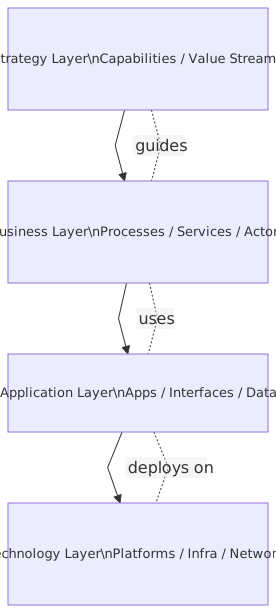
ArchiMate already gives us structure with business, application, and technology layers. But in real architecture work, layered abstraction is not just about ArchiMate layers. It’s also about levels of granularity inside and across those layers.
For example:
- Executive view: “Customer onboarding depends on identity verification, account creation, and risk checks.”
- Solution view: “The onboarding application consumes KYC events from Kafka and calls the IAM platform for token validation.”
- Platform view: “Kafka runs as a managed cloud service across two regions with topic-level ACLs integrated to enterprise IAM.”
- Operational view: “This service account has over-broad publish rights and violates separation of duties.”
All of those are valid. None of them should be crammed into one diagram.
That’s the core opinion of this article: good enterprise architecture is not one model with infinite detail. It is a coherent set of abstractions tied together deliberately.
And honestly, too many architects still get this wrong.
Why enterprise architecture gets messy so fast
Large enterprises are not just “complex.” That word is too soft.
They are layered systems of:
- old and new technology
- formal and informal processes
- product teams and central teams
- policy and exceptions
- duplicated capabilities
- political ownership boundaries
- controls that exist on paper but not in implementation
In banking, this gets even worse because every important thing is regulated, audited, integrated, and usually inherited from three previous generations of architecture.
Take a common banking scenario:
A retail bank wants to modernize customer onboarding.
On paper, it sounds straightforward:
- collect customer details
- verify identity
- check AML/KYC rules
- open account
- issue digital access
In reality, onboarding touches:
- mobile app and web channels
- customer master data
- CRM
- identity and access management
- fraud systems
- document services
- core banking
- messaging backbone like Kafka
- cloud API gateway
- compliance reporting
- branch systems
- call center tooling
Now ask five stakeholders what matters.
- The COO wants cycle time and exception rates.
- The CISO wants trust boundaries and privileged access.
- The cloud platform team wants deployment patterns.
- The integration lead wants event ownership and consumer contracts.
- The regulator wants control evidence and accountability.
If you produce one “complete” model, nobody gets what they need.
That is why abstraction is not optional. It is the only way to make architecture usable.
ArchiMate gives you the language. Abstraction gives you the discipline.
ArchiMate is useful because it provides a common vocabulary across business, application, technology, strategy, motivation, and implementation concerns. That matters. It lets you connect a capability to an application service to a node to a requirement to a work package. Very powerful.
But here’s the contrarian bit: ArchiMate by itself does not save you from bad architecture thinking.
I’ve seen teams proudly use ArchiMate and still produce: ArchiMate modeling guide
- unreadable diagrams
- meaningless relationships
- fake precision
- repository sprawl
- “business architecture” that is just application inventory with nicer colors
The notation is not the hard part. The hard part is deciding:
- what to hide
- what to reveal
- what question the model answers
- what level of truth is needed
- when detail becomes noise
Layered abstraction is that discipline.
In practice, that usually means creating a model stack that looks something like this:
- Context level
What enterprise outcome or value stream are we talking about?
- Domain level
What business capabilities, major applications, data domains, and platforms are involved?
- Solution level
How do specific services, integrations, and controls work together?
- Implementation or operational level
What components, deployments, interfaces, permissions, and runtime dependencies exist?
The mistake is thinking these are separate worlds. They are not. They are linked views of the same architecture.
A practical way to think about layered abstraction
Here’s the simple test I use in real architecture work:
Every ArchiMate view should answer a specific stakeholder question at a specific level of abstraction.
If it doesn’t, it’s probably vanity modeling.
A useful abstraction stack
This is not theory. This is how you stop architecture from becoming decorative.
Real enterprise example: digital onboarding in a bank
Let’s make this concrete.
A mid-sized bank is modernizing digital customer onboarding. The target state is cloud-first, event-driven, and integrated with centralized IAM. Kafka is the enterprise event backbone. Core banking remains partially on-prem. The onboarding journey spans mobile, web, branch-assisted, and partner channels.
Level 1: executive/context view
At the highest level, the architecture should show something like:
- Business capability: Customer Onboarding
- Related capabilities: Identity Verification, Risk Assessment, Account Opening, Access Provisioning
- Business services: Open Account, Verify Customer, Issue Digital Access
- Major applications: Onboarding Platform, IAM Platform, Core Banking, Fraud Engine, CRM
- Technology/platforms: Cloud Integration Platform, Kafka Event Streaming Platform
This view is useful because it tells leadership:
- what capabilities are impacted
- which major systems matter
- where strategic dependencies sit
- what transformation scope really means
This is where architects often go wrong. They start adding topics, APIs, containers, service accounts, and subnet details. Completely unnecessary. Leadership does not need to see that Kafka topic naming is inconsistent. They need to know onboarding depends on the event platform and IAM modernization.
Level 2: domain/landscape view
Now we go one level deeper.
Here, we model:
- customer onboarding process stages
- application services supporting each stage
- key data objects like Customer Profile, Verification Result, Account Request
- major integrations between onboarding, IAM, fraud, core banking, and CRM
- event-driven interactions via Kafka
- ownership boundaries between teams or domains
This is where useful architecture work starts happening.
For example:
- The onboarding platform serves the account initiation application service.
- The fraud engine serves risk scoring.
- Kafka serves event distribution capabilities.
- IAM serves authentication and token issuance.
- Customer Profile is accessed by CRM and onboarding.
- Verification Result is used by account opening.
At this level, domain architects can ask the right questions:
- Is onboarding too tightly coupled to core banking?
- Are we using Kafka as a proper event backbone or just as a queue replacement?
- Is IAM truly centralized or do channels still have local authentication logic?
- Who owns customer identity data versus access identity?
And yes, those are different things. Many enterprises still blur them, and it causes endless confusion.
Level 3: solution/design view
Now we get into actual design.
Suppose the onboarding solution works like this:
- Mobile app submits onboarding request through API gateway.
- Onboarding service authenticates via centralized IAM.
- Customer verification request is published to Kafka.
- KYC and fraud services consume the event.
- Results are published back as events.
- Account opening service invokes core banking APIs.
- IAM provisions digital credentials and entitlements.
- CRM is updated asynchronously.
At this level, the model should show:
- application components
- interfaces
- events and services
- trust boundaries
- synchronous vs asynchronous interaction
- where policy enforcement happens
- where cloud services are involved
This is where architecture becomes useful for engineering and security teams.
And this is also where architects make some of the worst mistakes.
Common mistakes architects make with layered abstraction
1. Confusing layers with audiences
ArchiMate has layers. Stakeholders have concerns. These are not the same thing.

A technology-layer diagram can still be useful to an executive if it only shows strategic platforms and risk concentration. A business-layer diagram can be useless to the business if it is too abstract to support decisions.
Don’t hide behind the framework. Model for decisions.
2. Trying to create one “master diagram”
This is the classic failure mode.
The architect says, “We need one integrated enterprise view.” Sounds mature. Usually ends badly.
A repository can be integrated. A diagram should be selective.
If one view includes:
- capabilities
- business processes
- application components
- Kafka topics
- cloud landing zones
- IAM roles
- legal entities
- implementation projects
then it answers nothing well.
3. Modeling nouns without behavior
Another common issue: architects inventory things but don’t model what they do.
They list applications, platforms, and data stores. Fine. But where are the services? The flows? The dependencies? The events? The access relationships? The outcomes?
In a Kafka-based architecture, for example, it is not enough to show “Kafka Platform” connected to ten systems. That tells us almost nothing. The architecture value comes from showing:
- what events are produced
- which domain owns them
- who consumes them
- whether interactions are asynchronous or not
- where control and trust boundaries exist
Otherwise you’re just drawing middleware in the middle and calling it architecture.
4. Going too abstract for too long
Some enterprise architects love altitude because detail is messy and politically dangerous.
So they stay at capability maps and target-state posters for six months. ArchiMate capability map
That’s not strategy. That’s avoidance.
If your abstract model never resolves into design constraints, ownership, interfaces, and control points, it is not architecture. It is brand management.
5. Going too detailed too early
The opposite problem also happens, especially with technically strong architects.
They jump straight into:
- topic taxonomies
- OAuth flows
- VPC peering
- Kubernetes namespaces
- service mesh policy
- IAM group nesting
before the enterprise-level service boundaries are agreed.
This creates a polished answer to the wrong question.
6. Failing to model ownership
This one is huge in real enterprises.
Architects model systems and flows but not ownership. Then everyone acts surprised when cross-domain dependencies stall delivery.
In the bank onboarding example, you need to know:
- who owns the onboarding journey
- who owns IAM
- who governs Kafka platform standards
- who owns customer profile data
- who controls cloud networking and landing zones
- who approves privileged access patterns
Without ownership, your architecture is technically accurate and operationally useless.
7. Treating IAM as just a technical service
IAM is not just another box on a technology diagram.
In modern enterprise architecture, IAM is a control plane. It shapes:
- user journeys
- machine-to-machine trust
- segregation of duties
- onboarding and offboarding
- auditability
- platform access
- data access patterns
Yet many ArchiMate models place IAM in a corner as a shared service, with a few arrows pointing at it. That underplays its architectural significance.
In cloud and Kafka environments especially, IAM should often be shown as a first-class dependency and trust boundary.
How layered abstraction applies in real architecture work
This is the part that matters most. How do you actually use it when the meeting calendar is full and the program is already late?
1. Use abstraction levels to structure architecture conversations
Different forums need different views.
For example:
- Steering committee: capability impact, strategic dependencies, risk concentration
- Domain architecture review: service boundaries, data ownership, integration patterns
- Security review: trust boundaries, IAM roles, token flows, privileged access, control inheritance
- Engineering design review: component interactions, runtime patterns, failure modes
- Operational readiness review: deployment topology, observability, support ownership, resilience
One repository. Multiple views. Deliberate abstraction.
2. Use high-level views to expose hidden coupling
In banking, modernization often fails because “digital” channels still depend on tightly coupled legacy processes.
A good domain-level ArchiMate view can reveal: ArchiMate tutorial
- onboarding claims to be omnichannel but branch and digital use different identity verification paths
- Kafka exists, but key systems still require synchronous core banking calls
- IAM is centralized for workforce users but fragmented for customers and service accounts
- cloud services are adopted, but network and security controls are still manually brokered
You don’t need implementation detail to expose these issues. You need the right abstraction.
3. Use solution-level views to challenge architecture theater
A lot of organizations say they are event-driven. Many are not.
If your solution-level ArchiMate view shows:
- every service still depends on direct synchronous calls
- Kafka is only used for notifications after the real transaction completes
- event ownership is unclear
- consumers rely on internal payload structures
- IAM for service identities is manually provisioned
then the architecture is not event-driven in any meaningful sense.
This is where layered abstraction becomes diagnostic. It helps distinguish aspiration from reality.
4. Use operational views for control evidence
This matters a lot in regulated enterprises.
Auditors and risk teams don’t care that your target architecture says “secure by design.” They care that:
- service identities are controlled
- topic access is restricted
- cloud roles are scoped
- production and non-production are separated
- customer data access is governed
- key controls map to actual platforms and responsibilities
A well-structured ArchiMate model can support that evidence trail, if the abstraction levels are linked properly.
Kafka, IAM, and cloud: where abstraction gets tricky
These three areas expose bad modeling very quickly.
Kafka
Many architects either over-model Kafka or under-model it.
Over-modeling looks like:
- every topic
- every partition strategy
- every consumer group
- every schema nuance
That belongs in engineering design, not enterprise architecture, unless it directly affects enterprise decisions.
Under-modeling looks like:
- one “Kafka Platform” box with twenty arrows
Also useless.
The right middle ground at enterprise and domain levels is to show:
- event backbone as a platform service
- major event domains
- producer and consumer ownership
- critical event dependencies
- where asynchronous decoupling is real versus cosmetic
In the bank example:
- Onboarding publishes CustomerVerificationRequested
- KYC and Fraud consume it
- AccountOpeningRequested is triggered only after required results
- CRM consumes CustomerOnboarded
- Analytics consumes anonymized event streams
That is meaningful architecture.
IAM
IAM suffers from false simplification.
Architects often collapse all identity concerns into one element. Bad idea.
At minimum, in enterprise models you often need to distinguish:
- workforce identity
- customer identity
- machine identity
- authorization and entitlements
- privileged access
- federation or trust relationships
In cloud-heavy environments, machine identity and authorization patterns are often the real architecture issue, not login screens.
For Kafka specifically, IAM-related questions include:
- how producer and consumer identities are issued
- how topic-level access is enforced
- whether service accounts are local or federated
- how secrets and credentials are rotated
- how audit trails map to enterprise identity governance
If your model ignores that, it misses the control architecture.
Cloud
Cloud architecture diagrams often become infrastructure diagrams wearing enterprise architecture clothing.
The enterprise architect does not need to show every subnet and route table. But they do need to show:
- landing zone boundaries
- shared platform services
- identity dependencies
- resilience patterns
- region strategy
- control inheritance
- where managed services change operational responsibilities
For the bank onboarding example, a useful cloud-level abstraction might show:
- onboarding services deployed in cloud application runtime
- Kafka as managed event platform
- IAM integrated with enterprise identity provider
- core banking connectivity to on-prem via controlled integration boundary
- data residency constraints by region
That’s enough to support enterprise decisions without pretending to be a Terraform plan.
A better modeling pattern for enterprise architects
Here’s the pattern I recommend. It’s not fancy, but it works.
Model from outside in
Start with:
- business outcome
- capability impact
- major services
- ownership boundaries
Then move inward:
- application collaboration
- integration pattern
- data objects
- technology services
- controls
- deployment dependencies
Not the other way around.
Starting from technical detail creates accidental architecture. Starting from outcomes creates intentional architecture.
Make every view answer one question
Examples:
- What business capabilities depend on IAM modernization?
- Which onboarding services are tightly coupled to core banking?
- Where is Kafka providing actual decoupling?
- Which trust boundaries exist between customer channels and internal services?
- What cloud platform services are critical to onboarding resilience?
If the view answers two or three adjacent questions, fine. If it answers twelve, it’s too broad.
Link abstract and detailed views explicitly
This is where mature modeling pays off.
A high-level application service should trace to:
- supporting application components
- consumed technology services
- relevant data objects
- associated controls and requirements
That traceability is what makes abstraction credible rather than hand-wavy.
Show what is stable, not just what is current
This is another contrarian point.
Too many architecture models mirror the current org chart or current implementation details. Those change constantly. The model becomes stale in weeks.
Focus on relatively stable abstractions:
- business capabilities
- enduring services
- domain ownership
- major trust boundaries
- platform dependencies
Then attach volatile implementation detail where needed, but don’t let it define the architecture.
What good layered abstraction feels like
You know it’s working when:
- executives can understand transformation scope in five minutes
- engineers don’t roll their eyes because the lower-level views are technically credible
- security teams can identify trust and control boundaries
- product teams can see ownership and dependencies
- auditors can trace controls to platforms and services
- the model helps people make decisions instead of admire notation
That last point matters. A lot.
Architecture is not there to impress other architects. If I’m being honest, that’s one of the profession’s recurring bad habits. We overvalue elegance and undervalue usefulness.
A layered ArchiMate model should create clarity under pressure:
- during portfolio planning
- during migration sequencing
- during incident reviews
- during control assessments
- during merger integration
- during cloud adoption
- during platform rationalization
If it can’t do that, it’s not pulling its weight.
Final thought: abstraction is not hiding detail, it is controlling meaning
Some people hear “abstraction” and assume it means vagueness. It doesn’t.
Bad abstraction is vague.
Good abstraction is precise about what matters at a given level.
That’s the real discipline in ArchiMate.
In enterprise architecture, especially in banking and other regulated sectors, complexity is unavoidable. But confusion is optional. Layered abstraction is how you avoid turning your model into a landfill of partially true facts.
And yes, this requires judgment. There is no magic metamodel setting for that.
You need to decide:
- what question is being answered
- what audience needs to decide
- what detail changes the decision
- what detail only flatters the modeler
Strong architects do this consciously. Weak ones hide behind notation and say the repository is the truth.
It isn’t.
The truth is that enterprises need multiple coherent views of the same system, tied together with discipline. That is what layered abstraction in ArchiMate is for. Not prettier diagrams. Better decisions.
And in the end, that’s the only reason to model anything.
FAQ
1. Is layered abstraction in ArchiMate just the same as using business, application, and technology layers?
No. Those layers are part of it, but layered abstraction also means using different levels of detail within and across those layers. You may have a high-level application landscape view and a much deeper solution interaction view, both in the application layer.
2. How many abstraction levels should an enterprise architecture team use?
Usually three to four is enough: context, domain, solution, and operational/control. More than that often becomes bureaucratic unless you have a very mature repository and strong governance. ArchiMate for governance
3. How do I model Kafka in ArchiMate without overcomplicating it?
At enterprise level, show Kafka as a platform or technology service and represent major event dependencies and ownership. At solution level, show key producers, consumers, and event flows. Don’t dump every topic and consumer group into strategic views.
4. Where should IAM sit in an ArchiMate model?
It depends on the question being answered. IAM can appear as an application service, a technology service, a control dependency, or even a strategic platform capability. In modern cloud environments, it usually deserves more prominence than architects give it.
5. What is the biggest mistake when applying abstraction in real projects?
Trying to make one diagram serve every audience. The repository can be integrated. The views should be selective. If you remember that, your models get more useful very quickly.
Frequently Asked Questions
What is enterprise architecture?
Enterprise architecture is a discipline that aligns an organisation's strategy, business processes, information systems, and technology. Using frameworks like TOGAF and modeling languages like ArchiMate, it provides a structured view of how the enterprise operates and how it needs to change.
How does ArchiMate support enterprise architecture practice?
ArchiMate provides a standard modeling language that connects strategy, business operations, applications, data, and technology in one coherent model. It enables traceability from strategic goals through business capabilities and application services to the technology platforms that support them.
What tools are used for enterprise architecture modeling?
The main tools are Sparx Enterprise Architect (ArchiMate, UML, BPMN, SysML), Archi (free, ArchiMate-only), and BiZZdesign Enterprise Studio. Sparx EA is the most feature-rich option, supporting concurrent repositories, automation, scripting, and integration with delivery tools like Jira and Azure DevOps.