⏱ 20 min read
Most enterprise strategy fails long before delivery teams ever touch a backlog.
That sounds harsh, but if you’ve worked in a large organisation for more than five minutes, you know it’s true. The slide deck says customer-first digital transformation. The portfolio says modernise core platforms. The delivery teams hear migrate some servers, buy another SaaS tool, and somehow reduce risk while increasing speed. Then six months later everyone is surprised that the outcomes are muddy, the architecture is fragmented, and the business still can’t explain why it spent millions.
This is exactly where ArchiMate should help. And too often, it doesn’t.
Not because the language is weak. It’s actually one of the better tools we have for connecting strategy, capabilities, value streams, applications, data, and technology in a way executives and engineers can both use. The problem is that many architects use ArchiMate like a drawing standard, not a thinking tool. They produce sterile diagrams that are technically valid and practically useless. Nice shapes. No decisions. ArchiMate modeling guide
So let’s be blunt: linking strategy to execution using ArchiMate models is not about producing “architecture views”. It’s about making strategy testable. It’s about showing, with enough precision to drive investment and delivery, how a strategic intent turns into capability changes, process changes, application changes, integration changes, and technology changes. If your model can’t influence funding, sequencing, ownership, or risk treatment, it’s decoration.
The simple version first
If someone asked me in a corridor, “How do you link strategy to execution with ArchiMate?” I’d answer like this: ArchiMate tutorial
- Model the strategy: goals, outcomes, drivers, constraints, and required capabilities.
- Model the business impact: value streams, business processes, products, customer journeys, and operating model changes.
- Model the application and data impact: what systems, APIs, events, and information objects need to change.
- Model the technology impact: cloud platforms, integration patterns, security controls, IAM, networking, observability, resilience.
- Model the transition: work packages, plateaus, dependencies, and roadmaps.
- Use those models to answer executive questions: why this, why now, what changes, what depends on what, what risk is reduced, and what gets retired.
That’s it. That’s the core idea.
ArchiMate gives you the structure to connect all of that end to end. Strategy on one side. Delivery on the other. Traceability in the middle. Done well, it becomes a decision-making instrument. Done badly, it becomes a very expensive wallpaper format.
Why this matters in real architecture work
In real enterprise architecture work, nobody pays you to make abstract models. They pay you to reduce ambiguity.
The business says:
- We need to improve customer onboarding.
- We need to launch products faster.
- We need to lower operational risk.
- We need to migrate to cloud.
- We need better identity security.
- We need event-driven integration.
Those are not architecture instructions. They’re directional statements. Somebody has to turn them into executable change. That “somebody” is usually architecture, whether the organisation admits it or not. TOGAF roadmap template
And this is where ArchiMate is useful because it lets you map:
- Drivers like regulatory pressure, cost pressure, fraud growth, or customer churn
- to Goals like faster onboarding, lower fraud losses, or reduced identity risk
- to Capabilities like customer identity verification, event streaming, access governance, or cloud platform engineering
- to Value streams and processes like retail account opening or payments exception handling
- to Applications and services like CRM, onboarding portal, IAM platform, Kafka platform, fraud engine
- to Technology services and infrastructure like managed Kafka, cloud landing zones, PKI, secrets management, observability stack
- to Work packages and transitions that delivery teams can actually execute
This is not theory. This is what stops strategy becoming a vague slogan.
The uncomfortable truth: most architecture models start too low
A common mistake architects make is starting with systems. They jump straight into application landscapes, interfaces, event flows, cloud zones, and security patterns. That work matters, obviously. But if you start there, you’ve already lost the strategic thread.
You end up with statements like:
- “We are implementing Kafka.”
- “We are introducing central IAM.”
- “We are moving workloads to AWS/Azure/GCP.”
- “We are rationalising applications.”
None of those are strategies. They are means. Sometimes good means, sometimes bad means. But still means.
A proper architecture narrative sounds more like:
- “To reduce retail onboarding abandonment by 20% and meet new KYC obligations, we need a reusable digital identity and consent capability, which requires changes across customer channels, IAM, event integration, and case management.”
- “To reduce time-to-market for lending products from 9 months to 3 months, we need decoupled product orchestration and event-driven integration, which means Kafka is a platform enabler, not the objective.”
- “To reduce privileged access risk in cloud operations, we need stronger identity governance and workload identity patterns, not just another SSO rollout.”
That distinction matters. A lot.
Strategy is not a box at the top of the diagram
Another thing architects get wrong: they treat strategy as a symbolic layer. A few boxes at the top labelled “Growth”, “Efficiency”, “Compliance”, then a huge stack of application and technology components underneath. It looks connected, but it isn’t. The relationships are often weak, generic, or frankly invented.
Good ArchiMate modelling forces harder questions:
- Which goal is this initiative serving?
- Which capability is changing?
- Which value item or business outcome improves?
- Which stakeholders care?
- Which constraints are non-negotiable?
- Which applications realise the capability?
- Which technology services enable those applications?
- Which work packages create the transition?
- Which plateau defines the before and after state?
If you can’t answer those, your model is not linking strategy to execution. It’s just layering nouns.
A practical way to structure ArchiMate models
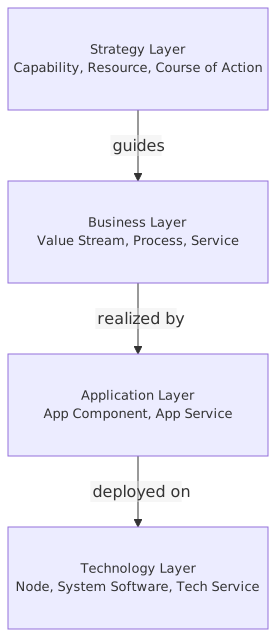
I prefer a simple, opinionated chain. Not because ArchiMate demands it, but because organisations need clarity more than purity.
Here’s the chain:
If you build your architecture around this chain, you can usually have a sensible conversation with both executives and engineers. That’s rare. Valuable too.
Real example: a bank modernising customer onboarding
Let’s make this concrete.

Imagine a mid-sized retail bank. It has a strategic objective to grow current accounts among younger customers and small businesses. At the same time, regulators are tightening KYC and fraud controls. The bank’s onboarding process is slow, fragmented, and partly manual. Customers bounce between mobile app, web portal, branch, and back-office review. Identity proofing is clunky. Internal teams have duplicated customer data. Access to onboarding systems is messy. Integration between channels and core systems is batch-heavy. Leadership wants “digital onboarding in the cloud”.
That phrase alone should make any architect nervous. It’s too vague to guide execution.
Step 1: model the strategic intent
At the strategy layer, you might model:
- Drivers
- Increased digital competition
- Regulatory KYC obligations
- Rising fraud attempts
- Cost pressure in operations
- Goals
- Reduce onboarding completion time from 2 days to 15 minutes for low-risk customers
- Increase onboarding conversion by 25%
- Reduce manual review volume by 40%
- Improve auditability and access control compliance
- Outcomes
- Faster account opening
- Lower operational cost per application
- Reduced identity-related risk
- Better customer satisfaction
- Capabilities
- Digital identity verification
- Consent and customer profile management
- Case management and exception handling
- Event-driven integration
- Identity and access governance
- Cloud platform engineering
Already this is better than “move onboarding to cloud”. We now know what success means.
Step 2: model the business change
Now map the business impact.
The relevant value stream might be:
- Discover product
- Apply
- Verify identity
- Assess risk
- Open account
- Activate services
The impacted business processes might include:
- Retail account application
- KYC screening
- Fraud review
- Customer record creation
- Credential issuance
- Welcome journey initiation
The key business roles:
- Customer
- Operations analyst
- Fraud analyst
- Contact centre agent
- Branch advisor
- Identity operations team
This matters because strategy usually dies in the gap between aspiration and operating model. If your model doesn’t show how work changes for these roles, you are not doing enterprise architecture. You’re doing enterprise illustration.
Step 3: model the application and data landscape
Now we get to systems.
Applications involved might include:
- Mobile banking app
- Web onboarding portal
- CRM/customer master
- KYC screening service
- Fraud decision engine
- IAM platform
- Consent service
- Case management platform
- Core banking account service
- Notification service
- Kafka event platform
Key data objects:
- Customer identity profile
- Application record
- Consent record
- Risk assessment
- Account record
- Access entitlement
- Audit event
This is where ArchiMate really helps because you can show which application services support which business services, and which data objects are created, consumed, or updated. You can also expose duplication and ambiguity. In banking, there is almost always too much ambiguity around customer data ownership. Everyone says they have the customer record. Usually nobody truly owns it.
Step 4: model the technology and security enablers
Here’s where many architecture teams either overdo the detail or avoid it completely.
You do need enough detail to make execution credible.
Technology services might include:
- Managed Kafka event streaming
- Cloud container platform
- API gateway
- Identity federation
- Privileged access management
- Logging and observability
- Secrets management
- Key management service
- Network segmentation
- CI/CD platform
For IAM, model explicitly:
- Customer identity service for authentication and registration
- Workforce identity service for staff access
- Role and policy administration
- Access review and certification
- Privileged session controls
- Workload identity for services running in cloud
That last one is often ignored. Bad idea. Modern cloud architecture without workload identity discipline becomes a credential sprawl problem very quickly.
Step 5: model the transition architecture
Now the important bit. Because strategy only reaches execution through transition.
A sensible roadmap might look like:
- Establish cloud landing zone and security baseline
- Implement IAM foundations for workforce and customer identity
- Stand up Kafka platform and event governance
- Modernise onboarding channel and identity verification flow
- Integrate KYC, fraud, and case management via events and APIs
- Migrate downstream account-opening orchestration
- Decommission manual handoffs and redundant identity stores
In ArchiMate, use:
- Work Packages for these chunks of change
- Plateaus for current state, interim state, target state
- Gaps to show what’s missing between plateaus
- Deliverables to anchor accountability
This is where architecture becomes useful to portfolio and programme leadership. It helps answer:
- What must happen first?
- What can run in parallel?
- What creates risk if delayed?
- What can be retired after each transition?
Without this, “strategy execution” becomes a bunch of disconnected projects.
Where Kafka fits — and where architects get it wrong
Let’s talk Kafka, because it’s a perfect example of architectural confusion.
In many enterprises, Kafka becomes a strategy by accident. Suddenly everyone is saying:
- “We’re going event-driven.”
- “Kafka is our integration backbone.”
- “All new systems publish events.”
Fine. But why? For what business purpose? Which value streams need event-driven behaviour, and which do not? Not every integration problem deserves Kafka. Sometimes a plain API is enough. Sometimes a batch process is still acceptable. Architects who force event streaming everywhere are often solving for elegance, not enterprise value.
In the banking onboarding example, Kafka is useful when you need:
- Near real-time propagation of onboarding events
- Decoupling between channel, risk, case management, and notification services
- Better observability of business milestones
- Reusable event streams for downstream analytics and fraud monitoring
ArchiMate helps by placing Kafka in the right role:
- not as the goal
- but as a technology service or platform enabler
- realising application interactions that support business capabilities
- which in turn support strategic outcomes
That hierarchy matters. It stops platform enthusiasm from becoming architecture theatre.
A common mistake is modelling Kafka as a giant central box with everything attached. Looks impressive. Tells you nothing. Better to model:
- event producers
- event consumers
- the business events involved
- governance boundaries
- ownership of topics
- critical non-functional constraints like retention, replay, privacy, resilience
Then you can have an adult conversation about whether the platform design matches the business need.
IAM is usually more strategic than people admit
Identity and access management is another area where architects undersell the strategic link.
IAM is often treated as plumbing. SSO, MFA, directories, policies. Important, yes, but somehow peripheral. That’s a mistake.
In real organisations, IAM is directly tied to:
- customer conversion
- fraud reduction
- workforce productivity
- auditability
- segregation of duties
- cloud security posture
- third-party access control
In our bank example, onboarding strategy cannot succeed if customer identity proofing is weak, consent handling is fragmented, staff access to case tooling is over-privileged, and cloud workloads rely on static secrets. That’s not just a security issue. It is a strategy execution issue.
In ArchiMate, IAM should appear across layers:
- As a capability: identity and access governance
- As business services: user access administration, identity proofing, consent management
- As application services: authentication, authorisation, token issuance, access review
- As technology services: federation, secrets management, PAM, policy enforcement
- As work packages: workforce IAM uplift, customer IAM modernisation, workload identity rollout
That multi-layer traceability is exactly why ArchiMate is useful. It lets you show IAM not as a side project, but as an enabler of strategic goals.
Cloud is not the strategy either
This should not need saying, but apparently it does: cloud migration is not a strategy.
It can support a strategy. It can accelerate one. It can also distract from one.
A lot of architecture teams model cloud adoption as if moving workloads onto a hyperscaler automatically creates business value. It doesn’t. If anything, rushed cloud moves often increase complexity before they deliver any meaningful gain.
In ArchiMate, cloud should be modelled in relation to:
- the capabilities it enables
- the applications it hosts
- the resilience, scalability, and security qualities it improves
- the delivery model changes it supports
- the work packages needed to make it operationally sustainable
For the bank, cloud matters because it can:
- support elastic onboarding traffic
- enable managed IAM and event platform services
- improve deployment speed
- standardise observability and security controls
But if the onboarding process remains fragmented, customer data remains duplicated, and IAM remains inconsistent, then cloud is just a more expensive place to be confused.
That’s the contrarian point some architects avoid because it annoys transformation sponsors. Still true though.
Common mistakes architects make with ArchiMate
Here’s the list I wish more teams admitted openly. ArchiMate in TOGAF ADM
1. Modelling everything
They try to represent the whole enterprise in one coherent model before making any decisions. That never works. Model enough to support the decision at hand.
2. Starting from technology
They jump into platforms, interfaces, and environments before clarifying goals, outcomes, and capability changes.
3. Confusing traceability with complexity
A good model shows relationships that matter. A bad model creates every possible relationship and becomes unreadable.
4. Producing one diagram for everyone
Executives, domain architects, security teams, and engineers need different views. Same underlying model, different viewpoints.
5. Ignoring transition states
They model current and target state and pretend the middle will sort itself out. It won’t. The middle is where programmes succeed or fail.
6. Treating capabilities as labels
Capability maps often become posters. Nice colours, no operational meaning. A capability should imply ownership, maturity, pain points, and investment intent.
7. Failing to model constraints
Regulatory obligations, data residency, IAM segregation rules, cloud landing zone standards, resilience targets — these are not footnotes. They shape execution.
8. No link to delivery constructs
If your model cannot map to work packages, epics, platform increments, and decommissioning milestones, it will not influence execution.
9. Over-abstracting data
Architects often avoid data ownership because it gets political. Unfortunately that means the model avoids reality. In banks especially, data ownership is half the battle.
10. Making ArchiMate the point
Nobody cares that your notation is perfect. They care whether the model helped make a better decision.
What good looks like in day-to-day architecture practice
In actual enterprise architecture work, linking strategy to execution with ArchiMate usually means building a small set of practical views, not one giant masterpiece.
For example:
1. Strategy-to-capability view
Shows drivers, goals, outcomes, and the capabilities needing investment.
Use this with:
- executives
- portfolio boards
- business sponsors
2. Capability-to-operating-model view
Shows how capabilities affect value streams, business services, roles, and control points.
Use this with:
- business architecture
- operations leaders
- risk and compliance
3. Capability-to-application view
Shows which applications realise which capabilities and where the pain points are.
Use this with:
- domain architects
- product teams
- application owners
4. Integration and information view
Shows APIs, events, data objects, ownership, and key dependencies.
Use this with:
- integration architects
- data architects
- engineering leads
5. Technology and security view
Shows cloud, IAM, Kafka, network, resilience, and observability services supporting the target state.
Use this with:
- platform teams
- security architects
- infrastructure teams
6. Transition roadmap view
Shows work packages, plateaus, dependencies, and retirements.
Use this with:
- programme leadership
- PMO
- funding governance
That’s how it applies in real work. You’re not drawing for the sake of drawing. You are giving each stakeholder a precise view of the same underlying change.
A simple test for whether your model is any good
I use a crude test.
If a sponsor asks:
- “Why are we doing Kafka first?”
- “Why can’t we delay IAM?”
- “Which applications can we retire after phase 2?”
- “What business outcome depends on modernising the onboarding portal?”
- “What happens if the cloud landing zone programme slips by three months?”
…can your ArchiMate model answer those questions quickly?
If yes, good.
If no, it’s probably not linked strongly enough to execution.
That may sound unfair, but architecture has to be accountable to decisions. Otherwise it becomes a spectator sport.
Contrarian thought: not every strategic initiative needs a full ArchiMate model
I like ArchiMate. I use it. I defend it more than most. But let’s not turn it into religion.
Some initiatives are small enough that a lightweight capability map, process sketch, and dependency view are enough. Forcing full formal modelling onto every change can slow teams down and make architecture seem bureaucratic. That’s one reason some delivery organisations distrust enterprise architecture in the first place.
The point is proportionality.
Use enough modelling to:
- clarify intent
- expose dependencies
- make trade-offs visible
- sequence change responsibly
No more than that.
The irony is that architects who insist on modelling everything often end up influencing less. The teams route around them. Understandably.
Another contrarian thought: execution sometimes teaches strategy
We often talk as if strategy flows neatly downward into execution. In reality, execution pushes back. It should.
You may model a strategic goal to centralise customer identity, then discover through delivery that product lines have genuinely different regulatory obligations and risk appetites. You may model event-driven integration as the target pattern, then find that one core banking package cannot emit reliable business events without ugly workarounds. You may model cloud as the target platform, then discover latency or residency constraints that force a hybrid design.
That is not failure. That is architecture doing its job.
ArchiMate is valuable here because it allows strategy and execution to stay linked while the design evolves. You can update capability impacts, transition states, and technology choices without losing the strategic narrative. That’s much better than pretending the original strategy was always right.
Final thought
Linking strategy to execution is the central job of enterprise architecture. Not governance theatre. Not standards policing. Not producing giant diagrams for SharePoint.
If you use ArchiMate well, it gives you a disciplined way to connect intent, capability, process, application, data, technology, and transition. It helps executives understand consequences and helps engineers understand purpose. That’s rare and worth protecting.
If you use it badly, it becomes another architecture artefact that nobody trusts.
So be opinionated. Start with outcomes, not tools. Treat Kafka, IAM, and cloud as enablers, not objectives. Model transitions, not just end states. Show ownership. Show constraints. Show what gets retired. Keep the model close enough to reality that delivery teams recognise it. Keep it strategic enough that sponsors can make decisions with it.
That’s the balance.
And honestly, that balance is most of the craft.
FAQ
1. What is the simplest way to link strategy to execution using ArchiMate?
Start with drivers, goals, and outcomes. Then map the capabilities that must change. From there, connect to business processes, applications, data, and technology services. Finally, model work packages and transition states. If you skip the transition layer, you haven’t really linked to execution.
2. How detailed should an ArchiMate model be?
Only detailed enough to support a decision. For executive strategy discussions, stay at goals, capabilities, value streams, and major system impacts. For programme planning, go deeper into applications, integrations, IAM controls, cloud services, and work packages. Don’t mix every detail into one diagram.
3. Where do Kafka and event-driven architecture belong in ArchiMate?
Usually as technology and application enablers, not strategic goals. Model Kafka as part of the platform that realises application interactions and supports business capabilities. Also model the business events, producer/consumer ownership, and transition dependencies. Otherwise it becomes just another shiny platform box.
4. How do you represent IAM in a strategy-to-execution model?
Across multiple layers. As a capability at the strategy level, as business services like access administration and identity proofing, as application services like authentication and authorisation, and as technology services like federation, PAM, and secrets management. IAM is often more strategic than organisations think.
5. What is the most common mistake architects make with ArchiMate?
Treating it like a notation exercise instead of a decision tool. The result is technically correct diagrams that don’t influence funding, sequencing, risk treatment, or delivery scope. If the model cannot help answer “why this change, why now, and what depends on it,” it’s not doing its job.
Frequently Asked Questions
What is enterprise architecture?
Enterprise architecture is a discipline that aligns an organisation's strategy, business processes, information systems, and technology. Using frameworks like TOGAF and modeling languages like ArchiMate, it provides a structured view of how the enterprise operates and how it needs to change.
How does ArchiMate support enterprise architecture practice?
ArchiMate provides a standard modeling language that connects strategy, business operations, applications, data, and technology in one coherent model. It enables traceability from strategic goals through business capabilities and application services to the technology platforms that support them.
What tools are used for enterprise architecture modeling?
The main tools are Sparx Enterprise Architect (ArchiMate, UML, BPMN, SysML), Archi (free, ArchiMate-only), and BiZZdesign Enterprise Studio. Sparx EA is the most feature-rich option, supporting concurrent repositories, automation, scripting, and integration with delivery tools like Jira and Azure DevOps.