⏱ 23 min read
ArchiMate Implementation Roadmap Diagram: Guide, Elements, and Best Practices
Learn how to use an ArchiMate Implementation Roadmap Diagram to plan transformation initiatives, visualize plateaus and deliverables, and align enterprise architecture with execution. ArchiMate tutorial for enterprise architects
ArchiMate Implementation Roadmap Diagram, ArchiMate roadmap, implementation roadmap, ArchiMate diagram, enterprise architecture roadmap, ArchiMate plateaus, ArchiMate deliverables, transformation planning, TOGAF ArchiMate, architecture implementation planning ArchiMate layers explained
Introduction
The ArchiMate Implementation Roadmap Diagram shows how architecture moves from intent to execution over time. Many ArchiMate views describe structure, behavior, or relationships at a point in time. The roadmap adds what those views often miss: progression. It explains not only what the target architecture contains, but also when change occurs, in what order, and through which implementation efforts it is delivered. That makes it especially useful in transformation programs, where stakeholders need a credible path from the current state to planned outcomes.
In practice, enterprise change rarely happens in a single clean transition. Most organizations evolve through coordinated increments: projects, work packages, release trains, migration waves, capability uplifts, process redesigns, and governance milestones. The roadmap brings those increments into one view. It links strategic intent to delivery reality by showing how stable architectural states are reached through staged implementation. Rather than treating architecture as a static blueprint, it presents it as a managed sequence of change.
That is the diagram’s practical value. It connects strategy, architecture, and portfolio execution. Strategy may set target capabilities or a future operating model, while delivery teams work within deadlines, dependencies, funding cycles, and release plans. The roadmap gives those groups a shared frame of reference. It shows which implementation efforts enable which outcomes, where dependencies drive sequencing, and why interim states are sometimes necessary to preserve business continuity. For example, an architecture board may approve a temporary coexistence state for two identity platforms because a full cutover before the annual access recertification cycle would create unnecessary operational risk.
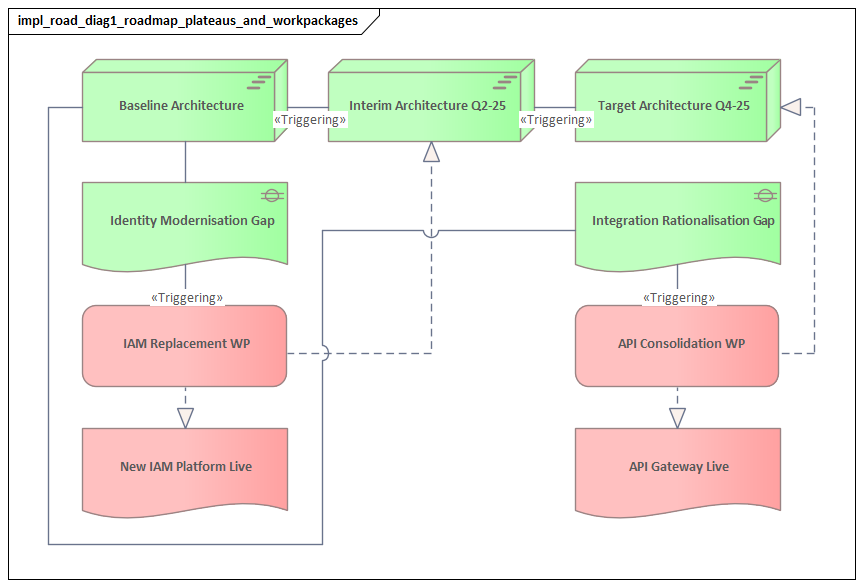
Three concepts sit at the center of this view: plateaus, gaps, and work packages. A plateau is a relatively stable architectural state, whether that is the current environment, an interim transition state, or the target state. A gap captures the differences between two plateaus: what must be introduced, changed, or retired to move forward. A work package represents the implementation effort that delivers that change, such as a migration project, deployment wave, or coordinated release. Together, these elements allow architects to describe change in architectural terms rather than in detailed task schedules.
A roadmap is only useful if it reflects real implementation conditions. Funding cycles, procurement lead times, regulatory deadlines, organizational readiness, and change saturation all affect what sequence is feasible. A roadmap that ignores those constraints may look tidy, but it will not support execution. A good roadmap does more than illustrate a desired future. It tests whether the path to that future is plausible.
Used well, the Implementation Roadmap Diagram becomes more than a presentation artifact. It supports governance, clarifies trade-offs, and helps leaders see how individual initiatives add up to measurable architectural progress. Its role is not to replace project plans or portfolio dashboards, but to explain the architectural meaning of change over time.
What Is an ArchiMate Implementation Roadmap Diagram?
An ArchiMate Implementation Roadmap Diagram is a viewpoint within the implementation and migration aspect of ArchiMate. It shows the progression of architectural change across defined periods, making visible how implementation activity moves the enterprise from one stable state to another. Where other ArchiMate views focus on the composition of the enterprise at a given moment, the roadmap focuses on movement: what is introduced, modified, retired, or stabilized as transformation unfolds.
The roadmap is built around plateaus, gaps, and work packages:
- Plateaus represent relatively stable architectural states.
- Gaps describe the architectural differences between those states.
- Work packages represent the implementation effort needed to close those gaps.
This is what makes the roadmap distinctive. It is not simply a timeline of initiatives. It is an architectural explanation of why implementation efforts exist and what state changes they are intended to produce.
That distinction matters because most organizations already have delivery artifacts: project plans, release calendars, portfolio dashboards. The roadmap does not replace them. Instead, it abstracts from detailed task management and highlights the architectural significance of implementation activity. An ERP delivery plan may contain hundreds of tasks covering configuration, data migration, testing, and training. The roadmap shows something different: how those efforts contribute to a transition plateau such as “Finance Processes Standardized” or “Core ERP Consolidated.” Similarly, an IAM modernization roadmap might show a plateau such as “Workforce SSO Established” before the later target plateau “Centralized Identity Governance Enabled.”
This makes the diagram particularly effective as a bridge between target architecture and migration planning. Architects may define future business, application, data, or technology landscapes in one set of views, but stakeholders still need to understand how that future will be reached. The roadmap answers that question by relating implementation activity to transition states and target outcomes. In doing so, it reveals whether the path is realistic, whether dependencies are manageable, and whether interim states are acceptable.
Often, those transition states matter as much as the final target. In real programs, enterprises may need to run legacy and modern platforms in parallel, maintain duplicate integrations for a period, or phase process adoption across regions. These are not necessarily design flaws. More often, they are the practical conditions of workable change. The roadmap gives architects a disciplined way to model these non-ideal but necessary states. A bank moving to event-driven integration, for instance, may need a transition plateau where both point-to-point interfaces and Kafka-based event streams coexist until the main customer and payments services have been migrated.
When used effectively, the Implementation Roadmap Diagram becomes a decision-support tool. It helps teams test sequencing, communicate implementation intent, and discuss trade-offs: whether to accelerate a capability, defer a dependency, combine work packages, or introduce an additional transition plateau to reduce risk. In that sense, the roadmap is best understood not as a schedule, but as a model of managed enterprise change.
Core Elements and Notation
The value of the Implementation Roadmap Diagram depends on using a small set of ArchiMate elements precisely. The view centers on plateaus, gaps, and work packages. Other elements can add timing and traceability, but these three carry the core meaning of the roadmap.
Plateau
A Plateau represents a relatively stable architectural state that exists for a meaningful period. It may describe:
- the current baseline,
- an intermediate transition architecture, or
- the intended target state.
Plateaus should be named in outcome-oriented terms rather than internal project shorthand. “Customer Data Unified” is clearer than “MDM Phase 2.” That naming discipline keeps the diagram intelligible to business stakeholders, delivery leaders, and architects.
A simple test helps here: could the enterprise operate in that state for some period without unacceptable disruption? If not, what is being modeled may be a milestone or project checkpoint rather than a true architectural state.
Gap
A Gap captures the architectural differences between two plateaus. It identifies what is missing, changed, or removed as the enterprise moves from one state to the next. A gap may involve:
- new or improved capabilities,
- retired applications or infrastructure,
- changed integrations,
- revised controls or policies,
- process redesign, or
- operating model adjustments.
A gap does not represent effort. It represents the change required. That distinction matters because it explains why implementation work exists. Not every roadmap needs to show gaps explicitly, but in complex transformations they are often the clearest way to make the logic of change visible.
Work Package
A Work Package represents a defined set of implementation actions that realizes part of the transformation. Depending on context, a work package may correspond to:
- a project,
- a program increment,
- a release train,
- a migration wave, or
- a coordinated deployment effort.
Work packages should be modeled at a level that suits architecture governance. If they are too broad, the roadmap becomes vague. If they are too detailed, it starts to resemble a delivery plan rather than an architectural view. The aim is to show implementation groupings that matter to sequencing, investment logic, and transition risk. For example, “Migrate privileged access to centralized IAM” is a useful work package; “configure 120 application connectors” is delivery detail.
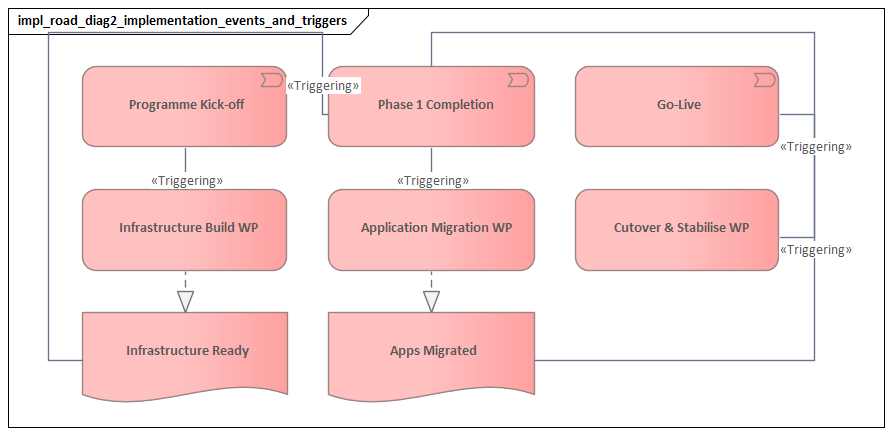
Implementation Event
An Implementation Event represents a significant occurrence in the transformation timeline, such as:
- a go-live,
- a regulatory deadline,
- a contract award,
- a steering decision, or
- a formal transition milestone.
These events are useful when timing matters but does not justify a separate work package. They also help anchor the roadmap to governance moments that influence sequencing and approvals. A typical example is a steering decision to extend a legacy technology standard for 12 months while a replacement platform is stabilized.
Deliverables, Outcomes, and Capabilities
Additional elements can provide traceability:
- Deliverables show concrete outputs produced by work packages, such as a migration design, operating model definition, or deployed release.
- Outcomes can express the business result expected from a transition.
- Capabilities can show what enterprise ability becomes available at each stage.
These elements should remain secondary unless the audience specifically needs that level of detail. Overusing them clutters the diagram and weakens its main purpose: showing progression between plateaus through work packages.
Relationships
Relationships matter as much as the elements themselves:
- Triggering shows temporal or causal sequence.
- Realization shows that a work package realizes a deliverable or contributes to a plateau.
- Association indicates a meaningful but less formal connection.
Roadmap diagrams become visually dense very quickly. Every connector should answer a stakeholder question. If a relationship does not clarify sequencing, dependency, or traceability, it is probably unnecessary.
Notation Discipline
A roadmap should not attempt to encode every dependency, milestone, and team activity. It should show only those elements that affect architectural progression, transition viability, or investment decisions. In practice, many organizations maintain a high-level roadmap for executives and a more detailed version for governance forums. Both can use the same ArchiMate concepts at different levels of granularity. ArchiMate relationship types
How the Roadmap Connects Strategy, Architecture, and Change
One of the roadmap’s most important roles is to connect three concerns that are often managed separately: strategic intent, architectural design, and change execution. Plateaus, gaps, and work packages are what make that connection visible.
Strategy defines where the enterprise wants to go: improve customer experience, reduce cost, strengthen compliance, modernize platforms, or make better use of data. Architecture describes the structures, capabilities, and operating models needed to support that direction. Delivery turns those designs into reality through programs, projects, and releases. The roadmap sits between them, showing how strategic ambition becomes staged architectural movement.
This matters because strategy is usually expressed in broad terms. It says what the organization wants, but not what must change first, what depends on what, or which interim states are acceptable. The roadmap translates strategic direction into a sequence of plateaus and work packages that can be governed, funded, and delivered.
Take a strategic goal such as “omnichannel customer engagement.” Reaching it may require several coordinated changes:
- customer identity consolidation,
- API enablement,
- process redesign,
- channel platform modernization,
- analytics capability uplift.
A roadmap can show which of these changes must come first, which can proceed in parallel, and what transition states are acceptable before the full target is reached. That staged view is often the difference between a credible transformation and a vague aspiration.
This is also where the roadmap helps reconcile strategy with operational reality. Leadership may set a new direction quickly in response to competition, regulation, or acquisition, but core systems and operating models do not pivot overnight. By making plateaus and gaps explicit, the roadmap reveals where dependencies limit speed, where coexistence is unavoidable, and where early foundational investment is needed to unlock later strategic options. In many IAM programs, for example, the first plateau is not advanced policy automation but “Trusted Identity Source Established,” because directory cleanup and authoritative-source alignment have to come first.
The roadmap also improves alignment between architecture and portfolio governance. Investment decisions are often made around initiatives and budgets, while architecture decisions are framed around target states, principles, and standards. Without a connecting view, those conversations drift apart. The roadmap helps decision-makers see whether funded initiatives are moving the enterprise toward the intended architecture or merely optimizing isolated areas.
That connection only works if the roadmap reflects real implementation conditions. Funding cycles, procurement timing, operational freeze periods, regional rollout constraints, and organizational readiness all shape what sequence is feasible. A target operating model may be architecturally sound, but if business units cannot absorb the required process change in a single wave, the roadmap should show phased adoption rather than idealized completion. A retailer, for example, may defer store-by-store POS replacement until after peak trading season, even if the technical solution is ready earlier.
The roadmap also strengthens accountability. Because it expresses strategic goals through defined architectural stages, leaders can ask whether change is producing the intended enterprise outcomes, not merely whether projects are generating activity. In long-running transformations, that distinction matters. Project completion alone says little about real progress if the enterprise remains in an unstable or fragmented state.
In practice, the roadmap becomes a coordination instrument across strategy, architecture, and delivery. It does not replace strategic planning, solution design, or program management. What it provides is a shared model of how enterprise change is expected to unfold.
Step-by-Step Approach to Creating an Implementation Roadmap Diagram
Creating an effective roadmap is less about drawing a timeline and more about making disciplined transformation choices visible. The structure is straightforward: define plateaus, identify gaps, group implementation effort into work packages, and place them in a realistic sequence.
1. Define the change objective and scope
Start by clarifying what transformation the roadmap is meant to explain. This may be:
- an enterprise-wide modernization effort,
- a domain transition such as identity and access management,
- a platform replacement,
- a regulatory transformation, or
- an ERP consolidation program.
The scope needs to be explicit. Which business units, capabilities, applications, technologies, or regions are in view? Which are not? Without a clear boundary, the roadmap becomes overloaded and loses decision value.
A useful discipline is to align scope with a governance question, such as:
- Should funding be approved?
- Is the sequencing credible?
- Are transition states acceptable?
- How should the transformation be communicated to executives?
2. Establish baseline and target plateaus
Before modeling transition, define the current and target plateaus. These should be described in architecture terms that stakeholders can understand and evaluate.
The baseline should capture the realities that drive migration complexity, such as:
- duplicated platforms,
- fragmented processes,
- technical debt,
- inconsistent data,
- regulatory exposure.
The target should express the intended future state clearly enough that intermediate decisions can be tested against it. If the target is still evolving, document assumptions. An uncertain target almost always produces an unstable roadmap.
3. Identify meaningful transition plateaus
Most transformations cannot move directly from baseline to target. Define intermediate plateaus that represent viable and governable states.
These should not be arbitrary phases. Each transition plateau should exist for a reason, such as:
- reducing delivery risk,
- enabling value earlier,
- supporting coexistence,
- matching organizational readiness, or
- aligning with funding or release windows.
As noted earlier, a good test is whether the enterprise could operate in that state for a period without unacceptable disruption. If not, it may be a milestone rather than a true plateau. For example, a technology lifecycle roadmap may include a plateau such as “Critical workloads off end-of-support Linux” before the broader target “Infrastructure estate standardized.”
4. Determine the gaps between plateaus
Once the plateaus are defined, analyze what changes between them. This is where the roadmap becomes architecturally meaningful.
Gap analysis should identify the differences that matter to sequencing and investment, such as:
- missing capabilities,
- retired applications,
- new integrations,
- control changes,
- process redesign, or
- infrastructure upgrades.
The goal is not to create an exhaustive inventory. It is to expose the architectural differences that explain why implementation work is needed. In an event-driven transformation, one gap may be “domain events published for order lifecycle,” not simply “Kafka installed.”
5. Group change into work packages
Translate the required changes into work packages at a level appropriate for architecture governance. Work packages may map to programs, releases, migration waves, or coordinated initiatives.
The key is to group effort by architectural outcome, not simply by team structure. If work packages are defined only by organizational ownership, the roadmap may end up mirroring delivery silos rather than enterprise change logic.
At this stage, identify enabling relationships between work packages. Dependency chains often determine whether the roadmap is realistic. For example, “Establish Kafka platform and governance” may need to precede “Migrate customer notification events,” while “Retire batch integration hub” can only follow after key consumers have been cut over.
6. Add timing, implementation events, and constraints
Place plateaus and work packages in sequence and add implementation events where needed. Then make external constraints visible, such as:
- contract renewals,
- regulatory deadlines,
- blackout periods,
- procurement lead times,
- regional rollout limits, or
- business readiness constraints.
This is the point where the roadmap shifts from conceptual to credible. A sequence that ignores operational constraints may be architecturally elegant, but it will not be practically useful.
7. Validate for coherence and value delivery
Review the roadmap as a transformation story:
- Does each transition produce recognizable value?
- Are there long periods of effort without visible outcome?
- Are dependencies credible?
- Does sequencing create unnecessary rework?
- Is coexistence prolonged longer than necessary?
A strong roadmap is not just documentation. It is a test of the transformation design itself. Architecture boards often use this review to decide whether to approve a transition state, split a work package, or defer a target date until a dependency is resolved.
8. Tailor the view to the audience
Finally, adjust granularity and notation for the stakeholders who will use the roadmap.
- Executives usually need major plateaus, key work packages, and decision points.
- Governance forums may need explicit dependencies, implementation events, and deliverables.
- Domain architects may need a more focused roadmap for one architecture area.
The same underlying logic should support all of these views. Different diagrams are acceptable; different transformation stories are not.
Governance, Stakeholder Communication, and Best Practices
Once created, the roadmap only becomes valuable if it is used as a governance instrument rather than a one-time planning visual. The earlier sections described how the diagram models transformation logic. This section focuses on how that logic is applied in decision-making.
Governance Role
In many organizations, the problem is not the absence of a target architecture. It is the absence of disciplined oversight over how change is sequenced, justified, and adjusted. The roadmap helps governance bodies assess whether implementation activity still supports the intended architectural direction, whether transition states remain acceptable, and whether emerging decisions are creating hidden future cost.
For governance to work, ownership of the roadmap must be clear. If it belongs only to enterprise architecture, delivery teams may treat it as conceptual. If it belongs only to program management, architectural intent may be diluted by short-term delivery pressure. Effective organizations usually treat the roadmap as a shared artifact maintained by architects, portfolio leaders, and transformation managers.
Stakeholder Communication
Different stakeholders ask different questions of the same roadmap:
- Executives want to know when major outcomes become visible, where risk is concentrated, and what decisions require sponsorship.
- Portfolio and program leaders need to see dependencies, implementation windows, and the impact of delay.
- Domain architects want confidence that sequencing does not undermine standards or long-term coherence.
- Operational leaders care about coexistence periods, cutover risk, and organizational readiness.
A roadmap works best when it can answer those questions without forcing every stakeholder into the same level of detail.
Maintain a Roadmap Hierarchy
For that reason, it is often useful to maintain a hierarchy of roadmap views:
- a strategic roadmap showing major plateaus, transformation streams, and key decisions;
- a governance roadmap showing dependencies, migration waves, and implementation events;
- a domain roadmap focused on one area such as data, integration, or infrastructure.
All of these should remain traceable to the same underlying transformation logic defined through plateaus, gaps, and work packages.
Best Practices
Several practices consistently improve roadmap quality.
Keep plateaus meaningful and limited.
Too many transitional states reduce clarity. Each plateau should represent a stable, understandable state with a reason to exist.
Make work packages traceable to architectural change.
Every major work package should clearly contribute to closing a gap or realizing a plateau. Otherwise, the roadmap becomes a generic program timeline.
Show major dependencies, not every dependency.
Stakeholders need to understand what constrains the sequence, but overloading the diagram with delivery detail makes it hard to read.
Make assumptions visible.
If a transition depends on vendor delivery, regulatory approval, procurement timing, or business-unit adoption capacity, show that clearly enough for decision-makers to test it.
Review the roadmap regularly.
The roadmap should be revisited after major investment decisions, scope changes, external events, or shifts in target-state assumptions.
Use the roadmap to challenge the transformation.
If a plateau delivers no usable value, if coexistence lasts too long, or if sequencing creates avoidable rework, the roadmap should trigger redesign rather than simply record the issue.
Communication Principle: Credibility Over Neatness
Roadmaps are often challenged not because the target is unclear, but because stakeholders doubt the path. Architects should therefore resist the urge to present an overly linear transformation story when the real journey includes overlap, contingency, and iteration. A roadmap that acknowledges complexity is usually trusted more than one that looks cleaner but ignores operational reality.
Used this way, the roadmap supports better governance, clearer communication, and more disciplined execution.
Common Challenges, Pitfalls, and Practical Tips
Even when the notation is well understood, organizations often struggle to use the Implementation Roadmap Diagram effectively. The difficulty usually lies not in drawing the view, but in getting architecture, portfolio, and delivery communities to use it as a shared decision tool.
1. Confusing the roadmap with a project plan
A common mistake is to overload the roadmap with every milestone, sprint, task, and dependency. When that happens, the diagram becomes too detailed to serve its architectural purpose and too weak to compete with delivery tooling.
Practical tip: Keep the roadmap focused on enterprise-significant change: plateaus, major work packages, critical dependencies, and decision points. If a detail does not affect architectural sequencing or transformation risk, it belongs elsewhere.
2. Modeling idealized transitions instead of workable ones
Architects sometimes produce elegant sequences that assume clean cutovers, immediate adoption, or perfect coordination. Real enterprises rarely change that way. Legacy coexistence, phased rollout, uneven readiness, and temporary duplication are common.
Practical tip: Model the enterprise as it actually changes. Transition plateaus are often necessary precisely because the path is not ideal. A healthcare provider rolling out a new scheduling platform, for example, may need six months of dual operation across hospitals because clinical rosters, local integrations, and staff training cannot all be switched at once.
3. Using unstable granularity
Some parts of a roadmap may be modeled at a strategic level while others drop into project or solution detail. This inconsistency makes significance difficult to interpret.
Practical tip: Define the modeling level before creating the view. Decide whether work packages represent programs, release trains, or migration waves, and apply that rule consistently.
4. Weak traceability to decisions
A roadmap may be produced once for architecture approval and then disconnected from funding reviews, steering committees, or replanning cycles. It quickly becomes outdated and loses authority.
Practical tip: Embed the roadmap into governance routines. Review it whenever funding changes, dependencies slip, regulatory dates move, or target assumptions are revised.
5. Overstating certainty
Roadmaps often depend on assumptions about vendor timelines, procurement outcomes, organizational capacity, or policy changes. If those assumptions remain hidden, the roadmap appears more precise than it really is.
Practical tip: Make uncertainty visible. Annotate critical assumptions, identify contingency points, or distinguish committed work from directional planning.
6. Treating the roadmap as architecture-owned only
If the roadmap is seen as an architecture artifact rather than a shared transformation instrument, delivery teams may ignore it and executives may view it as overly conceptual.
Practical tip: Maintain shared ownership between architecture and transformation leadership. The roadmap gains authority when it is used jointly in planning and governance.
7. Trying to model the whole enterprise at once
Large-scale adoption efforts often fail because teams attempt enterprise-wide coverage before proving value.
Practical tip: Start with a high-value use case, such as a major platform transition, regulatory program, or operating model shift. Use that case to demonstrate how the roadmap improves sequencing and governance. A technology lifecycle governance case, for example, may begin with retiring unsupported database versions in one critical domain before scaling the method enterprise-wide.
8. Letting outdated versions persist
Nothing undermines confidence faster than multiple roadmap diagrams telling different stories.
Practical tip: Review regularly, update deliberately, and retire obsolete versions quickly. A roadmap needs to function as a living view of change, not an archive of past intentions.
In mature practice, successful adoption depends less on notation skill than on disciplined use, realistic modeling, and a willingness to surface the true complexity of transformation.
Conclusion
The ArchiMate Implementation Roadmap Diagram is most valuable when it turns architectural ambition into a governable path of change. Its contribution is not simply to place initiatives on a timeline, but to give enterprises a disciplined way to reason about progression, dependencies, trade-offs, and transition viability. ArchiMate modeling best practices
Its strength comes from a small set of concepts used well: plateaus define stable states, gaps explain what must change between them, and work packages show the implementation effort that realizes that change. Together, these concepts connect strategy, architecture, and delivery in a form that supports real decisions.
The roadmap is also diagnostic. If the path contains excessive overlap, long coexistence periods, weak value delivery, or unrealistic sequencing, the problem usually lies not in the diagram itself but in the underlying transformation design. In that sense, the roadmap helps expose misalignment between architecture, funding, delivery capacity, and organizational readiness early enough to correct it.
Its practical value depends on realism. Strong roadmaps reflect how organizations actually absorb change: through constrained budgets, limited implementation windows, competing priorities, and uneven adoption across business units. Whether the case is IAM modernization, Kafka-based event architecture, ERP consolidation, or technology lifecycle governance, the roadmap helps leaders see not only where the enterprise intends to go, but whether the chosen path remains credible, resilient, and worth pursuing.
Frequently Asked Questions
How does ArchiMate support digital transformation planning?
ArchiMate supports transformation by modeling baseline architecture, target architecture, and transition plateaus. Implementation and Migration diagrams show work packages, migration events, and the sequencing of changes needed to move from current to future state.
What is a transition architecture in ArchiMate?
A transition architecture in ArchiMate represents an intermediate state between baseline and target. It describes the architecture at a specific milestone in the transformation journey, helping teams plan incremental delivery and manage dependencies across parallel workstreams.
How do you create an implementation roadmap in ArchiMate?
An implementation roadmap in ArchiMate is created using the Implementation and Migration layer, modeled with Work Packages (groups of work), Implementation Events (milestones or triggers), and Plateaus (stable architecture states). Gap Analysis diagrams show what must change between each plateau.