⏱ 20 min read
Most enterprise IAM diagrams are bad. Not ugly-bad, although many are that too. I mean structurally bad. They show boxes called “Azure AD,” “Okta,” “LDAP,” “PAM,” maybe a few arrows with “SSO” written on them, and everyone nods as if architecture happened. It didn’t. That’s inventory, not architecture.
If you model Identity and Access Management seriously, you’re not documenting products. You’re describing how trust, control, accountability, and risk move through an enterprise. And that matters because IAM is not just another platform domain. It is the operating system of enterprise control. If you get it wrong, your cloud program slows down, your Kafka platform becomes a compliance headache, your auditors start asking hostile questions, and your developers build workarounds that become tomorrow’s breach report.
So yes, this article has a strong opinion: ArchiMate is actually very good for modeling IAM, but only if you stop using it like a drawing tool and start using it like an architecture language.
The simple version first: what does it mean to model IAM with ArchiMate?
At a basic level, modeling IAM with ArchiMate means representing:
- who needs access
- what they need access to
- how access is granted and enforced
- why controls exist
- which systems and services participate
- where risk and accountability sit
In ArchiMate terms, that usually means combining:
- Business layer for actors, roles, processes, policies
- Application layer for IAM services and applications
- Technology layer for infrastructure, cloud services, directories, brokers, clusters
- sometimes Motivation for principles, requirements, constraints, risk
- sometimes Implementation & Migration if you’re showing transition states
That’s the simple explanation. Good for SEO, good for orientation. But not enough for real work.
Because real IAM architecture isn’t just “user authenticates to app.” Real IAM is a web of lifecycle management, federation, machine identity, privileged access, conditional policy, audit evidence, and operational boundaries between teams that often barely tolerate each other.
And this is exactly where ArchiMate can help — if you model the right things. ArchiMate modeling guide
Why IAM is hard to model
IAM cuts across nearly every architecture boundary:
- HR creates identities indirectly
- security defines policy
- IT operates directories and federation
- application teams consume identity services
- cloud platforms implement workload identities
- data platforms enforce authorization
- Kafka teams struggle with service-to-service trust
- audit and compliance expect evidence, not theory
That means IAM is never one diagram. It is a set of views that answer different questions for different stakeholders.
A common mistake is trying to make one master diagram that explains everything: joiner/mover/leaver, MFA, OAuth, SCIM, role mining, PAM, cloud IAM, Kafka ACLs, break-glass accounts, SIEM logging, and regulatory controls. The result is a visual landfill.
A better approach is brutally practical: model IAM as a set of concerns, not a pile of components.
In real architecture work, I usually split IAM modeling into five concerns:
- Identity lifecycle
- Authentication and federation
- Authorization and policy enforcement
- Privileged access
- Machine and workload identity
If you try to do serious enterprise IAM without separating those concerns, you will confuse your stakeholders and probably yourself.
What ArchiMate elements are actually useful for IAM
Let’s keep this practical. You do not need every ArchiMate element. In fact, using too many usually signals insecurity. Architects often over-model because they don’t trust the core story. ArchiMate tutorial
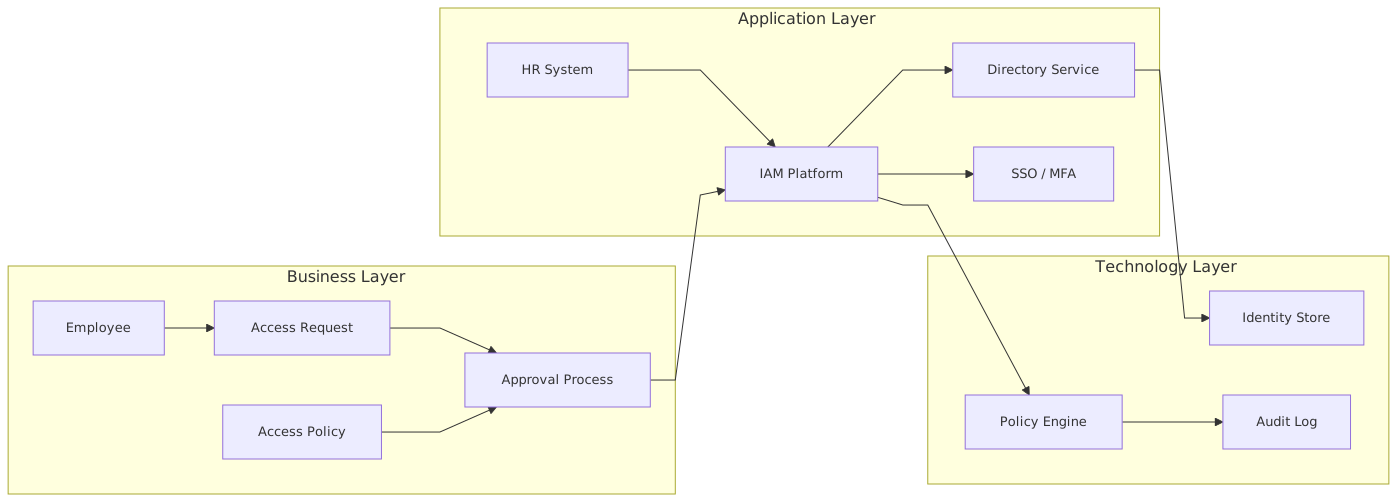
Here’s the subset that matters most.
That table looks simple. Good. It should. The job of architecture is not to impress people with notation density.
My rule of thumb
- Use Business layer to explain accountability and operating model.
- Use Application layer to explain IAM capabilities and service interaction.
- Use Technology layer to explain deployment, trust boundaries, and runtime enforcement.
- Use Motivation only when you need to explain why a control exists or why a trade-off was made.
Too many teams jump straight to the technology layer. They model Entra ID, Kubernetes, Kafka, HashiCorp Vault, AWS IAM, and maybe a firewall. Then they wonder why the model doesn’t answer governance questions. Of course it doesn’t. Governance lives above the products.
Start with capability and responsibility, not products
If I’m asked to model IAM for an enterprise, the first thing I want is not a product list. I want answers to these questions:
- What is the authoritative source of workforce identity?
- Who approves access and on what basis?
- Are roles business-defined or application-defined?
- How are non-human identities created and governed?
- Where is privileged access separated from standard access?
- What systems enforce policy versus merely store policy?
- What evidence is needed for audit?
- Which controls are central, and which are delegated?
These questions shape the model.
A lot of architecture teams avoid this because it gets political quickly. IAM exposes ownership confusion. It shows where HR data is unreliable, where application teams still manage users locally, where cloud engineers create long-lived credentials “temporarily,” and where Kafka admins become accidental security authorities because no one else understands topic-level authorization.
That discomfort is exactly why the model matters.
A useful way to structure an ArchiMate IAM model
For real enterprise work, I recommend building at least four separate views.
1. Business IAM operating model view
This shows:
- Business actors: employee, contractor, external partner, security admin, application owner, line manager
- Business roles: trader, call-center agent, cloud engineer, Kafka platform admin
- Business processes: onboarding, access request, access review, offboarding, privileged elevation
- Business services: identity governance, authentication, authorization, privileged access management
This view helps answer: who owns what, and who participates in which process?
Without it, you’ll get the classic problem where the IAM team is assumed to own all access decisions. They do not. They own the control framework and enabling platforms. The business owns access need. Applications own application-specific authorization logic. Cloud platform teams own cloud-native enforcement. This distinction is often absent in bad models.
2. Application cooperation view for IAM services
This shows:
- HR system as authoritative identity source
- Identity governance platform
- Directory service
- Identity provider
- MFA service
- Privileged access platform
- Application onboarding interfaces
- API gateway or federation services
- Logging/SIEM integration
This view answers: which IAM applications provide which services, and how do they interact?
It’s especially useful when you’re trying to rationalize overlapping products or design target-state architecture.
3. Technology trust-boundary view
This is where cloud and Kafka become very relevant.
Show:
- Cloud tenants/accounts/subscriptions
- Kubernetes clusters
- Kafka clusters
- Broker nodes or managed Kafka service
- Network/security zones
- Certificate authorities
- Secrets stores
- Workload identity mechanisms
- Communication paths
This view answers: where trust is enforced at runtime?
That matters because enterprise IAM discussions often stay too abstract. People say “service identity is managed centrally,” but at runtime the Kafka producer is authenticating using a client certificate issued through a completely separate process, and ACLs are maintained by platform scripts nobody governs properly. That gap between policy fantasy and runtime truth is where architecture should be sharp.
4. Motivation and control view
Use this sparingly, but use it.
Show:
- Drivers: regulatory compliance, zero trust, cloud transformation
- Requirements: MFA for privileged access, centralized joiner/mover/leaver, segregation of duties
- Constraints: legacy apps support only LDAP, Kafka ACL changes require platform approval
- Assessments: service accounts are unmanaged, local admin use is excessive, cloud entitlements are opaque
- Principles: no shared human identities, machine identities must be attributable, policy decisions should be centralized where feasible
This view answers: why the architecture is shaped this way.
And yes, “where feasible” matters. Architects who write absolutist principles usually haven’t met real systems.
Real enterprise example: a bank modernizing IAM across cloud and Kafka
Let’s make this concrete.
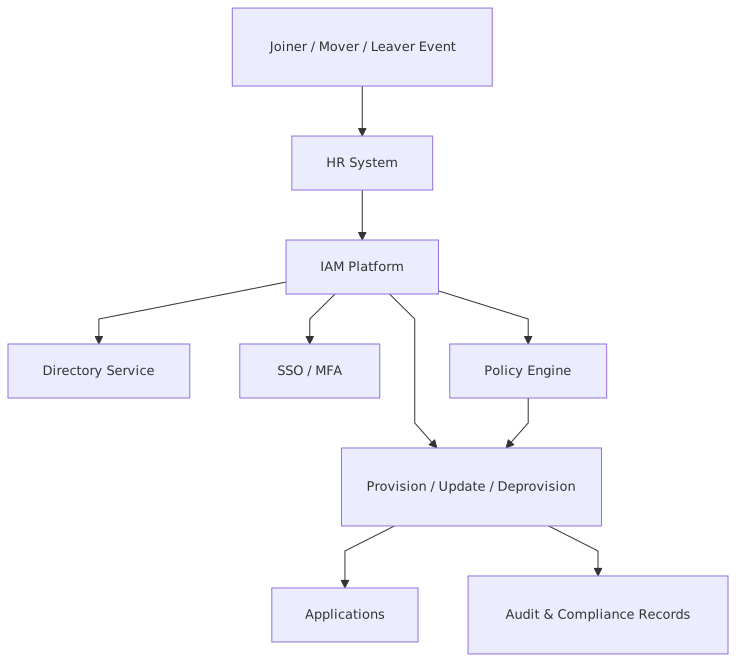
Imagine a mid-to-large bank. Not a greenfield digital startup pretending to be a bank. A real bank: multiple business units, merger history, old directories, too many service accounts, and a cloud strategy that arrived before identity was ready.
The situation
The bank has:
- a central HR system as the workforce source
- Active Directory on-prem
- Entra ID for Microsoft SaaS and some federated apps
- a separate IAM governance tool for access requests and certifications
- AWS and Azure cloud environments
- a Kafka platform used for payment events, fraud analytics, and customer-notification streams
- Kubernetes workloads using both static secrets and newer workload identity patterns
- local app accounts still present in some core banking systems
- privileged access managed partly in a PAM tool, partly by tradition and panic
The bank’s problem is familiar: identity lifecycle for employees is mostly centralized, but authorization is fragmented. Human access is somewhat controlled; machine access is not. Kafka topic permissions are issued through tickets. Cloud roles are over-broad. Audit findings keep repeating.
How I would model it
Business view
I’d model:
- Business Actors: Employee, Contractor, External Auditor, Application Owner, Platform Engineer, Security Operations Analyst
- Business Roles: Payments Analyst, Fraud Investigator, Cloud Administrator, Kafka Platform Administrator
- Business Processes: Hire Worker, Request Access, Approve Access, Certify Access, Revoke Access, Elevate Privilege
- Business Services: Workforce Identity Management, Access Governance, Authentication Service, Privileged Access Service
This immediately exposes a common issue: the Application Owner is responsible for approving business access, but for Kafka and cloud platforms, approvals often default to infrastructure teams because entitlement semantics are technical and not business-readable.
That’s an architecture problem, not just a process problem.
Application view
Then I’d show:
- HR platform serving an identity data object
- Identity governance platform consuming HR data and triggering provisioning
- Directory service providing identity repository services
- IdP providing authentication and federation services
- PAM platform providing credential vaulting and session brokering
- Cloud IAM services in AWS and Azure
- Kafka management tooling and policy administration functions
- SIEM collecting authentication and authorization logs
Now the ugly truth appears: cloud IAM and Kafka authorization are only partially integrated with central governance. A lot of provisioning happens through scripts, Terraform, and manually approved pull requests.
That’s not automatically wrong, by the way. Here’s a contrarian thought: not every access control needs to be provisioned by a central IAM suite. For cloud-native and platform-native environments, policy-as-code may be the better architecture. But if you choose that, then model it honestly. Don’t pretend central governance is in control when it only receives logs after the fact.
Technology view
I’d model:
- AWS accounts and Azure subscriptions as technology nodes/groupings
- managed Kafka clusters or self-hosted broker nodes
- Kubernetes clusters
- service mesh or ingress components if relevant
- certificate authority or workload identity issuer
- secrets manager / vault
- communication paths between producers, consumers, brokers, IAM services
This is where machine identity gets real.
For example:
- A payment-processing microservice in Kubernetes publishes to Kafka.
- It authenticates using mTLS certificate or SASL/OAUTHBEARER token depending on platform design.
- Authorization is enforced at topic level by Kafka ACLs or RBAC.
- Certificate issuance may be tied to workload identity, not a human-managed service account.
- Topic access may be requested via platform workflow but enforced by Kafka-native controls.
That chain should be visible in the model. If it isn’t, your architecture isn’t saying anything useful.
Where architects go wrong with IAM in ArchiMate
There are some repeat offenders here.
Mistake 1: Modeling vendors instead of services
A box labeled “Okta” tells me almost nothing.
Is it:
- the workforce IdP?
- customer CIAM?
- federation broker?
- lifecycle engine?
- MFA provider?
- all of the above?
Model the application service first: authentication, federation, identity proofing, lifecycle management. Then map the product implementing it. Otherwise every discussion collapses into product talk, which is usually where architecture goes to die.
Mistake 2: Ignoring authorization because authentication is easier
This is probably the biggest one.
Enterprises love to claim they have “modern IAM” because SSO and MFA are deployed. Fine. That’s table stakes. The hard part is authorization: who can do what, under what conditions, with what review path, and where enforcement actually happens.
In banking, this matters a lot. A user being authenticated to a fraud platform is not the same as being allowed to view suspicious transaction details, modify detection rules, approve payment exceptions, or administer Kafka topics carrying fraud events. ArchiMate in TOGAF ADM
Authentication gets you in the building. Authorization decides whether you’re allowed near the vault.
Mistake 3: Treating machine identity as a technical footnote
This is outdated thinking.
In many enterprises now, non-human identities outnumber human identities by a ridiculous margin. Service principals, API clients, workload identities, certificates, tokens, bots, functions, pipelines. Yet the architecture model still centers entirely on employee login.
That made sense ten years ago. It doesn’t now.
If your bank runs cloud-native payment and analytics workloads, your biggest IAM risk may not be a user password. It may be a long-lived client secret used by a Kafka producer, copied across environments, never rotated, and trusted by too many topics.
Model machine identity as a first-class concern.
Mistake 4: Confusing centralization with control
This one irritates me because it sounds sophisticated and often isn’t.
Architects say, “All identity and access must be centralized.” No. That is usually unworkable and sometimes counterproductive.
What should be centralized is:
- policy intent
- governance model
- identity assurance
- audit evidence
- critical control standards
What may remain federated or domain-managed:
- application-specific entitlements
- cloud-native policy constructs
- Kafka ACL/RBAC administration
- runtime enforcement in platforms
If you force everything into one central tool, you create brittle architecture and endless exceptions. The better approach is usually central governance, distributed enforcement.
Mistake 5: Not modeling lifecycle states
Access architecture is not static. Joiner, mover, leaver is obvious for humans, but machine identities also have lifecycle states:
- requested
- issued
- bound to workload
- rotated
- suspended
- retired
ArchiMate can represent process and state transitions well enough for this. Use it. Many security incidents come from identities that should have died months ago.
How this applies in real architecture work
Let’s get away from theory.
In actual enterprise architecture, an ArchiMate IAM model is useful in at least six situations.
1. Target-state design for cloud adoption
Before a large move to AWS or Azure, you need to answer:
- How will workforce identities federate into cloud?
- How will privileged admin access be separated?
- Will workloads use cloud-native managed identities?
- What remains in directory services versus cloud IAM?
- How will access reviews work for cloud entitlements?
An ArchiMate model lets you show the split between enterprise IAM, cloud platform controls, and application responsibilities. That’s much better than a 70-page PowerPoint full of principles nobody reads.
2. Kafka platform governance
Kafka is where many IAM models suddenly become honest.
Why? Because Kafka forces the question: who can publish, who can consume, who can administer, and how is that access represented and enforced?
In architecture reviews, I’ve seen Kafka treated as “just another app integration component.” Wrong. In many banks it becomes critical infrastructure carrying regulated event streams. Its identity and access model deserves explicit architecture.
Using ArchiMate, you can model:
- producer and consumer application components
- authentication mechanisms
- broker services
- policy administration
- operational roles
- audit logging
- trust boundaries across environments
This helps teams distinguish between:
- human admin access to Kafka
- application access to topics
- platform-level operational control
- data-level authorization concerns
That distinction is often blurred in implementation, and the model can expose it quickly.
3. IAM tool rationalization
Enterprises often accumulate:
- one SSO tool
- one governance tool
- one PAM tool
- local LDAP directories
- cloud-native IAM
- ad hoc secrets tooling
- API gateways with their own policy layer
A good ArchiMate model helps you decide what should remain, what should integrate, and what should be retired. It’s not just a current-state picture. It becomes a decision instrument.
4. Audit and control remediation
Auditors rarely care that your diagram is elegant. They care whether it explains control ownership and evidence paths.
With ArchiMate, you can trace:
- requirement → service → component → process → responsible role
That is useful when remediating findings like:
- orphaned accounts
- incomplete access reviews
- excessive privileged access
- unmanaged service credentials
- inconsistent cloud entitlement controls
5. M&A integration
Identity is one of the first places merger complexity becomes expensive. Multiple directories, duplicate identities, separate access governance processes, and incompatible role models.
ArchiMate is very good at showing transition architectures here:
- what remains separate for a period
- what federates first
- what becomes authoritative
- what gets decommissioned later
6. Security architecture communication
Security teams often produce control-heavy diagrams. Platform teams produce implementation-heavy diagrams. Enterprise architects are supposed to bridge this. ArchiMate gives just enough rigor to make both groups slightly uncomfortable, which is usually a sign you’re in the useful middle.
What a good IAM model should reveal
A good model should make certain truths obvious.
It should reveal:
- where identities originate
- where they are transformed or enriched
- where access decisions are made
- where access is enforced
- where exceptions exist
- where accountability changes hands
- where audit evidence is produced
- where manual controls still exist
If the model only shows systems connected by arrows, it reveals none of that.
One practical technique I like: explicitly distinguish between these three things in the model:
- Identity source
- Policy decision
- Policy enforcement
That separation is gold.
For example in a banking cloud/Kafka context:
- HR system is the source of workforce identity attributes
- Identity governance and policy definitions shape access eligibility
- Cloud IAM or Kafka ACL/RBAC enforce access at runtime
These are different functions with different owners. Keep them separate in the model.
Contrarian view: don’t over-model zero trust
A lot of people now force every IAM architecture conversation through the phrase “zero trust.” Fine, it’s useful at principle level. But I’ve seen teams create absurd ArchiMate diagrams with every control relabeled as zero trust, as if branding is architecture.
Here’s the contrarian take: zero trust is not a model; it is a posture.
Your IAM architecture still needs plain, boring, precise answers:
- who is authenticated?
- what attributes are trusted?
- what policy is evaluated?
- where is access enforced?
- how is privilege constrained?
- what logs are retained?
If your diagram says “continuous verification” everywhere but can’t show how Kafka producers authenticate to brokers across environments, it’s fluff.
Practical modeling tips that save time
A few hard-earned suggestions.
Keep human and machine identity separate
Do not cram them into one generic “identity management” blob. Their lifecycle, controls, and risks differ too much.
Show approval and enforcement as different things
A manager approving access does not enforce access. Neither does an IAM catalog. Runtime platforms do.
Use naming that stakeholders understand
“Policy Decision Point” may be accurate, but in many enterprise views “Access Policy Service” lands better. Be precise, not theatrical.
Add trust boundaries
Cloud account, VPC/VNet, cluster, on-prem zone, managed service boundary. These matter enormously for IAM interpretation.
Model exceptions deliberately
Legacy core banking app with local accounts? Fine, show it as an exception with a constraint and migration note. Hidden exceptions are worse than ugly exceptions.
Don’t chase perfect notation purity
ArchiMate is a language, not a religion. If a relationship is slightly simplified but communicates the architecture honestly, that is usually better than a perfectly pure but unreadable model.
Yes, some notation purists will twitch. They’ll survive.
A compact target-state pattern for enterprise IAM
If I had to summarize a sane target-state architecture for many enterprises, including banks, it would look like this:
- HR or equivalent authoritative source governs workforce identity baseline
- Identity governance platform manages lifecycle, approvals, certifications, and policy metadata
- Central IdP/federation layer handles authentication, MFA, and token issuance
- PAM platform handles privileged human access and elevation
- Cloud-native IAM enforces platform access using federated enterprise identities and workload identities
- Platform-native authorization remains in systems like Kafka, but aligned to central governance and evidence capture
- Secrets and certificate services manage machine credentials with rotation and attributable ownership
- Central logging and audit pipeline collects authentication, authorization, and admin activity records
That’s not radical. It’s just coherent. Which, in enterprise architecture, is rarer than it should be.
Final thought
Modeling IAM with ArchiMate is not about drawing your security stack. It’s about exposing the structure of trust in the enterprise.
That means you have to model things many teams prefer to keep blurry:
- who really owns access
- where controls are actually enforced
- which identities matter most
- where the exceptions are
- where the architecture is lying to itself
And yes, architecture sometimes lies to itself. Especially in IAM. Especially when cloud and Kafka arrive faster than governance can keep up.
Done well, an ArchiMate IAM model helps you cut through that. It gives business, security, platform, and delivery teams a shared language. Not perfect, not magical, but useful. Which is more than can be said for most IAM diagrams in the wild.
If you’re an architect, that’s the standard to aim for: not comprehensive decoration, but decision-grade clarity.
FAQ
1. Which ArchiMate layers are most important for IAM modeling?
Usually Business, Application, and Technology. Business shows ownership and process, Application shows IAM services and interactions, Technology shows runtime trust boundaries and enforcement. Motivation is useful when you need to explain controls, risks, or principles.
2. Should IAM always be modeled as centralized in ArchiMate?
No. That’s a common mistake. Governance, assurance, and audit may be centralized, while enforcement is often distributed across cloud IAM, Kafka, applications, and platforms. Model the split honestly.
3. How do you model Kafka access control in ArchiMate?
Model producers and consumers as application components, Kafka as an application/technology service depending on your view, authentication mechanisms in the technology layer, and authorization as policy/enforcement functions. Separate human admin access from machine topic access.
4. What is the biggest mistake architects make when modeling IAM?
Ignoring authorization and machine identity. Many diagrams stop at SSO and MFA. Real enterprise risk often sits in fragmented entitlements, unmanaged service identities, privileged access, and runtime enforcement gaps.
5. How detailed should an IAM ArchiMate model be?
Detailed enough to support decisions, not so detailed that it becomes unreadable. Build multiple views for different concerns: business operating model, application cooperation, technology trust boundaries, and control motivation. One giant diagram is usually a mistake.
Frequently Asked Questions
How is Identity and Access Management modeled in ArchiMate?
IAM is modeled in ArchiMate with the IAM platform as an Application Component providing authentication and authorization services. Business Roles consume these services through Business Processes. Technology Nodes (identity provider, policy decision point, LDAP/AD) are modeled in the Technology layer, assigned to the Application Components they support.
What ArchiMate elements are used for IAM architecture?
Key elements: Application Component (IAM platform, IdP, PAM), Application Service (authentication, authorisation, SSO, MFA), Application Interface (SAML, OAuth2, OIDC endpoints), Business Role (user types, service accounts), Data Object (identity claim, access token, policy), Technology Node (LDAP, Active Directory, HSM).
Why is IAM architecture important in enterprise EA?
IAM is the security boundary for every enterprise system. Modeling it in ArchiMate makes authentication and authorisation dependencies visible — critical for security governance, regulatory compliance (GDPR, ISO 27001, SOX), zero-trust architecture design, and impact analysis when identity systems change or are consolidated.