⏱ 5 min read
BPMN vs UML vs ArchiMate
Designing a Coherent Enterprise Modeling Strategy for Complex Organizations
Deep-Dive Whitepaper
Executive Summary
Enterprise modeling is not documentation. It is organizational cognition.

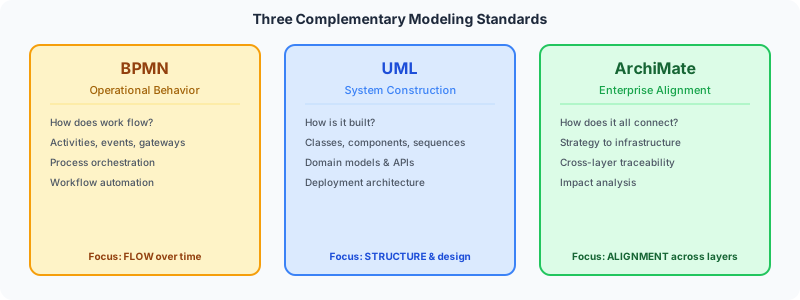
This whitepaper explores three dominant modeling standards:
- BPMN (Business Process Model and Notation)
- UML (Unified Modeling Language)
- ArchiMate
Rather than competing approaches, they represent complementary layers of enterprise abstraction. Mature organizations orchestrate them strategically.
1. Modeling as an Enterprise Capability
Enterprise modeling enables organizations to answer:
- Why are we changing?
- What must change?
- How will it operate?
- How will it be built?
- What is the impact of change?
Without modeling discipline, enterprises drift toward architectural entropy, redundancy, and compliance risk.
2. BPMN -- Operational Behavior Modeling
Purpose
BPMN models behavior over time. It represents:
- Activities
- Events
- Gateways
- Roles
- Message flows
Strengths
- Operational optimization
- Workflow automation
- Regulatory traceability
- Process orchestration
Limitation
BPMN focuses on flow, not structural enterprise alignment.
3. UML -- System Construction and Design
Purpose
UML models system realization and interaction.
Key diagram types:
- Class diagrams
- Sequence diagrams
- Component diagrams
- Deployment diagrams
Strengths
- Engineering precision
- Technical rigor
- Developer alignment
Limitation
UML does not inherently express strategy or enterprise motivation.
4. ArchiMate -- Enterprise Structure and Intent
ArchiMate structures enterprise architecture across layers: ArchiMate tutorial for enterprise architects
- Business
- Application
- Technology
- Motivation
- Implementation & Migration
Strengths
- Cross-layer traceability
- Capability-based planning
- Transformation roadmapping
- Impact analysis
Limitation
ArchiMate abstracts away code-level detail. ArchiMate layers explained
5. Layered Enterprise Modeling Framework
| Layer | Question | Language |
|---|---|---|
| Motivation | Why change? | ArchiMate |
| Capability | What must we do? | ArchiMate |
| Operational | How does work flow? | BPMN |
| Logical Design | How is it structured? | UML |
| Physical Deployment | Where is it hosted? | UML + ArchiMate |
6. Traceability as Strategic Advantage
Integrated modeling enables transformation traceability:
Driver → Goal → Capability → Application → Process → Service → Deployment
This transforms architecture into decision intelligence.
7. Tool Ecosystem
Enterprise Architecture Platforms: - Sparx Enterprise Architect - Archi - BiZZdesign - MEGA HOPEX - LeanIX - Orbus Infinity - Avolution ABACUS - Software AG Alfabet
Process & BPM Platforms: - Camunda - Signavio - Appian - IBM Business Automation Workflow
UML Tools: - Visual Paradigm - MagicDraw - StarUML
The goal is repository coherence, not tool monoculture.
8. Governance Model
A mature modeling governance includes:
- Defined viewpoints
- Naming standards
- Version control
- Role ownership
- Traceability enforcement
Without governance, modeling becomes decorative rather than strategic.
9. Cloud-Native Implications
In microservice and hybrid cloud environments:
- ArchiMate captures structural alignment
- BPMN models event-driven workflows
- UML defines service contracts and deployment topology
Enterprise modeling becomes more essential as complexity grows.
10. Conclusion
BPMN reveals motion. UML reveals construction. ArchiMate reveals structure and intent. ArchiMate relationship types
Together, they form a coherent enterprise modeling strategy for sustainable transformation in complex organizations.
For expert guidance on enterprise architecture, explore our enterprise architecture consulting, architecture capability development, and Sparx EA consulting. Get in touch.
Practical ArchiMate modeling guidance
Effective ArchiMate modeling requires discipline in three areas: element selection (choosing the right element type for each concept), relationship precision (using typed relationships instead of generic associations), and view composition (building viewpoint-specific diagrams with 15-20 elements maximum). These three disciplines determine whether an ArchiMate model communicates clearly or creates confusion. ArchiMate modeling best practices
Start each modeling effort by identifying the stakeholder question the view must answer. "Which applications support customer onboarding?" drives an Application Cooperation view. "What infrastructure is end-of-life?" drives a Technology Usage view with lifecycle tagged values. "How does this transformation affect the business?" drives a Layered view with migration plateaus. The question determines the viewpoint, the viewpoint determines the elements, and the elements determine the relationships.
Applying these patterns in practice
The value of ArchiMate modeling is realized not through comprehensive coverage of every element type, but through disciplined application of a few core patterns that answer recurring stakeholder questions. Three patterns account for the majority of architecture communication needs. ArchiMate viewpoints
The Layered View pattern shows how business processes depend on applications, and how applications depend on infrastructure. Build this view by placing Business Processes at the top, Application Components in the middle, and Technology Nodes at the bottom. Connect them with Serving and Realization relationships. This single view demonstrates cross-layer traceability — when a server is decommissioned, trace upward to see which applications and business processes are affected.
The Cooperation View pattern shows how application components interact through interfaces and data flows. Place the core application in the center and its integration partners around it, connected by Flow relationships labeled with the data exchanged. This view reveals integration dependencies that are otherwise buried in technical documentation.
The Motivation View pattern connects strategic goals to architecture decisions. Stakeholder concerns drive Goals, Goals are realized by Outcomes, Outcomes are enabled by Capabilities, and Capabilities are realized by Application Components. This chain answers the question executives always ask: "Why are we building this?"
Frequently Asked Questions
What is enterprise architecture?
Enterprise architecture is a discipline that aligns an organisation's strategy, business operations, information systems, and technology infrastructure. It provides a structured framework for understanding how an enterprise works today, where it needs to go, and how to manage the transition.
How is ArchiMate used in enterprise architecture practice?
ArchiMate is used as the standard modeling language in enterprise architecture practice. It enables architects to create consistent, layered models covering business capabilities, application services, data flows, and technology infrastructure — all traceable from strategic goals to implementation.
What tools are used for enterprise architecture modeling?
Common enterprise architecture modeling tools include Sparx Enterprise Architect (Sparx EA), Archi, BiZZdesign Enterprise Studio, LeanIX, and Orbus iServer. Sparx EA is widely used for its ArchiMate, UML, BPMN and SysML support combined with powerful automation and scripting capabilities.