⏱ 19 min read
Most enterprise architecture repositories are lying.
Not because architects are dishonest. Mostly because the models look clean in one view, persuasive in a slide deck, and completely contradictory when you compare them to another view built by the same team three weeks later. That is the dirty little secret of ArchiMate in many organizations: people love drawing views, but they neglect the metamodel integrity that makes those views mean anything.
And if the metamodel is weak, your architecture is weak. Full stop.
A lot of architecture teams treat ArchiMate like PowerPoint with better icons. They produce capability maps, application cooperation views, cloud migration diagrams, security views, process views, and “target state” posters for steering committees. Everything looks impressive. But the relationships don’t line up. The same application is a business actor in one view, a technology service in another, and somehow also “the platform” in a third. Data objects appear without owning applications. IAM capabilities exist without business services that depend on them. Kafka is shown as an application in one diagram and infrastructure in the next. Nobody notices until delivery teams ask a very practical question: “Which of these is true?”
That question is exactly why metamodel integrity matters.
First, a simple explanation
If you want the short version early: ArchiMate metamodel integrity means your elements and relationships stay consistent across all views, so the architecture tells one coherent story instead of ten conflicting ones.
That’s it.
ArchiMate gives you a formal language: business, application, technology, strategy, physical, implementation, and motivation concepts, plus allowed relationships between them. A view is just a filtered perspective. The metamodel is the grammar underneath. If you break the grammar, your views may still look good, but they stop being reliable.
Think of it this way:
- A view is what you choose to show.
- The metamodel is what is actually true in the model.
- Integrity means those truths are stable, consistent, and reusable.
If your customer onboarding process depends on an IAM service, and that IAM service depends on a cloud identity platform, and that platform emits events through Kafka for downstream fraud systems, then those relationships should hold wherever those elements appear. In security views. In cloud transformation views. In operational resilience views. In application rationalization views. Everywhere.
If they don’t, your repository is not architecture. It’s decorative ambiguity.
Why this matters more than most architects admit
Here’s the contrarian bit: many architecture teams overinvest in viewpoints and underinvest in model discipline. They obsess over whether to use a layered view or a cross-layer view. They debate color schemes. They spend hours deciding whether a diagram is “too busy for executives.” Meanwhile, the underlying model is inconsistent, duplicated, or semantically wrong.
That is backward.
A mediocre view on top of a strong metamodel is still useful. A beautiful view on top of a broken metamodel is dangerous.
And yes, dangerous is the right word. In enterprise architecture, inconsistency is not just a modeling issue. It creates real downstream problems:
- wrong impact analysis
- weak risk assessment
- false dependency mapping
- duplication in delivery portfolios
- security blind spots
- bad migration sequencing
- governance decisions based on fiction
I’ve seen banks make cloud exit assumptions based on architecture views that did not reflect actual integration dependencies. I’ve seen IAM modernization programs stall because business process views showed “authentication” as a generic capability, while application views buried identity dependencies inside undocumented components. I’ve seen Kafka become a conceptual dumping ground: integration bus, event backbone, messaging platform, streaming capability, and technical node, all represented differently by different architects. Once that happens, every discussion gets slower and more political.
Because now the team is arguing about definitions instead of decisions.
What metamodel integrity actually means in practice
Let’s get a bit deeper.
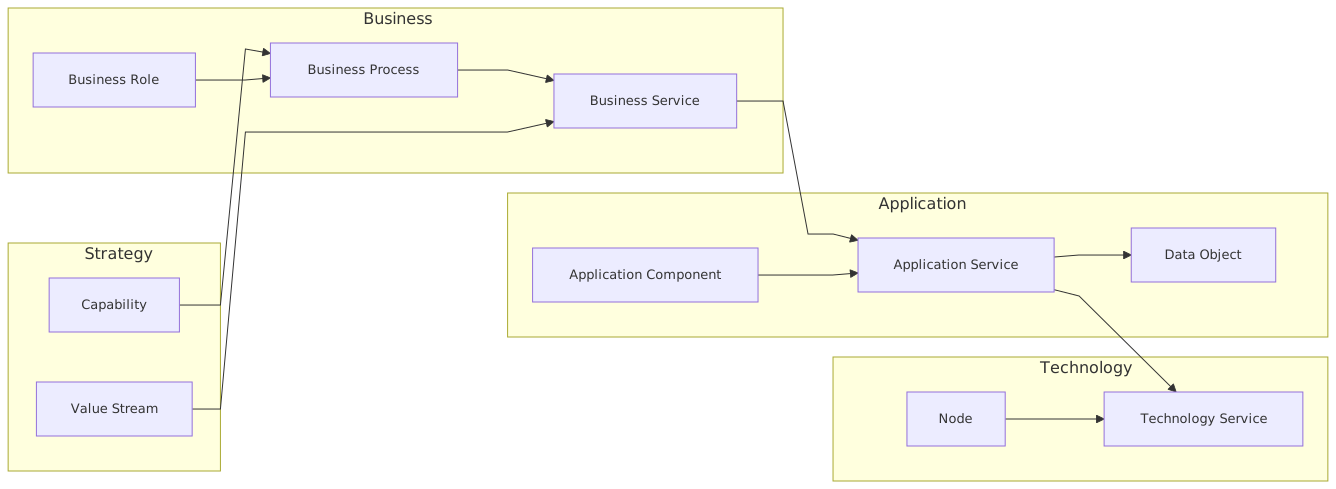
Metamodel integrity is not just “using ArchiMate correctly.” That’s too shallow. It means several things at once. ArchiMate modeling guide
1. Element identity is stable
An element should mean the same thing wherever it appears.
If “Customer Identity Service” is an application service, it should not quietly become an application component in another view because someone needed a box to connect to. If “Azure AD” or “Entra ID” is modeled as a technology service in one place and as an application component elsewhere, you have a semantic problem, not a notation problem.
2. Relationships are legitimate and intentional
ArchiMate allows certain relationships for a reason. You can’t just connect anything to anything because it “helps tell the story.” If a business process uses an application service, model that. Don’t bypass the application layer because it’s visually convenient. If Kafka provides a technology service to application components, say that. Don’t make the business process directly consume the Kafka cluster unless you are deliberately abstracting and know the consequence.
3. Abstraction levels are controlled
This one gets people all the time.
Architects mix conceptual, logical, and physical ideas in one model without any discipline. Then they wonder why the repository cannot support planning. A “Payments Platform” might be a logical application collaboration in one view, but then get linked directly to AWS MSK brokers and IAM roles in another. Maybe that is valid in a deployment view, maybe not. The issue is not mixing layers occasionally. The issue is doing it carelessly.
4. Reuse beats redraw
If your repository encourages architects to redraw the same domain each time they create a new view, metamodel integrity will collapse. Reuse of core elements is not optional. It is the whole game.
5. Governance is embedded, not bolted on
You do not preserve integrity by running quarterly cleanup exercises after 900 elements have already been modeled badly. You preserve it by defining modeling conventions, ownership, review rules, and repository quality checks from day one.
Views are not independent truths
This is the point people resist.
A view is not a standalone artifact with its own private semantics. It is a projection of a shared model. If your organization treats each view as an independent deliverable, you are basically guaranteeing inconsistency.
In real architecture work, this shows up everywhere:
- The business architect models “Customer Onboarding” as a business process supported by “Digital Identity.”
- The security architect models “Authentication and Access Control” as a security capability and references IAM tooling.
- The integration architect models Kafka event topics for onboarding and fraud events.
- The cloud architect models landing zones, managed services, and network controls.
- The domain architect models onboarding applications and APIs.
All of these should connect. Not conceptually. Literally in the repository.
Same underlying elements. Same relationships. Different views.
If they don’t, the architecture team is producing parallel narratives, not enterprise architecture.
A useful way to think about integrity
Here’s a practical table I’ve used with teams.
Simple table, but honestly, most architecture teams fail on at least four of these.
Common mistakes architects make
Let’s be blunt. These are not edge cases. These are routine.
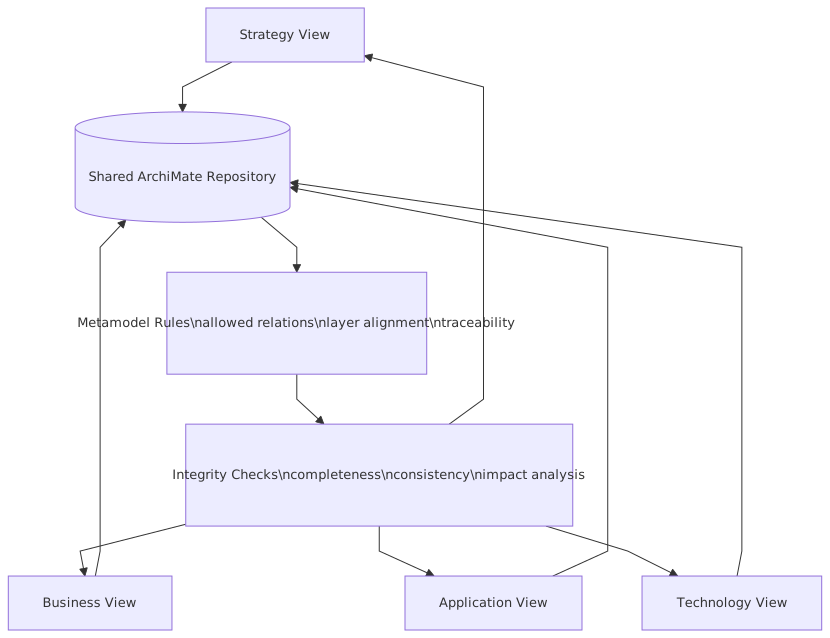
Mistake 1: Modeling the diagram instead of the enterprise
This is probably the biggest one.
An architect wants to explain a migration or a risk, so they create elements on the fly to make the diagram work. The view drives the model, instead of the model driving the view. That is exactly backwards.
You see this when someone creates “Kafka” as whatever they need in the moment:
- a technology node in infrastructure views
- an application service in integration views
- a data object in data lineage discussions
- a capability in target-state strategy decks
Now the repository contains four half-true versions of the same thing.
Mistake 2: Treating ArchiMate as if notation is the hard part
It isn’t. The hard part is semantic discipline.
A lot of teams can memorize symbols. Fewer can answer:
- What is our rule for modeling managed cloud services?
- When do we represent IAM as capability vs application service vs technology service?
- What is our enterprise definition of “platform”?
- How do we model event streams and topics consistently?
- What relationship do we use between business services and identity controls?
If those rules are not agreed, the notation won’t save you.
Mistake 3: Confusing product names with architectural types
“Kafka” is not an architectural type. “Okta” is not an architectural type. “AWS” is not an architectural type.
They are vendor or product labels that may instantiate multiple ArchiMate concepts depending on context. That nuance matters. Kafka might be represented as: ArchiMate tutorial
- a technology service for event streaming
- a system software element for the platform runtime
- a node for its deployed environment
- an artifact for configuration or connector packages
None of those are automatically wrong. What is wrong is using all of them randomly with no modeling convention.
Mistake 4: Skipping relationships because “everyone understands”
No, they don’t.
Architects often assume certain dependencies are obvious, especially around security and shared platforms. They’ll show an application box near an IAM box and call it enough. It is not enough. If the application uses an authentication service, consumes authorization decisions, or depends on token issuance, model those relationships. Otherwise, your security architecture becomes presentation theater.
Mistake 5: Mixing current state and target state in one ungoverned mess
This kills transformation planning.
In banks especially, teams love “hybrid state” diagrams that show old IAM, new IAM, old integration bus, Kafka, old data center, cloud landing zone, and several target services all in one colorful spaghetti plate. Then somebody asks what is live today versus planned next year, and nobody can answer confidently.
ArchiMate can support plateaus, gaps, work packages, and transition architectures. Use them. Or at least separate states with discipline.
How this applies in real architecture work
This is where people either get serious or drift back into theory.
Metamodel integrity matters because enterprise architecture is not just communication. It is decision support.
In real architecture work, you need to answer questions like:
- If we retire our legacy IAM stack, what business services are exposed?
- If we move event streaming from self-managed Kafka to a managed cloud offering, what applications and operational controls change?
- If a banking regulator asks for traceability from customer authentication controls to customer-facing services, can we show it?
- If we split a monolithic core banking application into domain services, what integration contracts and data objects move with it?
- If one cloud region fails, what technology services and application services are impacted?
You cannot answer those questions reliably from disconnected diagrams.
You answer them from a coherent model where:
- business processes are linked to business services
- business services are served by application services
- application services are realized by application components
- application components depend on technology services and infrastructure
- security services and controls are modeled as first-class dependencies
- implementation and migration elements show how the target state gets delivered
That is metamodel integrity at work. Not academic purity. Operational usefulness.
Real enterprise example: retail banking onboarding and fraud streaming
Let’s make this concrete.
Imagine a retail bank modernizing customer onboarding. Today, the onboarding journey spans:
- mobile banking app
- web onboarding portal
- legacy customer master
- on-prem IAM platform
- document verification vendor
- fraud engine
- batch integration to downstream systems
The target architecture introduces:
- cloud-based IAM
- Kafka for event streaming
- API-led onboarding services
- real-time fraud checks
- centralized identity and consent services
- managed cloud hosting for new digital services
Sounds familiar, because half the market is doing some version of this.
What the weak architecture repository looks like
In a weak repository:
- The business architecture team models “Customer Onboarding” and “Identity Verification” as business processes.
- The security architect creates a separate IAM view showing authentication, MFA, and role management.
- The integration architect creates a Kafka diagram with topics, producers, and consumers.
- The cloud architect creates a landing zone and managed services diagram.
- The solution architect draws onboarding APIs and microservices.
All useful views. But the elements are not shared.
So now:
- “Customer Identity Service” in security is not the same object as “Identity API” in application architecture.
- “Kafka Event Backbone” is not linked to the onboarding services that publish to it.
- “Fraud Decisioning” appears as a capability in one place and an application component in another.
- The customer consent data object appears nowhere in the IAM model, even though consent drives access policy.
- Legacy IAM decommissioning is shown in a roadmap, but not connected to impacted business services.
This is how transformation programs become confused. Not because the technology is hard. Because the model is incoherent.
What the strong architecture repository looks like
In a strong repository, the bank defines and reuses a coherent set of elements.
For example:
- Business process: Customer Onboarding
- Business service: Customer Identity Management
- Application service: Authentication Service
- Application service: Consent Management Service
- Application component: Digital Identity Platform
- Application component: Onboarding Orchestrator
- Application component: Fraud Decision Engine
- Technology service: Event Streaming Service
- System software / managed platform: Kafka Platform or managed Kafka service
- Data object: Customer Profile
- Data object: Consent Record
- Data object: Onboarding Event
- Technology service: Cloud IAM Foundation
- Work package: Migrate Onboarding to Cloud IAM
- Plateau: Current State / Transition 1 / Target State
Now the views become meaningful because they are projections of one story:
- The onboarding process uses authentication and consent services.
- The onboarding orchestrator realizes those application services.
- The orchestrator publishes onboarding events to Kafka.
- Fraud systems consume those events.
- IAM policies govern access to onboarding APIs and admin consoles.
- Cloud IAM foundation provides identity controls for workloads and operators.
- The target state replaces the legacy IAM dependency for digital channels but not yet for branch systems.
- Migration work packages and plateaus show sequencing.
Now when the bank asks, “What breaks if we delay cloud IAM rollout?” the architecture team can answer:
- onboarding MFA changes are delayed
- admin access model remains split
- event consumer authorization remains inconsistent
- target fraud integration cannot use unified identity claims
- decommissioning of legacy SSO slips by two quarters
That is architecture earning its keep.
Kafka, IAM, and cloud are where integrity usually gets exposed
Three areas reveal weak metamodel discipline faster than anything else: event platforms, identity, and cloud services.
Kafka
Kafka is notorious in enterprise models because it sits across concerns:
- integration
- eventing
- streaming
- infrastructure
- resilience
- data movement
Teams model it however suits the current conversation. Bad idea.
A better approach is to define a convention such as:
- Event Streaming Service as the technology service consumed by applications
- Kafka Platform as the system software or platform realization
- Kafka Cluster as the node or deployment instance where relevant
- Event Topic modeled carefully, often as a representation or artifact-like implementation object depending on your repository convention
- Publishing/consuming applications as application components using the service
You do not need one universal perfect convention. You need one enterprise convention that people follow.
IAM
IAM is even messier because it spans business, application, security, and technology layers.
You may need to model:
- identity governance as a capability
- authentication as an application service
- authorization decisioning as a service
- IAM platform as an application component
- cloud-native identity controls as technology services
- privileged access controls as specialized services
- business processes like joiner/mover/leaver
The mistake is flattening all of that into one generic “IAM” box. That box is useless. It hides the exact dependencies that regulators, auditors, and delivery teams care about.
Cloud
Cloud introduces abstraction traps. Managed services blur traditional boundaries. A managed Kafka service, managed database, cloud IAM, API gateway, and serverless runtime can each be represented in multiple valid ways depending on purpose.
Again, the answer is not dogma. The answer is convention plus consistency.
Personally, I think too many architecture teams overcomplicate cloud modeling. They try to represent every vendor construct exactly as documented. That creates noisy models nobody uses. Better to model cloud services at the architectural level that supports enterprise decisions:
- what service is provided
- who consumes it
- what it depends on
- what control boundaries exist
- what state it is in today versus target
Not every subnet needs to be in the enterprise repository. Sorry, but it doesn’t.
A practical operating model for preserving integrity
If you want metamodel integrity, do not start with tool configuration. Start with operating discipline.
1. Define a core metamodel profile for your enterprise
ArchiMate is broad. Your enterprise should define a constrained usage profile:
- approved element types
- approved relationship patterns
- naming conventions
- abstraction rules
- current/target state rules
- product-to-concept mapping conventions
This is not bureaucratic. It is liberating. People model faster when the rules are clear.
2. Establish domain ownership
Someone must own the integrity of key domains:
- customer and channel
- IAM and security
- integration and eventing
- cloud platform
- data and analytics
- core banking applications
Without ownership, shared elements decay into negotiation.
3. Reuse canonical elements
Create and protect canonical objects for major shared services and platforms:
- Enterprise IAM Service
- Event Streaming Service
- API Management Service
- Customer Master
- Fraud Decision Service
- Cloud Landing Zone
- Secrets Management Service
Architects should extend from these, not reinvent them for every project.
4. Review the model, not just the diagrams
Architecture governance boards often review slides, not repository integrity. That is a mistake.
Review questions should include:
- Are these reused elements or newly created duplicates?
- Are the relationships semantically valid?
- Is the abstraction level explicit?
- Is current vs target state separated?
- Can this view be traced to implementation and migration elements?
5. Automate quality checks where possible
If your tool supports it, run checks for:
- duplicate names
- orphaned elements
- invalid relationship patterns
- missing layer connections
- target-state elements without migration linkage
- unmanaged proliferation of generic labels like “platform” or “service”
Not glamorous, but very effective.
Strong opinion: too much freedom ruins repositories
Here’s the part some architects won’t like.
The idea that every architect should have broad freedom to model “in the way that best tells the story” sounds mature and collaborative. In practice, it often wrecks the repository. Shared languages need constraint. Enterprise architecture is not a poetry slam.
There should be room for judgment, yes. But not unlimited semantic improvisation.
If one architect models IAM as capability-centric, another as application-centric, another as control-centric, and another as vendor-centric, the repository becomes intellectually interesting and operationally useless. That is not sophistication. That is governance failure dressed up as flexibility. ArchiMate for governance
A good architecture practice has standards. Not because standards are beautiful, but because inconsistency is expensive.
Final thought
ArchiMate metamodel integrity is not a niche modeling concern. It is the difference between an architecture repository that supports real enterprise decisions and one that merely produces attractive diagrams.
If your views contradict each other, your architecture is telling leaders a comforting lie.
And the fix is not more views. It is better discipline underneath:
- stable elements
- valid relationships
- controlled abstraction
- shared conventions
- domain ownership
- model-based governance
In banking, in cloud transformation, in Kafka-enabled event architectures, in IAM modernization — this is where architecture either becomes a serious management tool or remains a slide factory.
My honest view? Most teams need fewer diagrams and a stronger metamodel. Not the other way around.
FAQ
1. What is ArchiMate metamodel integrity in plain English?
It means the elements and relationships in your architecture repository remain consistent across all views. A service, application, process, or platform should mean the same thing wherever it appears.
2. Why do architecture teams lose consistency across views?
Usually because they build diagrams for specific audiences without reusing shared model elements. Different architects create their own versions of the same concepts, especially in areas like IAM, Kafka, and cloud services.
3. How do I model Kafka consistently in ArchiMate?
Define a convention. For example, model event streaming as a technology service, the Kafka platform as system software or managed platform, and consuming/publishing systems as application components. The exact convention matters less than using it consistently.
4. How does metamodel integrity help in real enterprise work?
It improves impact analysis, migration planning, security traceability, and governance decisions. For example, in a bank, it helps show exactly which onboarding services, fraud systems, and IAM controls are affected by a cloud migration or platform change. EA governance checklist
5. What is the most common mistake architects make with ArchiMate?
Treating views as independent artifacts instead of projections of a shared model. That leads to duplicate elements, invalid relationships, and architecture packs that look polished but cannot support real decisions.
Frequently Asked Questions
What is the ArchiMate metamodel?
The ArchiMate metamodel formally defines all element types (Business Process, Application Component, Technology Node, etc.), relationship types (Serving, Realisation, Assignment, etc.), and the rules about which elements and relationships are valid in which layers. It is the structural foundation that makes ArchiMate a formal language rather than just a drawing convention.
How does the ArchiMate metamodel support enterprise governance?
By defining precisely what each element type means and what relationships are permitted, the ArchiMate metamodel enables consistent modeling across teams. It allows automated validation, impact analysis, and traceability — turning architecture models into a queryable knowledge base rather than a collection of individual diagrams.
What is the difference between using ArchiMate as notation vs as an ontology?
Using ArchiMate as notation means drawing diagrams with its symbols. Using it as an ontology means making formal assertions about what exists and how things relate — leveraging the metamodel's semantic precision to enable reasoning, querying, and consistency checking across the enterprise model.