⏱ 5 min read
Recommended Reading
Executive summary
Cross-domain modeling is where language discipline matters most. ArchiMate is positioned as an open modeling language that enables enterprise architects to describe, analyze, and visualize relationships among business domains in an unambiguous way.
Large enterprises should therefore model cross-domain relationships through stable anchors (capabilities and application services) and stakeholder-specific viewpoints rather than attempting a single mega-model diagram. Viewpoints like the capability map provide structured overviews that can be heatmapped for investment, demonstrating how a small set of views can deliver high governance value. ArchiMate for architecture governance
- Core anchor pattern: capabilities and services
- Viewpoint governance (audiences and purposes)
- Federation: domain ownership within shared semantics
- Governance controls: decision traceability and reviews

- ArchiMate 3.2 framing (unambiguous relationships).
- ArchiMate reference cards.
- Capability map viewpoint and heatmap use.
- ADR practice (decision capture).
Cross-domain traceability architecture
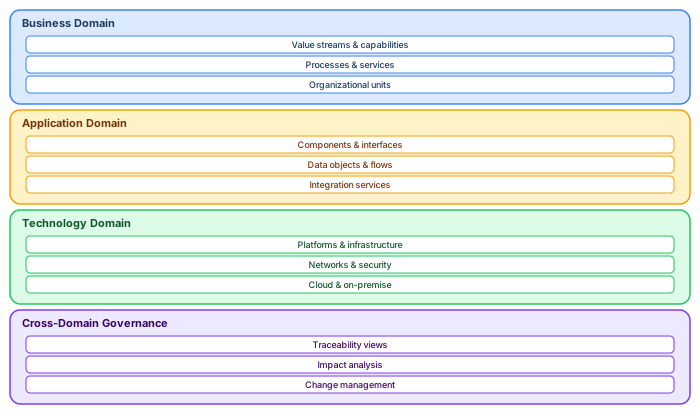
In large enterprises, architecture teams are typically organized by domain: Business Architecture, Application Architecture, Technology Architecture, Data Architecture, Security Architecture. Each domain models independently, using its own views and conventions. The challenge is ensuring coherence across domains — a change in the application layer must be traceable to the business capability it supports and the technology service it depends on.
ArchiMate's layer structure provides the semantic framework for cross-domain traceability. The key discipline is shared elements at domain boundaries: Business Services are the interface between Business and Application domains (owned by Business Architecture, consumed by Application Architecture). Application Services are the interface between Application and Technology domains (owned by Application Architecture, consumed by Technology Architecture).
The governance overlay ensures cross-domain consistency. A Cross-Domain Traceability view shows elements from all three layers with their inter-layer relationships. This view is owned by the Enterprise Architecture team (not any single domain) and is the primary artifact for architecture review boards. When a project proposes a change, the cross-domain view reveals the full impact chain — from the affected business capability through the changing applications to the technology services that need updating.
Practical implementation
In Sparx EA, implement cross-domain modeling with shared packages. Create a "Shared Elements" package containing Business Services, Application Services, and Technology Services that sit at domain boundaries. Domain teams import these shared elements into their domain-specific views. Changes to shared elements require cross-domain review — they affect multiple teams simultaneously. Automate impact detection: a script that identifies all elements connected to a changed shared element across all packages and notifies the affected domain leads. free Sparx EA maturity assessment
Practical ArchiMate modeling guidance
Effective ArchiMate modeling requires discipline in three areas: element selection (choosing the right element type for each concept), relationship precision (using typed relationships instead of generic associations), and view composition (building viewpoint-specific diagrams with 15-20 elements maximum). These three disciplines determine whether an ArchiMate model communicates clearly or creates confusion. ArchiMate tutorial for enterprise architects
Start each modeling effort by identifying the stakeholder question the view must answer. "Which applications support customer onboarding?" drives an Application Cooperation view. "What infrastructure is end-of-life?" drives a Technology Usage view with lifecycle tagged values. "How does this transformation affect the business?" drives a Layered view with migration plateaus. The question determines the viewpoint, the viewpoint determines the elements, and the elements determine the relationships.
Applying these patterns in practice
The value of ArchiMate modeling is realized not through comprehensive coverage of every element type, but through disciplined application of a few core patterns that answer recurring stakeholder questions. Three patterns account for the majority of architecture communication needs. ArchiMate layers explained
The Layered View pattern shows how business processes depend on applications, and how applications depend on infrastructure. Build this view by placing Business Processes at the top, Application Components in the middle, and Technology Nodes at the bottom. Connect them with Serving and Realization relationships. This single view demonstrates cross-layer traceability — when a server is decommissioned, trace upward to see which applications and business processes are affected.
The Cooperation View pattern shows how application components interact through interfaces and data flows. Place the core application in the center and its integration partners around it, connected by Flow relationships labeled with the data exchanged. This view reveals integration dependencies that are otherwise buried in technical documentation.
The Motivation View pattern connects strategic goals to architecture decisions. Stakeholder concerns drive Goals, Goals are realized by Outcomes, Outcomes are enabled by Capabilities, and Capabilities are realized by Application Components. This chain answers the question executives always ask: "Why are we building this?"
If you’d like hands-on training tailored to your team — Sparx Enterprise Architect, BPMN, SysML, Apache Kafka or the Archi tool — or modelling coaching in ArchiMate and TOGAF-aligned governance, you can reach us via our contact page.
Frequently Asked Questions
What is enterprise architecture?
Enterprise architecture is a discipline that aligns an organisation's strategy, business operations, information systems, and technology infrastructure. It provides a structured framework for understanding how an enterprise works today, where it needs to go, and how to manage the transition.
How is ArchiMate used in enterprise architecture practice?
ArchiMate is used as the standard modeling language in enterprise architecture practice. It enables architects to create consistent, layered models covering business capabilities, application services, data flows, and technology infrastructure — all traceable from strategic goals to implementation.
What tools are used for enterprise architecture modeling?
Common enterprise architecture modeling tools include Sparx Enterprise Architect (Sparx EA), Archi, BiZZdesign Enterprise Studio, LeanIX, and Orbus iServer. Sparx EA is widely used for its ArchiMate, UML, BPMN and SysML support combined with powerful automation and scripting capabilities.