⏱ 19 min read
Most enterprise architecture workshops fail for one simple reason: they confuse drawing with thinking.
That sounds harsh, but it is true.
A lot of teams walk into an “ArchiMate workshop” expecting a modeling class. They think they’ll learn what shape represents an application service, what relationship to use between a business process and an application component, and maybe how to make the diagram look less ugly in the repository tool. Then they go back to work, create a few pretty views, and nothing changes. Delivery teams still ignore architecture. Executives still say architecture is too abstract. Security still arrives late. Integration is still a mess. Cloud costs still rise. Kafka becomes a dumping ground. IAM becomes a political fight. And the architecture team wonders why nobody takes them seriously.
Here’s the uncomfortable opinion: if your ArchiMate workshop is mainly about notation, you are teaching the least important part.
A good enterprise ArchiMate workshop is not really about boxes and lines. It is about learning how to expose complexity without drowning in it. It is about making strategy, operating model, applications, integrations, technology, risk, and change visible in one language that different stakeholders can actually use. Not perfectly. Not elegantly all the time. But usefully.
That is what people should learn.
What is an ArchiMate workshop, in simple terms?
Let’s keep the SEO-friendly answer early and plain.
An ArchiMate workshop is a structured session where architects, product leaders, engineers, and business stakeholders learn how to use the ArchiMate modeling language to describe how an enterprise works and how it changes.
In practical terms, participants learn how to model:
- business capabilities
- business processes
- applications and services
- data and integrations
- technology and infrastructure
- security and IAM
- migration and transformation roadmaps
And if the workshop is any good, they also learn:
- what not to model
- how to choose the right level of detail
- how to use models in decision-making
- how to connect architecture views to real delivery work
That last part matters more than most training providers admit. TOGAF roadmap template
Because enterprises do not need more diagrams. They need better decisions.
The real point of ArchiMate in enterprises
ArchiMate gives you a common language for architecture across business, application, and technology domains. Fine. That’s the formal answer.
The real value is this: ArchiMate lets you show dependency, impact, ownership, and change in a way that cuts across silos.
That is why it works in large enterprises.
In a bank, for example, a customer onboarding problem is never just a business process issue. It is tied to:
- identity proofing and IAM controls
- KYC and compliance checks
- event flows through Kafka
- CRM updates
- cloud-hosted onboarding APIs
- branch and digital channel experience
- fraud services
- data retention policies
- operational support teams
Without a modeling language, every team explains its own part in its own words. The result is noise.
With ArchiMate, you can create a coherent set of views that answer practical questions:
- Which business capabilities are involved?
- Which application services support them?
- Which systems are authoritative for identity?
- Where are the Kafka topics introducing coupling?
- Which cloud components are critical for resilience?
- What changes first in the migration roadmap?
- What is impacted if IAM policy changes?
That is why workshops matter. Not because people need to memorize symbols, but because enterprises need a shared way to reason about change.
What you actually learn in a serious ArchiMate workshop
Let’s get specific. A serious enterprise workshop should teach several things, and they should build on each other.

1. How to think in layers without becoming simplistic
People often describe ArchiMate as layered: business, application, technology. That is useful, but also dangerous. ArchiMate modeling guide
The mistake is treating layers like separate worlds. In real architecture work, they are not separate. They are entangled.
A workshop should teach participants how to use layers to simplify discussion while still preserving relationships across them.
For example:
- a business process “Approve Loan Application”
- uses an application service “Credit Decision Service”
- exposed by an application component “Lending Decision Engine”
- running on a technology service in cloud infrastructure
- secured by an IAM platform
- connected to event streams in Kafka
- constrained by risk and compliance requirements
That is not academic. That is a normal Tuesday in a bank.
The workshop should help people model this chain clearly enough that everyone sees the same architecture story.
2. The difference between structure and behavior
This is where many architects get sloppy.
They draw systems and say they have shown architecture. Not really. They have shown inventory.
A useful workshop teaches the distinction between:
- structure: capabilities, actors, roles, applications, nodes, interfaces
- behavior: processes, functions, interactions, services, events
Why does this matter? Because most enterprise problems are caused by behavior crossing structures.
A customer identity platform may be perfectly rational structurally. But if onboarding, authentication, authorization, fraud checks, and consent management behave inconsistently across channels, the architecture is broken in practice.
In workshops, participants should learn to ask:
- What exists?
- What does it do?
- Who uses it?
- What triggers it?
- What depends on it?
- What changes if it fails?
That line of questioning is more valuable than learning every relationship symbol by heart.
3. How to model capabilities without turning them into PowerPoint wallpaper
Capability maps are everywhere. Most are useless.
I’ll be blunt: many enterprise capability models are just strategy theater. They look polished, but they do not help investment decisions, portfolio rationalization, or transformation planning.
A good ArchiMate workshop teaches how capabilities become actionable by connecting them to:
- business outcomes
- processes
- applications
- data ownership
- risks
- target-state priorities
- maturity gaps
Suppose a bank identifies “Customer Identity and Access Management” as a core capability. Fine. But unless that capability is linked to actual IAM platforms, identity stores, onboarding workflows, authentication journeys, privileged access controls, and regulatory requirements, it remains decorative.
Participants should learn how to move from “we have a capability map” to “we can justify architecture investment.”
4. How to create views for different stakeholders
This is where architects either become useful or irrelevant.
No executive wants to review a full metamodel view. No engineer wants a strategy-only picture. No risk leader wants a cloud network diagram with no control context.
An enterprise workshop should teach one of the most important architecture skills: viewpoint selection.
You learn how to tailor architecture views for:
- executives
- domain architects
- solution architects
- security architects
- platform teams
- delivery teams
- audit and compliance stakeholders
Same underlying architecture. Different views. Different emphasis.
This is one of the strongest reasons to use ArchiMate in enterprises. It supports traceability across abstraction levels, if you use it properly. ArchiMate tutorial
And yes, this is where many workshops are weak. They spend too much time on notation and too little on communication design.
5. How to model change, not just the current state
Current-state architecture is easy to overproduce and underuse.
The real value comes when people learn to model change: transition architectures, work packages, dependencies, plateaus, and migration paths.
In plain English: how the enterprise gets from the mess it has now to the operating model it wants later.
This matters enormously in cloud, Kafka, and IAM transformations.
Take a typical enterprise initiative:
- moving customer-facing applications to cloud
- decoupling legacy integrations through Kafka
- centralizing IAM
- retiring duplicate identity stores
- introducing API-based access enforcement
If your workshop does not teach how to model the transition, it is incomplete.
Because the hard part is not drawing the target state. The hard part is sequencing change without breaking the bank, the controls, or production.
What this looks like in real architecture work
Let’s leave theory for a minute.
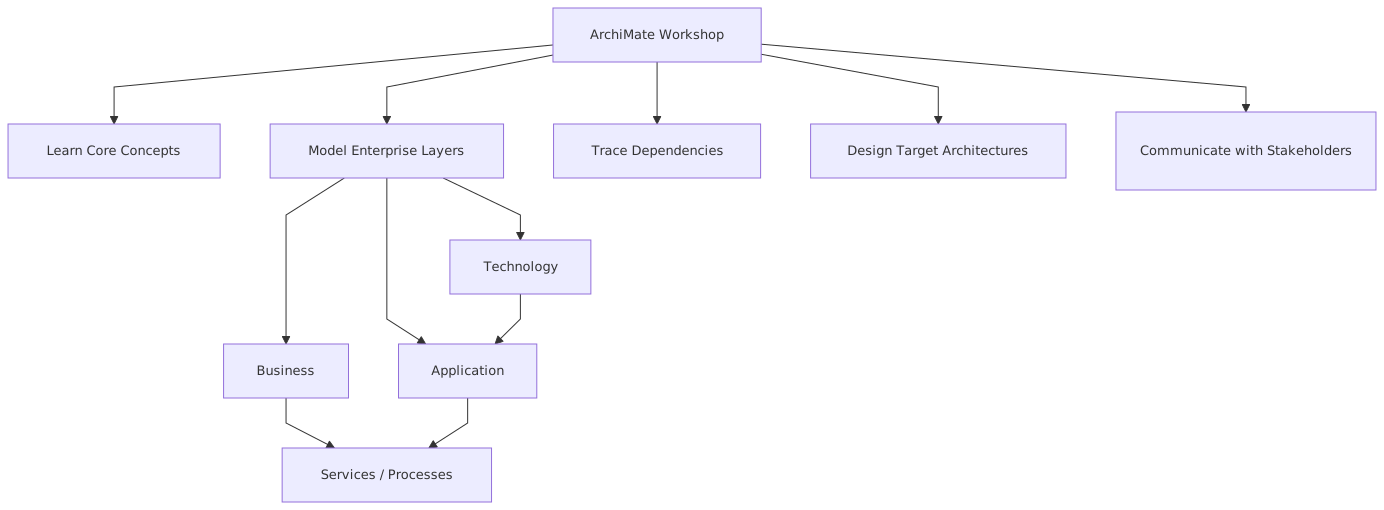
In real enterprise architecture work, ArchiMate workshops help teams do five practical things.
Align business and technology in the same room
This sounds obvious, but it rarely happens well.
Business leaders describe customer friction. Security describes control failures. Engineering describes technical debt. Cloud teams describe platform limitations. Nobody is wrong, but nobody is speaking the same language either.
A workshop creates a structured way to map those concerns into one model. That alone can save weeks of circular discussion.
Expose hidden dependencies
This is probably the biggest practical benefit.
Many architecture failures happen because dependencies are invisible until late in delivery. IAM changes affect onboarding. Kafka topic design affects data lineage. Cloud network segmentation affects service communication. A “simple” API modernization effort turns out to depend on four legacy systems and three approval bodies.
ArchiMate models make those dependencies explicit.
That does not eliminate politics. Let’s not be naive. But it gives the politics something concrete to argue about.
Improve architecture decision records and governance
Governance often fails because architecture review boards are working from disconnected artifacts: slides, spreadsheets, Jira epics, Visio diagrams, and tribal memory.
A workshop teaches teams how to create reusable architecture views that support governance:
- impact assessment
- risk review
- investment prioritization
- standards compliance
- target-state alignment
In other words, architecture review becomes less about opinion and more about evidence.
Support transformation roadmaps
Roadmaps built without architecture traceability are usually fantasy with dates.
Workshops help participants learn how to connect initiatives to capabilities, systems, services, and migration dependencies. That makes roadmap conversations more honest. ArchiMate in TOGAF ADM
Not easier. More honest.
Give solution architects enterprise context
Solution architects are often asked to deliver local solutions in globally messy environments. They need to know where their design sits in the broader operating model.
A good workshop helps them understand:
- what enterprise constraints are real
- what standards matter
- where reuse is possible
- what dependencies cannot be ignored
- what future-state direction should influence today’s design
That is actual architecture value.
A real enterprise example: retail banking onboarding modernization
Let’s use a concrete example.
A retail bank wants to modernize customer onboarding across mobile, web, and branch channels. Today the process is fragmented:
- branch onboarding uses one identity verification flow
- mobile onboarding uses another
- web onboarding relies on legacy IAM integration
- customer profile data is duplicated across systems
- fraud screening is inconsistent
- Kafka is used for event distribution, but topic ownership is unclear
- cloud-hosted onboarding services exist, but legacy systems remain system-of-record for several steps
This is a very believable enterprise situation. In fact, it’s almost boringly common.
The business problem
Executives see:
- slow onboarding
- inconsistent customer experience
- compliance risk
- high operational cost
- low reuse across channels
The technology problem
Architects and engineers see:
- multiple IAM patterns
- duplicated identity data
- unclear source-of-truth boundaries
- Kafka topics acting as accidental integration contracts
- hybrid cloud and on-prem dependencies
- brittle orchestration across onboarding steps
What an ArchiMate workshop would teach in this scenario
Participants would learn to model:
- Business layer
- customer onboarding capability
- identity verification process
- fraud review process
- branch advisor role
- digital channel interactions
- Application layer
- onboarding portal
- identity proofing service
- customer master service
- IAM platform
- fraud engine
- Kafka event broker
- CRM and core banking applications
- Technology layer
- cloud runtime platform
- API gateway
- Kafka cluster deployment
- IAM infrastructure
- legacy data center nodes
- network and resilience dependencies
- Motivation and constraints
- regulatory requirements
- customer experience objectives
- resilience requirements
- data retention policies
- zero-trust security direction
- Migration
- transition from channel-specific onboarding to shared onboarding services
- phased IAM consolidation
- Kafka topic governance improvement
- legacy decommission milestones
What becomes visible
Once modeled properly, several truths usually emerge:
- IAM is not a supporting side concern; it is central to onboarding.
- Kafka is not solving integration by itself; it is exposing ownership confusion.
- Cloud migration is not the transformation; it is one enabler.
- The bank cannot modernize onboarding without clarifying customer identity authority.
- Several “quick wins” are fake quick wins because they depend on deeper data and security decisions.
That is exactly the kind of insight a real architecture workshop should surface.
Common mistakes architects make in ArchiMate workshops
There are many. Here are the worst ones.
1. Teaching notation before purpose
This is the classic failure.
Participants get overwhelmed with element types and relationships before they understand why any of it matters. They leave thinking ArchiMate is complicated and abstract.
Start with the problem. Then model just enough to clarify it.
2. Modeling everything
Some architects cannot resist completeness. They produce giant diagrams that nobody can read, maintain, or trust.
A model is useful because it is selective.
If your workshop encourages exhaustive capture too early, it is going in the wrong direction.
3. Confusing applications with services
This happens constantly.
Teams label every box as an application and skip service thinking entirely. But in enterprise architecture, services matter because they express what is actually provided and consumed.
If you do not model services, you miss dependency and accountability patterns.
4. Ignoring security and IAM until later
This is one of my strongest opinions: enterprise architecture that leaves IAM out of the early conversation is not serious architecture.
Identity, authentication, authorization, consent, privileged access, and policy enforcement are not peripheral details. They shape business flow, customer experience, integration design, and compliance posture.
In banking especially, IAM is architecture, not merely security plumbing.
5. Treating Kafka like architecture magic
Kafka is useful. Kafka is powerful. Kafka is not a substitute for architecture.
I have seen enterprises use Kafka to avoid making hard decisions about ownership, contracts, and process boundaries. They publish events everywhere, call it decoupling, and then spend years untangling semantic inconsistency.
A workshop should teach people how to model event-driven architecture honestly:
- who owns the event
- what business event it represents
- which services consume it
- what consistency assumptions apply
- what governance is required
Otherwise Kafka becomes a distributed confusion engine.
6. Making cloud the center of every diagram
Cloud is important. But too many architecture workshops drift into infrastructure-centric thinking.
Executives do not care that a service runs in Kubernetes unless that affects resilience, cost, speed, or risk. Business teams do not care about subnets unless those constrain service design or compliance.
Cloud belongs in the model where it matters. Not everywhere by default.
7. Producing views with no audience
Architects often create diagrams for themselves and then wonder why nobody else uses them.
Every view should answer:
- who is this for?
- what decision does it support?
- what level of abstraction is right?
- what should be omitted?
If you cannot answer that, do not create the view.
What a strong enterprise workshop usually covers
Here’s a practical summary.
This is the minimum useful scope, honestly.
Contrarian thought: not everyone in the enterprise needs full ArchiMate fluency
This may annoy purists, but it is true.
You do not need every stakeholder to become an ArchiMate expert. In fact, trying to do that can waste time.
What enterprises actually need is:
- a core group with strong modeling discipline
- a wider group that can read key views
- facilitators who can translate architecture into business decisions
- governance that uses models pragmatically
Architecture languages should reduce friction, not create a priesthood.
If your workshop makes non-architects feel stupid, the workshop failed.
Another contrarian thought: workshops should include disagreement, not just instruction
Some training sessions are too polite. Everyone nods. Everyone accepts the example. Nobody challenges assumptions.
That is not how enterprise architecture works.
Real workshops should create productive disagreement:
- Is IAM centralized enough?
- Are Kafka topics domain-owned or platform-owned?
- Is cloud migration actually reducing complexity?
- Which system is authoritative for customer identity?
- Are we modeling a capability or a team boundary?
- Is this target state achievable or just fashionable?
Those arguments are healthy. They reveal architecture truth.
A workshop that avoids tension may be comfortable, but it is probably shallow.
How enterprise architects should use workshop learning afterward
The workshop is not the point. What happens after is the point.
After a good workshop, architects should be able to:
Build a usable repository structure
Not a dumping ground. A structure.
Models should support:
- traceability
- reuse
- impact analysis
- versioning
- governance reviews
- roadmap planning
If the repository becomes a graveyard of disconnected views, all the workshop energy dies.
Standardize a few core viewpoints
Enterprises often need a small set of recurring views, such as:
- capability to application mapping
- business process to application service mapping
- integration and event flow view
- IAM trust and access view
- cloud deployment and resilience view
- transition roadmap view
Do not invent twenty-seven custom viewpoints in month one. Start with the views that support real decisions.
Integrate architecture with delivery artifacts
This is non-negotiable if you want relevance.
Architecture models should connect to:
- epics and initiatives
- architecture decision records
- standards and guardrails
- risk controls
- service catalogs
- CMDB or platform metadata where sensible
No, ArchiMate should not replace every other artifact. That is another common fantasy. It should connect them.
Use models in governance meetings
If architecture models are not referenced in governance, they become decorative.
Use them to answer:
- What is impacted?
- What standards apply?
- What is the migration dependency?
- What capabilities improve?
- What risks increase?
- What can be retired?
That is where architecture earns credibility.
What participants often underestimate they will learn
There are also second-order lessons that matter a lot.
They learn how messy enterprise language really is
Different teams use the same word differently:
- service
- platform
- capability
- product
- domain
- customer
- identity
A workshop exposes these inconsistencies fast. Good. Better to surface them than pretend they are harmless.
They learn that architecture is partly facilitation
Many architects think their value is in knowing frameworks. Frameworks matter, but enterprise architecture is also facilitation under ambiguity.
A workshop shows that modeling is often a way to guide discussion, resolve ambiguity, and make assumptions testable.
They learn that abstraction is a skill
Too much detail kills understanding. Too little detail kills usefulness.
Finding the right abstraction level is one of the hardest parts of architecture work. Workshops help people practice that judgment.
Signs your enterprise needs an ArchiMate workshop now
If any of these sound familiar, you probably need one:
- strategy decks and solution designs do not connect
- teams argue endlessly about system ownership
- Kafka usage is growing faster than integration clarity
- IAM is fragmented across channels and products
- cloud migration is happening without target-state coherence
- architecture governance feels subjective
- nobody can explain end-to-end impact of a major change
- capability maps exist but do not influence investment
That is the sweet spot for ArchiMate workshops. Not when the enterprise wants pretty modeling. When it needs shared architectural reasoning.
Final thought
ArchiMate workshops are valuable when they teach architects and stakeholders how to think across business, application, technology, security, and change as one enterprise system.
That is the standard.
Not notation trivia. Not repository tourism. Not framework worship.
If you run these workshops well, people leave with a sharper understanding of how the enterprise actually works, where the real dependencies are, and how transformation should be sequenced. They become better at discussing capability gaps, Kafka event ownership, IAM control points, cloud deployment implications, and migration trade-offs in one connected conversation.
And that is rare.
Because in most enterprises, the architecture problem is not lack of intelligence. It is lack of shared visibility.
ArchiMate, used well, gives you that visibility.
Used badly, it gives you more diagrams nobody reads.
Choose carefully.
FAQ
1. What will I learn in an ArchiMate workshop if I’m already an experienced architect?
Usually the biggest value is not basic notation. It is learning how to create better enterprise views, model cross-domain dependencies, and use ArchiMate for roadmap and governance work. Experienced architects often improve most in viewpoint selection and migration modeling.
2. Are ArchiMate workshops only useful for enterprise architects?
No. They are especially useful for solution architects, domain architects, security architects, and transformation leads. Product and business stakeholders also benefit if the workshop is practical and not overloaded with notation theory.
3. How does ArchiMate help with Kafka and event-driven architecture?
It helps you model event producers, consumers, services, processes, and dependencies in a structured way. More importantly, it forces clearer thinking about ownership, contracts, and business meaning. That is where many Kafka programs struggle.
4. Can ArchiMate workshops help with IAM and security architecture?
Yes, and they should. IAM can be modeled in relation to business processes, application services, trust boundaries, and technology platforms. This is very useful in banking and regulated industries where identity and access controls shape customer journeys and compliance outcomes.
5. How long should an enterprise ArchiMate workshop be?
For real enterprise value, one short intro session is rarely enough. A practical format is a 1–2 day foundation workshop followed by domain-specific working sessions using real enterprise cases, like cloud migration, banking onboarding, or IAM consolidation. That is where learning becomes usable.
Frequently Asked Questions
What is enterprise architecture?
Enterprise architecture is a discipline that aligns an organisation's strategy, business processes, information systems, and technology. Using frameworks like TOGAF and modeling languages like ArchiMate, it provides a structured view of how the enterprise operates and how it needs to change.
How does ArchiMate support enterprise architecture practice?
ArchiMate provides a standard modeling language that connects strategy, business operations, applications, data, and technology in one coherent model. It enables traceability from strategic goals through business capabilities and application services to the technology platforms that support them.
What tools are used for enterprise architecture modeling?
The main tools are Sparx Enterprise Architect (ArchiMate, UML, BPMN, SysML), Archi (free, ArchiMate-only), and BiZZdesign Enterprise Studio. Sparx EA is the most feature-rich option, supporting concurrent repositories, automation, scripting, and integration with delivery tools like Jira and Azure DevOps.