⏱ 20 min read
Most ArchiMate problems are not ArchiMate problems.
They’re team problems disguised as modeling problems. One team draws everything as an application cooperation view. Another team uses ArchiMate like it’s a process flow tool. A third team creates beautiful diagrams nobody can read unless they were in the workshop where the diagram was born. Then leadership asks for “enterprise-wide architecture visibility,” and what they get is a museum of inconsistent pictures. ArchiMate modeling guide
That’s the blunt truth.
If you want consistent ArchiMate views across teams, stop obsessing over notation purity for a minute and start treating views as products. A view is not just a diagram. It’s a communication artifact with a defined audience, purpose, level of abstraction, and set of modeling rules. If those things aren’t standardized, your teams will produce different-looking diagrams even when they’re describing the same reality.
The simple version
Here’s the short explanation up front.
To create consistent ArchiMate views across teams, you need five things: ArchiMate tutorial
- A small set of standard view types
- Clear modeling conventions
- Shared element and relationship definitions
- Review and governance that is practical, not bureaucratic
- A repository strategy that supports reuse instead of diagram-by-diagram improvisation
That’s it. Not magic. Not a giant framework deck. Not a 90-page style guide nobody reads.
The goal is simple: if two architecture teams model the same thing — say a Kafka-based event integration between online banking and fraud systems — their views should look recognizably similar, use the same concepts, and answer the same stakeholder questions.
That matters because enterprise architecture is not art. It’s operational communication.
And yes, there is room for judgment. But not on the basics.
Why consistency matters more than most architects admit
A lot of architects talk about consistency as if it’s mainly a repository hygiene issue. It’s not. It’s a decision quality issue.
In real enterprise work, architecture views are used to:
- decide funding
- assess impact
- identify risk
- support audit and regulatory conversations
- align delivery teams
- explain cloud migrations
- clarify ownership
- make integration dependencies visible
If one team’s “application interface” means an API and another team uses it to represent a Kafka topic, people start making wrong assumptions. If one domain models IAM capabilities at business layer and another models them as application services only, your security architecture becomes incoherent. If cloud platform views vary wildly by team, your infrastructure governance becomes storytelling instead of architecture. ArchiMate for governance
In a bank, inconsistency is not harmless. It creates blind spots.
I’ve seen this play out in a large retail banking environment. The payments architecture team modeled event-driven integration in a fairly disciplined way: applications, application interfaces, application services, data objects, and technology services underneath. Meanwhile, the customer identity team modeled almost everything as business processes and capabilities, because they were trying to keep diagrams “executive friendly.” Both teams were competent. Both teams were trying to help. But when the bank started a cross-domain initiative to centralize IAM events over Kafka and move workloads to cloud-managed messaging, the models couldn’t be stitched together. Same enterprise, same repository, same notation standard on paper. Totally different languages in practice.
That is the real cost of inconsistency: you lose the ability to reason across domains.
What “consistent ArchiMate views” actually means
Let’s define this properly, because people use the phrase loosely.
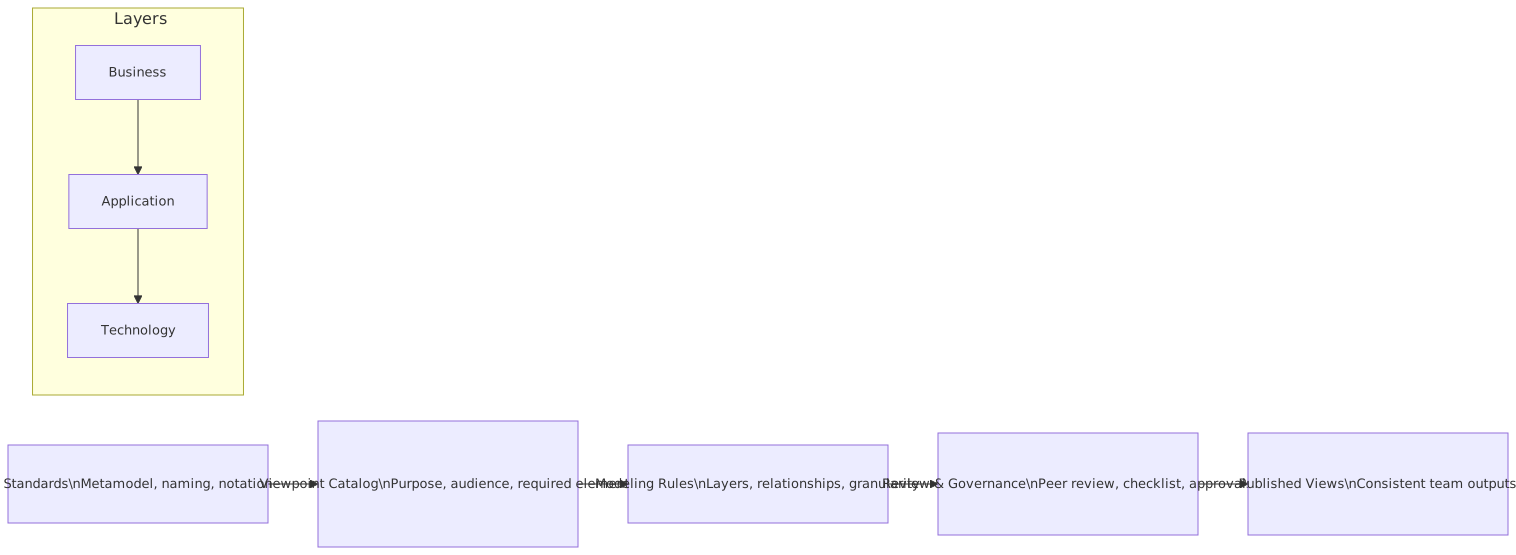
Consistent ArchiMate views across teams does not mean:
- every diagram looks visually identical
- every team uses every ArchiMate element
- all architecture work gets flattened into one style
- creativity disappears
- every stakeholder gets the same view
That would be dumb.
Consistency means that across teams:
- the same concepts are modeled in the same way
- the same view purpose leads to the same kind of diagram
- the same abstraction level is used for the same audience
- naming is predictable
- relationships are used intentionally
- cross-team reuse is possible
In other words, consistency is semantic first, visual second.
This is where many architecture teams go wrong. They create a notation cheat sheet, maybe define colors and line styles, then declare victory. But the real issue is not whether someone used blue for application components. The real issue is whether “Customer IAM Platform” is modeled as an application component in one domain, an application collaboration in another, and a technology service in a third because nobody agreed what the object represents.
A style guide without semantic discipline is just branding.
Start with a small set of standard view types
This is the most practical move you can make.
Do not let every team invent its own diagram types. ArchiMate is flexible, and that flexibility is exactly why teams drift. If you want consistency, define a small catalog of enterprise-standard views.
For most organizations, especially banks and large regulated enterprises, I’d start with around 8–12 standard view types. Not 40.
Here’s an example.
That table alone solves more inconsistency than another architecture principles workshop.
Why? Because it shifts the conversation from “draw what you think is useful” to “for this problem, use this view type and these rules.”
Now, be careful. Standard view types should not become rigid templates that force nonsense. A team should still be allowed to create an additional view when needed. But the default should be a shared set.
My strong opinion here: if your enterprise repository contains hundreds of one-off diagram types with no common purpose, you don’t have architecture content. You have diagram debt.
Define the viewpoint before the diagram
A lot of architects start with the drawing tool. That’s backwards.
Before anyone creates a view, they should answer four questions:
- Who is the audience?
- What decision or understanding is this view meant to support?
- What level of detail belongs here?
- What ArchiMate concepts are in scope?
This sounds obvious, but teams skip it all the time.
A cloud engineer wants to explain AWS deployment patterns, so they throw EC2, EKS, IAM roles, VPCs, APIs, and business capabilities into one giant diagram. A business architect wants to show customer onboarding, so they include process flows, application components, data objects, Kafka topics, and identity providers all in one picture. The result is not richer architecture. It’s just mixed abstraction.
For example, if the purpose is to explain how Kafka supports banking event integration, your standard integration view might include:
- application components producing and consuming events
- application interfaces where relevant
- data objects or business objects representing event payload concepts
- technology services for Kafka platform capabilities
- perhaps system software or nodes if deployment is needed
It probably should not include:
- every business process in the value stream
- every cloud subnet and firewall
- every IAM policy
- every project work package
That belongs elsewhere.
Consistency comes from saying, “This type of question gets this type of view.”
Not every truth belongs in every picture.
Standardize modeling conventions ruthlessly
Here’s where architects often get squeamish. They say things like, “We don’t want to be too prescriptive” or “Teams need autonomy.”
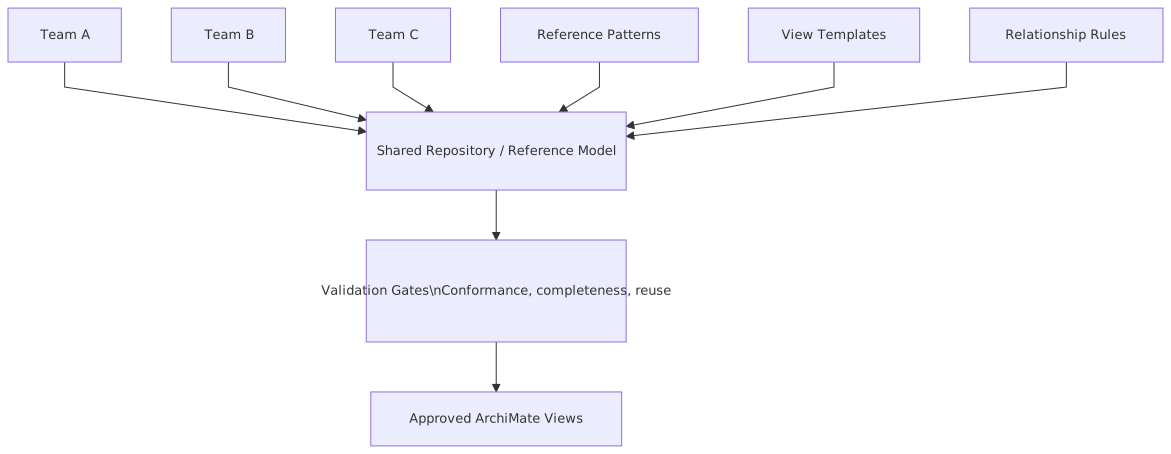
Fine. Let teams choose delivery tools, sprint rituals, and whether they like dark mode. But if they’re contributing to enterprise architecture content, some conventions should be non-negotiable.
At minimum, standardize these areas:
1. Element usage
Define which ArchiMate elements represent common enterprise concepts.
Examples:
- Application Component = deployable or logically distinct application/system
- Application Service = externally visible behavior offered by an application
- Application Interface = access point such as API endpoint, UI, event interface
- Technology Service = platform capability such as managed Kafka, cloud IAM, Kubernetes runtime
- Business Capability = stable business ability, not a process
- Business Process = behavior sequence, not a capability
- Data Object = structured information used in applications
- Node = infrastructure execution environment
This is basic, but teams mess it up constantly.
2. Relationship usage
This one matters even more.
Pick a limited set of relationships that teams should use by default, and define them with examples. Otherwise people use association for everything because they’re afraid to be wrong.
In a well-run enterprise practice, you want people comfortable with a core set such as:
- serving
- realization
- assignment
- access
- flow
- triggering
- composition
- aggregation
Not every relationship. Just the ones that are meaningful and teachable.
3. Naming standards
You need naming rules for:
- applications
- services
- interfaces
- Kafka topics
- IAM components
- cloud services
- capabilities
If one team writes “Customer IAM,” another writes “CIAM Platform,” and another writes “Identity & Access Service Layer,” cross-domain views become painful.
4. View metadata
Every view should contain or be linked to:
- owner
- purpose
- audience
- date updated
- lifecycle status
- scope
- related architecture decision or initiative
Without metadata, repositories decay into archaeology.
5. Level-of-detail rules
A context view should not look like a deployment diagram. A capability map should not contain every API call. Sounds obvious. Still happens every week.
The Kafka example: where inconsistency usually explodes
Kafka is a great example because it sits in the gray zone between application integration, data architecture, and platform architecture. That gray zone is exactly where inconsistent modeling multiplies.
Let’s say a bank uses Kafka for these scenarios:
- online banking publishes customer login events
- fraud platform consumes authentication events
- IAM platform publishes identity lifecycle changes
- notification services consume profile update events
- cloud platform team provides managed Kafka clusters
Now ask five teams to model this. You’ll get five different stories.
Typical mess:
- Team A models Kafka as an application component
- Team B models it as technology service only
- Team C models topics as data objects
- Team D models topics as application interfaces
- Team E puts producers and consumers in one view with no distinction between service exposure and event flow
Who’s right? Annoying answer: pieces of all of them can be defensible depending on purpose. But that’s exactly why you need enterprise conventions.
A practical convention might be:
- Kafka platform = Technology Service, optionally realized by system software/nodes
- Producer/consumer applications = Application Components
- Event publishing/consumption endpoints = Application Interfaces where useful
- Event schemas or event payload concepts = Data Objects
- Flow relationships = indicate event movement where the view purpose requires it
Now teams can model event-driven architecture in a way that is both understandable and consistent.
And no, this doesn’t mean every nuance is captured. That’s okay. Architecture views are abstractions. The job is to make the right abstractions repeatable.
IAM is another place where teams lose the plot
Identity and access management looks simple until you try to model it consistently across business, application, security, and platform teams.
A common mistake is treating IAM as just one box called “IAM” and moving on. Another common mistake is the opposite: exploding it into OAuth flows, SCIM provisioning, identity proofing, MFA, RBAC, cloud role federation, and directory sync all in one unreadable view.
In real architecture work, you need multiple consistent IAM views for different purposes:
- Business context view: what capabilities IAM supports, such as customer authentication, workforce access, privileged access, consent, identity lifecycle
- Application cooperation view: which systems depend on identity providers, access gateways, directories, token services
- Integration view: where authentication events, provisioning flows, and access decisions move between systems
- Cloud deployment/security view: how identity services integrate with cloud IAM, secrets, workload identities, and platform controls
If teams don’t share a common model, they make dangerous assumptions. I’ve seen banking programs where customer IAM and workforce IAM were modeled using the same generic “identity service” object. That looked neat on a slide. It was also misleading enough to confuse risk, audit, and delivery teams for months.
Consistency means being explicit enough to avoid those errors while staying abstract enough to keep the view useful.
That balance is architecture. Not decorative notation.
Real enterprise example: a bank modernizing IAM and event integration
Let me give you a realistic scenario.
A mid-sized bank is modernizing customer identity, fraud detection, and digital channels. It has:
- legacy internet banking
- a mobile banking platform
- a new cloud-based customer IAM service
- an enterprise Kafka platform
- fraud and AML systems
- a mix of on-prem and cloud workloads
- multiple architecture teams: channel, security, integration, cloud, and enterprise architecture
The bank’s problem wasn’t lack of diagrams. It had diagrams everywhere. Confluence pages, PowerPoints, Visio files, repository views. The problem was that each team modeled from its own center of gravity.
The security team’s IAM views were vendor-centric.
The integration team’s Kafka views were message-centric.
The cloud team’s views were infrastructure-centric.
The channel teams’ views were journey-centric.
Again, none of that is inherently wrong. But there was no cross-team consistency.
So what did the architecture lead do?
Step 1: Defined standard viewpoints
The bank created a small set of required views for all major initiatives:
- business context
- application cooperation
- integration/event view
- deployment/cloud view
- transition view
Step 2: Created a modeling playbook
Not a giant encyclopedia. A 20-ish page working guide with examples.
It defined things like:
- how to represent Kafka
- how to represent IAM providers and identity services
- how to distinguish business capabilities from business processes
- when to use flow vs serving vs access
- naming patterns for interfaces and services
Step 3: Appointed domain model stewards
This is important. They didn’t centralize all modeling in one architecture ivory tower. Instead, each domain had a steward responsible for keeping domain concepts reusable and aligned.
For example:
- security steward for IAM concepts
- integration steward for event and API patterns
- cloud steward for deployment and platform services
- enterprise architecture steward for cross-domain quality
Step 4: Reviewed views by purpose, not by ideology
Review sessions focused on questions like:
- Does this view answer its intended stakeholder question?
- Are concepts used according to agreed conventions?
- Is the abstraction level right?
- Can this view connect to adjacent domain views?
Not:
- “I personally would have drawn this differently”
- “I prefer this relationship type”
- “Can you fit more detail on one page?”
That shift matters a lot.
Step 5: Enforced repository reuse
Applications, services, capabilities, and technology services had to be reused from the shared repository. Teams could not keep recreating “Customer IAM” as new objects in every diagram.
Within about two quarters, the bank got something rare: when executives, engineers, risk teams, and architects looked at views from different programs, the diagrams felt like they came from the same enterprise.
That’s the point.
Not visual beauty. Shared architectural language.
Common mistakes architects make
Let’s be honest. Most inconsistency comes from architect behavior, not tool limitations.
Mistake 1: Treating ArchiMate as self-explanatory
It isn’t. The notation standard does not automatically create shared interpretation. Teams need enterprise-specific guidance.
Mistake 2: Modeling for themselves
Architects often draw diagrams they personally understand, then assume others will too. That’s not communication. That’s private notation with witnesses.
Mistake 3: Mixing abstraction levels
This is probably the biggest one.
A single view shows:
- business capabilities
- detailed process steps
- application services
- Kafka topics
- cloud clusters
- IAM roles
That’s not “holistic.” That’s muddled.
Mistake 4: Using association because it’s safe
Association is the junk drawer of bad ArchiMate practice. If every line is association, your model is barely a model.
Mistake 5: Overengineering the metamodel
Some architects respond to inconsistency by building an elaborate modeling constitution with dozens of rules and exception paths. Teams then ignore it. Keep the rules few, clear, and tied to real use cases.
Mistake 6: Under-governing shared concepts
If there’s no control over core enterprise objects — applications, capabilities, platforms, IAM domains, cloud services — reuse collapses.
Mistake 7: Letting tools drive semantics
Just because a tool makes some element easier to drag onto a canvas doesn’t mean it’s the right concept.
Mistake 8: Confusing completeness with usefulness
A useful architecture view is not the one with the most boxes. It’s the one that helps someone make sense of reality.
I’ll say something mildly contrarian here: many enterprise repositories would improve if 30% of their views were deleted. Not archived. Deleted. Too much low-quality architecture content creates false confidence.
How to make this work in day-to-day architecture practice
This is where theory usually falls apart, so let’s make it practical.
Use reference models aggressively
Create reusable reference patterns for common enterprise scenarios:
- API integration pattern
- Kafka event integration pattern
- IAM federation pattern
- cloud workload deployment pattern
- shared service consumption pattern
These are not final diagrams for every case. They are starter structures. Teams move faster and stay more consistent when they begin from proven patterns.
Build views from the repository, not from blank canvases
Blank-canvas architecture is one of the hidden causes of inconsistency. If teams start by reusing existing elements and reference views, they naturally stay aligned.
Keep a small architecture review loop
Do lightweight review of views at key moments:
- before architecture sign-off
- before major governance forums
- before publishing as reusable reference content
Review should be quick and useful. If your review process takes two weeks and returns 47 comments about line routing, people will bypass it.
Train with real enterprise examples
Don’t train architects using generic manufacturing examples from certification courses. Use your own bank, your own IAM stack, your own Kafka platform, your own cloud landscape.
That’s how conventions become real.
Separate “core objects” from “local detail”
Enterprise-wide objects should be centrally governed:
- capabilities
- application inventory
- shared platforms
- enterprise services
- core data domains
Local solution detail can stay more flexible.
This prevents central governance from becoming suffocating while preserving consistency where it matters. EA governance checklist
Make view purpose mandatory
A team should not publish a view without specifying:
- audience
- purpose
- scope
- level of detail
This one rule cuts a surprising amount of noise.
A practical operating model for consistency
If you want this to survive beyond one architecture lead’s enthusiasm, you need an operating model.
A workable model usually includes:
Enterprise architecture team
Owns:
- standards for viewpoints
- modeling conventions
- cross-domain integration
- quality baseline
Domain architects
Own:
- domain-specific patterns
- stewardship of shared domain concepts
- coaching solution architects
Solution architects
Own:
- initiative-level views
- correct use of standards in context
- contribution of reusable insights back to the repository
Architecture governance forum
Owns:
- adjudicating edge cases
- evolving standards when needed
- preventing standards from becoming stale religion
That last part matters. Standards should be stable, but not frozen. If your cloud architecture evolves from mostly VM-based deployments to Kubernetes and managed services, your view conventions should adapt. Same for IAM modernization. Same for event-driven architecture.
Consistency is not static sameness. It’s controlled evolution.
Contrarian thought: don’t chase full standardization
Here’s the part some architects won’t like.
You do not need perfect consistency across every diagram in the enterprise. In fact, chasing that can make architecture worse.
Why? Because some variation is healthy. Different domains have genuinely different concerns. A cloud platform view should not feel exactly like a business capability map. A fraud architecture team may need different emphasis than a branch banking team.
The trick is to standardize the things that create interoperability of meaning:
- core concepts
- standard view purposes
- naming
- relationship discipline
- abstraction rules
Leave room for domain expression beyond that.
I’ve seen architecture practices become so obsessed with standardization that they produce sterile diagrams nobody wants to use. That’s not success. If the views are consistent but irrelevant, the practice has failed in a more elegant way.
So yes, be strict. But be strict about the right things.
What good looks like
When ArchiMate views are consistent across teams, you can tell almost immediately.
A new architect joins the bank and can navigate the repository without needing tribal knowledge.
A cloud migration program can link its deployment views to application cooperation views without reinterpretation.
The IAM team can expose architecture that delivery and audit both understand.
Kafka integration patterns can be compared across domains.
Executives can look at transition views from different programs and see a coherent enterprise story.
And maybe most importantly, architecture conversations become less about “what does this box mean?” and more about “is this the right decision?”
That’s where you want to be.
Because architecture value is not in producing diagrams. It’s in reducing ambiguity across change.
Final advice
If you’re trying to create consistent ArchiMate views across teams, don’t begin with tool configuration and don’t begin with notation theology.
Begin with these questions:
- What recurring stakeholder questions do we need views to answer?
- Which concepts do teams repeatedly model differently?
- Which view types should become enterprise defaults?
- What minimum conventions will improve interoperability of meaning?
- How do we make reuse easier than reinvention?
Then enforce just enough discipline to make consistency normal.
My own bias is clear: I would rather have eight well-defined, consistently used view types that people trust than a massive repository of clever, inconsistent diagrams. Enterprise architecture has enough ambiguity already. It does not need architects adding more of it for sport.
ArchiMate is a powerful language. But like any language in a large organization, it only works when people agree on how to speak it.
That agreement doesn’t happen by accident.
FAQ
1. How many ArchiMate view types should an enterprise standardize?
Usually 8 to 12 is enough for most organizations. Start small. If you standardize too many, teams ignore the catalog and go back to improvising.
2. Should every team use exactly the same ArchiMate elements and relationships?
Not exactly. Teams should use the same definitions for common concepts and a shared core set of relationships. But different domains may still need different emphasis depending on purpose.
3. How do you model Kafka consistently in ArchiMate?
Pick a convention and stick to it. A practical approach is to model Kafka as a technology service, producer/consumer systems as application components, and event payload concepts as data objects. Add interfaces and deployment detail only when the view purpose needs them.
4. What is the biggest mistake teams make with ArchiMate consistency?
Mixing abstraction levels in one view. That creates diagrams that look comprehensive but communicate badly. It’s the fastest path to confusion.
5. How do you keep standards from becoming architecture bureaucracy?
Keep the rules short, tied to real use cases, and supported by examples. Review views for usefulness and consistency, not for stylistic perfection. If governance slows teams down without improving clarity, it’s probably doing too much.
Frequently Asked Questions
What is enterprise architecture?
Enterprise architecture is a discipline that aligns an organisation's strategy, business processes, information systems, and technology. Using frameworks like TOGAF and modeling languages like ArchiMate, it provides a structured view of how the enterprise operates and how it needs to change.
How does ArchiMate support enterprise architecture practice?
ArchiMate provides a standard modeling language that connects strategy, business operations, applications, data, and technology in one coherent model. It enables traceability from strategic goals through business capabilities and application services to the technology platforms that support them.
What tools are used for enterprise architecture modeling?
The main tools are Sparx Enterprise Architect (ArchiMate, UML, BPMN, SysML), Archi (free, ArchiMate-only), and BiZZdesign Enterprise Studio. Sparx EA is the most feature-rich option, supporting concurrent repositories, automation, scripting, and integration with delivery tools like Jira and Azure DevOps.