⏱ 17 min read
Most architecture reviews are theater.
There, I said it.
A lot of organizations claim they have “strong governance,” “rigorous architecture assurance,” and “formal audit services.” What they actually have is a monthly meeting where tired architects stare at PowerPoint decks, ask whether the solution “aligns to standards,” and then approve something nobody has seriously tested against operational reality. Six months later, the same team is in an incident review asking why identity broke, why Kafka became a bottleneck, why cloud costs exploded, or why a regulator is suddenly interested in system access logs nobody can produce.
That’s the problem. Architecture review and architecture audit are often treated as paperwork exercises. They are not. Or at least they shouldn’t be.
If you want the simple version early: architecture review services help teams make better design decisions before implementation gets too expensive; architecture audit services check whether the architecture that was designed, approved, and supposedly delivered actually exists and works as claimed. Review is mostly forward-looking. Audit is mostly evidence-based and backward-looking. In real enterprises, you need both.
And yes, they overlap. But confusing them is one of the reasons architecture functions lose credibility.
This article explains what architecture review and audit services actually are, how they work in real enterprise environments, where architects routinely get it wrong, and why the best architecture teams are a little more skeptical and a lot more practical than the framework slides suggest.
The simple explanation: review versus audit
Let’s not make this harder than it needs to be.
Architecture review
An architecture review is a structured assessment of a proposed or evolving solution. The purpose is to challenge assumptions, validate design choices, identify risks, and improve the solution before the organization pays the full price of bad decisions.
Typical questions in a review:
- Does this design fit the business need?
- Does it align with enterprise standards and target architecture?
- Are security, integration, resilience, and operations considered?
- Are there hidden dependencies or scaling problems?
- Is the delivery team creating unnecessary complexity?
Architecture audit
An architecture audit checks what was actually implemented or is actually operating. It looks for evidence. Not aspiration. Not diagrams from six months ago. Evidence.
Typical questions in an audit:
- Was the approved architecture implemented as designed?
- Are security controls really in place?
- Are IAM roles over-privileged?
- Is Kafka configured for resilience and retention as expected?
- Is cloud networking segmented correctly?
- Are logs, controls, and operational procedures real and usable?
That distinction matters. A review says, “this should work if built correctly.” An audit says, “show me that it exists and works.”
Too many enterprises only do the first and assume the second happened by magic.
Why enterprises need both
In enterprise architecture work, the failure pattern is painfully predictable.
A solution gets reviewed at concept stage. Maybe at high-level design too. The deck looks fine. The standards section references cloud landing zones, IAM principles, Kafka eventing patterns, and resilience requirements. Approval is granted with a few action items.
Then reality takes over.
The delivery team changes vendors. A deadline gets pulled forward. A security exception is quietly accepted. The Kafka topology is simplified because “we’ll optimize later.” IAM roles become broad because onboarding fine-grained permissions is too slow. A cloud network gets opened up to make testing easier. The architecture decision record says one thing; Terraform and deployment scripts say something else.
Without audit, nobody notices until:
- the regulator asks,
- the platform team complains,
- the cost report lands,
- production fails,
- or the customer does the audit for you by leaving.
This is why mature architecture functions treat review and audit as complementary services:
If your enterprise only has review boards and no audit capability, you don’t have architecture assurance. You have architecture advice.
Advice is useful. Assurance is better.
What architecture review services should actually do
A good review service is not a gate for the sake of being a gate. It is a decision quality function.

That means the review should help answer five things.
1. Is the business problem clear enough?
You’d be surprised how many technical architectures are approved without anyone forcing clarity on the business outcome.
If a banking team says, “we need a new event-driven customer platform using Kafka on cloud,” that sounds modern. It also says almost nothing useful. Is the real objective:
- faster onboarding?
- fraud detection?
- cross-channel customer profile updates?
- regulatory reporting?
- decoupling from a core banking mainframe?
Different objectives lead to different architecture decisions. If the architecture team doesn’t challenge ambiguity at the start, they’ll spend six months reviewing technical detail around the wrong problem.
2. Are the core decisions explicit?
Real architecture work is decision work. Reviews should surface the big decisions:
- Why Kafka instead of API-led integration only?
- Why cloud-native IAM controls instead of federated enterprise role mapping?
- Why multi-region active-active versus active-passive?
- Why managed Kafka service versus self-managed clusters?
- Why event-carried state transfer versus canonical data APIs?
If these decisions are hidden inside slides or buried in technical assumptions, the review has failed.
3. Are trade-offs acknowledged?
This is where weak architecture reviews collapse into checkbox nonsense. Every meaningful design has trade-offs.
Example:
- Kafka improves decoupling and scalability for banking event streams.
- It also introduces schema management, replay risk, consumer lag, data governance complexity, and operational overhead.
Both statements are true. If a review only celebrates the first and ignores the second, it’s not architecture. It’s sales.
4. Is the design operable?
Architects love drawing systems. Operators have to keep them alive.
A review service should test whether the design can actually be run:
- Who owns Kafka topic lifecycle?
- How are IAM entitlements approved and removed?
- What happens when cloud secrets rotate?
- How are failed events replayed safely?
- What is the incident path if an identity provider fails?
- How will teams observe cross-domain transactions?
This is where many “good” architectures die. Not because the design was intellectually wrong, but because nobody designed for operations.
5. Is there a credible path to delivery?
A review that approves ideal-state architecture with no credible migration path is basically fiction.
Real enterprise environments are messy:
- legacy IAM directories exist,
- data quality is poor,
- Kafka consumers are inconsistent,
- cloud controls vary by account,
- and funding is phased.
A practical review service should ask:
- Can this be delivered incrementally?
- What are the architectural milestones?
- What technical debt is consciously accepted?
- Which controls must exist before go-live, and which can follow?
That is real architecture work. Not “future state by 2028” wallpaper.
What architecture audit services should actually do
Now the harder, more neglected part.
A proper architecture audit is not an architecture review done late. It is not a governance checklist. It is not a vague “health check.” It is an evidence-led examination of whether architectural intent became implementation reality. ARB governance with Sparx EA
That means audits should inspect:
- deployed configurations,
- IAM policies and role assignments,
- network segmentation,
- Kafka topic design and ACLs,
- resilience settings,
- observability implementation,
- deployment pipelines,
- exception records,
- operational procedures,
- and actual runtime behavior.
In other words: the truth.
The core audit questions
A useful architecture audit usually tests four dimensions.
Conformance
Did the solution implement what was approved?
Example:
The review approved private cloud connectivity, least-privilege IAM, encrypted Kafka topics, and schema registry enforcement. The audit checks whether those things are really configured.
Control effectiveness
Do the controls work in practice?
Example:
A policy says all service identities rotate credentials every 90 days. Fine. Audit asks for evidence. Is the automation active? Did rotations occur? Did failures get handled? Is there emergency break-glass access and is it monitored?
Drift
Has the architecture diverged from the approved model over time?
This is common in cloud environments. Teams start with compliant infrastructure and then drift through manual changes, temporary exceptions, urgent fixes, and convenience shortcuts.
Risk exposure
What architectural risk exists now, not just in theory?
This is where audit becomes valuable beyond compliance. It highlights concentrated risk:
- single points of failure,
- over-broad IAM permissions,
- Kafka topics with no retention governance,
- unencrypted backups,
- cross-account trust relationships nobody understands,
- undocumented dependencies on identity providers or third-party APIs.
That is the stuff that causes real incidents.
How this applies in real architecture work
Let’s bring this down from theory.
In real enterprise architecture, review and audit services show up in several moments:
At project inception
Review helps shape the solution before contracts, roadmaps, and platform choices harden. This is where architects can still influence direction without causing huge rework.
At high-level design
Review tests the major patterns, standards alignment, and risks. This is where cloud, IAM, integration, resilience, and data choices should be challenged properly.
Before go-live
This is where audit becomes non-negotiable. Not every system needs a massive formal audit, but critical systems absolutely need implementation assurance.
After major change
If a platform changes identity model, migrates Kafka clusters, moves workloads across cloud accounts, or introduces new regulated data flows, audit should follow.
Periodically for critical platforms
Shared enterprise platforms need recurring audit because drift is inevitable. Anyone who believes cloud environments remain compliant because they were compliant once is living in a fantasy.
A real enterprise example: retail banking event platform
Let’s use a realistic example.
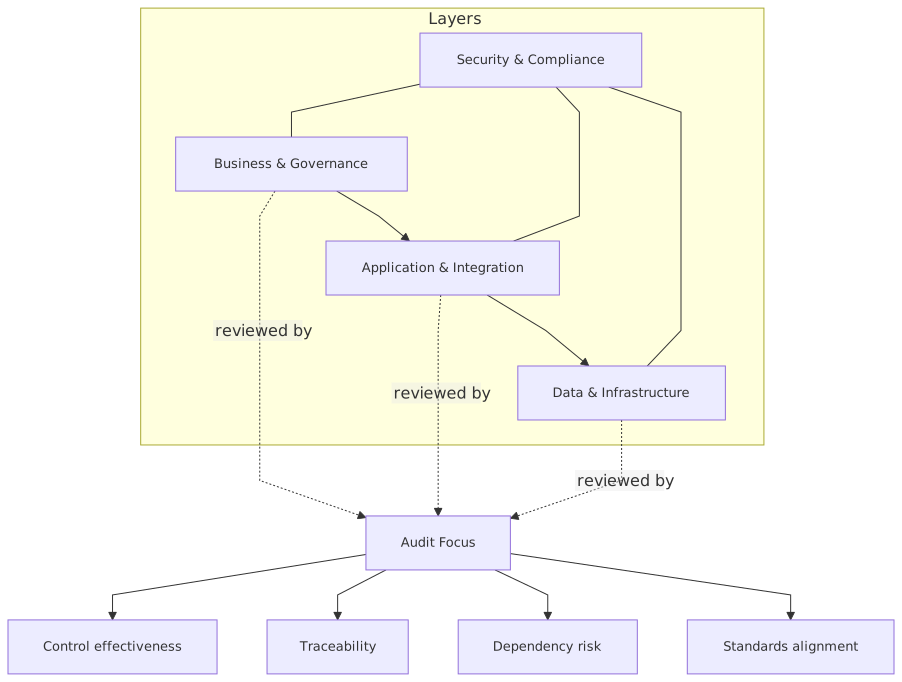
A retail bank launches a customer event platform to support real-time alerts, fraud triggers, onboarding journeys, and downstream analytics. The architecture uses:
- cloud-hosted microservices,
- managed Kafka,
- centralized IAM federation,
- API gateway for synchronous services,
- and event streaming for asynchronous updates.
Sounds sensible. And mostly it is.
What the architecture review found
During review, the architecture team identified:
- good use of Kafka for decoupling customer state changes,
- sound cloud landing zone alignment,
- a need for stronger event schema governance,
- unclear ownership for topic lifecycle,
- over-optimistic assumptions about IAM role granularity,
- and weak plans for replay handling and dead-letter queues.
The review approved the solution with conditions:
- Define topic ownership and retention rules.
- Implement schema registry with compatibility enforcement.
- Separate machine identities from human admin roles.
- Add formal replay and poison-message procedures.
- Prove resilience for identity federation failure scenarios.
This is a good review. Practical, specific, not ideological.
What happened during delivery
Delivery pressure hit. Fraud deadlines moved up. Two product teams onboarded fast. The platform team made some “temporary” choices:
- shared service accounts were used across multiple microservices,
- Kafka topic ACLs were broad to speed integration,
- retention periods were set inconsistently,
- some services bypassed enterprise IAM role mapping,
- and non-production cloud accounts had looser controls than expected.
None of this was visible in architecture diagrams. Of course not.
What the architecture audit found
Three weeks before production expansion, the audit team checked evidence and found:
- 38% of service identities had permissions beyond approved scope,
- four Kafka topics carrying sensitive customer events had retention settings inconsistent with policy,
- dead-letter queues existed but no operational ownership was assigned,
- one consumer group could replay data without adequate access controls,
- break-glass admin access was poorly monitored,
- and one cloud subnet path allowed broader east-west communication than the design intended.
Now, here’s the contrarian bit: this did not mean the architects failed. It meant the review process worked partially, and the audit process exposed reality before a regulator or outage did.
That’s what good assurance looks like. Not perfection. Early detection.
The remediation outcome
The bank did three smart things:
- tightened IAM by moving to service-specific managed identities,
- introduced Kafka ACL automation tied to topic registration,
- and made architecture conditions traceable in delivery governance.
That last point matters. If review conditions disappear into meeting minutes, they are dead on arrival.
Common mistakes architects make
Architects are not innocent in this. We create a lot of our own problems.
Mistake 1: treating review as approval, not challenge
Some architects think the job is to determine whether a solution is “compliant enough” to pass the gate. That mindset produces shallow reviews.
The real job is to improve the design and expose risk. Sometimes that means saying, “This is not mature enough to approve.” Not because you enjoy being difficult. Because the enterprise will pay later if you pretend uncertainty is acceptable.
Mistake 2: reviewing diagrams instead of systems
A review of boxes and arrows is not enough. You need to understand:
- deployment models,
- operational ownership,
- IAM flows,
- failure modes,
- data classification,
- migration sequencing.
Pretty diagrams hide ugly truths.
Mistake 3: over-indexing on standards
Enterprise architects can become standards police. That’s lazy architecture.
Standards matter. But blind standards enforcement can be stupid. Sometimes the right answer is to deviate from the standard because the business context, risk profile, or delivery need justifies it. The key is to make the deviation explicit and managed.
A standard is a tool, not a religion.
Mistake 4: ignoring operational architecture
If your review focuses on design-time purity and ignores runtime support, observability, access recertification, certificate rotation, Kafka lag monitoring, cloud cost controls, or incident recovery, you are designing fantasy systems.
Mistake 5: failing to audit drift
Architects often assume their work ends at design approval. It doesn’t. In cloud-heavy enterprises, architecture drift starts almost immediately. If there is no audit or continuous assurance mechanism, architecture authority becomes symbolic.
Mistake 6: asking generic questions
Nothing kills credibility faster than generic review questions:
- “Have you considered security?”
- “Is this scalable?”
- “Does it align with standards?”
These are useless unless made concrete.
Better questions:
- How are Kafka consumer retries bounded to avoid replay storms?
- Which IAM roles can access customer PII, and how is that recertified?
- What is the RTO if the primary identity provider is unavailable?
- How are cross-account cloud network routes restricted and validated?
- What evidence proves schema compatibility enforcement in production?
That is architect-level questioning.
Contrarian view: not every architecture needs a big formal review
Here’s a view some governance people won’t like: not every change needs a heavyweight architecture review board.
If a team is making a low-risk, well-understood change on a mature platform with strong guardrails, forcing a giant review is wasteful. It slows delivery and teaches teams to perform governance instead of engaging with it. EA governance checklist
The better model is proportionality:
- light-touch review for low-risk standard changes,
- focused expert review for medium-risk designs,
- deep review and audit for high-risk, regulated, customer-critical systems.
Same with audit. Don’t audit everything equally. Audit what matters:
- regulated data,
- financial transactions,
- identity boundaries,
- critical event platforms,
- resilience-sensitive systems,
- and high-cost cloud patterns.
Architecture assurance should be risk-based, not ego-based.
What a good architecture review and audit service looks like
If you are building or improving this function in an enterprise, here’s what actually works.
That last row matters a lot. Architecture review and audit should not be done in isolation from security, operations, platform engineering, and delivery leads. Architects who think they can assess everything alone usually end up being confidently wrong.
Practical review and audit checklist areas
Not a giant framework. Just the areas that matter in real work.
For cloud architecture
- account/subscription structure
- network segmentation
- identity federation and role design
- secrets and key management
- resilience and backup strategy
- observability and logging
- cost controls and scaling assumptions
- deployment automation and policy enforcement
For Kafka architecture
- topic ownership
- retention and compaction policies
- schema governance
- ACL design
- replay controls
- dead-letter handling
- consumer lag monitoring
- multi-cluster or DR strategy
- sensitive data handling in events
For IAM architecture
- human versus machine identity separation
- least privilege implementation
- privileged access controls
- recertification and joiner-mover-leaver processes
- federation trust boundaries
- break-glass procedures
- audit logging
- service account lifecycle and rotation
For banking and regulated environments
- data classification traceability
- segregation of duties
- resilience against provider failure
- evidence retention
- control ownership
- regulatory mapping where relevant
- exception management
- third-party dependency visibility
If your review service cannot go deep in these areas when needed, it is not ready for enterprise work.
How to make these services credible
Credibility is everything. Once delivery teams think architecture review is just bureaucracy, the game is lost.
1. Be fast
A slow architecture review process is a bad process. Teams will route around it. Good services are responsive, scoped, and prepared.
2. Be specific
Don’t issue findings like “security needs more detail.” Say exactly what is wrong and what evidence is missing.
3. Focus on material risk
Nobody respects architects who obsess over notation while ignoring identity sprawl, Kafka overexposure, or cloud misconfiguration.
4. Follow through
If conditions are raised, track them. If remediation is promised, verify it. If audit finds drift, make it visible.
5. Accept reality
Sometimes a design is imperfect but acceptable given constraints. Mature architects know the difference between unmanaged risk and conscious trade-off.
That’s a big one. Enterprise architecture is not about eliminating compromise. It’s about making compromise legible and survivable.
Final thought
Architecture review and audit services are not there to make architecture look important. They are there to stop expensive surprises.
Review helps teams make better decisions before implementation hardens. Audit checks whether the delivered system matches the intent, the controls, and the promises. In banking, cloud, Kafka, IAM-heavy environments, this distinction is not academic. It is operational, financial, and sometimes regulatory.
If you only review, you are trusting too much.
If you only audit, you are intervening too late.
Good enterprises do both. And they do them with enough rigor to matter, but not so much ceremony that everyone starts lying just to get through the process.
That balance is harder than most governance frameworks admit. But that’s architecture work. Messy, political, technical, and very real. ArchiMate in TOGAF ADM
FAQ
1. What is the difference between an architecture review and an architecture audit?
An architecture review evaluates a proposed or evolving design to improve decisions and reduce risk. An architecture audit verifies, using evidence, whether the implemented solution actually conforms to approved architecture and controls.
2. When should an enterprise perform an architecture audit?
Typically before go-live for critical systems, after major architectural changes, periodically for shared platforms, and whenever there is significant risk around security, resilience, regulatory exposure, or cloud drift.
3. Who should be involved in architecture review and audit services?
Not just enterprise architects. You usually need solution architects, security architects, platform engineers, operations, IAM specialists, and sometimes risk or compliance teams. Architecture done in isolation is usually incomplete.
4. Are architecture reviews just governance gates?
They shouldn’t be. A good review service is a design quality function, not a bureaucratic hurdle. If it only exists to approve or reject documents, it will add little value and teams will bypass it.
5. What are the biggest risks in cloud, Kafka, and IAM architecture that reviews often miss?
Common misses include over-privileged IAM roles, weak service identity design, Kafka topic sprawl, poor retention governance, replay and dead-letter operational gaps, cloud network drift, and lack of evidence that controls actually work in runtime. architecture decision record template
Frequently Asked Questions
What is enterprise architecture?
Enterprise architecture is a discipline that aligns an organisation's strategy, business processes, information systems, and technology. Using frameworks like TOGAF and modeling languages like ArchiMate, it provides a structured view of how the enterprise operates and how it needs to change.
How does ArchiMate support enterprise architecture practice?
ArchiMate provides a standard modeling language that connects strategy, business operations, applications, data, and technology in one coherent model. It enables traceability from strategic goals through business capabilities and application services to the technology platforms that support them.
What tools are used for enterprise architecture modeling?
The main tools are Sparx Enterprise Architect (ArchiMate, UML, BPMN, SysML), Archi (free, ArchiMate-only), and BiZZdesign Enterprise Studio. Sparx EA is the most feature-rich option, supporting concurrent repositories, automation, scripting, and integration with delivery tools like Jira and Azure DevOps.