⏱ 25 min read
Modeling Business Architecture Using ArchiMate: Practical Guide and Best Practices
Learn how to model business architecture using ArchiMate with practical examples, core concepts, viewpoints, and best practices for aligning strategy, processes, capabilities, and stakeholders. ArchiMate tutorial for enterprise architects
Modeling Business Architecture Using ArchiMate, ArchiMate business architecture, ArchiMate modeling, business architecture framework, enterprise architecture modeling, ArchiMate business layer, business capabilities, business processes, ArchiMate viewpoints, TOGAF and ArchiMate, business architecture best practices, strategy alignment, operating model design ArchiMate layers explained
Introduction
Business architecture gives an enterprise a structured way to describe how it creates, delivers, and captures value. It connects strategic intent to the operating model by making capabilities, services, processes, roles, products, and their relationships explicit. Without that structure, organizations often struggle to turn strategy into coordinated execution. The strategy may be sound, yet change still slows because responsibilities are fragmented, services are poorly defined, and dependencies across business and technology remain hidden.
This is where ArchiMate is useful. It provides a consistent modeling language for representing those relationships. It is not simply a way to document process flows or draw organization charts. Its real strength lies in connecting different views of the enterprise within a coherent model. A business service can be tied to the processes that realize it, the roles that perform it, the products that include it, the business objects it uses, and the applications that support it. In enterprise change, that kind of traceability matters because even a small business decision can affect multiple parts of the operating model. ArchiMate relationship types
ArchiMate also handles different levels of abstraction well. Executives may need a high-level picture of value streams, core capabilities, and strategic outcomes. Business architects usually need more detail around products, services, processes, and ownership. Transformation teams need traceability from strategic drivers to implementation impacts. ArchiMate allows these viewpoints to sit in a shared repository instead of drifting into disconnected documents built for separate audiences. ArchiMate modeling best practices
That matters even more in modern enterprises, where value is delivered across channels, partners, shared services, and digital platforms rather than through isolated departments. A service-oriented business view can expose redundancies, clarify accountability, and reveal gaps between what the business promises and what it can reliably deliver. It also supports better decisions during reorganizations, outsourcing, regulatory response, capability investment, and platform modernization. A bank reviewing IAM modernization, for example, can use a shared model to see which business services rely on fragmented identity processes and where customer onboarding, workforce access, and partner access should be separated or standardized.
This article explains how to use ArchiMate to model business architecture in a disciplined, practical way. It starts by showing why business architecture matters at enterprise scale, then introduces the ArchiMate concepts most relevant to business modeling. From there, it looks at how to connect strategy, capabilities, value streams, organizational structure, processes, products, and services into an architecture that can actually be analyzed. The final section covers governance, best practices, and common pitfalls. Throughout, the focus is on using ArchiMate not as a diagramming tool, but as a structured language for planning, communication, and change.
Why Business Architecture Matters in the Enterprise Context
Business architecture matters because it gives the enterprise a shared design for how it is intended to operate. In large organizations, the problem is rarely lack of effort. More often, it is fragmentation. Strategy is defined in one place, operating model decisions are made somewhere else, process changes happen within local teams, and technology investments move through separate governance channels. Without business architecture, those decisions accumulate as disconnected improvements that may help individual functions while weakening the enterprise as a whole.
A strong business architecture makes the enterprise understandable as a system of value creation. It clarifies what the organization must be able to do, how value is delivered to customers or stakeholders, where responsibilities sit, and where dependencies cross organizational boundaries. This becomes especially important in complex environments where products, channels, regions, partners, and regulations intersect. In those settings, even a small change can have broad effects, and those effects often remain invisible until delivery is already underway.
One of ArchiMate’s main strengths is its ability to make dependencies explicit. That matters because business architecture is not only descriptive; it also acts as a control mechanism for change. It provides stable reference points—capabilities, services, products, roles, and business objects—that outlast individual projects or organization charts. Programs come and go, systems are replaced, reporting lines shift, but the enterprise still needs a durable understanding of the business design it is trying to preserve or improve.
This is also why business architecture is valuable in investment prioritization. Most enterprises face more demand for change than they can fund or absorb. Architecture helps leaders compare initiatives by business significance rather than sponsorship strength or local urgency. If several proposals all claim strategic value, business architecture can show which capabilities are weak, which services are unstable, which value streams are constrained, and where operational risk is concentrated. The discussion moves from opinion to structure. An architecture board, for instance, may decide to fund identity consolidation ahead of a new customer app because the model shows access management is a shared dependency across onboarding, servicing, and compliance controls.
It also improves alignment between business and technology planning without reducing business questions to system requirements. Too often, organizations jump straight from strategy to solution design and skip the business design questions in between. Which services should be standardized? Which customer interactions should remain differentiated? Where is end-to-end ownership missing? Which roles depend on too much manual coordination? A structured business architecture brings those questions into view before technology decisions turn them into expensive assumptions.
Resilience is another reason it matters. Enterprises have to respond to mergers, regulation, market shifts, supply disruption, and digital competition. Adaptation depends not only on flexible systems, but on a clear view of the business structure being changed. If leaders do not know which capabilities are core, which services are shared, or which products depend on fragile operating arrangements, transformation becomes slower and riskier.
Business architecture also strengthens accountability. In matrixed enterprises, unclear ownership often leads to duplicated effort, inconsistent policy application, and poor customer outcomes. By making roles, services, products, and processes explicit, architecture helps governance focus on responsibility and outcomes rather than hierarchy alone.
For all of these reasons, business architecture is not a documentation exercise. It is an enterprise discipline for aligning strategy, execution, and change.
Overview of ArchiMate for Business Architecture Modeling
ArchiMate provides a formal but practical way to model business architecture. Its value comes from a defined set of concepts for representing business structure, behavior, offerings, and motivation in one coherent language. Rather than treating strategy maps, process diagrams, organization charts, and service models as separate artifacts, ArchiMate allows them to be expressed as related views of the same enterprise reality.
At the business layer, ArchiMate includes core elements such as business actor, business role, business collaboration, business process, business function, business interaction, business event, business service, product, contract, and business object. These concepts help architects distinguish between who performs work, how work is organized, what behavior occurs, and what is offered externally or internally. That distinction matters because many organizations blur teams, roles, services, and processes into informal descriptions that are hard to compare or govern.
A useful way to understand ArchiMate is through three complementary concerns:
- Structure: actors, roles, collaborations, and interfaces
- Behavior: processes, functions, interactions, and events
- Offerings and value expression: services, products, value, and contractual commitments
Taken together, these concerns allow architects to move beyond isolated process documentation and model the operating model more fully.
ArchiMate is particularly valuable because it supports different levels of abstraction without creating ambiguity. A capability map can stay high-level, while a process view can show operational flow. A product model can describe bundled services and commitments, while a role model clarifies accountability. These are not competing notations. They are related views built on a shared metamodel. That allows architects to start at the level of detail needed for a decision and refine only where necessary.
ArchiMate also links business architecture to strategy and implementation without forcing everything into a single diagram. Business elements can be related to goals, outcomes, drivers, requirements, and constraints, which explains why a business design exists. They can also be linked to applications, data objects, and technology services, which supports impact analysis across domains. This traceability is especially useful in transformation planning, where leaders need to understand not only what the business looks like, but why certain structures matter and what else will be affected by change. In an event-driven architecture initiative, for example, a business event such as “payment received” can be tied to the business processes it triggers and to the application services that distribute the event across finance, fulfillment, and customer notification.
In practice, ArchiMate should not be used to capture every operational detail. Its purpose is architectural clarity. Good models focus on decisions: where standardization is needed, where differentiation matters, which services need clear ownership, which collaborations create complexity, and which processes are critical to value delivery. That is why viewpoint selection matters as much as notation knowledge. Executives may need a capability-and-service view; operating model teams may need roles and processes; transformation programs may need a cross-layer dependency view.
Used well, ArchiMate becomes more than a notation standard. It becomes a disciplined modeling foundation for communication, analysis, and governance, while keeping business architecture connected to the broader enterprise architecture landscape.
Core ArchiMate Business Layer Concepts and Relationships
The ArchiMate business layer works best when its elements are treated as a small set of architectural building blocks with clear semantic roles. The quality of a business architecture model depends less on diagram density than on consistent use of those elements to show how the enterprise is structured, how it behaves, and what it delivers.
A useful starting point is the distinction between active structure, behavior, and passive structure.
Active structure
Active structure elements identify who performs or coordinates work:
- Business actor: an organizational entity capable of behavior, such as a business unit, partner, or regulator
- Business role: a responsibility assumed in a specific context, independent of the actor fulfilling it
- Business collaboration: two or more active structure elements working together
The distinction between actor and role is especially important. Reporting lines often change faster than responsibilities do. Modeling roles separately from actors makes the architecture more stable during reorganizations and clarifies where accountability actually sits.
A practical example helps. In a healthcare provider, the Outpatient Services Division is a business actor. The Referral Coordinator is a business role. If referral intake is moved from hospital sites to a centralized shared-service team, the actor changes, but the role remains. That stability is exactly why the distinction matters in architecture.
Behavior
Behavioral elements describe what the business does:
- Business process: behavior organized as a sequence of activities to achieve an outcome
- Business function: behavior grouped by required skills or resources rather than sequence
- Business interaction: behavior performed jointly by multiple roles or actors
- Business event: something that triggers or influences behavior
This distinction helps architects avoid forcing every activity into process form. Some work is best understood as end-to-end flow, some as ongoing functional responsibility, and some as cross-party coordination. Choosing the right concept improves both clarity and analytical value.
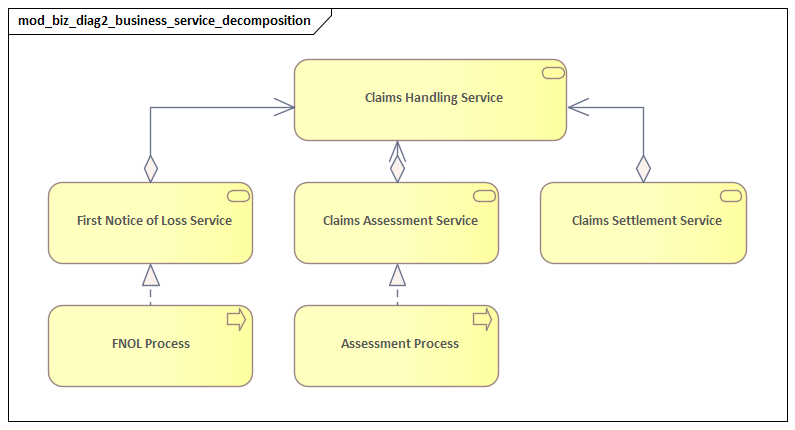
For example, in an insurer, Claims Handling may be modeled as a business process because it follows a recognizable end-to-end flow from claim receipt to settlement. Fraud Investigation, however, may be better modeled as a business function because it supports multiple flows and depends on specialist expertise rather than a single sequence. A suspected fraud alert would be a business event that triggers or diverts behavior.
Offerings and external expression
The external expression of business behavior is modeled through:
- Business service: externally visible behavior offered to a customer, partner, or internal consumer
- Product: a coherent bundle of services, often associated with commitments, pricing, channels, or brand promise
- Contract: the formal or implicit agreement associated with an offering
Separating service from process is critical. A service describes what is made available; a process describes how it is realized. One service may be realized by several processes and roles. That separation allows the enterprise to redesign internal operations without changing the service commitment visible to the consumer.
A telecom example makes this concrete. Mobile Plan Activation may be sold as part of a retail product bundle that includes voice, data, and roaming terms. The customer sees a product. Internally, the activation service may be realized by identity verification, credit assessment, SIM provisioning, and billing setup processes. If the provider automates credit checks or outsources SIM logistics, the service can remain stable even as the underlying processes change.
Passive structure
At the business layer, passive structure is mainly represented by:
- Business object: a business-domain concept used by behavior, such as order, claim, policy, or customer case
Business objects provide semantic anchors across services and processes. They reduce ambiguity before information is translated into application data structures, which is especially important in large enterprises where terminology often varies by function.
Relationship patterns
The real analytical value comes from the relationships among these elements. Common patterns include:
- actors are assigned to roles
- roles perform processes or functions
- processes or functions realize business services
- products aggregate services and contracts
- services and processes access business objects
- collaborations perform interactions that support shared value delivery
These patterns make it possible to trace responsibility, identify duplication, and expose weak ownership. If a critical service is realized by fragmented processes with no clear role ownership, the model reveals an operating risk. If multiple products depend on the same service, the wider impact of changing that service becomes visible.
The point is not to model every possible relationship. The discipline is to model what supports decisions: who owns a service, which roles participate in a value stream, what business objects are central to coordination, and where products depend on shared operational behavior.
Mapping Strategy, Capabilities, and Value Streams in ArchiMate
One of the most valuable uses of ArchiMate is connecting strategic intent to operational execution. Enterprises often define strategy in terms of growth, efficiency, customer outcomes, market position, or regulatory commitments, but those statements remain abstract until they are linked to capabilities and value delivery. ArchiMate helps make that chain explicit.
A practical starting point is the motivation layer, using elements such as:
- Driver
- Goal
- Outcome
- Assessment
- Requirement
- Constraint
These elements matter because they force clarity about what is driving change and what success should look like. A driver such as digital competition may influence a goal to reduce onboarding friction, which in turn is linked to outcomes such as faster activation and higher conversion.
Capabilities as the bridge
Capabilities sit at the center of this translation. Although capability is not a business-layer element, it is central to business architecture because it describes what the enterprise must be able to do, independent of the current organization or process design. In ArchiMate, capabilities can be linked to goals and outcomes to show strategic relevance, and linked to behavior and resources to show how they are realized.
This becomes especially useful in transformation. Capabilities are stable enough to guide investment even when teams, processes, and platforms are changing. They provide a better planning anchor than organization charts or current workflows.
Capability mapping is most effective when used selectively. Not every capability needs the same level of detail. The focus should usually be on capabilities that are:
- strategically differentiating
- operationally weak
- heavily affected by planned change
- shared across multiple products or value streams
A capability such as customer onboarding or regulatory reporting can then be associated with the services it enables, the processes that realize it, the roles involved, and the applications that support execution. In IAM modernization, for example, the capability may be access governance, while the linked services include workforce provisioning, privileged access approval, and customer authentication support.
Value streams and value creation
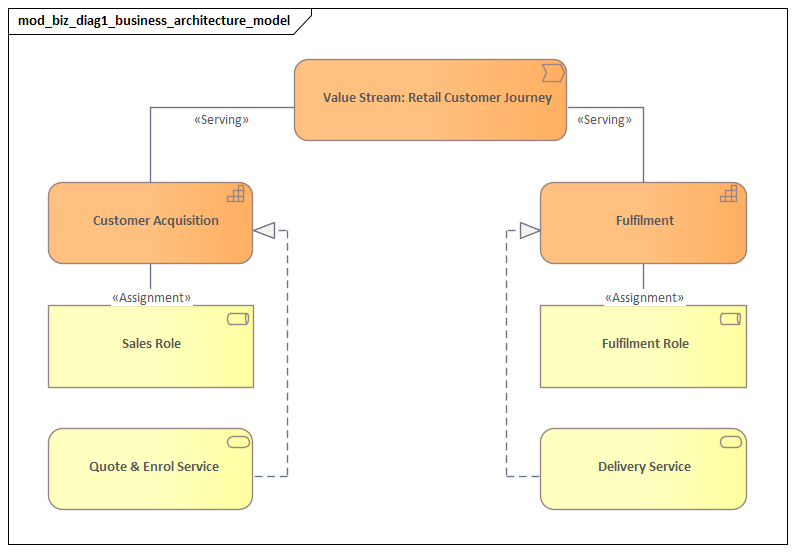
Value streams add the end-to-end perspective. If capabilities describe what the enterprise must be able to do, value streams describe how value accumulates across stages of stakeholder interaction. In ArchiMate, value stream stages can be linked to services, processes, roles, and outcomes. This helps architects see where handoffs occur, where delays build up, and where multiple capabilities must work together to produce a meaningful result.
The combination of capability and value stream views is powerful because it exposes a common planning problem: organizations often invest in isolated capabilities without understanding where those capabilities matter in end-to-end delivery. A capability may look mature within one function but still constrain the overall value stream because upstream and downstream coordination is weak.
Consider a utility company trying to improve time to connect new commercial customers. The strategic goal may be faster revenue activation. The relevant capabilities might include customer onboarding, network planning, field scheduling, and billing setup. The value stream reveals that the real delay is not in any single capability, but in the handoff between site survey approval and field crew scheduling. Without the value stream view, the organization might invest in the wrong area.
By mapping capabilities to value stream stages, architects can ask better questions:
- Is the issue local performance or cross-functional orchestration?
- Should investment focus on standardization, automation, or ownership redesign?
- Which services are critical at each stage?
- Where do weak handoffs undermine strategic outcomes?
A practical traceability pattern
A useful modeling chain is:
Driver → Goal → Outcome → Capability → Business Service → Process / Role / Application
This traceability gives different stakeholders a common decision structure. Executives can discuss strategic outcomes, business leaders can focus on capability health and service performance, and delivery teams can assess process and system impacts.
ArchiMate is most valuable when it connects viewpoints rather than replaces them. Strategy, capabilities, and value streams should not sit in separate frameworks. Modeled together, they allow business architecture to show how strategic intent should reshape the operating model.
Modeling Organizational Structure, Processes, Products, and Services
Once strategy, capabilities, and value streams are visible, the next step is to model how the operating model actually works. In ArchiMate, that means connecting organizational structure, business behavior, services, and products while keeping them conceptually distinct. That distinction matters because it allows change to be analyzed without confusing ownership, execution, and value delivery.
Organizational structure
Many organizations start with departments and reporting lines, but those alone rarely explain how value is delivered. ArchiMate allows architects to model business actors such as divisions, teams, shared service centers, and external partners, while separately modeling the business roles they perform.
This is particularly useful in federated or matrixed enterprises. A regional operations team may be a business actor, while roles such as service owner, case handler, or compliance approver may cut across several actors. Modeling both shows where accountability is stable and where delivery depends on coordination across boundaries.
A retail example illustrates the point. A Store Operations Team, an E-commerce Fulfillment Team, and a third-party logistics provider may all participate in the same order journey. Those are actors. The roles—Inventory Allocator, Fulfillment Coordinator, Returns Approver—cut across those actors. If the company shifts from store-based fulfillment to dark stores, the actors change, but the business roles and services may remain largely the same.
Processes and functions
A business process should represent a meaningful flow that produces a business outcome, not just any sequence of tasks. In business architecture, the goal is usually not procedural detail. The value comes from identifying:
- process boundaries
- triggering events
- major handoffs
- critical business objects
- the business services realized by the process
For example, an order fulfillment process may involve sales operations, warehouse coordination, billing, and customer communication. The architectural model should emphasize changes in responsibility, shared objects, and service realization rather than every operational step. In an event-driven design, the same model might show that “order confirmed” and “shipment dispatched” are business events propagated to downstream applications, while the business architecture remains focused on service ownership and process impact rather than topic-level design.
The distinction between process and function also matters here. A process shows end-to-end flow. A function groups behavior by specialization or resource concentration. Both may be useful in the same model. A finance function can support many value streams, while a claims handling process may cut across several functions. Modeling both perspectives helps reveal tensions between functional efficiency and end-to-end responsiveness.
Services and products
Organizations often use the terms service and product interchangeably, but they are not the same:
- a business service is behavior made available to a consumer
- a product is a packaged offering that may bundle several services with contractual or commercial commitments
This distinction is essential when rationalizing portfolios or redesigning customer propositions. Two products may look different in the market while relying on the same underlying services. Conversely, one product may depend on several services delivered by different organizational units.
A mortgage lender provides a useful example. Home Purchase Mortgage and Refinance Mortgage are products. Both may rely on common business services such as applicant verification, underwriting decisioning, document management, and payment setup. If the lender wants to improve customer experience, the model helps show whether the issue lies in a product feature, a shared service, or a specific process variant.
A strong modeling pattern is to trace:
Product → Business Services → Processes / Functions → Roles → Actors
This creates a direct line from market offering to operating model. It supports questions such as:
- Which products depend on fragile manual coordination?
- Which services lack a clear owner?
- Where do several products create unnecessary process variation?
- Which services should be standardized across products?
- Which actors support differentiated offerings?
Business objects and consistency
Business objects strengthen this model by providing a common business vocabulary. If multiple services and processes manipulate the same core object—such as customer case, order, claim, or policy—that object often becomes a critical point of coordination. Modeling it explicitly helps reveal semantic inconsistency, duplicated handling, and ownership ambiguity.
Why this matters in transformation
This style of modeling is especially useful in mergers, channel redesign, outsourcing, and shared services transformation. It reveals whether the enterprise is organized around historical structures or around the services and products it intends to deliver. More importantly, it supports deliberate redesign rather than inherited complexity.
The goal is not exhaustive documentation. It is to build an analyzable model that shows how the business is put together and where change will have structural consequences.
Best Practices, Governance, and Common Pitfalls in Business Architecture Modeling with ArchiMate
Effective business architecture modeling with ArchiMate depends less on notation completeness than on discipline, governance, and fitness for purpose. Organizations usually fail not because they chose the wrong symbols, but because their models become either too abstract to guide decisions or too detailed to maintain.
Best practices
1. Model from decision needs outward
Before creating views, define the questions the model must answer. If the purpose is investment prioritization, emphasize capabilities, services, value impact, and ownership. If the purpose is operating model redesign, emphasize roles, collaborations, processes, and product-service dependencies.
The model should earn its place in governance. If no decision depends on a view, that view probably does not need to exist.
2. Establish clear modeling conventions
ArchiMate is precise, but teams will still interpret concepts differently unless conventions are explicit. The organization should define how it distinguishes:
- service from process
- role from actor
- capability from function
- product from service
- business object from data object
Naming rules, decomposition principles, relationship usage, and abstraction levels should be documented. In practice, a lightweight metamodel guide is often more useful than a large methodology document because it supports day-to-day consistency.
3. Keep a stable core model and tailor viewpoints separately
The repository should hold stable elements and relationships. Diagrams should then be created as stakeholder-specific views of that core. If teams duplicate concepts for presentation convenience, traceability weakens and multiple versions of the truth begin to emerge.
4. Govern the repository as an architectural asset
Core reference models—capability maps, service taxonomies, product structures, and key business objects—need stewardship. They should not be changed informally by every project. Governance typically includes:
- ownership of core domains
- review cycles
- change control for reference models
- quality checks for duplication and completeness
- alignment with portfolio and solution governance
Without this, the repository becomes a historical archive rather than a decision tool. Technology lifecycle governance is a good example: if the repository shows a business-critical service depends on an authentication platform marked for retirement, architecture can force a transition plan before risk becomes operational.
5. Model selectively
Not every workflow variation, role exception, or organizational nuance belongs in the architecture. Model enough detail to expose structural issues, dependencies, and decision points. Stop before the model turns into operational micromanagement.
A simple test helps: if removing an element changes no decision, it probably does not belong in the architectural view.
Common pitfalls
Overmodeling
Overmodeling happens when architects try to capture every workflow variation, local role, or procedural exception. The result is high maintenance cost and low analytical value. Structural issues get buried in detail.
Undermodeling
Undermodeling is the opposite problem. Diagrams remain so abstract that they cannot reveal ownership gaps, service dependencies, or change impacts. A model that cannot support analysis is not architecture in any practical sense.
Misframing
Misframing occurs when ArchiMate is used as a drawing tool rather than an architectural language. The diagrams may look polished, but if the semantics are weak, the model cannot support traceability or decision-making.
Inconsistent concept use
If one team models “customer onboarding” as a process, another as a service, and a third as a capability, the repository becomes difficult to interpret. That is why clear conventions matter so much.
Treating business architecture as a one-time exercise
A baseline created once and then left untouched quickly loses relevance. Business architecture has to evolve with portfolio decisions, organizational changes, and transformation programs. If it is disconnected from governance, investment review, and target-state planning, it becomes shelfware.
Embedding the practice
To remain useful, business architecture modeling must be embedded in enterprise decision processes. It should inform:
- portfolio prioritization
- target-state design
- merger and reorganization planning
- service ownership decisions
- solution architecture impact assessment
- transformation governance
Used with purposeful scope and sound governance, ArchiMate becomes a reliable mechanism for maintaining business design integrity through continuous change.
Conclusion
Modeling business architecture with ArchiMate is ultimately about creating a shared enterprise design language for deliberate change. Its value does not come from visual consistency alone or from standards compliance. It comes from enabling the business to be described in a form that can be tested, governed, compared, and evolved over time.
ArchiMate is at its strongest when it connects concerns that organizations too often keep separate: strategy, capabilities, value streams, services, processes, products, roles, and supporting domains. That connection allows architects to move beyond broad ambition and examine the structural implications of change with greater confidence.
In practice, an ArchiMate model proves its worth when it influences decisions. If it helps clarify which services should be standardized, which capabilities need investment, where ownership is fragmented, or how a product depends on shared operational behavior, then it is doing real architectural work. If it remains only a documentation artifact, its value is limited no matter how complete it appears.
ArchiMate also helps make trade-offs explicit. Most enterprise change is not a choice between good and bad options, but between competing priorities such as efficiency and differentiation, control and agility, or centralization and local autonomy. By modeling relationships across business structure, behavior, and value delivery, architects can expose those tensions early and support more realistic planning. That is why architecture boards use these models not only to describe the enterprise, but to decide, for example, whether to standardize identity services, introduce event-driven integration in selected domains, or retire aging platforms under lifecycle governance.
Over time, this creates more than a set of diagrams. It creates a reusable knowledge base for impact analysis, operating model design, portfolio alignment, and transformation governance. In that sense, business architecture modeling is not the endpoint of architecture work. It is the foundation that keeps strategy, execution, and enterprise change connected.
Frequently Asked Questions
What is enterprise architecture?
Enterprise architecture is a discipline that aligns an organisation's strategy, business operations, information systems, and technology infrastructure. It provides a structured framework for understanding how an enterprise works today, where it needs to go, and how to manage the transition.
How is ArchiMate used in enterprise architecture practice?
ArchiMate is used as the standard modeling language in enterprise architecture practice. It enables architects to create consistent, layered models covering business capabilities, application services, data flows, and technology infrastructure — all traceable from strategic goals to implementation.
What tools are used for enterprise architecture modeling?
Common enterprise architecture modeling tools include Sparx Enterprise Architect (Sparx EA), Archi, BiZZdesign Enterprise Studio, LeanIX, and Orbus iServer. Sparx EA is widely used for its ArchiMate, UML, BPMN and SysML support combined with powerful automation and scripting capabilities.