⏱ 20 min read
Most enterprise architecture fails for a very boring reason: people model the wrong thing.
They jump straight into applications, interfaces, cloud platforms, event streams, IAM policies, and diagrams with 14 colors. Then they wonder why nobody in the business cares. Or worse, why delivery teams ignore the architecture deck completely.
Here’s the uncomfortable truth: if your ArchiMate model starts with technology, you are probably documenting complexity, not designing an enterprise.
That sounds harsh. Good. It should.
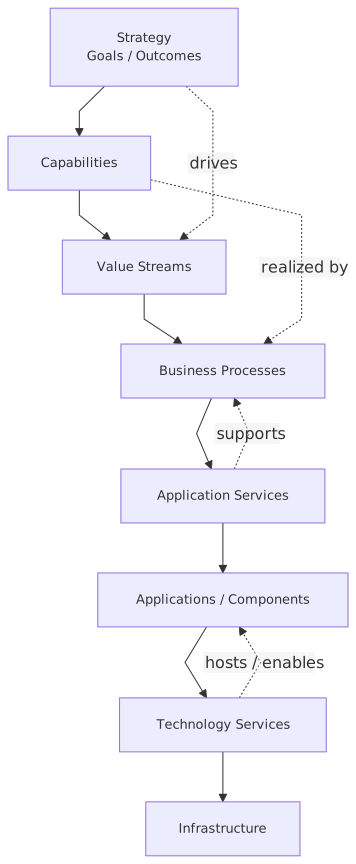
Because ArchiMate is not supposed to be a prettier way to draw systems. It’s supposed to connect business intent to operational reality. Strategy to capability. Capability to process. Process to application. Application to data and integration. Integration to technology. Technology to risk and change. End to end. If you’re not doing that, then you’re not really doing enterprise architecture. You’re doing structured diagramming.
And yes, I have a strong opinion on this one.
A lot of architecture teams say they use ArchiMate, but what they really mean is they use ArchiMate icons to produce application landscape pictures. That’s not useless, but let’s not pretend it’s strategic architecture. The real value comes when the model tells a story: why this investment exists, what business outcome it supports, what capabilities it changes, which processes it affects, which applications enable it, which events and services tie it together, and what technology is actually needed.
That is end-to-end modeling.
What ArchiMate end-to-end modeling actually means
Let’s make this simple early.
ArchiMate end-to-end modeling means building traceability from business strategy all the way down to technology implementation, using a consistent architecture language.
In plain English:
- The business has goals
- Goals require capabilities
- Capabilities are realized through processes and services
- Processes are enabled by applications
- Applications use data, integrations, and platforms
- Platforms run on technology and infrastructure
- Everything should be related in a way that can be explained
That’s it. Not magic. Not academic. Just disciplined modeling.
If your CIO says, “We need faster digital onboarding for SME customers,” you should be able to model:
- the strategic objective
- the affected business capability
- the value stream or business process
- the business services exposed to customers or staff
- the applications involved
- the integrations, maybe Kafka-based event flows
- the IAM controls and identity services
- the cloud platform components hosting the solution
- the work packages and migration path
And ideally, you should also be able to show what happens if one part changes. That’s the practical power.
ArchiMate gives you the vocabulary. The hard part is using it like an architect instead of like a diagram operator.
Why this matters in real architecture work
In real enterprise architecture work, nobody pays you for diagrams. They pay you for decision support.
That distinction matters.
A good ArchiMate model helps answer questions like:
- Which strategic goals are not supported by current capabilities?
- Which applications are critical to revenue but poorly governed?
- Where are we duplicating business services across channels?
- Which Kafka event streams are core to customer onboarding?
- Where does IAM become a dependency or bottleneck?
- Which workloads can move to cloud without breaking control requirements?
- What projects are changing the same capability in conflicting ways?
This is where architecture becomes useful.
I’ve seen architecture teams build beautiful repositories that nobody touched because they modeled everything equally. That’s another common failure: treating all model elements as equally important. They aren’t.
A customer identity service used across digital channels and fraud controls is not “just another application component.” In a bank, that may be a strategic control point. A Kafka cluster carrying customer lifecycle events is not just middleware. It may be the backbone of operational agility. A cloud landing zone is not a technology detail if it determines how fast regulated workloads can be deployed.
Real architecture work is about understanding significance, not just structure.
The biggest misconception: ArchiMate is not a bottom-up notation
Many teams use ArchiMate bottom-up because that feels safer. Start with what exists. Document applications. Add interfaces. Maybe some infrastructure. Then later, if there’s time, connect it to business. ArchiMate modeling guide
This is understandable. It’s also backwards.
You do need bottom-up discovery. Of course you do. Enterprises are messy. But the architecture logic should be top-down, even when the evidence gathering is bottom-up.
That’s the contrarian point I’ll defend all day.
If you start from current systems alone, you inherit current dysfunction. You model accidental architecture as if it were intentional design. You end up preserving organizational history instead of enabling strategy.
Start with the strategic question. Then model only what matters to answer it.
That doesn’t mean ignore technical depth. It means earn the technical depth.
A practical end-to-end structure for ArchiMate modeling
Here’s a structure that works in practice, especially in large enterprises like banks.
That table looks simple. Good. Simplicity is underrated in architecture.
The point is not to create six disconnected views. The point is to maintain traceability across them.
Start with strategy, but don’t stay abstract
A lot of architects love strategy because it sounds important. They build lofty models with goals like “improve customer centricity” and “accelerate innovation.” Nobody can implement that. It’s architecture theater.
A useful strategic model has to be specific enough to drive design.
For example, in a bank:
- Driver: Rising customer abandonment during onboarding
- Assessment: Manual verification causes delays and inconsistent outcomes
- Goal: Reduce SME onboarding time from 5 days to under 1 day
- Outcome: Increased conversion and lower operational cost
- Course of action: Introduce event-driven onboarding and centralized digital identity verification
Now we have something real.
That can be mapped to capabilities such as:
- Customer onboarding
- Identity and access management
- Compliance screening
- Case management
- Event processing
- Customer communication
Already, the architecture is becoming useful. We’re no longer talking in slogans.
Capabilities: the bridge too many architects misuse
Capabilities are where serious architecture either gets disciplined or gets fluffy.

My opinion: capabilities are often abused because they let architects sound strategic without committing to operational meaning.
A capability is not a department. Not a team. Not a process. Not an application. It is what the enterprise must be able to do.
In banking, “Retail Operations” is not a capability. “KYC Verification” is closer. “Digital Customer Onboarding” is better. “Authorization Management” is a capability. “Kafka Platform Support” is not really a business capability, though “Event-Driven Integration Enablement” might be an enabling capability depending on your model.
The trick is to define capabilities at a level where investment decisions make sense. Too broad, and they become slogans. Too narrow, and they become task lists.
Good capability modeling lets you say:
- This strategy requires these capabilities
- These capabilities are immature
- These projects improve those capabilities
- These applications support them today
- These gaps remain
That is architecture speaking the language of business and delivery at the same time.
Business processes and services: where reality enters
Capabilities are stable. Processes are not. That’s why both matter.
In an end-to-end ArchiMate model, capabilities tell you what the business needs to be able to do, while processes show how it currently does it.
This matters in transformation work. If you tie everything to processes only, your model becomes fragile because processes change often. If you tie everything only to capabilities, your model stays too abstract to guide implementation.
Use both.
Let’s continue the banking example. The business wants faster SME onboarding. The relevant process might include:
- Customer submits application
- Identity is verified
- Business entity is checked
- AML and sanctions screening is performed
- Risk score is calculated
- Account is created
- Digital credentials are issued
- Customer is notified
Now we can identify business services such as:
- Identity Verification Service
- Compliance Screening Service
- Account Opening Service
- Credential Issuance Service
- Customer Notification Service
Notice something important: services are a cleaner bridge to application design than processes alone. Processes are sequences; services are units of value and enablement. That distinction helps a lot when talking to product teams and platform teams.
Application architecture: this is where many models collapse
Here is the usual failure pattern.
An architect does decent strategy work. Decent capability work. Then reaches the application layer and dumps in every system anyone has ever heard of. Core banking, CRM, IAM, fraud engine, workflow engine, document management, customer portal, API gateway, Kafka, data lake, MDM, mobile app, email service, SIEM, you name it.
Suddenly the model explains nothing.
The application layer should answer a focused question: which application services and components realize the business services and support the target capability improvement?
Not every application belongs in every view.
For our banking onboarding case, maybe the key application components are:
- Digital Onboarding Portal
- Workflow / Case Management Platform
- IAM Platform
- KYC/AML Screening Engine
- Customer Master / Party Service
- Core Banking Account Service
- Kafka Event Backbone
- Notification Service
- Audit and Compliance Logging Service
That’s enough for one target architecture view. You can decompose further in supporting views if needed.
And yes, Kafka belongs here as part of the integration/application landscape depending on how you structure your repository. Don’t get dogmatic. Purity of notation is less important than clarity of meaning.
Kafka in ArchiMate: stop modeling it as just “middleware”
This is one of those areas where architects often undersell what’s actually happening.
Kafka is not just middleware. In many enterprises it becomes an operational design principle. It changes coupling, ownership, latency expectations, scalability assumptions, and observability needs. In some banks it becomes part of the enterprise nervous system.
So model it accordingly.
In an onboarding architecture, Kafka may support event flows such as:
- ApplicationSubmitted
- IdentityVerified
- ScreeningCompleted
- RiskAssessed
- AccountOpened
- CredentialsIssued
These are not technical trivia. They represent business state transitions.
A good ArchiMate model can show:
- business events or application events
- application services producing or consuming them
- the event streaming platform enabling asynchronous integration
- downstream dependencies like fraud, analytics, notifications, and audit
The common mistake is drawing Kafka as one box in the middle with lines going everywhere. That’s not architecture; that’s a plumbing sketch.
The better approach is to model which services publish what, who consumes what, and why it matters to the business flow.
Also, a contrarian thought: not everything should go through Kafka just because your platform team had a successful pilot. Event-driven architecture is not maturity by default. Sometimes a direct API is simpler, cheaper, and more governable. Architects need to say that out loud more often.
IAM: the most underestimated architecture dependency
If I had to pick one domain that gets consistently under-modeled in enterprise architecture, it would be IAM.
People treat identity and access management as a security side topic. In reality, IAM is often a central business enabler and a central delivery constraint.
In banking, especially in digital onboarding and servicing, IAM affects:
- customer authentication
- employee access
- delegated administration
- consent
- role-based and attribute-based authorization
- step-up verification
- auditability
- regulatory compliance
If the strategy says “deliver secure self-service onboarding across channels,” then IAM is not a supporting footnote. It is a core architecture concern.
In ArchiMate, model IAM as part of the business-to-technology chain:
- business need: trusted digital onboarding
- capability: identity assurance and access control
- business service: credential issuance and access authorization
- application services: authentication, authorization, identity proofing
- application components: IAM platform, policy decision point, directory, MFA service
- technology: cloud identity services, secrets management, HSMs, network controls
This matters in design reviews. It also matters in funding conversations. If IAM is invisible in the architecture model, it gets discovered late as a blocker, and then everyone acts surprised.
They shouldn’t be surprised.
Cloud in ArchiMate: model decisions, not vendor brochures
Cloud architecture diagrams are another place where enterprise architecture loses the plot.
I’ve seen “cloud target architectures” that are basically vendor reference posters recreated in ArchiMate. Very polished. Very useless. ArchiMate tutorial
Your cloud model should show architecture decisions that matter to the enterprise:
- which workloads move and why
- what landing zones or platform services are required
- where data residency or control constraints apply
- how resilience and recovery are handled
- how IAM integrates across cloud and enterprise boundaries
- how event platforms like Kafka are deployed and governed
- what remains on-prem and why
For our bank example, maybe the target state is:
- Digital onboarding portal in public cloud
- IAM integrated with enterprise identity and customer identity services
- Kafka platform running in managed cloud with regulated controls
- Screening engine partly SaaS, partly internal due to policy constraints
- Core banking account opening still on-prem or private cloud
- Audit logs centralized in a compliance-controlled environment
That’s real architecture. It shows hybrid reality, not fantasy modernization.
One more strong opinion: “cloud-first” is not an architecture strategy. It’s a procurement bias unless you connect it to business outcomes, risk posture, and operating model changes.
A real enterprise example: banking onboarding transformation
Let’s bring this together in a realistic scenario.
A regional bank wants to grow SME customers but has a terrible onboarding experience. Opening a business account takes several days, sometimes over a week. Customers re-enter data, operations teams manually verify documents, compliance checks run in batches, and credentials are issued only after several handoffs. ArchiMate for governance
The executive strategy is straightforward:
- increase SME acquisition
- reduce onboarding cycle time
- improve compliance consistency
- lower operational cost per onboarded customer
Step 1: Strategy model
In ArchiMate terms, we model:
- Driver: competitive pressure and customer abandonment
- Assessment: fragmented onboarding creates delay and control issues
- Goal: onboarding under 24 hours
- Outcome: higher conversion, lower manual effort, stronger auditability
- Course of action: digitize and orchestrate onboarding through event-driven services
Step 2: Capability model
Capabilities affected include:
- Digital Customer Onboarding
- Identity Verification
- Access Provisioning
- Compliance Screening
- Case Handling
- Event-Driven Integration
- Customer Communication
We assess maturity and identify that Identity Verification and Event-Driven Integration are weak, while Compliance Screening exists but is too fragmented. EA governance checklist
Step 3: Business model
The target business process reduces handoffs and introduces automated decision points.
Business services include:
- Application Intake
- Identity Verification
- Screening and Risk Assessment
- Account Opening
- Credential Provisioning
- Notification and Status Tracking
Step 4: Application model
Applications and services mapped:
- Digital Portal captures application and documents
- Workflow Platform manages exceptions and manual reviews
- IAM Platform performs identity proofing and issues credentials
- KYC/AML Engine checks sanctions, PEP, and compliance rules
- Party Service manages customer and business identity records
- Core Banking Service creates account
- Kafka Platform distributes onboarding events
- Notification Service informs customer and internal staff
- Audit Platform stores evidence trail
Step 5: Integration and event model
Kafka topics/events:
- SMEApplicationSubmitted
- IdentityProofingCompleted
- ScreeningDecisionGenerated
- ManualReviewRequested
- AccountCreated
- CredentialsActivated
Consumers include fraud monitoring, analytics, customer communications, and operational dashboards.
Step 6: Technology model
- Portal runs on cloud-native web platform
- IAM uses managed identity services plus internal policy controls
- Kafka runs on managed cloud with encryption and retention controls
- Core banking remains in existing data center
- Secure network connectivity and secrets management support hybrid operations
- Logging and monitoring feed compliance and SRE operations
Step 7: Migration model
Transition architectures might be:
- Digitize intake and workflow first
- Introduce IAM proofing and centralized authorization
- Add Kafka-based event backbone
- Shift non-core services to cloud
- Retire manual handoff tools and duplicate verification apps
Now the model is not just descriptive. It is actionable. Executives can see why the investment exists. Product teams can see dependencies. Security teams can see IAM implications. Platform teams can see cloud and Kafka requirements. Operations can see process changes.
That is what good enterprise architecture feels like.
Common mistakes architects make with end-to-end ArchiMate modeling
Let’s be blunt. These happen all the time.
1. Modeling everything
If everything is in scope, nothing is meaningful. Model to answer decisions, not to satisfy completeness anxiety.
2. Starting from applications
Applications matter, but if they lead the narrative, the model becomes a system inventory.
3. Confusing capabilities with processes or org units
This destroys traceability quickly. Be disciplined with definitions.
4. Ignoring services
Architects often jump from process to application. Services are the cleaner abstraction and often the missing middle.
5. Treating integration as lines
Especially with Kafka or APIs, integration has architectural meaning. Model events, contracts, responsibilities, and dependencies.
6. Under-modeling IAM
Then discovering late that onboarding, authorization, consent, and audit requirements were central all along.
7. Over-modeling infrastructure
Nobody needs every subnet and VM in the core enterprise view. Keep technology views decision-oriented.
8. No migration logic
A target architecture with no transition states is just wishful thinking.
9. No ownership
If model elements don’t have accountable owners, the repository decays into fiction.
10. Worshipping notation purity
ArchiMate is a language, not a religion. If a view is technically pure but nobody understands it, you failed.
How this applies in day-to-day architecture work
This is the part people skip, and they shouldn’t.
End-to-end modeling is not just for giant transformation programs. It helps in everyday architecture work:
In investment planning
You can map proposed projects to strategic goals and capabilities. This exposes duplicate initiatives and orphan projects fast.
In solution architecture alignment
When a new onboarding tool is proposed, you can check whether it fits the target business service and application service model, or just adds another silo.
In platform governance
When the Kafka team wants to standardize event contracts, the enterprise model tells you which business capabilities and critical flows depend on those events.
In security reviews
IAM dependencies become visible before design freezes. That saves time and avoids ugly rework.
In cloud migration decisions
You can distinguish workloads that are strategic, regulated, tightly coupled, or suitable for decomposition. Much better than blanket migration targets.
In operating model discussions
You can show where shared services make sense and where domain ownership should stay local.
That’s the real payoff. Better conversations, earlier.
My recommended modeling approach
If I were setting up an EA team to do this well, I’d insist on a few practical rules.
Rule 1: Every model starts with a business question
Not “document the landscape.” A real question. Example: What must change to reduce SME onboarding time to under 24 hours?
Rule 2: Build a thin end-to-end chain first
One goal, a few capabilities, one value stream or process, a handful of services, core applications, key integrations, enabling technology. Thin before thick.
Rule 3: Decompose only where decisions need detail
If IAM is a risk hotspot, go deeper there. If Kafka is becoming strategic integration fabric, go deeper there. Don’t decompose everything equally.
Rule 4: Keep views audience-specific
Executives need outcome traceability. Delivery teams need service and dependency clarity. Platform teams need deployment and control context.
Rule 5: Model current, target, and transition
Without all three, you can’t govern transformation properly.
Rule 6: Connect models to governance
Architecture that never enters funding, design authority, risk review, or portfolio planning is just decorative.
The uncomfortable truth about repositories
Here’s another contrarian thought: a massive ArchiMate repository is not automatically a sign of maturity. Sometimes it’s a sign that the team had time but no focus.
Maturity is not the number of elements. It is the quality of traceability and the usefulness of the model in decisions.
I would rather have 200 well-governed elements tied to real change than 20,000 stale ones nobody trusts.
Architects need to stop equating repository size with architecture value. Business leaders certainly don’t.
Final thought
ArchiMate is powerful precisely because it can connect strategy to implementation without collapsing into either management fluff or technical detail overload.
But the tool is not the point. The point is architectural thinking.
If you use ArchiMate to draw isolated technology pictures, you’ll get isolated technology decisions. If you use it to connect business ambition to operational design, you create leverage. And leverage is what enterprise architecture is really about.
So start with the business problem. Model the capability change. Make services explicit. Treat Kafka as architecture when it is architecture. Put IAM where it belongs: near the center, not in the margin. Use cloud models to express decisions, not slogans. And for the love of clarity, stop modeling everything.
End-to-end ArchiMate modeling is not about completeness. It’s about consequence.
That’s the difference between diagrams and architecture.
FAQ
1. What is ArchiMate end-to-end modeling in simple terms?
It is modeling the chain from business strategy down to applications, integrations, and technology so you can trace how a business goal is supported by real systems and platforms.
2. Where should I start: business capabilities or application landscape?
Start with the business question and the relevant capabilities. You may collect application facts early, but the architecture logic should begin from strategy and business need, not from system inventory.
3. How do Kafka and event-driven architectures fit into ArchiMate?
Model them as part of the application/integration architecture, but don’t just show Kafka as a generic middleware box. Show which services publish and consume events, and how those events support business flows and state transitions.
4. Why is IAM so important in enterprise architecture models?
Because IAM often affects customer experience, employee access, compliance, security, audit, and delivery speed all at once. In regulated industries like banking, it is a core business enabler, not just a technical control.
5. How detailed should the technology layer be in ArchiMate?
Detailed enough to support decisions, no more. Show cloud platforms, key runtime dependencies, security controls, and deployment constraints. Don’t drown the enterprise model in low-level infrastructure detail unless that detail is directly relevant.
Frequently Asked Questions
What is enterprise architecture?
Enterprise architecture is a discipline that aligns an organisation's strategy, business processes, information systems, and technology. Using frameworks like TOGAF and modeling languages like ArchiMate, it provides a structured view of how the enterprise operates and how it needs to change.
How does ArchiMate support enterprise architecture practice?
ArchiMate provides a standard modeling language that connects strategy, business operations, applications, data, and technology in one coherent model. It enables traceability from strategic goals through business capabilities and application services to the technology platforms that support them.
What tools are used for enterprise architecture modeling?
The main tools are Sparx Enterprise Architect (ArchiMate, UML, BPMN, SysML), Archi (free, ArchiMate-only), and BiZZdesign Enterprise Studio. Sparx EA is the most feature-rich option, supporting concurrent repositories, automation, scripting, and integration with delivery tools like Jira and Azure DevOps.