⏱ 20 min read
Most banking architecture decks are lying to someone.
Not always intentionally. But if you’ve sat through enough “target state architecture” presentations in a bank, you know the pattern: immaculate boxes, perfect arrows, three layers of color-coded certainty, and absolutely no clue how any of it survives contact with Kafka topics, IAM sprawl, cloud controls, or a mainframe team that still owns the customer golden record.
That’s where ArchiMate gets a bad reputation. People think the notation is the problem. It isn’t. The problem is that many architects use ArchiMate like a drawing tool for governance theater instead of a language for making hard decisions visible.
Used properly, ArchiMate is one of the few enterprise architecture tools that can actually help banking teams connect strategy, operating model, applications, data flows, security controls, and migration steps without turning the whole thing into unreadable nonsense. Used badly, it becomes another layer of abstraction nobody trusts.
So let’s say it plainly early, because this matters for both clarity and SEO: ArchiMate is an enterprise architecture modeling language used to describe business, application, technology, and strategy relationships in a consistent way. In banking, it helps architects map capabilities, systems, processes, integrations, controls, and transformation roadmaps across complex environments.
That’s the simple explanation. The real story is messier, and much more useful.
This article is about how ArchiMate actually works in banking architecture: not in certification examples, not in toy diagrams, but in real-world situations involving core banking, Kafka-based eventing, IAM architecture, cloud adoption, regulatory controls, and the usual organizational chaos. I’ll also call out common mistakes, because there are many, and banks repeat them with impressive discipline.
Why ArchiMate matters in banking more than in most industries
Banking is not “just another enterprise domain.” It has a few characteristics that make architecture modeling either extremely valuable or completely pointless.
Banks have:
- deep legacy estates
- strict regulatory and audit expectations
- high integration density
- duplicated customer and account data across channels and products
- control-heavy IAM requirements
- hybrid cloud realities, not cloud fantasy
- business change programs that cut across dozens of platforms
In that environment, architecture is mostly about relationships and constraints, not isolated systems.
That’s why ArchiMate fits banking better than many architects admit. Its strength is not visual beauty. Its strength is that it lets you show, in one language:
- what the business is trying to do
- which capabilities matter
- which applications support those capabilities
- what data or events move between them
- which technology services they depend on
- what risks, controls, and migration steps exist
And in banking, those relationships are the work.
If your architecture language can’t explain how a retail onboarding process depends on IAM policies, KYC services, CRM workflows, event streams, fraud decisioning, and cloud-hosted APIs, then it’s not helping. It’s decorating.
The simple way to think about ArchiMate
A lot of people overcomplicate ArchiMate. Here’s the practical version. ArchiMate modeling guide
ArchiMate gives you a way to model architecture in layers:
That’s the basic structure. You then connect elements with relationships like:
- serves
- realizes
- accesses
- triggers
- flows to
- composes
- aggregates
- assigned to
If that sounds abstract, good. It is abstract. But abstraction is not the enemy. Uncontrolled abstraction is.
In real banking work, ArchiMate becomes useful when you answer concrete questions like: ArchiMate tutorial
- Which business capability is this program actually improving?
- Which applications are in the critical path for that capability?
- Where is identity enforced?
- Which event streams are system-of-record versus derivative?
- What breaks if we move this service to cloud?
- What controls are inherited from the platform and what remains application-specific?
- What’s in scope for transition state 1 versus transition state 2?
That’s where the notation earns its keep.
Strong opinion: most ArchiMate models fail because architects model everything except decisions
Here’s the contrarian bit.
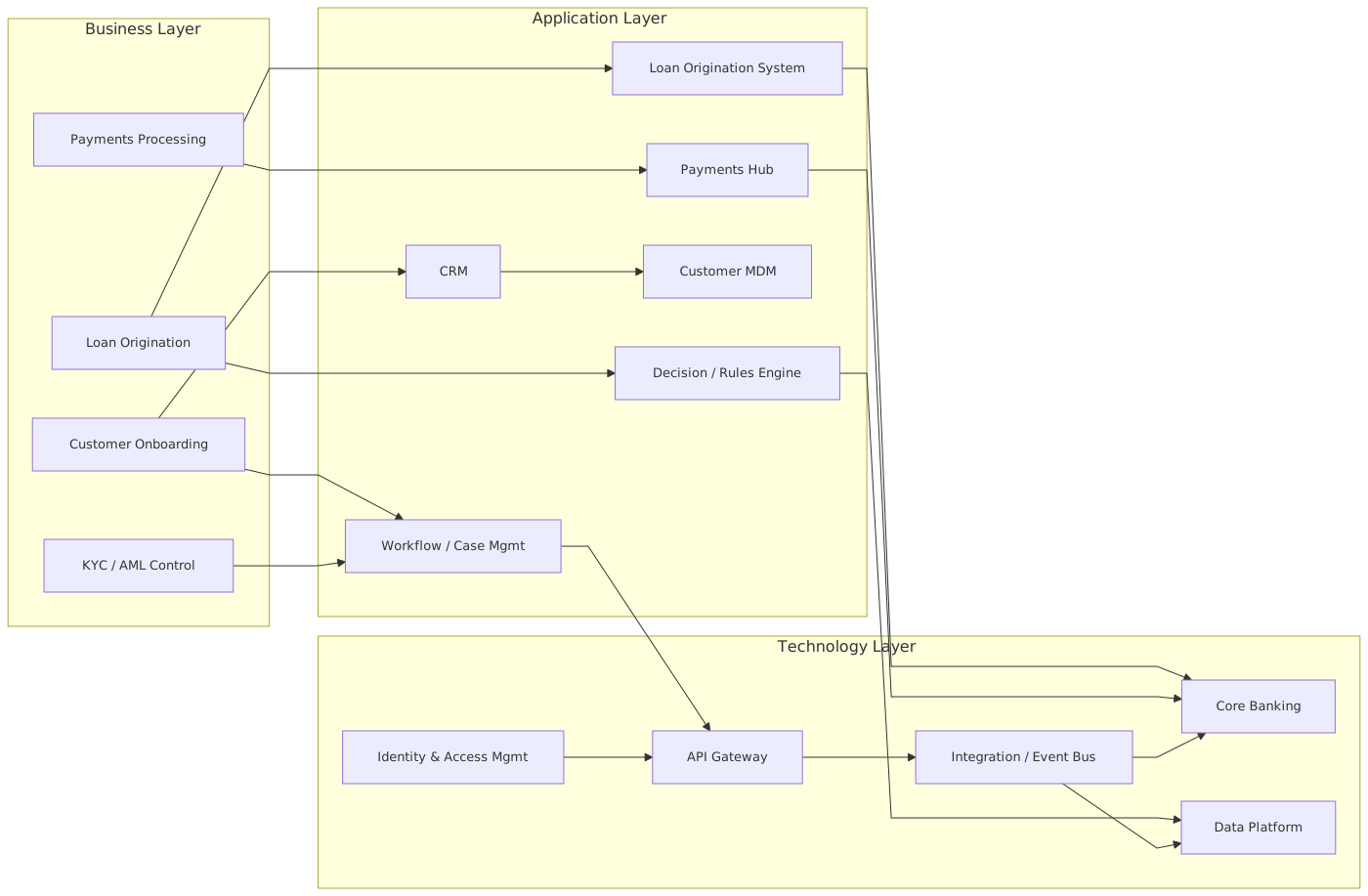
Too many enterprise architects think completeness is quality. It isn’t. In banking, a complete model of the current state is often just a very expensive way to avoid making choices.
A giant repository with 6,000 application components and no point of view is not architecture. It’s inventory.
Good ArchiMate work in a bank is selective. It highlights what matters to a decision, a risk, a transformation, or an operating problem. It shows dependencies that are otherwise invisible. It helps teams argue productively.
If your model cannot support a funding decision, a control review, a migration sequence, or an incident root-cause discussion, then it’s probably too generic.
Architecture should reduce ambiguity, not preserve it.
Real use case #1: Customer onboarding in a retail bank
Let’s start with a use case nearly every bank has wrestled with: digital customer onboarding.
The board wants faster acquisition. The product team wants fewer drop-offs. Compliance wants stronger KYC and AML controls. Security wants MFA and identity proofing. Operations wants fewer manual exceptions. And somewhere in the middle, the architecture team has to explain why a “simple onboarding journey” touches 18 systems.
This is a very good ArchiMate use case.
What the model should show
At the business layer, model things like:
- Customer Onboarding capability
- Identity Verification process
- KYC Review process
- Account Opening service
- Customer support handling for exceptions
At the application layer, include:
- Mobile onboarding app
- API orchestration layer
- CRM
- KYC vendor integration service
- Decision engine
- Core banking customer/account service
- Document management system
- Case management tool
At the technology layer, include:
- IAM platform
- API gateway
- Kafka event platform
- cloud container platform
- observability stack
- encryption/key management services
Then connect them in a way that answers practical questions:
- The onboarding business process uses the Account Opening application service.
- The mobile app accesses the onboarding API.
- The API orchestration service calls identity proofing, sanctions screening, and customer master services.
- The IAM platform serves authentication and token issuance.
- Kafka carries onboarding events to downstream analytics and fraud monitoring.
- The case management system is triggered when identity confidence falls below threshold.
This is already more useful than most current-state diagrams because it gives traceability from business intent to technical implementation.
Where banks usually go wrong
Common mistake number one: they model the journey but ignore control points.
In banking, onboarding is not just a process. It is a control environment. If the model doesn’t show where authentication, consent capture, screening, decisioning, and exception handling occur, then it’s incomplete in the only way that matters.
Common mistake number two: they confuse user channels with business services.
The mobile app is not the business service. It’s a delivery mechanism. The business service is account opening or customer onboarding. This sounds obvious, but many diagrams elevate channels into business architecture and bury actual operational services.
Common mistake number three: they model integrations as arrows without semantics.
An arrow from app A to app B means almost nothing. Is it synchronous? Asynchronous? Event notification? Command? Data replication? Human task trigger? In modern banking, those distinctions are architecture.
Where Kafka fits
Kafka often appears in these journeys because banks want event-driven onboarding. For example:
- onboarding initiated
- identity verified
- KYC review completed
- account created
- onboarding failed
- manual review requested
In ArchiMate, don’t just draw Kafka as a magical integration cloud. Model it as a technology service or platform service that serves application components. Then model the application-level event producers and consumers separately.
That matters because the bank needs to know:
- which team owns the event contract
- whether the event is business-significant or operational
- what retention and replay policies apply
- whether downstream systems are using events for action or just analytics
A lot of event-driven banking architectures are fragile because they never established that distinction.
Real use case #2: IAM modernization across channels and products
If there is one topic where ArchiMate can save a bank from architectural self-deception, it’s IAM.
Banks often say they have “enterprise IAM.” What they usually have is:
- one customer identity stack for digital channels
- a separate workforce IAM setup
- several legacy authentication mechanisms for older portals
- hardcoded entitlements in product applications
- local role models no one can reconcile
- inconsistent API authorization
- and a heroic spreadsheet somewhere trying to map it all
This is not unusual. It’s normal. But normal doesn’t mean acceptable.
Why ArchiMate helps here
IAM is cross-cutting. That makes it hard to discuss using application-only views or infrastructure-only views. ArchiMate lets you model:
- business roles and actors
- application services for authentication and authorization
- technology services for identity federation, token issuance, directory, secrets, policy enforcement
- relationships between channels, APIs, and protected resources
- migration from fragmented IAM to platform-based IAM
A practical IAM model in banking
At the business layer:
- Customer
- Relationship Manager
- Operations Analyst
- Fraud Investigator
- Privileged Administrator
At the application layer:
- Customer Identity Service
- Workforce SSO Service
- Authorization Decision Service
- API Access Control Service
- Entitlement Management Service
At the technology layer:
- IAM platform
- directory services
- MFA service
- PKI / certificate service
- secrets vault
- policy engine
- cloud-native identity integration
Then map where these services are actually used:
- mobile banking app uses Customer Identity Service
- CRM portal uses Workforce SSO Service
- API gateway uses Authorization Decision Service
- admin tools require Privileged Access Management controls
- Kafka management plane integrates with workforce IAM and service account controls
The uncomfortable truth
Most architects model IAM as a box called “IAM” and move on. That is architecture malpractice in a bank.
Authentication, authorization, identity proofing, federation, privileged access, machine identity, and entitlement governance are not one thing. They are related things. If your model collapses them into a single blob, then your migration plan will be equally vague.
And this is where ArchiMate is useful because it forces separation of concerns if you let it.
Real example pattern
A mid-sized universal bank modernizes digital channels by moving customer-facing applications to cloud-hosted APIs and container platforms. The architecture team initially creates a target diagram showing “central IAM” serving all applications. Nice picture. Useless picture.
After a few painful workshops, the model is redone properly:
- Customer authentication remains distinct from workforce authentication.
- Customer consent management is modeled as a business/application concern, not hidden inside IAM.
- API authorization is modeled as a separate application service using token claims and policy checks.
- Legacy branch systems are shown as consumers of federated workforce identities but not full participants in modern authorization.
- Privileged administration for cloud and Kafka platforms is modeled separately with stronger controls.
That second model is what actually supports the roadmap. The first one just made everyone feel aligned for two weeks. ArchiMate in TOGAF ADM
Real use case #3: Event-driven banking with Kafka
Kafka is one of those technologies that gets added to every target architecture whether it belongs there or not.

Banks love the idea of event-driven architecture because it promises decoupling, speed, streaming analytics, and operational resilience. Sometimes it delivers that. Sometimes it delivers 400 topics, no ownership model, and a distributed misunderstanding of what “real-time” means.
ArchiMate can help, but only if you model event-driven patterns honestly.
What to model
At the business level:
- Payment Processing capability
- Fraud Monitoring capability
- Customer Notification service
- Treasury Liquidity Monitoring process
At the application level:
- Payments engine
- Fraud detection platform
- notification service
- customer ledger service
- channel applications
- reconciliation platform
At the technology/platform level:
- Kafka cluster
- schema registry
- event governance tooling
- cloud network and security services
- IAM integration for service identities
The pattern that works
A good ArchiMate pattern for Kafka in banking separates:
- Business events
Example: Payment Initiated, Payment Settled, Customer Address Changed
- Application components that publish/consume
Example: Payments engine publishes Payment Settled; fraud platform consumes Payment Initiated
- Technology platform providing event transport
Kafka cluster, brokers, topics, security mechanisms
- Control services
IAM, encryption, observability, schema management
This sounds basic. It is basic. Yet banks constantly blur these layers.
Common Kafka architecture mistakes
Here are the mistakes I see repeatedly:
A real enterprise example
Consider a retail and commercial bank trying to modernize payments and customer servicing.
The bank has:
- a core payments engine on-prem
- online banking channels in cloud
- fraud analytics on a separate data platform
- customer notifications managed by a SaaS communication service
- IAM split across legacy AD, cloud IAM, and API security tooling
The architecture team uses ArchiMate to model an event-driven pattern around payment lifecycle events.
What actually helps is not just showing Kafka in the middle. What helps is showing:
- the Payments Processing business process triggers application behavior in the payments engine
- the payments engine publishes Payment Initiated and Payment Settled events
- the fraud platform consumes Payment Initiated for behavioral scoring
- the notification service consumes Payment Settled to send customer alerts
- the reconciliation service consumes both events for downstream balancing
- IAM services provide machine identity and access control to producer and consumer applications
- cloud network and encryption services support the Kafka platform where applicable
- transition state 1 includes read-only consumers; transition state 2 introduces command-side decoupling
That model gives operations, security, product, and engineering a shared picture. More importantly, it exposes what is not yet solved: event ownership, replay policy, schema governance, and service identity design.
That is what architecture should do.
Real use case #4: Cloud migration in a regulated bank
Cloud architecture in banking is where ArchiMate can either become incredibly useful or become a compliance coloring book.
Many banks still produce cloud target-state diagrams that imply all workloads can move neatly into managed services if only the organization becomes “agile enough.” That’s fantasy. Real banking cloud architecture is constrained by residency, latency, vendor dependencies, batch windows, licensing, operational maturity, and control inheritance questions.
Where ArchiMate helps
ArchiMate can show:
- which business capabilities are enabled by cloud migration
- which application services are candidates for rehosting, refactoring, or replacement
- which technology services are consumed from cloud platforms
- where security and resilience controls are inherited versus application-owned
- which workloads remain on-prem in transition states
A useful banking cloud pattern
For example, model:
- Digital Account Servicing capability
- Customer API platform
- statement generation service
- document archive service
- IAM integration
- Kafka/event platform
- cloud container platform
- on-prem core banking system
- secure connectivity between cloud and data center
- implementation work packages for phased migration
This becomes powerful when you stop pretending “cloud” is a destination and instead model responsibility shifts.
That’s the real architecture question. Not “is it in cloud?” but:
- Who operates identity?
- Who owns encryption keys?
- Which resilience controls are platform-provided?
- Where is customer data persisted?
- What dependencies remain on on-prem systems?
- What failure mode appears when cloud APIs are available but core systems are not?
A lot of cloud architecture reviews in banks miss this because they focus on landing zones and service catalogs. Important, yes. But not sufficient.
How this applies in real architecture work
Let’s get practical. What does ArchiMate actually do for a working architect in a bank on a Tuesday afternoon?
It helps in five very real ways.
1. It gives structure to stakeholder conversations
Banking architecture involves product leaders, security teams, risk, operations, infrastructure, engineering, procurement, and audit. They all use different language. ArchiMate gives enough structure to map their concerns without forcing everyone into one technical vocabulary.
You can start with capability maps for executives, then drill into application cooperation views for engineering, then deployment or technology views for platform teams.
That traceability matters.
2. It forces explicit dependency mapping
In banks, hidden dependency is the main source of surprise.
A channel change depends on IAM. IAM depends on directory cleanup. API access depends on token design. Fraud scoring depends on event quality. Event quality depends on source application semantics. Source application semantics depend on a product team that thought they were only changing a UI flow.
ArchiMate helps expose these chains. Not perfectly, but better than PowerPoint freehand boxes.
3. It supports transition architecture properly
This is underused.
Most banks spend too much time on current and target states and too little on transitions. But transformation lives in transition. ArchiMate’s implementation and migration concepts are genuinely useful for showing phased delivery, coexistence states, and temporary controls.
In a bank, temporary states often last years. Model them honestly.
4. It improves architecture governance if used selectively
Used well, ArchiMate models can support:
- design authority reviews
- risk/control assessments
- cloud exception decisions
- integration governance
- decommission planning
- investment prioritization
Used badly, they become mandatory artifacts no one reads. You know which one your organization tends toward.
5. It helps separate fact from aspiration
This is maybe the biggest benefit.
When teams say “centralized customer identity,” “event-driven integration,” or “cloud-native onboarding,” ArchiMate can force the question: where exactly, through which services, under which controls, and in which transition state?
That alone is worth the effort.
Common mistakes architects make with ArchiMate in banking
Let’s be blunt.
Mistake 1: Modeling notation instead of architecture
Some architects become notation purists. They spend more time debating whether something is an application function or application service than understanding whether the bank has three contradictory customer identity stores.
Precision matters. But not at the expense of relevance.
Mistake 2: Creating one giant metamodel-driven repository and calling it value
Banks love repositories. Repositories feel serious. But a repository without curation is just a graveyard of stale relationships.
Model for decisions. Curate aggressively. Archive ruthlessly.
Mistake 3: Ignoring security and control architecture
In banking, if your ArchiMate model doesn’t show IAM, trust boundaries, privileged access, key control points, and operational accountability, then it’s not enterprise architecture. It’s solution sketching.
Mistake 4: Treating integration as generic arrows
Especially with Kafka, APIs, batch, and file-based flows coexisting, generic arrows are lazy. Model the nature of interaction. It changes design, resilience, ownership, and control implications.
Mistake 5: Jumping straight to target state
Banks often model a clean target state no one can reach from the current estate without 40 undocumented assumptions. Transition states are not optional. They are the architecture.
Mistake 6: Confusing business capability maps with operating reality
Capability maps are useful. But they’re often too clean. In banking, one capability like “Customer Servicing” may be split across products, regions, channels, and legal entities. Don’t let the capability map hide fragmentation.
Mistake 7: Not modeling ownership
If the model doesn’t imply who owns an application service, event contract, IAM policy, or platform dependency, then governance will fail later. Ownership is architecture, not administration.
Patterns that actually work
Here are a few patterns I’ve seen work well in banking ArchiMate practice.
Pattern 1: Capability-to-platform traceability
Start with a business capability, then map:
- business process
- application services
- application components
- technology/platform services
- key controls
This works especially well for onboarding, payments, fraud, and servicing.
Pattern 2: Cross-cutting control overlay
Create a focused view showing how IAM, logging, encryption, secrets management, and monitoring serve critical applications. This is excellent for cloud control reviews and audit conversations.
Pattern 3: Event landscape view
Model business events, publishers, consumers, event platform, and governance/control services separately. Very useful for Kafka-heavy environments.
Pattern 4: Transition-state roadmap
Show current-state fragmentation, interim coexistence, and target-state consolidation. This is probably the most useful pattern for banks because transformation is always phased.
Pattern 5: Domain architecture slices
Instead of modeling the whole enterprise, model one domain deeply:
- retail onboarding
- payments
- lending
- treasury
- customer identity
This produces better architecture than enterprise-wide wallpaper.
Final thought: ArchiMate is only as honest as the architect using it
ArchiMate will not save a weak architecture practice. It will not fix poor governance. It will not force product teams to care about event ownership or make IAM magically coherent.
But it can do something valuable in banking: it can make complexity discussable without flattening it into nonsense.
That’s the real benefit.
If you use ArchiMate to create polished diagrams that conceal unresolved dependencies, then yes, it’s bureaucratic overhead. If you use it to expose capability gaps, integration realities, control boundaries, and migration constraints, then it becomes one of the few EA tools that genuinely earns its place.
My strong view is this: in banking, ArchiMate is most useful when it is used less broadly and more sharply. Fewer diagrams. Better questions. Clearer relationships. More explicit control points. More honest transition states.
Architecture is not about drawing the future. It’s about making change survivable.
And in a bank, survivable is a very high bar.
FAQ
1. Is ArchiMate too abstract for banking teams that need practical delivery decisions?
No, but many architects use it too abstractly. In banking, ArchiMate works best when tied to concrete questions: system ownership, IAM control points, Kafka event contracts, cloud migration dependencies, and transition states. If the model can’t support delivery or governance decisions, it’s too vague.
2. How detailed should an ArchiMate model be for a banking program?
Detailed enough to expose dependencies and controls, not so detailed that it becomes unreadable. For most banking programs, model capabilities, core business processes, application services, key systems, integration patterns, IAM/security services, and migration phases. Don’t model every interface unless that level of detail is needed for a decision.
3. How do you represent Kafka in ArchiMate?
Usually as a technology or platform service that serves application components. Then separately model publishers, consumers, and business-significant events at the application/business level. Don’t use Kafka as a vague integration blob. Show ownership and the kind of interaction it supports.
4. Can ArchiMate model IAM effectively in a bank?
Yes, and it should. It’s particularly useful for separating customer identity, workforce IAM, authorization, federation, privileged access, and machine identity. The mistake is collapsing all of that into one “IAM” box. In banking, those distinctions matter operationally and for audit.
5. What is the biggest mistake banks make with ArchiMate?
Using it to document architecture instead of improve architecture. The best models support decisions, funding, governance, migration planning, and control clarity. The worst ones are polished inventories that nobody trusts when real change starts.
Core ArchiMate banking view
Common banking pattern: onboarding to servicing
Frequently Asked Questions
How is ArchiMate used in banking architecture?
ArchiMate is used in banking to model regulatory compliance (Basel III/IV, DORA, AML), integration landscapes (core banking, payment rails, channels), application portfolio rationalisation, and target architecture for transformation programs. Its traceability capabilities make it particularly valuable for regulatory impact analysis.
What enterprise architecture challenges are specific to banking?
Banking faces unusually complex EA challenges: decades of legacy core systems, strict regulatory change requirements (DORA, Basel IV, PSD2), fragmented post-M&A application landscapes, high-stakes integration dependencies, and the need for real-time operational resilience views. Architecture must be both accurate and audit-ready.
How does Sparx EA support banking enterprise architecture?
Sparx EA enables banking architects to model the full DORA ICT asset inventory, maintain integration dependency maps, track application lifecycle and vendor EOL, and generate compliance evidence directly from the model. Integration with CMDB and Jira keeps the model current without manual maintenance.