⏱ 18 min read
Most architecture functions are too busy producing diagrams to actually improve architecture.
That’s the uncomfortable truth.
A lot of organizations say they want “scalable architecture practices,” but what they really have is a review board, a few standards documents nobody reads, and some overworked architects acting as human approval workflows. That is not an architecture practice. That is governance theater. ArchiMate for governance
A scalable architecture practice is not about adding more checkpoints. It’s about making good technical decisions easier to repeat across teams, products, and years of change. If your architecture only works when your best architect is in every meeting, it does not scale. If every project starts from scratch, it does not scale. If standards exist but delivery teams bypass them because they slow work down, it definitely does not scale.
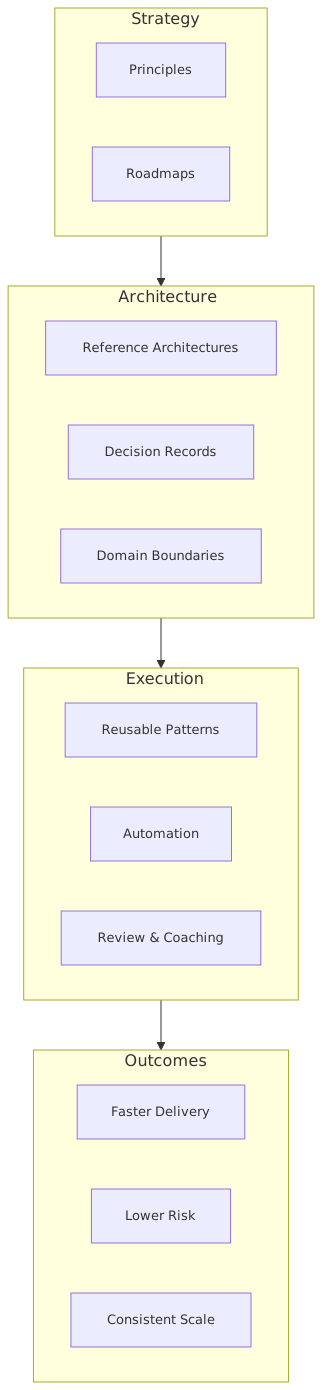
So when we help organizations build scalable architecture practices, we’re not selling a prettier target-state diagram. We’re helping them build a decision system. A way of working. A practical operating model for architecture that survives growth, cloud migration, regulation, platform sprawl, and the very human tendency to overcomplicate things. cloud architecture guide
In simple terms: a scalable architecture practice helps teams make consistent, high-quality technology decisions without central architecture becoming a bottleneck.
That sounds obvious. It rarely is.
What scalable architecture practice actually means
Let’s make this plain early.
A scalable architecture practice usually includes five things:
- Clear principles that people can remember and use
- Decision mechanisms for trade-offs, exceptions, and risk
- Reference patterns teams can adopt without reinventing everything
- Governance that guides, not blocks
- Feedback loops from delivery, operations, security, and business change
That’s it. Not 140-page architecture frameworks. Not giant capability maps nobody updates. Not endless debates about whether the integration layer is “event-driven enough.” ArchiMate capability map
Architecture at enterprise scale works when it is repeatable. Repeatability comes from constraints, patterns, and shared language. The trick is doing that without killing engineering autonomy.
This is where many architecture teams get lost. They think scale means more standardization. Sometimes it does. But more often, scale means being opinionated about the few things that really matter, and deliberately flexible about the rest.
That’s a contrarian view in some enterprises, because they are addicted to completeness. They want standards for everything. Every cloud service. Every API style. Every logging format. Every IAM edge case. It feels mature. It usually isn’t. It creates paperwork, not coherence.
A better approach is to standardize the highest-friction, highest-risk, highest-repeatability areas:
- identity and access management
- integration patterns
- cloud landing zones
- security controls
- observability
- data ownership and movement
- resiliency expectations
- technology lifecycle rules
If you get those right, teams can move fast without creating chaos.
The real problem: architecture doesn’t fail on strategy, it fails in translation
Most organizations are not missing ambition. They are missing translation.
Their strategy says:
- move to cloud
- modernize legacy
- improve customer experience
- reduce risk
- increase reuse
- support digital products faster
Fine. Every executive deck says that.
But in delivery, teams are asking much more concrete questions:
- Should this banking service publish events through Kafka or expose synchronous APIs?
- Do we federate IAM from the enterprise identity provider or create app-local authorization?
- Is this workload allowed in public cloud or does regulation require hybrid deployment?
- Can we use managed cloud databases for customer data?
- How do we authenticate machine-to-machine traffic across domains?
- Who owns the customer profile event schema?
- What’s the approved pattern for secrets rotation?
That is where architecture earns its keep. Not in abstract statements. In operationalized decisions.
A scalable architecture practice closes the gap between strategic intent and day-to-day engineering choices.
How we usually approach it
When we work with organizations, we almost never start by redesigning the entire enterprise architecture function. That’s too slow and too political. We start where pain is visible.

Usually one of these is happening:
- cloud adoption is fragmented
- there are too many integration patterns
- IAM is inconsistent across channels and products
- architecture reviews are slow and unpredictable
- platform teams and solution architects are working at cross-purposes
- every major program is inventing “temporary” standards
- Kafka or event streaming exists, but with no ownership model
- regulatory pressure is exposing weak controls
We start by mapping three things:
1. Decision hotspots
Where do teams repeatedly get stuck or escalate?
In banking, for example, common hotspots are:
- customer identity federation
- privileged access management
- data residency in cloud
- event publication and consumption controls
- encryption and key management
- API authentication between internal and partner systems
2. Architecture bottlenecks
Where is the architecture function becoming the delay?
This is often painful but useful. We look for:
- review boards that meet weekly but decide little
- architects manually checking the same control set every time
- standards spread across SharePoint, Confluence, and tribal memory
- exception processes with no risk model
- architects acting as project managers because no one else owns cross-cutting decisions
3. Reusable patterns
Where are teams solving the same problem over and over?
This is the gold. Because scalability comes from reusable patterns, not heroic architects.
A few examples:
- cloud landing zone patterns for regulated workloads
- Kafka topic governance and schema management patterns
- IAM patterns for workforce, customer, and machine identities
- API gateway and token validation patterns
- secure connectivity patterns between on-prem and cloud
- observability baselines for distributed systems
Once you identify these, you can start turning architecture from bespoke consulting into an operating model.
What this looks like in real architecture work
Let’s get practical, because this is where articles usually become vague.
A scalable architecture practice affects real work in at least six ways.
1. It changes the architect’s job from reviewer to enabler
Architects should not spend most of their time saying yes or no.
They should spend more time:
- defining guardrails
- socializing patterns
- helping teams handle exceptions intelligently
- connecting business priorities to technology consequences
- identifying systemic risks early
- reducing unnecessary diversity in the stack
This sounds softer than governance. It’s actually harder. It requires architects to understand delivery pressure, engineering reality, and operational consequences. Not just produce standards in neat boxes. EA governance checklist
2. It creates pattern-based delivery
Instead of reviewing every team from first principles, you give them approved paths.
For example, in a cloud-first bank:
- a web channel team gets a standard IAM integration pattern using OIDC with centralized token validation and managed secrets
- an integration team gets a Kafka event publication pattern with schema registry, topic naming, retention defaults, and PII handling rules
- a core modernization team gets a hybrid deployment pattern for workloads that need low-latency links to on-prem mainframe services
- a data product team gets a standard observability and access control baseline for cloud analytics services
Now architecture review becomes lighter:
- Are you using an approved pattern?
- If not, why not?
- What risk are you taking?
- Is the exception local or strategic?
That is much better than asking every project to explain distributed systems from scratch.
3. It treats governance as a risk tool, not a ceremony
This is a big one.
Too many enterprises run architecture governance as if all decisions carry equal weight. They don’t. architecture decision record template
Choosing a dashboard library is not the same as choosing customer authentication architecture. Running a low-risk internal workflow in cloud is not the same as streaming regulated payment events across domains.
Scalable practices classify decisions by impact:
- customer risk
- regulatory risk
- security exposure
- operational criticality
- financial significance
- strategic reuse potential
That lets you apply the right level of review. High-risk decisions get deeper scrutiny. Low-risk ones get guardrails and move on.
4. It makes cross-cutting architecture explicit
This matters in large organizations, especially banks.
If nobody owns cross-cutting concerns, every team solves them differently. That creates hidden coupling and expensive cleanup later.
Cross-cutting domains usually include:
- IAM
- integration and eventing
- cloud platform
- data architecture
- security architecture
- resilience and service continuity
- observability
A scalable architecture practice assigns clear ownership for these domains, but not in a territorial way. Ownership means:
- defining enterprise patterns
- maintaining standards
- supporting solution teams
- reviewing exceptions
- feeding lessons back into the practice
5. It shortens time to decision
This is underrated. Architecture should improve decision velocity.
A healthy architecture practice answers common questions fast because:
- principles are clear
- patterns exist
- roles are defined
- exception handling is lightweight
- decision records are easy to find
If teams are waiting two weeks for architecture guidance on whether to use Kafka or REST between bounded domains, the practice is not scaling.
6. It learns from production, not just design
Architecture teams often live too much in pre-delivery. Real architecture quality shows up in production:
- incident patterns
- latency
- auth failures
- cloud cost drift
- schema breakage
- operational handoff failures
- access review findings
- resilience test results
If your architecture practice doesn’t absorb production feedback, it becomes decorative.
Common mistakes architects make
Let’s be honest about this. Architects are not just victims of bad org design. We create some of this mess ourselves.
Here are the mistakes I see repeatedly.
Mistake 1: Confusing control with influence
Some architects think authority equals effectiveness. So they centralize decisions, demand mandatory reviews, and guard standards like sacred texts.
The result? Teams route around architecture.
Influence scales better than control. If teams trust your patterns because they are useful, architecture spreads. If they only comply because they must, architecture becomes brittle.
Mistake 2: Writing standards that nobody can apply
A standard that cannot be translated into engineering action is just architecture fiction.
Bad standard:
- “All systems must support secure identity federation and fine-grained authorization.”
Fine. What does a delivery team do with that on Monday?
Better:
- Workforce authentication uses enterprise IdP via SAML or OIDC.
- Customer-facing channels use centralized CIAM with token-based federation.
- Service-to-service auth uses mTLS plus short-lived OAuth tokens.
- Application teams must not store passwords locally.
- Authorization decisions for shared APIs must use centralized policy patterns where feasible.
Now people can act.
Mistake 3: Treating cloud as a hosting decision
Cloud is not just where workloads run. It changes architecture economics, controls, operating models, and platform responsibilities.
A lot of enterprise architects still evaluate cloud workloads as if they are approving a new data center rack. Wrong frame.
Cloud architecture decisions include:
- tenancy and landing zones
- identity boundaries
- network segmentation
- policy enforcement
- service consumption models
- resilience patterns
- cost transparency
- automation expectations
If your architecture practice does not adapt to that, cloud turns into expensive decentralization.
Mistake 4: Using Kafka without operating discipline
Kafka is a great platform. It is also a fantastic way to create enterprise-wide confusion at high speed.
Common anti-patterns:
- no clear event ownership
- topics created ad hoc
- event schemas changing without compatibility rules
- using Kafka as a replacement for all APIs
- publishing internal database changes as “business events”
- unclear retention and replay policies
- no classification for regulated data in streams
This is why event-driven architecture often gets a bad reputation. Not because the pattern is wrong. Because the practice around it is weak.
Mistake 5: Underestimating IAM complexity
IAM is one of the most important architecture domains in the enterprise, and one of the most commonly oversimplified.
Architects often assume:
- authentication and authorization are basically one problem
- customer IAM and workforce IAM can share the same patterns
- federation solves access design
- privileged access can be handled later
- machine identity is just certificates somewhere
No. IAM is where security, user experience, compliance, and platform architecture collide. If your architecture practice does not treat IAM as a first-class discipline, you will get fragmentation fast.
Mistake 6: Thinking reference architecture is enough
Reference architecture is useful. But by itself, it does not change delivery behavior.
Teams need:
- reference patterns
- implementation guidance
- approved technology choices
- sample pipelines
- templates
- decision records
- known exception paths
- actual support
Architecture only scales when it gets close enough to delivery to be usable.
A real enterprise example: banking modernization with Kafka, IAM, and cloud
Here’s a real composite example based on a pattern I’ve seen more than once in banking.
A regional bank was modernizing digital channels while still relying heavily on core systems on-prem. They had:
- internet and mobile banking platforms
- customer onboarding services
- payment and card servicing domains
- a growing cloud footprint
- Kafka introduced by one program and copied by others
- multiple IAM stacks across customer and workforce channels
- an architecture review process that took too long and delivered inconsistent outcomes
On paper, they had enterprise architecture. In practice, every major initiative negotiated architecture from scratch.
The symptoms
The problems showed up everywhere:
- digital teams wanted cloud-native managed services, but security reviews varied by project
- Kafka topics had inconsistent naming, ownership, and data classification
- customer identity flows were different across channels, creating duplicate consent and session issues
- service-to-service authentication between cloud and on-prem was handled differently by each team
- architects were dragged into every integration and IAM discussion
- platform teams felt architecture was too abstract
- delivery teams felt architecture was too slow
Pretty standard story.
What changed
We did not start with a grand enterprise redesign. We started with three architecture domains that had the highest repeat value:
- IAM
- event streaming and integration
- cloud deployment patterns for regulated workloads
Then we built a lightweight architecture practice around those.
IAM domain
We separated identity patterns into three categories:
- workforce identity
- customer identity
- machine identity
That sounds basic, but many organizations blend them badly.
For customer identity, the bank moved toward centralized CIAM patterns with consistent token handling for digital channels.
For workforce identity, they aligned to enterprise federation and stronger privileged access controls.
For machine identity, they defined a standard pattern for service auth across cloud and on-prem using managed secrets, certificates, and token exchange where needed.
The big win was not just better security. It was fewer architecture arguments. Teams knew what pattern applied.
Kafka and integration domain
The bank already had Kafka, but no real enterprise event model.
We introduced:
- topic ownership rules
- schema registry usage standards
- event classification for sensitive data
- compatibility expectations
- guidance on when to use Kafka vs synchronous API
- retention and replay defaults by event type
- platform responsibilities vs application responsibilities
One contrarian point here: we explicitly told teams not everything should be an event. Some interactions were better as APIs. That reduced a lot of unnecessary complexity.
Cloud domain
The bank had cloud accounts, but not a true architecture pattern for regulated deployment.
We defined:
- approved landing zone patterns
- connectivity controls to on-prem
- identity integration requirements
- baseline logging and monitoring
- encryption and key management approach
- deployment classes based on data sensitivity and criticality
Again, the value was not the document. It was repeatability.
The operating model changes
Then we changed how architecture work happened.
Instead of sending every project through the same heavy review, we introduced a tiered model:
This changed the tone completely. Architects spent less time checking obvious things and more time on real trade-offs.
The outcome
The bank did not become magically perfect. No enterprise does.
But within a couple of quarters:
- architecture review time dropped
- teams reused patterns more consistently
- IAM decisions became less fragmented
- Kafka usage became more disciplined
- cloud deployment decisions became faster and less political
- architects had better visibility into exceptions and technical debt
The most important shift was cultural: architecture stopped being seen mainly as approval and started being seen as a source of usable direction.
That is what scalable practice looks like.
The table most organizations actually need
Here’s a simple way to think about scaling architecture practices.
Simple table, but honestly, it explains half the problem.
Strong opinion: architecture maturity is often overestimated
A lot of enterprises say they are mature because they have:
- architecture principles
- a review board
- reference architectures
- a cloud strategy
- some domain architects
- governance forums
Maybe. Maybe not.
My view is harsher: you are only as mature as your ability to produce consistent technical decisions across teams without creating drag.
If one business unit uses Kafka as an event backbone, another uses it as a queue replacement, and a third bans it because of a past incident, you do not have architectural maturity. You have local habits.
If IAM patterns differ wildly between mobile, web, partner, and internal systems, you do not have a scalable security architecture. You have negotiated exceptions.
If cloud deployment approvals depend on which architect happens to be assigned, you do not have architecture governance. You have personalized policy.
That may sound blunt. Good. It should.
How organizations can start without boiling the ocean
You do not need a two-year transformation program to improve architecture practice. In fact, those often collapse under their own ambition.
Start smaller and sharper.
Pick 2–3 high-friction architecture domains
Usually this is enough:
- IAM
- cloud
- integration/eventing
Define a handful of decision principles
For example:
- prefer approved patterns over project-specific design
- event-driven integration is used where asynchronous business decoupling is needed, not by default
- identity is centralized where trust boundaries cross products
- cloud adoption must align to workload classification and operational capability
- exceptions require explicit ownership and expiry
Build reusable patterns
Not just conceptual diagrams. Actual usable patterns with:
- scope
- when to use
- when not to use
- technology options
- security controls
- operational expectations
- known trade-offs
Reduce governance weight
Shift from blanket reviews to targeted reviews.
Create a visible decision record system
Architecture decisions should be easy to discover. If teams cannot find prior decisions, they will repeat debates.
Use delivery evidence
Review incidents, audit findings, and platform pain points quarterly. Feed that back into patterns.
That’s the work. Not glamorous. Very effective.
Final thought
Scalable architecture practices are not built by making architects more central. They are built by making architecture more usable, more consistent, and more embedded in delivery.
That means fewer abstract artifacts and more practical guidance.
Fewer universal standards and more deliberate guardrails.
Fewer architecture heroes and more repeatable decisions.
And yes, it means architects have to let go of a certain ego. The goal is not to be needed in every conversation. The goal is to make good architecture happen even when you are not in the room.
That is scale.
FAQ
1. What is a scalable architecture practice in simple terms?
It is a way for organizations to make consistent, high-quality architecture decisions across many teams without relying on a few central architects to review everything manually.
2. How does Kafka fit into enterprise architecture practice?
Kafka is not just a tool choice. It needs architecture discipline around event ownership, schema governance, retention, security, and when eventing is actually the right pattern. Without that, Kafka creates complexity faster than value.
3. Why is IAM such a big part of architecture scaling?
Because identity touches security, user experience, compliance, integration, and platform design. If workforce, customer, and machine identity are handled inconsistently, architecture fragmentation spreads quickly across the enterprise.
4. How should cloud governance work in a scalable architecture model?
Cloud governance should rely on landing zones, workload classifications, baseline controls, and automated guardrails. It should not depend on manual case-by-case review for every normal deployment.
5. What is the most common mistake enterprise architects make?
Trying to scale architecture through more control instead of better patterns. When architects become bottlenecks, teams bypass them. Real scale comes from clear principles, reusable patterns, and risk-based governance.
Frequently Asked Questions
What is enterprise architecture?
Enterprise architecture is a discipline that aligns an organisation's strategy, business processes, information systems, and technology. Using frameworks like TOGAF and modeling languages like ArchiMate, it provides a structured view of how the enterprise operates and how it needs to change.
How does ArchiMate support enterprise architecture practice?
ArchiMate provides a standard modeling language that connects strategy, business operations, applications, data, and technology in one coherent model. It enables traceability from strategic goals through business capabilities and application services to the technology platforms that support them.
What tools are used for enterprise architecture modeling?
The main tools are Sparx Enterprise Architect (ArchiMate, UML, BPMN, SysML), Archi (free, ArchiMate-only), and BiZZdesign Enterprise Studio. Sparx EA is the most feature-rich option, supporting concurrent repositories, automation, scripting, and integration with delivery tools like Jira and Azure DevOps.