⏱ 25 min read
ArchiMate vs BPMN in Enterprise Architecture Practice: Key Differences and Use Cases
Compare ArchiMate vs BPMN in enterprise architecture practice. Learn their key differences, modeling strengths, and when to use each for business and IT alignment. ArchiMate tutorial for enterprise architects
ArchiMate vs BPMN, enterprise architecture, BPMN, ArchiMate, business process modeling, enterprise architecture practice, TOGAF, process modeling, architecture modeling, business and IT alignment ArchiMate layers explained
Introduction
In enterprise architecture, ArchiMate and BPMN are often discussed together because both describe how an organization works and how it changes. They are not interchangeable, however. Each serves a distinct purpose, answers different questions, and supports different decisions. For architects, that distinction matters more than deep loyalty to either notation. ArchiMate relationship types
At a high level, ArchiMate is an enterprise architecture modeling language. Its strength lies in linking strategy, capabilities, business processes, applications, data, and technology in a coherent view. It helps architects show how business intent is realized through organizational and technical structures, and how change in one area affects the rest. BPMN addresses a different need. It is designed to represent process behavior: how work flows, where decisions occur, how events trigger action, and how participants interact in operational scenarios. ArchiMate provides context. BPMN provides procedural precision. ArchiMate modeling best practices
In practice, the choice is rarely ArchiMate or BPMN. The more useful question is when to use each, how much detail is warranted, and how the two should connect so they support decisions rather than create documentation for its own sake. Executives usually want to understand impact, traceability, and the scope of transformation. Business leaders need clarity on responsibilities, value delivery, and operational consequences. Delivery and automation teams need enough detail to implement change with confidence. No single notation serves all of those needs equally well.
That is why modeling discipline matters more than notation preference. ArchiMate is most useful when the goal is to understand dependencies, assess change impact, rationalize portfolios, or design target states across business and technology. BPMN becomes more valuable when the goal is to analyze handoffs, expose bottlenecks, standardize execution, strengthen controls, or prepare workflows for automation. Used together, they complement one another: ArchiMate shows where change matters in the enterprise, while BPMN explains how a specific operational thread actually works.
The distinction also matters for governance. Modeling efforts often fail not because teams chose the wrong notation, but because they never clarified scope or audience. BPMN diagrams become too detailed for strategic planning. ArchiMate views remain too abstract for process redesign. Effective practice starts with three simple questions: what decision must the model support, who will use it, and what level of detail is justified? Those questions keep the repository maintainable and tie models back to real change work.
This article compares ArchiMate and BPMN from a practical enterprise architecture perspective. It begins by defining the purpose and scope of each notation, then looks at how each is used in practice, where each is strongest, and how they can be combined in a disciplined modeling approach.
ArchiMate and BPMN at a Glance
The clearest way to compare ArchiMate and BPMN is to look at the questions each is designed to answer.
ArchiMate is suited to questions such as:
- What capabilities enable this value stream?
- Which applications support this business process?
- What technology services are affected if a business function changes?
- How does a transformation initiative affect business and IT together?
BPMN is suited to questions such as:
- In what sequence do activities occur?
- Where does a decision branch?
- What happens when an exception occurs?
- Which participant performs which step?
This distinction is practical, not academic. Enterprise architecture is not about documenting everything. It is about selecting the right representation for the decision in front of you.
ArchiMate works as a cross-domain language. It lets architects connect motivation, strategy, business structure, application behavior, information concepts, and infrastructure in one model. In practice, its value lies in dependency mapping. When an organization plans a transformation initiative, ArchiMate can reveal whether a proposed change touches multiple capabilities, requires new application services, affects key data objects, or depends on technology components nearing end of life. For example, an architecture board reviewing IAM modernization might use an ArchiMate view to see that replacing a legacy directory affects HR onboarding, customer portals, access governance, and several integration services at once. That makes ArchiMate well suited to impact analysis and target-state design.
BPMN operates differently. It focuses on the internal logic of a process instance: tasks, events, gateways, message flows, roles, and handoffs. Its strength is operational clarity. If a business architecture view shows that customer onboarding is strategically important, BPMN can reveal where approvals are delayed, where manual rework occurs, or where a handoff between teams introduces risk. In the same IAM program, a BPMN model may show that access requests still move through email approvals and spreadsheet checks even after a new identity platform has been introduced. That level of detail is often essential for process standardization, control design, and workflow automation.
The two notations also differ in how they represent behavior over time. BPMN is explicitly dynamic. It shows progression, branching, exceptions, and interaction. ArchiMate can represent behavior as well, but usually at a level intended to show architectural relationships rather than full execution semantics. In simple terms, ArchiMate frames the landscape; BPMN examines the mechanics of a specific operational thread within it.
Stakeholder communication follows the same pattern. ArchiMate is especially useful for architecture boards, portfolio managers, and transformation leaders because it compresses structural information into views that support trade-off discussions. BPMN is more useful for process owners, analysts, operational managers, and automation teams because it makes responsibilities and workflow logic explicit. This helps avoid a familiar failure mode: showing executives gateway-heavy process diagrams, or giving operations teams capability maps that never explain how work actually gets done.
From a governance standpoint, ArchiMate often serves as the organizing backbone of the repository. It anchors capabilities, value streams, business processes, applications, and technology assets in a consistent metamodel. BPMN artifacts then add detail to selected processes where precision matters. Not every process needs full BPMN treatment. The notation adds the most value where operational accuracy is important: regulatory compliance, customer-critical journeys, process automation, service integration, or known performance problems.
At a glance, then, ArchiMate and BPMN are not substitutes. One provides enterprise-wide architectural context; the other provides process-level behavioral detail. The rest of this article builds on that distinction.
Purpose, Scope, and Core Modeling Concepts
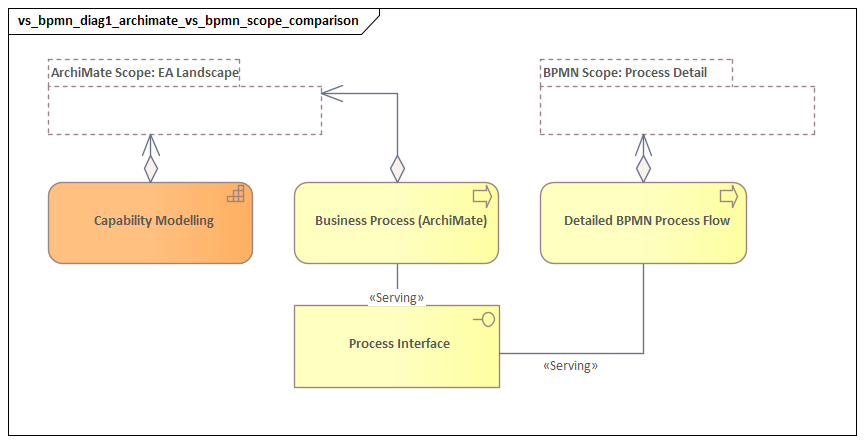
The difference becomes clearer when we look at the primary modeling object of each notation. ArchiMate models elements of the enterprise and the relationships between them. BPMN models the flow logic of work. That distinction shapes scope, abstraction, and ultimately model quality.
In ArchiMate, the model is built around structural and behavioral elements within an architectural landscape: capabilities, business actors, business processes, application components, services, data objects, technology nodes, goals, requirements, and work packages. The notation is designed to show how these elements work together and how change in one area affects others. A process in ArchiMate is therefore usually represented as an architectural behavior element, not as a fully elaborated procedural script. Its value lies in traceability.
BPMN starts from a different premise. Its concern is how a process instance unfolds. Activities, events, gateways, sequence flows, message flows, pools, and lanes define the logic of execution and collaboration. The model answers operational questions: who does what next, under what condition, in response to which trigger, and with what exception path. BPMN is therefore less concerned with enterprise-wide dependency structures and more concerned with behavioral correctness and clarity.
That leads to an important scoping principle. ArchiMate is usually scoped horizontally across domains. A single view may span strategy, business, application, and technology layers to explain an end-to-end transformation concern. BPMN is usually scoped vertically into a specific operational scenario. It drills into one process or collaboration to expose execution detail. Reverse those scopes, and problems appear quickly: ArchiMate models become overloaded with unnecessary flow detail, while BPMN diagrams turn into bloated attempts to represent portfolios, capability maps, and target architectures.
The two notations also make different assumptions about abstraction. ArchiMate encourages viewpoint design. Architects select and combine concepts to address a stakeholder concern, such as capability realization, application support, project impact, or risk exposure. The same repository can generate multiple views without implying that every relationship must appear at once. BPMN is less about viewpoint composition and more about process specification. Even when simplified for communication, it still carries the expectation that the depicted flow represents real or intended operational behavior.
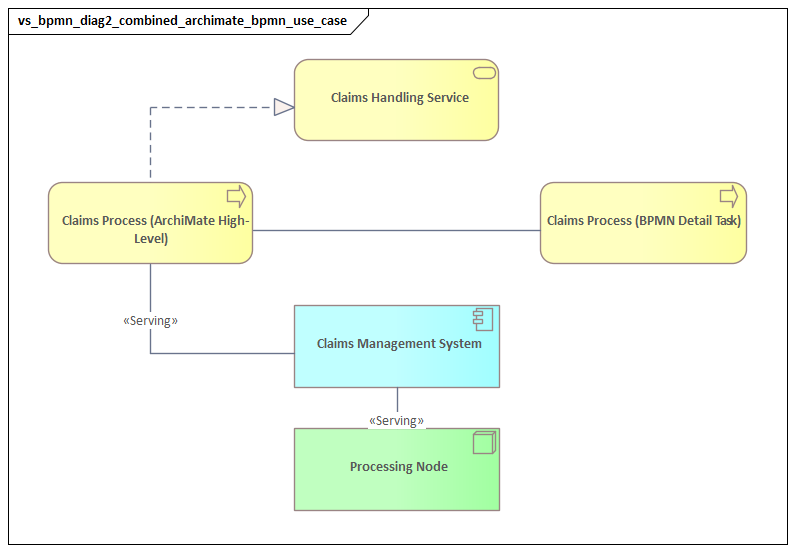
This matters when moving from current-state understanding to change design. Suppose an enterprise is redesigning claims handling. ArchiMate can show that claims handling supports a customer service capability, depends on policy data, uses a case management platform, and is affected by a modernization initiative. That is the level needed to assess investment options and cross-domain impact. BPMN becomes useful when the team needs to redesign intake, triage, fraud checks, approvals, and escalation paths. At that point, the issue is no longer just architectural alignment; it is operational design quality.
A second example appears in procurement. An ArchiMate view may show that supplier onboarding supports the source-to-pay capability, relies on master data services, and spans ERP, risk screening, and contract management platforms. That tells leaders where change lands. BPMN is needed when the procurement team asks why onboarding takes 18 days for low-risk vendors, why legal review is triggered too early, or why exceptions bypass standard controls.
There is also a difference in model stability. ArchiMate often captures relatively stable architectural knowledge: what capabilities exist, which applications support which processes, which services are exposed, and what target state is being pursued. BPMN often captures more variable operational logic, where rules, handoffs, and exception paths may change more frequently. For repository governance, that implies different maintenance patterns. ArchiMate artifacts should be curated as enterprise reference knowledge. BPMN artifacts should be maintained where process ownership, compliance needs, or automation value justify the effort.
Taken together, these differences create a useful separation of concerns. ArchiMate defines where a process sits in the enterprise and why it matters. BPMN defines how that process actually works. As later sections will show, that separation is what allows the two notations to complement one another without duplicating effort.
How Enterprise Architects Use ArchiMate in Practice
Given that scope, ArchiMate is most valuable when architects need to connect strategic intent to operational and technical consequences in a way that is consistent and reusable. In mature practices, it is more than a diagramming notation. It becomes a decision-support language and, often, the backbone of the architecture repository.
One common use is capability-based planning. Architects map business capabilities to the processes, applications, data, and technology services that enable them, then use that structure to identify weaknesses, duplication, or investment priorities. This is particularly useful during transformation planning, when leaders want to understand not only what needs to improve, but also what dependencies make improvement difficult. A capability may look strategically important on paper, yet an ArchiMate model may show fragmented applications, inconsistent data ownership, or aging infrastructure behind it. That changes the conversation from aspiration to feasibility.
Another major use is impact analysis. When a regulatory change, merger, platform replacement, or product launch is proposed, architects need to estimate which parts of the enterprise will be affected. In practical terms, that means tracing relationships across business actors, processes, application services, interfaces, and technology components. ArchiMate is strong here precisely because it spans those domains. The architect is not simply documenting the current state; they are identifying the blast radius of change. That helps architecture boards and delivery leaders see where coordination is required and where hidden constraints may slow execution.
ArchiMate is also effective for target-state design. Enterprise architects often need to express a future operating model without dropping straight into implementation detail. ArchiMate supports this by allowing teams to model transition architectures, plateaus, gaps, and work packages alongside business and technology structures. In a transformation program, this helps answer questions such as:
- Which capabilities will be improved first?
- Which legacy applications remain during transition?
- What interim integrations are required?
- Which projects realize which parts of the target state?
That makes ArchiMate especially useful for roadmap discussions, where sequencing matters as much as destination. A common example is event architecture using Kafka: an ArchiMate target-state view can show which domains will publish events, which applications subscribe, and which legacy point-to-point interfaces will be retired over time.
Portfolio rationalization is another practical use. Many organizations struggle with overlapping systems, redundant services, and unclear ownership. By modeling application components, business services, and supporting processes consistently, architects can identify where multiple assets perform similar roles or where critical processes depend on unsupported platforms. The resulting insight supports not only cost reduction, but also resilience and simplification. Rationalization decisions are easier to defend when they are tied to business support and strategic relevance rather than technology preference.
ArchiMate also helps align architecture domains. Business architects, solution architects, data architects, and infrastructure architects often work with different concerns and vocabularies. ArchiMate provides a shared structure that lets these groups align without forcing them into the same level of detail. A business-oriented view may show capability gaps and value implications, while a technology-oriented view focuses on platform dependencies and service exposure. Because both views are derived from the same underlying model, the organization gains coherence without losing specialization.
In many organizations, ArchiMate also proves its value during platform decisions. Consider a bank planning to retire an aging document management product. An ArchiMate analysis may show that the platform supports retail lending, branch servicing, fraud investigations, and regulatory retention. What looks like a contained infrastructure upgrade turns out to be a business-critical dependency spanning multiple value streams. That level of visibility often changes sequencing, funding, and risk treatment.
The strongest enterprise architecture teams are selective in how they use ArchiMate. They do not try to model the entire enterprise exhaustively. Instead, they focus on decision-relevant areas: strategic initiatives, high-risk domains, major customer journeys, regulatory hotspots, or expensive platforms. This reflects the governance principle introduced earlier: every model should justify itself through decision support. In practice, ArchiMate works best when every view is tied to a concrete question, a defined audience, and an architectural decision.
Used this way, ArchiMate helps architects move beyond static documentation and provide structured insight into alignment, dependency, transition, and investment choice. That creates the foundation on which BPMN can add operational detail.
How BPMN Supports Process Analysis and Design
If ArchiMate helps identify where change matters, BPMN helps determine how a selected process should work. Its contribution is more than visual clarity. BPMN provides a disciplined way to test process logic before organizations invest in policy changes, systems integration, workflow tooling, or automation.
One of BPMN’s main strengths is that it exposes the gap between the nominal process and the real one. Many organizations describe work in broad labels such as intake, review, approve, and fulfill, but those labels conceal operational reality. BPMN forces teams to make explicit where work waits, where decisions are made, what information is required, which interactions are manual, and which exceptions trigger alternate handling. This is often where the most useful insight emerges. Delays, duplicate checks, unclear ownership, and inconsistent escalation paths become visible only when the flow is modeled with enough rigor to show actual behavior rather than policy intent.
For enterprise architects, that matters because process issues are rarely just process issues. As the ArchiMate discussion suggested, operational friction often points to broader dependencies. A bottleneck visible in BPMN may indicate a missing application integration, fragmented data ownership, weak control design, or an organizational boundary that creates unnecessary handoffs. In that sense, BPMN acts as a diagnostic instrument. It reveals the friction; the architectural model helps explain why it exists.
BPMN is also useful for distinguishing different kinds of process work. Some processes are highly standardized and repeatable, which makes them good candidates for workflow automation. Others are judgment-heavy, event-driven, or collaborative, where too much standardization can reduce effectiveness. By modeling tasks, decision points, message exchanges, and exception paths, BPMN helps teams decide whether a process should be automated, guided, monitored, or simply clarified. That matters because not every process problem should be solved with technology. Sometimes the right intervention is a policy change, a role redesign, or a simpler approval structure.
Another important contribution is control and compliance design. In regulated environments, process documentation often needs to show more than activity sequence. It must demonstrate where approvals occur, where segregation of duties applies, how exceptions are handled, and what events trigger mandatory responses. BPMN provides a structured way to represent those control points without reducing the process to prose or informal swimlane sketches. For architects in financial services, healthcare, government, and similar sectors, this makes BPMN a useful bridge between business design, operational risk, and implementation planning.
A realistic example is mortgage underwriting. An ArchiMate model can show the capability, channels, applications, and data domains involved. BPMN is what reveals that high-value loans trigger parallel credit, fraud, and valuation checks; that missing income evidence pauses the case; and that exceptions are routed to a senior underwriter rather than the standard queue. Those details determine cycle time and control effectiveness.
BPMN also improves collaboration across delivery roles. Process owners, business analysts, solution designers, and automation teams can use the same model to discuss different concerns. A process owner may focus on service quality and accountability, a business analyst on rule clarity, and a delivery team on system touchpoints and orchestration logic. Used well, BPMN becomes a shared working model rather than a handoff artifact. That reduces the gap between process redesign workshops and implementation, where intent is often lost as teams move from conceptual discussion to technical delivery.
As with ArchiMate, selectivity matters. Not every process needs full BPMN elaboration, and over-modeling creates maintenance overhead without adding decision value. The best candidates are processes with measurable pain, regulatory significance, customer impact, cross-team coordination complexity, or automation potential. For example, if Kafka is introduced to support near-real-time order updates, BPMN may be used only for the exception-heavy order cancellation and refund flows, not for every event in the platform. In those cases, BPMN helps teams move from general statements about improvement to a concrete design that can be challenged, tested, governed, and implemented.
In short, BPMN adds value where behavioral precision matters. It does not replace the architectural perspective described earlier; it depends on it. Once the enterprise has identified the process area worth improving, BPMN becomes the tool for examining its operational truth.
ArchiMate vs BPMN: Key Differences, Strengths, and Limitations
With the practical uses of both notations established, the differences between them can be stated more directly. The most important distinction is not simply abstraction level, but modeling intent. ArchiMate is optimized for coherence across the enterprise. BPMN is optimized for fidelity within a process. That difference shapes what each notation makes easy, what each makes difficult, and how each can be misused.
1. Primary purpose
ArchiMate is designed to show relationships across strategy, business, application, data, and technology. It is strongest when the question is about dependency, alignment, impact, transition, or portfolio structure.
BPMN is designed to show process behavior. It is strongest when the question is about sequence, decision logic, exception handling, collaboration, control points, or automation readiness.
2. Typical level of abstraction
ArchiMate usually operates at enterprise or domain level. Even when it includes behavior, that behavior is typically represented at an architectural level.
BPMN usually operates at process or sub-process level. Its purpose is to expose operational logic in enough detail to support analysis or implementation.
3. Main strengths
ArchiMate’s strengths include:
- Cross-domain traceability
- Impact analysis
- Capability-based planning
- Target-state and transition design
- Portfolio rationalization
- Communication with strategic stakeholders
BPMN’s strengths include:
- Process precision
- Visibility of handoffs and bottlenecks
- Exception and control modeling
- Support for process standardization
- Workflow and automation design
- Collaboration among process and delivery teams
4. Main limitations
ArchiMate can create the impression of understanding without proving operational viability. A process may appear well supported in the architecture, yet still fail in execution because detailed flow, timing, and exception behavior have not been examined.
BPMN has the opposite limitation. It can become locally accurate but strategically disconnected. A process may be modeled in great detail without clarifying whether it supports the right capability, fits the target operating model, duplicates another process, or depends on applications the enterprise plans to retire.
5. Durability and maintenance
As noted earlier, ArchiMate models often remain useful over longer planning cycles because they capture relationships that change relatively slowly. BPMN models can age faster because they reflect procedural logic and business rules that may be adjusted more frequently. This affects repository strategy: ArchiMate often justifies broader curation, while BPMN requires stronger selection criteria.
This is especially visible in technology lifecycle governance. An ArchiMate repository may continue to support board decisions about retiring an end-of-life integration platform over several planning cycles, while the related BPMN models for incident handling or release approvals may need more frequent updates as operating procedures evolve.
6. Analytical bias
ArchiMate encourages systems thinking. It helps architects reason about dependencies, trade-offs, and structural consequences.
BPMN encourages execution thinking. It helps analysts and designers reason about sequence, accountability, and interruption handling.
Neither is better in the abstract. Each reveals a different class of problem. An ArchiMate-heavy practice may miss operational friction. A BPMN-heavy practice may optimize workflows that should have been redesigned at the capability or service level instead.
From a practical enterprise architecture perspective, a simple rule emerges: use ArchiMate to decide where intervention is needed, and BPMN to decide how a selected process should work. ArchiMate is better for framing investment decisions, transformation scope, and cross-domain alignment. BPMN is better for validating process design, clarifying handoffs, and preparing implementation or automation.
The goal is not to choose a winner. It is to choose the notation that reduces the right uncertainty.
Using ArchiMate and BPMN Together in Enterprise Architecture Practice
The strongest enterprise architecture practices do not treat ArchiMate and BPMN as competing standards or parallel modeling tracks. They use them as linked representations within a single decision framework. ArchiMate provides the enterprise context for change. BPMN provides detailed understanding of selected operational behavior. The practical challenge is to connect them without duplicating effort.
A useful way to think about their relationship is as a modeling progression. ArchiMate is often used first to identify where attention is needed: which capability is underperforming, which value stream stage is constrained, which application support is fragmented, or which initiative creates cross-domain impact. BPMN is then applied selectively to the processes within that architectural hotspot. That sequencing prevents process modeling from becoming an isolated analysis exercise. The BPMN effort begins with a clear reason grounded in enterprise priorities.
In practice, the linkage works best when teams define explicit traceability rules. A business process represented in ArchiMate should not be duplicated in BPMN at the same level of abstraction. Instead, the ArchiMate element should serve as the architectural anchor, while the BPMN model acts as a detailed realization of a specific operational scenario or variant. This keeps the repository coherent and helps stakeholders understand why a high-level process appears stable in the architecture model even when multiple BPMN diagrams exist for different channels, regions, products, or exception cases.
This combined approach is especially valuable during transformation design. Consider a customer service modernization initiative. ArchiMate can show the relationship between customer-facing capabilities, business services, application components, data objects, and transition work packages. But once the initiative reaches implementation planning, teams still need to know how requests are routed, where approvals occur, how exceptions are escalated, and which interactions should be automated. BPMN provides that operational layer. Because the process area has already been framed architecturally, the detailed design remains connected to capability outcomes, platform changes, and roadmap commitments.
A similar pattern works in healthcare operations. An ArchiMate view may show that prior authorization touches provider portals, case management, payer integration, clinical rules, and member data. BPMN is then used only for the authorization decision flow, where missing documents, medical review, and escalation timers materially affect turnaround time and compliance.
There is also a governance benefit in separating architectural ownership from process ownership while keeping both connected. Enterprise architects typically curate the cross-domain model, ensuring consistency in capabilities, applications, services, and target-state relationships. Process owners or business analysts often maintain BPMN models for the operational areas they control. A mature practice establishes a handshake between these roles:
- changes in architecture trigger review of affected process models
- major process redesigns trigger review of architectural dependencies
- process automation initiatives are traced back to capability and application impacts
- repository standards define what must be linked and what can remain local
Without that governance loop, the two model sets drift apart and lose credibility.
Integration should be driven by decisions, not by tooling ambition. Many repositories fail because teams try to create exhaustive links between every ArchiMate element and every BPMN task. That level of granularity is rarely sustainable. A better approach is to define a small number of high-value connection points, such as:
- capability to business process
- business process to application service
- business process to key data object
- process change to work package or initiative
Those links are usually enough for impact analysis, transformation planning, and governance without creating excessive maintenance overhead.
The two notations are also most effective at different moments in stakeholder engagement. ArchiMate works well in early framing discussions, investment reviews, and architecture board decisions because it clarifies scope, dependency, and strategic relevance. For instance, a board may approve Kafka as the target event backbone but require phased retirement of legacy middleware based on lifecycle risk and team readiness. BPMN becomes more useful in design workshops, control reviews, automation assessments, and delivery alignment sessions where operational precision is required. Used in sequence, they create continuity from strategy to execution.
Ultimately, combining ArchiMate and BPMN is less about notation compatibility than about architectural discipline. ArchiMate helps the enterprise decide what must change and why. BPMN helps teams design how a selected part of that change will operate. When linked through clear ownership, selective traceability, and decision-focused governance, the two notations create a stronger architecture practice than either can provide on its own.
Conclusion
For enterprise architecture teams, the value of comparing ArchiMate and BPMN lies in improving modeling judgment. The real question is not which notation is more powerful in the abstract, but which one reduces uncertainty for the decision at hand. Good architecture practice depends on matching model type, audience, and level of detail to a specific change problem.
As this article has argued, ArchiMate is strongest when the concern is enterprise coherence: capabilities, dependencies, target states, portfolio structure, and transformation impact. BPMN is strongest when the concern is operational behavior: sequence, handoffs, exceptions, controls, and automation readiness. One frames the enterprise context; the other tests process reality.
This distinction has practical consequences for governance. Models are assets with operating costs. Every artifact added to the repository must justify its maintenance through reuse, traceability, or decision support. That is why mature teams define modeling entry criteria such as strategic relevance, operational risk, regulatory exposure, automation potential, or cross-domain impact. Without that discipline, both ArchiMate and BPMN become documentation burdens rather than architecture assets.
There is also an organizational lesson in how the two notations work together. ArchiMate strengthens enterprise conversations about alignment, dependency, and transformation sequencing. BPMN strengthens collaboration around process accountability, control design, and implementation realism. Linking the two helps bridge a common gap in change programs: strategy is often too abstract for execution, while delivery detail is often too narrow for enterprise decision-making.
Ultimately, mature practice is not defined by having more models, but by having models that stay relevant as change progresses. When ArchiMate provides the structural frame and BPMN is introduced only where behavioral precision is needed, the result is a repository that supports both strategic direction and practical delivery. The advantage is not better diagrams alone. It is better-informed change.
Frequently Asked Questions
What is enterprise architecture?
Enterprise architecture is a discipline that aligns an organisation's strategy, business operations, information systems, and technology infrastructure. It provides a structured framework for understanding how an enterprise works today, where it needs to go, and how to manage the transition.
How is ArchiMate used in enterprise architecture practice?
ArchiMate is used as the standard modeling language in enterprise architecture practice. It enables architects to create consistent, layered models covering business capabilities, application services, data flows, and technology infrastructure — all traceable from strategic goals to implementation.
What tools are used for enterprise architecture modeling?
Common enterprise architecture modeling tools include Sparx Enterprise Architect (Sparx EA), Archi, BiZZdesign Enterprise Studio, LeanIX, and Orbus iServer. Sparx EA is widely used for its ArchiMate, UML, BPMN and SysML support combined with powerful automation and scripting capabilities.