⏱ 21 min read
Most ArchiMate extension work is bad.
Not malicious. Not stupid. Just bad in the very ordinary enterprise way: well-intentioned, over-designed, and quietly dangerous.
A team starts with a reasonable complaint — “ArchiMate doesn’t capture our cloud landing zone controls,” or “we need to distinguish Kafka topics from generic application interfaces,” or “IAM concepts are too important to leave as labels” — and before long they’ve built a private modeling language that only six people in the company understand, four of whom have already left.
That is the real problem with extending ArchiMate. The risk is not that you break notation purity. The risk is that you destroy the one thing architecture models are supposed to do: create shared understanding across teams.
So let’s say the simple thing early, because this is where most people need clarity:
You can extend ArchiMate safely by specializing existing concepts when the specialization improves decision-making without breaking shared semantics.
You should not extend it just because your domain is complex, politically important, or full of vendor jargon.
That’s the short version. It sounds obvious. In practice, architects get this wrong all the time.
This article is about how to do it properly: the patterns that work, the anti-patterns that quietly rot your repository, and how this shows up in real architecture work — especially in banking, Kafka-heavy integration estates, IAM, and cloud platforms.
The real issue: ArchiMate is abstract on purpose
People often complain that ArchiMate is “too generic.” Yes. That is the point. ArchiMate modeling guide
ArchiMate is not trying to be your bank’s canonical metamodel for every implementation detail from customer onboarding through mainframe batch settlement to Azure tenant policy exemptions. It is a language for describing architecture coherently across layers and viewpoints.
That abstraction is a feature, not a bug.
But abstraction has limits. In real enterprises, some distinctions matter enough that “just put it in the name” is lazy. If your security architecture cannot distinguish a role, a policy, an identity provider, and a privileged access workflow, then your model is not helping. If your integration architecture treats a Kafka topic, a REST API, and a file drop as the same shape with different labels, then your dependency analysis will be weak and your review conversations will drift into ambiguity.
So yes, extension is sometimes necessary. But only if it increases clarity more than it increases entropy.
That’s the test. Not compliance. Not elegance. Clarity versus entropy.
What “extending ArchiMate” should mean in practice
Let’s keep this practical.
When architects say they are extending ArchiMate, they usually mean one of four things: ArchiMate tutorial
- Specializing an existing ArchiMate element
Example: defining “Kafka Topic” as a specialization of an Application Interface or another chosen concept in your modeling convention.
- Specializing a relationship
Less common, and often riskier. Example: introducing a more specific dependency relationship for security trust or event subscription.
- Adding properties, tags, or profiles
Example: adding metadata such as data classification, resilience tier, RTO/RPO, cloud region, owner, regulatory criticality.
- Creating an enterprise-specific vocabulary around viewpoints
Example: a standard way to model IAM trust chains or cloud landing zone controls without inventing entirely new semantics.
The safest path is almost always specialization of existing elements plus disciplined use of properties.
The least safe path is usually inventing new element types and pretending they are universally meaningful.
That’s where things go off the rails.
My strong opinion: if you need a workshop to explain your specialization, it’s probably bad
Here’s the contrarian bit.
Architects love precision. Too much, sometimes. We think if we can carve reality into finer categories, we are making the architecture more rigorous. Often we are just making it more fragile.
If your repository contains 14 custom application-layer element types, each with subtle distinctions no product team can remember, you have not created rigor. You have created dependency on the architecture team as interpreters of the model. That is not maturity. That is a bottleneck with nice diagrams.
A safe extension should pass a brutal test:
- Can a domain architect understand it in under five minutes?
- Can a solution architect use it correctly without a style-police review?
- Can a platform lead map it to implementation choices?
- Can it survive a tool migration?
- Can a new architect join and still read the model without tribal initiation rites?
If the answer is no, simplify.
When specialization is actually justified
There are only a handful of reasons to specialize ArchiMate concepts, and most of them come down to one thing: the distinction changes architectural decisions.
That means the specialization should affect one or more of these:
- governance decisions
- risk analysis
- dependency analysis
- impact assessment
- control design
- architecture review outcomes
- target-state roadmaps
If the distinction does not change any of that, it probably belongs in a property or a label, not in the metamodel.
Good reasons to specialize
- Different lifecycle or ownership model
- Different non-functional expectations
- Different control requirements
- Different integration behavior
- Different risk posture
- Different deployment or hosting constraints
- Different audit or regulatory significance
Bad reasons to specialize
- Vendor product categories
- Team pride in their domain language
- Temporary project terminology
- “Because cloud is special”
- “Because security is special”
- “Because Kafka is different from APIs”
- Needing prettier diagrams
Notice that some things appear in both lists, depending on whether the distinction changes architecture decisions. That’s the whole game.
Safe specialization patterns
Let’s get concrete.
Pattern 1: Specialize only where semantics remain obvious
This is the most important pattern.
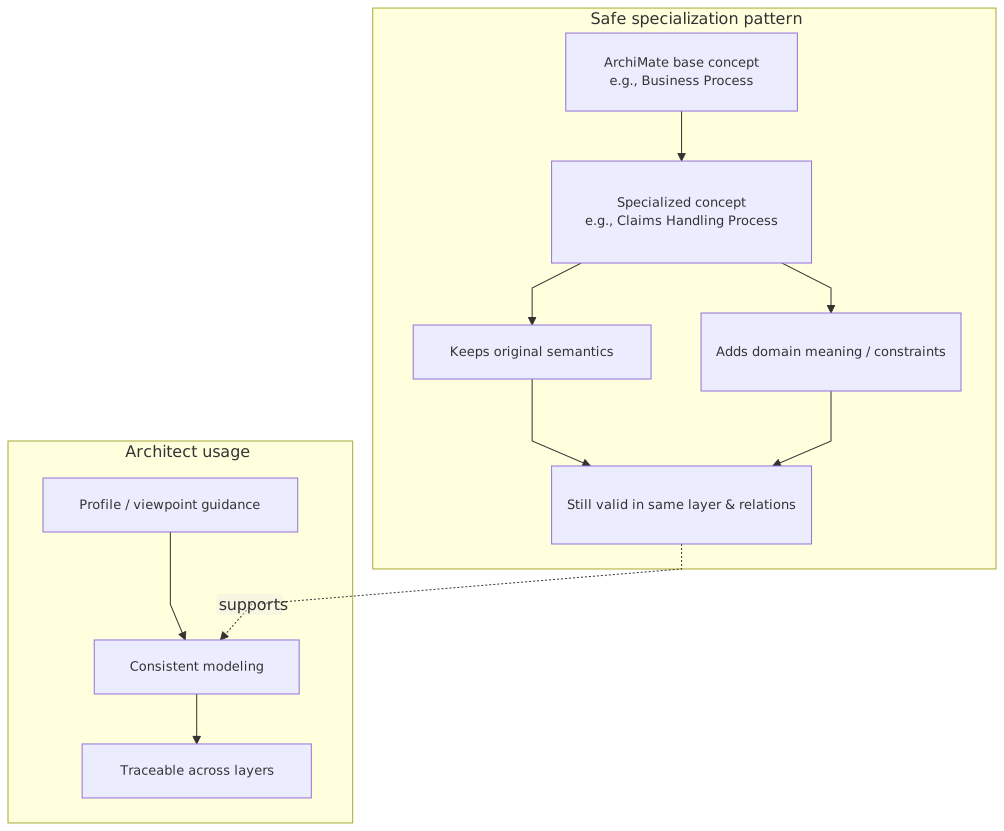
A specialization should still clearly inherit the meaning of the parent concept. If you create “Kafka Topic” as a specialization, people should still be able to understand what kind of architectural thing it fundamentally is in your metamodel.
There will always be debate over the best parent concept for technical artifacts like Kafka topics, IAM policies, cloud subscriptions, or service mesh gateways. That’s fine. The key is consistency and semantic discipline.
For example:
- Kafka Producer as a specialization of an Application Component
- Kafka Consumer as a specialization of an Application Component
- Kafka Topic as a specialization of an Application Interface or a technology/application interaction concept based on your convention
- Identity Provider as a specialization of an Application Component
- IAM Policy as a specialization of a Business Object, Representation, or contract-like concept depending on modeling intent
- Cloud Landing Zone as a specialization of a Node, Technology Collaboration, or grouped platform construct depending on abstraction level
The exact choice matters less than this: pick one interpretation and document it with examples.
Because in real architecture work, the danger is not philosophical impurity. The danger is three teams modeling the same thing in three different ways and all of them claiming compliance.
Pattern 2: Use profiles and properties aggressively before inventing new types
This one is boring, and boring is good.
A lot of architects extend the metamodel when they really need better metadata discipline.
Example from banking:
A bank wants to distinguish customer-facing APIs by regulatory impact, authentication method, resilience tier, and data sensitivity. They start proposing custom element types like:
- Regulatory API
- PII API
- High Resilience API
- Open Banking API
- Internal Trusted API
This is a mess. These are not stable semantic types. They are classifications.
A better approach:
Use standard application/service/interface elements, then attach properties such as:
data_classificationauth_patternresilience_tierexternal_exposureregulatory_scopecritical_business_process
Now you can filter, report, and govern without turning every policy dimension into a fake ontology.
This matters in real work because architecture repositories are used for analysis, not just drawing. Once you encode dimensions as properties, you can query them consistently across portfolios.
Pattern 3: Create domain-specific viewpoints, not domain-specific chaos
A lot of extension pressure comes from a real need: standard ArchiMate viewpoints often don’t tell the story architects need for a specific domain.
That does not mean you need a whole new language.
Often the right move is to define a viewpoint convention for a domain.
Examples:
Kafka viewpoint convention
Show:
- producers
- consumers
- topics
- schemas
- ownership
- data classification
- replay/retention concerns
- cross-domain event dependencies
IAM viewpoint convention
Show:
- identity source
- identity provider
- federation path
- application relying parties
- authorization policy points
- privileged access controls
- trust boundaries
Cloud platform viewpoint convention
Show:
- landing zones
- subscriptions/accounts/projects
- network segmentation
- shared services
- policy enforcement points
- workload placement
- operational ownership
This is how mature teams work. They don’t keep expanding the language every time a new platform appears. They define repeatable views using a controlled subset of concepts and metadata.
That scales much better.
Pattern 4: Specialize when governance depends on the distinction
This is the one case where I become much more supportive of extension.
If a specialized element triggers a different review path, control set, assurance requirement, or ownership model, then the distinction is probably worth encoding.
For example in IAM:
A generic “application component” is too broad if some components act as:
- identity provider
- authorization service
- privileged access vault
- directory service
- policy decision point
Those are not just labels. They imply different control expectations, integration patterns, and failure impacts.
In banking, that matters a lot. If your architecture review board cannot quickly identify which components are making authorization decisions versus merely consuming tokens, your control analysis will be shallow. The model should help expose that.
So yes, specialize those roles if your governance process genuinely uses them.
Pattern 5: Keep the specialization catalog small and governed
A safe extension model has a small number of highly reusable specializations. Usually much smaller than people expect.
If your enterprise architecture team cannot maintain a one-page specialization catalog, you are overdoing it.
A practical catalog should include:
- name of specialization
- parent ArchiMate concept
- intended meaning
- when to use it
- when not to use it
- example
- required properties
- related viewpoints
That last one matters. A specialization with no viewpoint and no governance use case is usually vanity modeling.
A useful rule of thumb
Here’s a simple test table I’ve used in architecture teams.
This sounds basic. It is basic. And still, many teams ignore it because inventing a neat custom metamodel feels more sophisticated than applying discipline.
Common mistakes architects make
Now the ugly part.
Mistake 1: Confusing classification with specialization
This is probably the most common error.
“Gold API”, “regulated workload”, “internal app”, “shared platform service”, “critical topic” — these are often classifications, not fundamentally different concept types.
If the same underlying thing can move in and out of the category over time, that is usually a hint it should be a property, not a specialization.
A Kafka topic can become critical. An API can become regulated. A workload can move from non-production to production. That doesn’t make them different semantic species.
Architects often know this in theory but ignore it under delivery pressure.
Mistake 2: Modeling the vendor product catalog instead of the architecture
This one is rampant in cloud and security.
You see repositories full of specialized elements like:
- Azure Policy Initiative
- AWS SCP
- Entra Conditional Access
- Okta Sign-On Policy
- Kafka Connect Cluster
- Confluent Schema Registry Subject
Some of these may matter, but usually the model has collapsed into product taxonomy. That is not enterprise architecture. That is an annotated admin console. TOGAF roadmap template
At enterprise level, the question is usually not “what exact console object exists?” but “what control capability exists, where is it enforced, what depends on it, and what risk does it mitigate?”
Model the architecture first. Map products second.
Mistake 3: Extending to compensate for weak naming
Sometimes teams create custom types because they are bad at naming and structuring views.
A diagram with clear names, grouping, and properties often solves the perceived need for extension.
For instance, instead of inventing five custom service types for banking integration, try naming things well:
- Customer Profile Event Stream
- Payments Fraud Decision API
- Retail IAM Federation Service
- Treasury Batch Settlement File Interface
A surprising amount of “metamodel innovation” is really just avoidance of disciplined communication.
Mistake 4: Letting each domain create its own extensions
This kills repository coherence.
The cloud team extends one way. The security team extends another way. Integration architects create Kafka-specific types. Data architects create event and schema concepts differently. Then someone tries to run impact analysis across the estate and discovers that “service” means four different things.
Local flexibility feels empowering. Enterprise-wide, it is poison.
You need a minimal central governance mechanism for specialization. Not bureaucratic theater. Just enough control to stop semantic drift.
Mistake 5: Treating specializations as permanent truths
Here’s a contrarian point architects don’t like hearing: some specializations are temporary and should die.
A specialization may be useful during a platform transformation, regulatory remediation, or architecture capability uplift. That does not mean it belongs in the metamodel forever.
If your bank creates specializations to track migration from legacy IAM to centralized federation, fine. But once the transformation is complete, some distinctions may no longer justify dedicated types. Collapse them if needed.
Architecture repositories should evolve. People forget that.
Real enterprise example: a bank modernizing event-driven architecture and IAM
Let me give you a realistic example, because this is where theory gets tested.
A large retail and commercial bank was modernizing two things at once:
- moving from point-to-point integration and batch-heavy processing toward Kafka-based event streaming
- consolidating fragmented identity and access management across on-prem, SaaS, and cloud workloads
Predictably, every architecture team believed their domain was special enough to require custom modeling.
The initial mess
The integration architects introduced:
- Event Producer
- Event Consumer
- Event Channel
- Kafka Topic
- Kafka Cluster
- Schema
- Dead Letter Topic
- Replay Service
The IAM architects introduced:
- IdP
- RP
- AuthN Service
- AuthZ Engine
- Token Service
- Directory
- PAM Vault
- Conditional Access Policy
- Federation Trust
The cloud team added:
- Landing Zone
- Subscription
- Shared VNet
- Security Hub
- Policy Guardrail
- Workload Boundary
Individually, none of these were crazy. Collectively, the repository became unreadable. Different teams modeled the same application differently depending on which concern they cared about. A digital channel platform appeared as an application component in one view, a relying party in another, a consumer in another, and a regulated workload in another. All true. None reconciled.
What we changed
We cut the specialization set hard.
We kept a small number of domain-specific specializations where governance and design review truly depended on them.
For Kafka and integration
We kept:
- Kafka Producer
- Kafka Consumer
- Kafka Topic
We did not keep:
- Dead Letter Topic as a separate type
- Replay Service as a separate metamodel concept
- Schema as a universal custom type everywhere
Why? Because dead-letter behavior and replay capability were important, but they were better represented as properties or related services depending on context. Otherwise every integration pattern became a custom species.
Required properties for Kafka Topic included:
- data classification
- retention class
- domain owner
- schema governance status
- resilience tier
For IAM
We kept:
- Identity Provider
- Policy Decision Point
- Privileged Access Service
We did not keep:
- every policy artifact as a distinct specialized type
- every federation object from the product stack
- token service as a universal type unless it had clear independent governance significance
Required properties included:
- trust domain
- authentication assurance level
- regulatory scope
- external federation flag
For cloud
We kept:
- Landing Zone
- Shared Platform Service
We did not model every account/subscription policy object as its own architecture concept.
Instead, cloud controls were attached through properties and relationships:
- hosting region
- control baseline
- internet exposure
- sovereign boundary
- operational ownership
Why this worked
Because it aligned with actual architecture decisions.
The review board needed to know:
- which components publish or consume regulated events
- which topics carry customer or payment-sensitive data
- which services make authorization decisions
- which workloads sit in controlled landing zones
- where trust boundaries and operational dependencies exist
The specialized set made those questions answerable.
The rest — product-specific mechanics, policy syntax, environment-level details — stayed in supporting metadata and linked technical documentation.
That is the balance.
The business benefit
This wasn’t just prettier modeling.
It improved:
- impact analysis for IAM outages
- resilience planning for streaming dependencies
- control mapping for regulated workloads
- migration planning from legacy middleware to Kafka
- cloud onboarding governance
One example stood out. During a resilience review, the bank discovered that several customer channels depended on authorization decisions from a centralized IAM policy service hosted in a shared cloud landing zone, while also depending on Kafka event streams for fraud signals. The architecture model made both dependencies visible in one place. That changed the prioritization of failover design and led to a redesign of degraded-mode behavior.
That is what good specialization does. It changes decisions.
How this applies in real architecture work
This is where architects often get too theoretical. So let’s tie it back to day-to-day practice.
In architecture reviews
Specializations help reviewers quickly identify patterns that require deeper scrutiny.
Examples:
- a Policy Decision Point requires security review
- a Kafka Topic carrying regulated data requires classification and retention validation
- a Landing Zone hosting tier-1 workloads requires platform compliance checks
If your specialization does not improve review effectiveness, question its value.
In portfolio rationalization
A small set of specializations can expose duplication and hidden risk.
Example:
You may discover five different “identity providers” across business units, all doing slightly different federation and policy enforcement. That is a meaningful target for consolidation. Generic application components would hide that pattern.
In migration planning
During cloud migration or event modernization, specializations can reveal transformation scope.
Example:
Applications consuming Kafka topics with no schema governance or weak IAM trust patterns can be identified as migration risks. That’s useful. Much more useful than a generic application inventory.
In operational risk and resilience
Dependencies become sharper when the model distinguishes control points and communication patterns properly.
Example:
A bank’s payment fraud decisioning flow may depend on:
- event ingestion through Kafka
- token validation through central IAM
- cloud-hosted policy enforcement
- downstream case management APIs
A generic model may show “some integrations.” A specialized model shows architecture risk.
Anti-patterns to avoid if you want your repository to survive
Let me be blunt.
Anti-pattern 1: The taxonomy vanity project
This is where the architecture team spends months crafting a beautiful extension ontology no delivery team uses.
Symptoms:
- dozens of custom types
- long glossary debates
- no direct governance use
- diagrams become harder, not easier, to read
Result:
The repository becomes ceremonial.
Anti-pattern 2: Product-first modeling
Your ArchiMate views become diagrams of Kafka, Azure, Okta, or AWS admin constructs with enterprise logos slapped on. ArchiMate in TOGAF ADM
Result:
You lose the cross-platform abstraction that architecture needs.
Anti-pattern 3: Security exceptionalism
Security teams often insist their domain is too nuanced for standard abstraction. Sometimes true. Often exaggerated.
Not every policy object deserves a custom metamodel concept. Model decision points, trust boundaries, and control capabilities. Leave implementation clutter out unless it changes enterprise decisions.
Anti-pattern 4: Event-driven mysticism
Some integration architects talk as if Kafka changes the laws of architecture.
It doesn’t. It is an important platform pattern, yes. But not every topic, schema, connector, and retention nuance belongs as a first-class architecture concept. Keep the model useful.
Anti-pattern 5: Metamodel drift through local templates
A team creates a “temporary” template with custom shapes in one tool. Other teams copy it. Soon there are incompatible conventions everywhere.
This is how architecture repositories decay — not through dramatic failures, but through gradual inconsistency.
A practical governance approach that isn’t unbearable
You do not need a giant standards bureaucracy. You need lightweight discipline.
I recommend five controls:
- Extension request with a real use case
Why is the specialization needed? What decision does it support?
- Named parent concept and semantics
What ArchiMate concept is being specialized? Why?
- Two examples and two non-examples
This prevents vague definitions.
- Required properties and viewpoint usage
If you can’t specify these, the specialization is not mature.
- Review every 12 months
Keep, merge, downgrade to property, or retire.
That is enough in most enterprises.
The uncomfortable truth: most extension problems are actually governance problems
People blame ArchiMate for being too abstract. Usually the issue is weaker than that.
The real problem is often:
- no modeling conventions
- no property standards
- no viewpoint discipline
- no stewardship of the repository
- no agreement on what decisions the model should support
In other words, the language is not the bottleneck. The operating model is.
That’s why some enterprises get excellent value from relatively plain ArchiMate, while others produce elaborate but useless diagrams with custom extensions everywhere.
Final advice: extend reluctantly, standardize aggressively
If I had to reduce all of this to one line, it would be this:
Extend ArchiMate only when the distinction changes enterprise decisions, and even then, do it with restraint.
Not because purity matters. I’m not interested in purity.
Because enterprises are messy, teams rotate, tools change, and architecture only works if people can still understand each other six months later under pressure.
A safe specialization is one that survives contact with reality:
- architecture reviews
- cloud migrations
- IAM incidents
- Kafka dependency failures
- audit questions
- onboarding new architects
If it helps there, keep it.
If it mainly impresses other architects, kill it.
That sounds harsh. Good. Enterprise architecture needs more subtraction.
FAQ
1. When should I specialize an ArchiMate element instead of just using a property?
Specialize when the distinction changes governance, risk, review, or dependency analysis. Use a property when it is just classification or metadata, especially if the category can change over time.
2. Is it okay to create custom types for Kafka concepts like topics and consumers?
Yes, sometimes. Kafka Producer, Kafka Consumer, and Kafka Topic can be useful if they support architecture decisions consistently across teams. Don’t model every Kafka implementation detail as a first-class enterprise concept.
3. How far should IAM specialization go in ArchiMate?
Far enough to expose trust boundaries, decision points, and privileged control services. Not so far that every policy artifact, token nuance, or product object becomes its own architecture type.
4. Should cloud constructs like landing zones and subscriptions be specialized?
Landing Zone often deserves specialization because it carries governance and control significance. Subscriptions/accounts/projects are often better handled as properties or contextual elements unless they are central to ownership and control analysis in your enterprise.
5. What is the biggest anti-pattern in extending ArchiMate?
Confusing a useful architecture model with a detailed technical taxonomy. If your extension mostly mirrors vendor products or local jargon, it will age badly and reduce shared understanding.
Frequently Asked Questions
What is enterprise architecture?
Enterprise architecture is a discipline that aligns an organisation's strategy, business processes, information systems, and technology. Using frameworks like TOGAF and modeling languages like ArchiMate, it provides a structured view of how the enterprise operates and how it needs to change.
How does ArchiMate support enterprise architecture practice?
ArchiMate provides a standard modeling language that connects strategy, business operations, applications, data, and technology in one coherent model. It enables traceability from strategic goals through business capabilities and application services to the technology platforms that support them.
What tools are used for enterprise architecture modeling?
The main tools are Sparx Enterprise Architect (ArchiMate, UML, BPMN, SysML), Archi (free, ArchiMate-only), and BiZZdesign Enterprise Studio. Sparx EA is the most feature-rich option, supporting concurrent repositories, automation, scripting, and integration with delivery tools like Jira and Azure DevOps.