⏱ 19 min read
Most enterprise data models fail for a boring reason: people confuse drawing boxes with defining meaning.
That sounds harsh, but it’s true. I’ve seen teams spend months polishing logical data models, publishing immaculate diagrams, and still ship systems that disagree on what a “customer” is, what “account status” means, or whether an “identity” is the same thing as a “user.” Then Kafka topics start multiplying, IAM integrations become political, cloud analytics turns into archaeology, and everyone wonders why the architecture “didn’t scale.”
Here’s the uncomfortable opinion: the problem is rarely lack of notation. It’s usually lack of a metamodel — a clear model of what your model elements actually are, how they relate, and what rules govern them.
That’s where the UML metamodel for data modeling becomes useful. Not because UML is magical. It isn’t. In fact, UML is often overused, overcomplicated, and abused by people who think more notation means more rigor. But when used properly, the UML metamodel gives architects something they desperately need: a disciplined way to define data concepts, relationships, constraints, and semantics above the level of individual diagrams.
And yes, this matters in real architecture work. A lot.
The simple explanation first
Let’s do the plain-English version early.
A data model describes business data: things like Customer, Account, Payment, Role, Device, Consent, LedgerEntry.
A metamodel describes the building blocks used to create that data model. It defines concepts like:
- Class
- Attribute
- Association
- Generalization
- Multiplicity
- Constraint
- Data type
In UML, these are not just drawing symbols. They’re formal modeling concepts with semantics.
So when people say “UML metamodel for data modeling”, what they really mean is:
> Using UML’s underlying modeling language — especially classes, attributes, associations, types, and constraints — to define data structures in a disciplined, reusable, semantically consistent way.
At a practical level, this helps architects answer questions like:
- Is this thing an entity, a value object, an event, or a reference?
- Is this relationship mandatory or optional?
- Is this inheritance or just categorization?
- Is this field a business identifier or a technical key?
- Is this model for persistence, integration, analytics, or governance?
- Are we modeling the business truth, or just one application’s table layout?
That distinction is where many architecture efforts either become useful or become wallpaper.
Why architects should care
If you’re doing enterprise architecture and you think metamodels are too academic, I’d say you’re probably living with hidden inconsistency already.
Because enterprise architecture is not just about applications and integrations. It’s about meaning at scale.
In a small system, people can get away with ambiguity. In a bank with 400 services, 150 Kafka topics, 12 IAM integrations, three cloud platforms, and five reporting estates, ambiguity becomes operational cost.
A metamodel helps because it creates consistency across models, not just within one diagram.
That matters in:
- domain modeling
- canonical event design
- master data management
- IAM data structures
- API schema governance
- data product design
- cloud lakehouse semantics
- regulatory reporting
If your architecture repository contains dozens of “customer” models and no one can explain whether they mean party, person, principal, account holder, authenticated identity, or CRM record, then you do not have architecture. You have illustrated confusion.
What UML brings to data modeling
UML wasn’t originally created as a pure data modeling notation. That’s one reason some data professionals dislike it. Fair enough. ER modeling is often more direct for relational design. But in enterprise architecture, we’re usually not solving only relational design. We’re trying to connect business semantics, application boundaries, integration contracts, and sometimes implementation constraints.
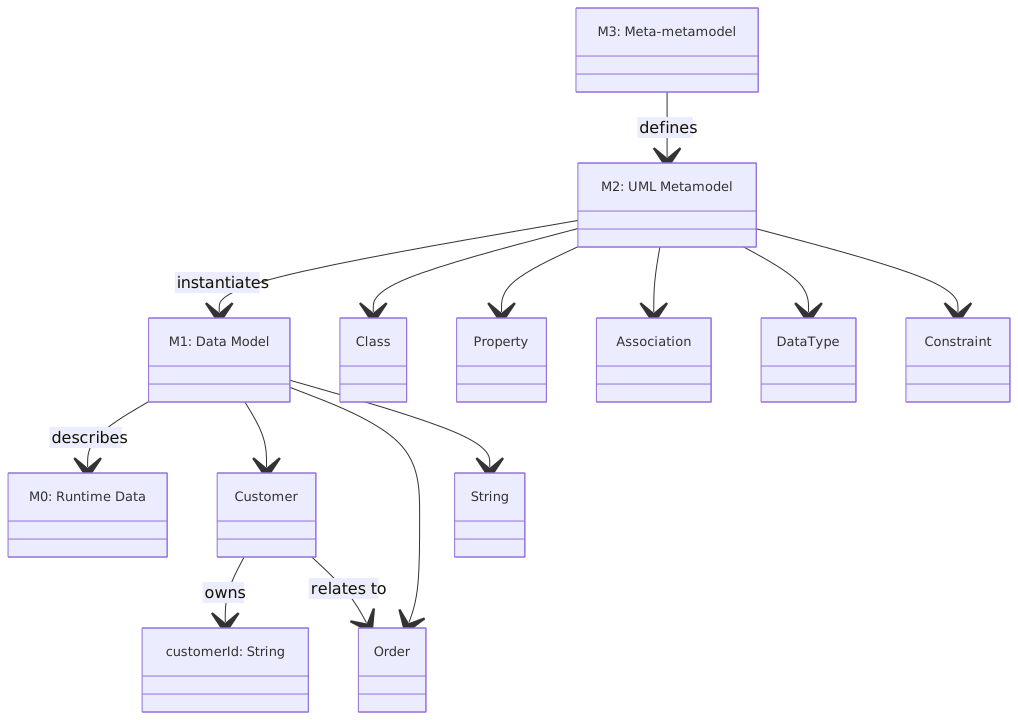
That’s where UML’s broader abstraction is useful.
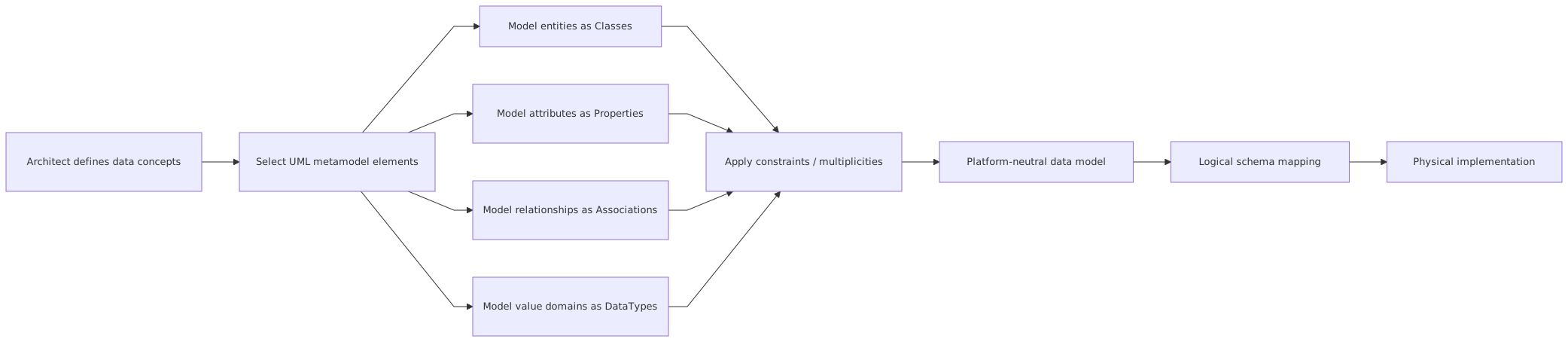
The core UML concepts that matter most for data modeling are these:
That’s the surface level.
Underneath, UML has a metamodel that defines what a Class is, what an Attribute is, what relationships are legal, and how models can be extended. You do not need to memorize the UML specification to benefit from this. But you do need to think like a metamodeler: what kinds of things are allowed in this architecture, and what do they mean?
That mindset changes everything.
The real point: model semantics, not just structures
This is where architects often go wrong.
They create models that look structurally tidy but are semantically weak. For example:
- they model
Customeras a class without deciding whether it means person, legal entity, or commercial relationship - they model
UserandIdentityas synonyms in IAM-driven environments - they model Kafka event payloads as if they were database entities
- they use inheritance because it looks elegant, not because the domain requires substitutability
- they flatten value concepts like Address, Money, Consent, RiskRating into plain strings
The UML metamodel helps if you use it to ask better questions:
- Is this concept stable enough to deserve its own class?
- Is this merely an attribute, or a governed value object?
- Is this relationship directional in business terms, or only in implementation?
- Is this model conceptual, logical, or physical?
- Is this type part of the enterprise vocabulary, or local to one service?
These are not academic questions. They decide whether your integration estate remains manageable.
Conceptual, logical, physical: stop mixing them
One of the worst habits in enterprise modeling is blending model layers into one “master diagram.” It’s the architectural equivalent of putting strategy, process, schema, and deployment into one PowerPoint and calling it alignment.
A UML-based data modeling approach works best when you separate at least three levels:
1. Conceptual model
This captures business meaning.
Examples:
- Customer
- Account
- Product
- Consent
- Identity
- Payment Instruction
At this level, you care about semantics and relationships, not database columns.
2. Logical model
This refines the structure for solution design.
Examples:
- Customer has CustomerIdentifier, CustomerStatus, RiskClassification
- Account relates to Party through AccountOwnership
- Consent has effective dates and policy scope
Now you care about normalized structure, cardinality, and reusable types.
3. Physical model
This maps to implementation.
Examples:
- PostgreSQL tables
- Avro schemas for Kafka
- JSON documents in cloud storage
- IAM directory attributes
- BigQuery or Snowflake structures
At this level, performance, storage, serialization, and platform limitations matter.
A metamodel-driven approach helps maintain traceability across these levels. Without that, teams end up arguing whether the Kafka event should contain the same fields as the Oracle table. That argument alone has burned thousands of hours in enterprises. ArchiMate traceability
And no, they usually should not be identical.
A contrarian thought: don’t turn UML into a religion
Let me say something that needs saying.
A lot of UML work in enterprises is bad. Not just mediocre. Bad.
Too many architects build giant abstract models no delivery team can use. They create six layers of inheritance, twenty stereotypes, and a repository full of model elements disconnected from actual systems. Then they wonder why engineering ignores architecture.
That is not a UML problem. It’s an architect problem.
If your UML metamodel effort does not improve one or more of these, it’s probably vanity:
- cross-team semantic consistency
- integration design quality
- governance automation
- impact analysis
- regulatory traceability
- onboarding speed
- cloud data interoperability
I’m strongly in favor of disciplined metamodels. I’m strongly against architecture theater.
Use UML where it adds precision. Don’t use it to signal sophistication.
How the UML metamodel applies in real architecture work
This is the part people often skip. They explain notation and never connect it to actual architecture decisions. But this is where the value is.
1. Canonical event design for Kafka
In event-driven enterprises, especially in banking, teams often treat Kafka schemas as independent local contracts. That sounds agile. It also creates semantic drift fast.
A UML-based metamodel can define enterprise concepts like:
- Party
- Customer
- Account
- Transaction
- Identity
- Device
- Consent
Then event types like:
- AccountOpened
- PaymentInitiated
- CustomerAddressChanged
- AuthenticationSucceeded
can be modeled as events referencing governed business concepts, rather than ad hoc payload blobs.
This helps in several ways:
- common identifiers are used consistently
- event payloads separate business facts from technical metadata
- teams understand whether an event carries a snapshot, delta, or command-like structure
- lineage from business concept to event schema becomes possible
A common mistake is modeling Kafka events directly from source database tables. That creates brittle, implementation-leaking event contracts. The metamodel acts as a buffer between business meaning and technical serialization.
2. IAM and identity domain modeling
IAM is one of the messiest data domains in large enterprises because words get overloaded.
Consider these terms:
- User
- Identity
- Principal
- Subject
- Account
- Credential
- Role
- Entitlement
- Permission
- Group
Many organizations model them inconsistently across HR, Active Directory, cloud IAM, customer identity, and application authorization.
A UML metamodel approach forces architects to define types and relationships explicitly:
- An Identity may represent a persistent subject record.
- A Credential authenticates an identity.
- A Role aggregates entitlements.
- An Account may be a provisioned target-system representation.
- A Person is not automatically the same thing as an Identity.
That distinction matters enormously in zero trust, cloud federation, and audit contexts.
I’ve seen banks fail audits because they couldn’t consistently trace person-to-identity-to-role-to-entitlement-to-system-account relationships across platforms. That is not solved by buying another IAM tool. It’s solved by modeling the domain correctly first.
3. Cloud data platform governance
In cloud environments, data proliferates because storage is cheap and publishing data feels modern.
You get:
- raw landing zones
- curated zones
- lakehouse tables
- streaming topics
- API payloads
- ML features
- operational data stores
Without a metamodel, every team invents its own idea of what a “trusted customer dataset” is.
A UML metamodel can define:
- business entities
- analytical subjects
- event types
- data products
- quality constraints
- ownership semantics
- classification metadata
This creates a bridge between enterprise architecture and data governance. Not perfect, but much better than spreadsheets and tribal memory. ArchiMate for governance
A real enterprise example: retail bank modernization
Let’s make this concrete.
Imagine a retail bank modernizing its customer and payments architecture.
The situation
The bank has:
- a core banking platform
- CRM
- digital channels
- a customer IAM platform
- Kafka for event streaming
- a cloud data lake
- multiple payment services
- legacy batch reporting
Each system has its own data model.
“Customer” exists in:
- CRM as a sales-managed relationship
- core banking as an account-holding party
- IAM as a digital identity subject
- payments as an ordering or beneficiary party
- analytics as a householded reporting entity
Now the bank wants:
- real-time event-driven integration
- better onboarding
- unified IAM controls
- cloud-based reporting
- customer 360
Classic enterprise ambition. Also classic setup for semantic disaster.
What the architects did right
The architecture team created a UML-based enterprise information metamodel with a modest but disciplined scope. UML modeling best practices
They defined:
- Party as the broad legal/business actor concept
- Person and Organization as specializations of Party
- CustomerRelationship as a commercial relationship, not the person itself
- Account as a financial arrangement
- DigitalIdentity as an authentication/authorization subject
- SystemAccount as a provisioned target-system account
- PaymentInstruction as a business transaction request
- Consent as a governed authorization artifact
They also defined key associations:
- Party holds or controls Account
- Party may have one or more DigitalIdentities
- DigitalIdentity may map to one or more SystemAccounts
- CustomerRelationship links Party to Product holdings and servicing context
- Consent may be granted by Party and used by channels or services
Then they traced those concepts into:
- Kafka event schema standards
- API design guidelines
- IAM integration mappings
- cloud data product definitions
What changed in practice
This wasn’t just a repository exercise. It directly improved delivery.
Kafka
Before, every service emitted different customer identifiers. After the metamodel, events had explicit rules:
- enterprise business identifier
- source-system identifier
- event identifier
- event time
- subject type
- payload semantics
Consumers stopped guessing what ID they were reading.
IAM
Before, digital banking treated user profile records as customers. After the model, architects separated:
- person
- customer relationship
- digital identity
- credential
- entitlement
That reduced access review ambiguity and improved audit traceability.
Cloud analytics
Before, the cloud platform had five different “customer” datasets. Afterward, data products were mapped to enterprise concepts:
- Party master
- Customer relationship mart
- Identity activity stream
- Account servicing view
Not perfect. Still political. But much more governable.
What they still got wrong
Because no architecture story is clean.
They overused inheritance in some areas, especially product hierarchies. Every banking product became a specialization tree. Nice diagram, poor agility. In practice, product variation was better handled with composition and rules than deep class inheritance.
They also underestimated versioning. A metamodel does not remove the need for schema evolution strategy, especially in Kafka and cloud analytics. That lesson usually arrives with pain.
Common mistakes architects make
Let’s be honest here. Most problems are not because UML is too hard. They’re because architects make predictable mistakes. UML for microservices
Mistake 1: confusing business concepts with system records
A CRM customer row is not automatically the enterprise Customer concept. A cloud IAM user object is not automatically a Person. A Kafka message is not automatically a business event.
Model the business meaning first. Then map systems to it.
Mistake 2: using one model for all purposes
You cannot use the same model equally well for:
- business communication
- relational design
- event contracts
- IAM provisioning
- analytics
You need related models, not one giant “single source of truth” diagram. The metamodel gives consistency across them.
Mistake 3: overusing inheritance
Architects love inheritance because it looks tidy. But deep hierarchies often become rigid and misleading.
If the differences are behavioral, lifecycle-based, or policy-driven, composition may be better than specialization.
In banking, for example, not every product variation should become a subclass. Sometimes it’s just a product configuration with attributes and rules.
Mistake 4: ignoring identifiers as first-class design elements
Identifiers are where enterprise data models become real.
You need to distinguish:
- business identifier
- technical surrogate key
- external reference
- immutable identifier
- versioned identifier
A UML metamodel can support this explicitly. If you don’t model identifiers properly, integration quality collapses quietly.
Mistake 5: treating enumerations casually
Status codes, reason codes, risk ratings, consent scopes, account types — these look simple until ten systems disagree on values.
Enumerations and controlled vocabularies should be governed model elements, not random strings.
Mistake 6: skipping constraints
A diagram without constraints is often just a suggestion.
Important rules include:
- uniqueness
- mandatory relationships
- valid state transitions
- lifecycle dependencies
- temporal validity
- conditional cardinality
If your model doesn’t capture these somewhere, delivery teams will invent them independently.
Mistake 7: no connection to implementation governance
This is the big one.
If the metamodel lives only in architecture tooling and has no effect on:
- API design reviews
- Kafka schema validation
- IAM mappings
- cloud data catalog standards
- data product contracts
then it will die. Quietly, and deservedly.
A practical way to use UML metamodeling without becoming unbearable
Here’s the approach I recommend.
Step 1: define modeling intent
Be explicit about what your enterprise data modeling is for.
Usually one or more of:
- business vocabulary alignment
- integration semantics
- regulatory traceability
- master/reference data consistency
- event and API contract governance
- cloud data product standardization
If you can’t state the purpose, don’t start modeling.
Step 2: define a lightweight enterprise metamodel
Not the whole UML spec. Just your architecture subset.
For example:
- BusinessEntity
- ValueObject
- ReferenceData
- Event
- Identifier
- PolicyArtifact
- Relationship
- Constraint
- SystemRepresentation
This is where stereotypes or profiles can help, if kept simple.
Step 3: separate viewpoints
Maintain distinct but linked models for:
- conceptual business model
- logical information model
- integration/event model
- physical platform mappings
This preserves clarity.
Step 4: govern a few critical domains first
Don’t model the whole enterprise at once. That’s how architecture programs become fossils.
Start with domains where semantic inconsistency is expensive:
- customer/party
- account
- identity and access
- payment
- product
- consent
Step 5: connect models to delivery controls
This is non-negotiable.
Tie the model to:
- API standards
- schema registry conventions
- IAM role and entitlement structures
- cloud catalog metadata
- naming standards
- review checkpoints
That’s where architecture becomes operational.
UML metamodel and data modeling in banking, specifically
Banking is a perfect example because the industry has high data volume, high regulation, old systems, and lots of semantic ambiguity pretending to be certainty.
A few examples where UML-based metamodel thinking helps:
Party vs customer
Banks constantly confuse legal entity, individual person, beneficial owner, account holder, borrower, and customer relationship.
These should not collapse into one vague Customer class.
Account vs product
An account is often an instantiated financial arrangement. A product is a market offering or configuration template. They are related, but not the same.
Transaction vs event
A financial transaction is a business/ledger concept. A Kafka event is an integration artifact that may describe a change or occurrence related to that transaction. Again, not the same thing.
Role vs entitlement
In IAM for banking platforms, roles are governance/grouping constructs; entitlements are specific permissions or rights. Treating them as synonyms creates audit trouble. EA governance checklist
Consent vs preference
A consent can have legal and regulatory significance. A preference often does not. Don’t model them as one generic “setting.”
These distinctions sound obvious in an article. In real programs, they get blurred constantly.
Where UML is weaker, and how to deal with it
Let’s not pretend UML is perfect for all data modeling.
It has a few weaknesses in practice:
- relational implementation detail is often clearer in ER notation
- temporal modeling is not naturally intuitive for many teams
- event semantics need additional discipline beyond standard class modeling
- repository tooling can become cumbersome
- many engineers dislike UML because they’ve seen it weaponized badly
Fair points.
The answer is not to abandon metamodeling. The answer is to use UML where it provides semantic structure, and complement it with:
- ER models for relational specifics
- Avro/JSON Schema/OpenAPI for contract detail
- ontology or glossary tools for business terminology
- data catalog metadata for operational governance
In other words: UML is one tool in the architecture toolbox, not the cathedral itself.
What good looks like
A good UML metamodel for enterprise data modeling is:
- small enough to explain in one workshop
- precise enough to remove ambiguity
- connected to delivery artifacts
- versioned and governed
- used by architects, data teams, and integration teams
- opinionated about key distinctions
- tolerant of multiple implementation patterns
A bad one is:
- huge
- abstract
- notation-heavy
- disconnected from engineering
- full of unused stereotypes
- impossible to trace to APIs, Kafka topics, IAM schemas, or cloud datasets
If people can’t use it in architecture decisions within a month, it’s probably too elaborate.
Final thought
The biggest misconception about the UML metamodel for data modeling is that it’s about drawing better diagrams.
It isn’t.
It’s about creating shared semantic discipline in environments where data crosses systems, teams, platforms, and trust boundaries. That is exactly what enterprise architecture is supposed to help with.
In modern enterprises — especially banks running Kafka, cloud platforms, and sprawling IAM estates — the challenge is not simply storing data. It’s making sure that when one team says “customer,” another team doesn’t hear “login account,” a third hears “party,” and a fourth publishes a topic with all three meanings mixed together.
That’s where metamodeling earns its keep.
Not as theory. As damage prevention.
And frankly, architects should care more about that than they usually do.
FAQ
1. Is UML actually a good choice for data modeling?
Yes, for enterprise-level semantic and logical modeling. Not always for detailed relational design. Use UML to define meaning and structure across domains; use ER or physical schema tools for implementation specifics where needed.
2. What is the difference between a model and a metamodel?
A model describes the business or system domain, like Customer, Account, or Payment. A metamodel defines the kinds of elements that can appear in that model, such as Class, Attribute, Association, Identifier, or Constraint, and what they mean.
3. How does this help with Kafka architecture?
It prevents event schemas from becoming random local payloads. A metamodel-driven approach gives consistent business concepts, identifiers, relationships, and event semantics across topics, which improves interoperability and reduces consumer confusion.
4. How is UML metamodeling useful in IAM?
IAM domains are full of overloaded terms like user, identity, account, role, and entitlement. UML metamodeling helps separate these concepts clearly so provisioning, authorization, federation, and audit reporting are based on explicit semantics rather than assumptions.
5. What is the most common mistake architects make here?
Trying to build one giant model for everything. Good architecture uses multiple linked models — conceptual, logical, integration, physical — governed by a lightweight metamodel. One oversized “master model” usually becomes irrelevant fast.
Frequently Asked Questions
What is a UML metamodel?
A UML metamodel is a model that defines UML itself — it specifies what element types exist (Class, Interface, Association, etc.), what relationships are valid between them, and what constraints apply. It uses the Meta Object Facility (MOF) standard, meaning UML is defined using the same modeling concepts it uses to define other systems.
Why does the UML metamodel matter for enterprise architects?
The UML metamodel determines what is and isn't expressible in UML models. Understanding it helps architects choose the right diagram types, apply constraints correctly, use UML profiles to extend the language for specific domains, and validate that models are internally consistent.
How does the UML metamodel relate to Sparx EA?
Sparx EA implements the UML metamodel — every element type, relationship type, and constraint in Sparx EA corresponds to a metamodel definition. Architects can extend it through UML profiles and MDG Technologies, adding domain-specific stereotypes and tagged values while staying within the formal metamodel structure.